What Is Pepero Day? Korea's November 11 Snack Holiday, Explained
11/11 looks like four sticks. Korea made a marketing calendar event into an actual holiday.
- Hangul
- 빼빼로데이
- Romanization
- ppaeppaero dei
- Pronunciation
- ppae-ppae-ro day
- Category
- Culture
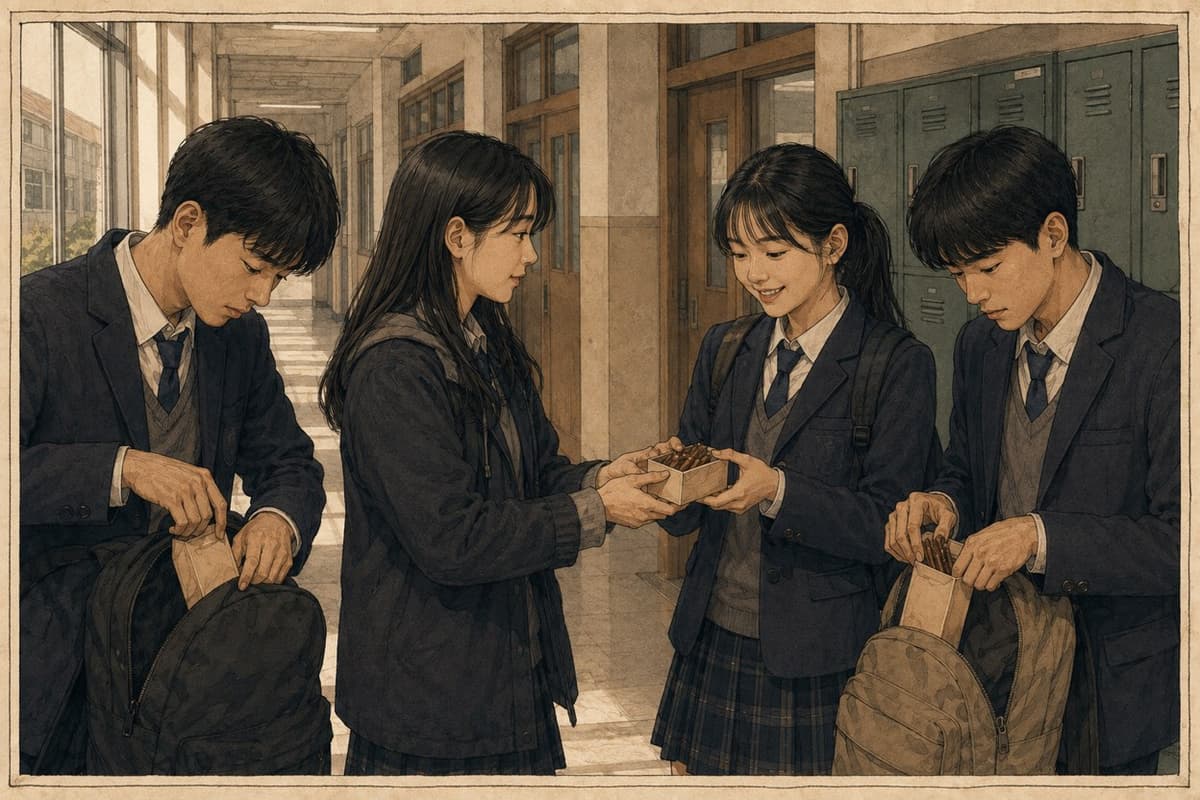
Pepero Day (빼빼로데이, pronounced ppae-ppae-ro day) is Korea's November 11 gift-giving ritual built around Pepero: long, thin, chocolate-coated snack sticks made by Lotte. Friends, classmates, and coworkers exchange boxes of Pepero—or other similarly shaped snacks—on 11/11, a date chosen because 11/11 looks like four sticks standing in a row. One-sentence definition: Pepero Day is a lighthearted annual snack exchange anchored by visual date logic and sustained by school culture and corporate momentum.
English speakers sometimes call it "Pocky Day" or "the Korean Pocky Day." That is close but imprecise. Pepero and Pocky are not the same brand, though the snacks are nearly identical in form. Pepero is Korean (Lotte), Pocky is Japanese (Glico). Both countries mark 11/11 as a stick-shaped snack day, but the traditions emerged separately and carry different brand loyalties and local flavor.
Quick facts
| Hangul | 빼빼로데이 |
| Romanization | ppaeppaero dei (often simplified to "Pepero Day" in English) |
| Pronunciation | ppae-ppae-ro day |
| Date | November 11, every year (Gregorian) |
| Core practice | exchanging Pepero or similar long thin snacks with friends, coworkers, classmates |
| Origin story | 1990s school custom met 1996 Lotte marketing; both claim credit; the ritual stuck |
| Commercial peak | schools, universities, young adults, light office gifting |
| Official holiday status | none—no public break, no ancestral rites, no government seal |
What does Pepero Day mean?
In everyday Korean, Pepero Day is simply the name of the November 11 snack exchange. The phrase itself does not decode into deep meaning; it is product name plus "day," turned ritual by repetition.
What people do is straightforward:
- Buy Pepero (or similar sticks—chocolate-dipped pretzels, cookie sticks, homemade versions)
- Give them to people (friends, classmates, coworkers, crushes, siblings)
- Receive some in return (usually, though asymmetry happens)
- Eat more thin sticks than you planned
The mood is casual and social, not romantic by default. Some couples fold Pepero Day into their own November affection calendar, but the wider practice is peer-to-peer acknowledgment: "I thought of you; here is a box."
Schools drive the most visible energy. Middle and high school hallways on November 11 fill with locker drops, surprise handoffs, and the faint tension of who remembered whom. Offices participate more lightly—team snack stashes, a box on a coworker's desk, sometimes nothing at all.
The ritual is low-stakes and high-visibility: not giving costs you little socially, but participating buys you easy goodwill and a place in the collective calendar.
The 11/11 date logic — why four sticks picked November 11
The entire event hinges on a visual pun:
11/11 → four vertical lines → four thin sticks → Pepero sticks
This is not ancient numerology. It is a date that looks like the product. The match gave marketers an ownable day and gave teenagers a reason to care. Aesthetic alignment is a surprisingly durable foundation for a national ritual when schools amplify it year after year.
Other countries have adopted 11/11 as a commercial food day for similar visual reasons (China's Singles' Day, Japan's Pocky Day), but Korea's version specifically centers the Pepero brand and the social practice of exchange, not solo consumption or online shopping sprees.
Pepero vs Pocky — two snacks, two countries, one date
Pepero and Pocky are structurally twins: thin biscuit sticks partially coated in chocolate, sold in tall narrow boxes, aimed at snack portability and gift compactness.
Key differences:
| Pepero | Pocky | |
|---|---|---|
| Maker | Lotte (Korea) | Glico (Japan) |
| Home market | Korea | Japan |
| 11/11 event name | Pepero Day (빼빼로데이) | Pocky Day (ポッキーの日) |
| Cultural association in Korea | default name and product for the ritual | imported competitor; present but not lead |
Both brands acknowledge 11/11. Both countries celebrate it. But in Korea, the day is called Pepero Day, and the default gift box people grab is Lotte Pepero, not Glico Pocky. Calling it "Pocky Day" when you are in Korea or talking to Koreans is like calling Chuseok "Japanese Harvest Festival"—technically adjacent, culturally tone-deaf.
If you give Pocky on Pepero Day in Korea, no one will throw it back. But know that you chose the import, and your friends know too. Brand nationalism is light here but real.
Origin stories — students first, then a company that noticed
Two stories get told. The press record is clearer than either slogan.
First in the papers: a student custom
The first Korean news uses of “Pepero Day” appear in November 1996. They describe teenage girls in the Gyeongsang / Yeongnam region exchanging Pepero on 11/11 and wishing each other to grow slim like the sticks. School-origin years float between 1993 and 1994 depending on the teller; treat a specific campus as folklore unless you have a named source in front of you.
Yonhap’s 2024 fact-check and a Korea Times interview with Lotte Wellfood both put the student custom before the national campaign. Lotte’s own line, paraphrased: the company did not invent the day.
Then the company scaled it
1997: after regional sales jumped every November, Lotte (now Lotte Wellfood) used the name in free-giveaway events and nationwide marketing. That is the documented commercial amplification—not a 1996 boardroom invention of the calendar.
What we know for sure: by the late 1990s the day lived in schools and in snack aisles. Marketing made it national. Students gave it a date. Both halves are real; only one of them started the name.
How people actually celebrate Pepero Day
At school (the emotional center)
Middle school and high school are Pepero Day's high season. Students:
- Pack multiple boxes in their bags
- Leave Pepero in friends' lockers
- Hand them out in hallways between classes
- Keep a running mental tally of who gave what to whom
- Navigate the mild social mathematics of reciprocity and acknowledgment
The ritual is not romantic by default, but it can carry confession subtext—giving someone a fancier box, a homemade version, or a note changes the message. Most exchanges stay platonic and friendly, though the day's structure makes it easy to encode a crush signal without saying it aloud.
Teachers tolerate the sugar parade with varying patience. Some schools have tried to ban or discourage Pepero Day to reduce commercialism or peer pressure; the bans rarely hold. The day is woven into November school culture now.
At work (lighter, optional)
Offices observe Pepero Day more casually:
- A team member buys a bulk box and leaves it on the break room counter
- Coworkers exchange boxes at their desks
- Some workplaces skip it entirely
- Gifting usually flows peer-to-peer, not hierarchically (no formal superior-to-subordinate Pepero obligation like Chuseok gifts)
The vibe is low-key goodwill, not corporate ceremony. Participation signals you are tuned into the social calendar; non-participation does not mark you as rude, just neutral.

Among friends and couples
- Close friends trade boxes, often with joke flavors or homemade versions
- Couples may treat it as a minor romantic checkpoint (lighter than Valentine's or White Day)
- Long-distance friends sometimes mail Pepero or substitute another thin stick snack with a note
The practice is flexible and culturally undemanding. You can ignore Pepero Day without offense. But if you are in a Korean social circle in early November, expect the question: "Did you get Pepero yet?"
Homemade Pepero and the DIY flex
Buying boxed Pepero is the default. Making your own is the status upgrade.
Homemade Pepero usually means:
- Pretzel sticks or thin cookies dipped in melted chocolate
- Toppings: crushed nuts, sprinkles, coconut, matcha powder
- Packaged in clear bags or small boxes with ribbons
- Given to people you want to impress or show extra care for
The gesture reads as more personal than store-bought, and the effort is visible. If someone hands you a bag of homemade chocolate-dipped pretzels on November 11, they thought about you longer than the three minutes it takes to grab a box at the convenience store.

DIY Pepero Day posts flood Korean social media every November: aesthetic shots of chocolate drips, pastel toppings, and neat rows of stick snacks cooling on parchment paper. It is an accessible craft flex—no advanced skill required, maximum visible affection per hour invested.
Store strategies and the November retail wave
Korean convenience stores and supermarkets prepare for Pepero Day weeks in advance:
- Towering Pepero displays appear in early November
- Special edition flavors and packaging (seasonal, character tie-ins, premium boxes)
- Competing stick snack brands position themselves as Pepero alternatives
- Pricing skirmishes as stores undercut each other to move volume
The day is a measurable retail event. Sales data confirms that mid-November Pepero purchases spike hard, then drop. Lotte has made a commercial calendar fixture; other snack brands ride the same date with their own thin stick offerings.
Convenience store clerks brace for November 11 like florists brace for Valentine's. The morning shift sees students buying armloads. The evening shift sees last-minute panic buyers who forgot until 6 PM. The day after, leftover boxes go on discount.
Example dialogues
1. School hallway handoff, casual friends
Between classes. Locker zone. Standard exchange energy.
- Student A: 야, 이거 받아. 빼빼로데이 챙겼어.
Ya, igeo bada. Ppaeppaero dei chaenggyeosseo.
Hey, take this. I got you something for Pepero Day. - Student B: 어, 고마워! 나도 너 줄 거 있는데 나중에 줄게.
Eo, gomawo! Nado neo jul geo inneunde najounge julge.
Oh, thanks! I have something for you too—I'll give it to you later. - Student A: ㅇㅋ. 근데 넌 몇 개 받았어?
Okay. Geunde neon myeot gae badasseo?
Okay. Wait, how many did you get so far?
Gloss: Banmal among peers. The tally question is normal social currency, not bragging—just calibration.
2. Office desk drop, coworker gesture
Morning at the desk. Small box appears.
- Coworker: 빼빼로데이라서 하나 샀어요. 맛있게 드세요.
Ppaeppaero deiraseo hana sasseoyo. Masitge deuseyo.
It's Pepero Day, so I picked one up. Enjoy. - You: 아, 감사합니다! 저도 나중에 드릴게요.
A, gamsahamnida! Jeodo najunge deurilgeyo.
Oh, thank you! I'll get you one later too. - Coworker: 아니에요, 괜찮아요. 그냥 나눠 먹으려고요.
Anieyo, gwaenchanayo. Geunyang nanwo meogeuryeogoyo.
No need, it's fine. Just thought we could share.
Gloss: Polite jondaemal. The gesture is light; the reciprocity expectation is even lighter. Accepting gracefully without making it transactional is good nunchi.
3. Homemade gift, closer friends or mild crush signal
After school. Homemade box, carefully wrapped.
- Giver: 이거 내가 만든 거야. 빼빼로데이니까.
Igeo naega mandeun geoya. Ppaeppaero deinikka.
I made this. You know, for Pepero Day. - Receiver: 헐, 진짜? 너 이거 언제 만들었어?
Heol, jinjja? Neo igeo eonje mandeureosseo?
Whoa, really? When did you make this? - Giver: 어제. 그냥 재미 삼아. 맛있을지 모르겠어.
Eoje. Geunyang jaemi sama. Masisseulji moreugesseo.
Yesterday. Just for fun. Not sure if it's good. - Receiver: 아니야, 되게 예쁘다. 고마워, 잘 먹을게.
Aniya, doege yeppeuda. Gomawo, jal meogeulge.
No way, it looks really pretty. Thanks, I'll enjoy it.
Gloss: Banmal between peers. Homemade effort signals care; the receiver's quick affirmation keeps the moment warm. If romantic subtext is present, it lives in the effort and the wrapping, not the words.
Good nunchi / Zero nunchi
Good nunchi
You are a high school exchange student in Korea in early November. You notice hallway chatter about Pepero Day. You ask a friend what people usually do. You buy a few boxes from the convenience store and give them to your close classmates and host family. You do not film the exchange or announce "I am doing a Korean tradition." You receive some boxes back. You say thank you. You eat the sticks. You understood the assignment: light gesture, shared calendar, no performance.
Zero nunchi
Same scenario. You ignore all the November 11 energy, then on November 12 you ask loudly why everyone has chocolate sticks. Or you buy Pocky instead of Pepero because "they are the same," then tell your Korean friends that Pocky is the original and better. Or you give Pepero only to people you want something from, skipping the friends who were kind to you all semester. Or you hand out boxes while calling it "Korea's Valentine's Day" and film reactions for your social account without asking. The room stays polite. The invitations stop coming.
Do / Don't
Do
- Learn the 11/11 date and understand the visual stick logic.
- Call it Pepero Day when in Korea, not Pocky Day.
- Give Pepero (or similar sticks) to friends, classmates, or coworkers as a light acknowledgment.
- Accept homemade versions as a sign of extra care.
- Keep the tone casual—it is a snack ritual, not a formal ceremony.
- Say thank you when you receive; reciprocate if the relationship calls for it.
Don't
- Call Pepero "Korean Pocky" in front of Korean friends—brand matters here.
- Assume Pepero Day is romantic by default; peer exchange is the core.
- Ignore November 11 entirely if you are actively part of a Korean school or friend group, then act confused when people reference it.
- Over-explain the "marketing origins" to people who are just trying to enjoy their sticks.
- Film or perform the exchange as exotic content without consent.
- Give only to people you want to impress while skipping the people who were kind to you—social accounting is visible.
Nearby ideas (on Have Nunchi)
- Chuseok (추석) — Korea's lunar harvest holiday; Pepero Day is the opposite end of the ceremony spectrum
- Happy Birthday in Korean — another calendar occasion that mixes gift-giving, speech levels, and social accounting
- Korean Age System — why your Korean friend is older on November 11 than you thought
- Korean slang 2026 — the language of hallway handoffs and locker notes
A closing line
Pepero Day is not sacred tradition. It is not even particularly old. It is a snack company's date logic meeting teenage social appetite, then becoming real through repetition, sugar, and the fact that people kept showing up every November 11 with boxes in their hands.
Hold the brand name right, keep the gesture light, and if someone hands you a stick, say thank you before you argue about the origins.
FAQ
What is Pepero Day?
Pepero Day (빼빼로데이) is a November 11 gift-giving custom in Korea centered on Pepero—long thin chocolate-coated snack sticks made by Lotte. People exchange Pepero with friends, classmates, and coworkers. The date 11/11 resembles four sticks, which gave marketing a foothold and a generation a tradition.
When is Pepero Day?
November 11, every year. Unlike Chuseok or other lunar holidays, Pepero Day is locked to the Gregorian calendar. Some stores and school hallways feel it in early November; most action lands on the actual day.
Is Pepero the same as Pocky?
Structurally almost identical—both are thin biscuit sticks dipped in chocolate—but Pepero is a Korean brand (Lotte) and Pocky is Japanese (Glico). Pepero Day and Pocky Day both fall on 11/11, but they grew separately. Do not call Pepero Day 'Pocky Day in Korea.'
How do people celebrate Pepero Day?
Exchange Pepero boxes with friends, classmates, coworkers, or anyone you want to acknowledge. Schools see locker stuffing and hallway handoffs. Offices receive desk drops. Some people give homemade chocolate-covered pretzel sticks instead of buying branded boxes. The gesture is casual, not romantic by default, though couples may fold it into their own ritual.
Do adults actually do Pepero Day?
Yes, but differently. Workplaces see modest box exchanges or team snack runs. Close friends might trade joke gifts or fancy versions. Parents buy for kids. The commercial peak is still schools and young adults, but the day is not age-gated. It is light enough that participation does not demand ceremony—just awareness of the date and a willingness to hand someone a box.
Is Pepero Day a real holiday or just marketing?
Both. Lotte's 1996 marketing campaign gave it commercial oxygen, but the ritual became real through school culture, peer expectation, and the fact that people kept doing it. Korea observes no official Pepero Day public break. It is real the way Valentine's Day is real—socially enforced, financially tracked, emotionally mixed, and annually recurring.
Sources
Primary and authoritative references used for definitions and context on this page.
- [Fact check] Did a snack company invent Pepero Day? — Yonhap News Agency
- How 'Pepero Day' got started in Korea — The Korea Times
Read next
Do you have nunchi?
Get short Korean word lessons and social cues in your inbox.