How to Say Happy Birthday in Korean — 생일 축하해, 축하해요, and 생신
Three speech levels, one honorific trap, seaweed soup, and a song you already know the tune to.
- Hangul
- 생일 축하해요
- Romanization
- saengil chukahaeyo
- Pronunciation
- seng-il chu-ka-hae-yo
- Category
- Phrases
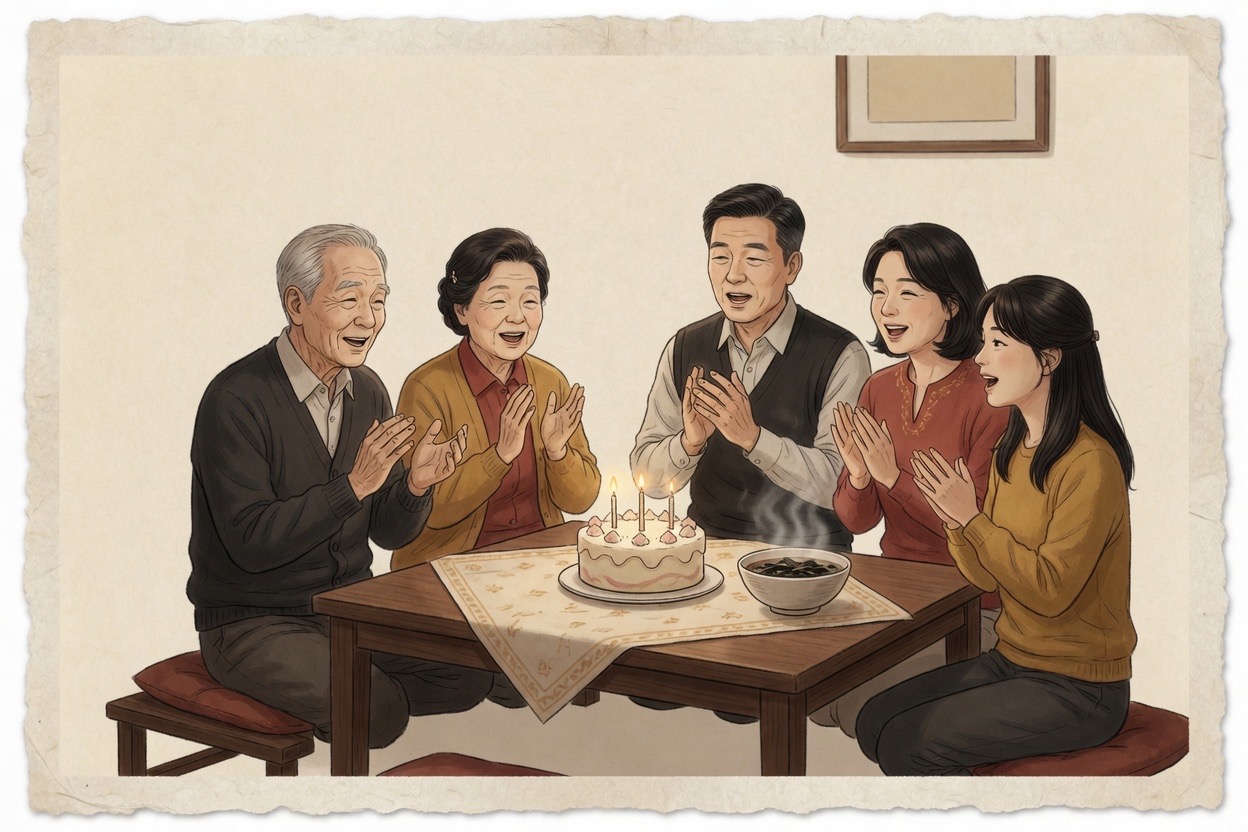
Happy birthday in Korean is 생일 축하해 for close friends, 생일 축하해요 for polite everyday use, and 생일 축하합니다 for formal or group settings. The hangul for the polite default is 생일 축하해요 (saengil chukahaeyo, pronounced seng-il chu-ka-hae-yo). One high-stakes upgrade: for parents, grandparents, and other elders, switch the noun. Use 생신 (생신), not 생일, and say 생신 축하드립니다. That single swap is the difference between a warm greeting and a social scrape.
If you only memorize two lines before a Korean birthday dinner: 생일 축하해요 for peers, 생신 축하드립니다 for elders.
Quick facts
| Hangul (polite) | 생일 축하해요 |
| Romanization | saengil chukahaeyo |
| Pronunciation | seng-il chu-ka-hae-yo |
| Literal sense | “birthday + congratulate” |
| Casual | 생일 축하해 (saengil chukahae) |
| Formal | 생일 축하합니다 (saengil chukahamnida) |
| Honorific for elders | 생신 축하드립니다 (saengsin chukadeurimnida) |
| Birthday food | 미역국 (miyeokguk, seaweed soup) |
| Song | 생일 축하합니다 — same melody as English Happy Birthday |
How to say happy birthday in Korean — three registers
Search intent treats “happy birthday in Korean” as one phrase. Spoken Korean treats it as a speech-level choice, the same logic that sorts hello in Korean into 안녕 vs 안녕하세요.
| Register | Hangul | When it fits |
|---|---|---|
| Casual (banmal) | 생일 축하해 | Close friends, siblings, same-age buddies already on banmal |
| Polite (jondaemal) | 생일 축하해요 | Coworkers, classmates, acquaintances, most mixed rooms |
| Formal | 생일 축하합니다 | Stages, announcements, group cards, high formality |
생일 (생일, saengil) is “birthday.” 축하하다 is “to congratulate.” Stack them, pick an ending, and you have the greeting:
- -해 → warm and close
- -해요 → polite default for most adults you are not intimate with
- -합니다 → formal, broadcast, ceremony energy
You can also add a name or title first: 민지야, 생일 축하해! or 팀장님, 생일 축하해요. The ending still has to match the relationship. When the room is mixed ages and you are unsure, 생일 축하해요 is the grown-up default.
생일 vs 생신 — the correction that actually matters
This is the highest-value distinction for English speakers who learned one phrase and stop there.
| Word | Hangul | Who it is for |
|---|---|---|
| 생일 | 생일 | Peers, younger people, most everyday birthdays |
| 생신 | 생신 | Elders—parents, grandparents, older relatives, respected seniors |
생신 is the honorific noun for an elder’s birthday. The celebration is the same cake-and-soup day; the vocabulary upgrades the person.
Safe elder lines:
- 생신 축하드립니다. — Saengsin chukadeurimnida. (very respectful; common and clean)
- 생신 축하합니다. — Saengsin chukahamnida. (formal, still honorific on the birthday word)
- 생신 축하드려요. — Saengsin chukadeuryeoyo. (polite soft version)
Using 생일 for a grandparent is not always a nuclear offense—some families are casual—but it is a real misstep in many rooms. If you already study Korean honorifics, treat 생신 as the birthday-specific version of that system: the noun itself carries respect, not only the verb ending.
Quick map: who you are greeting → what to say
| Who you are greeting | Birthday word | Phrase to use |
|---|---|---|
| Close friend, sibling, partner (banmal) | 생일 | 생일 축하해! |
| Classmate, coworker peer, polite acquaintance | 생일 | 생일 축하해요. |
| Group announcement, formal card, stage | 생일 | 생일 축하합니다. |
| Parent, grandparent, older relative | 생신 | 생신 축하드립니다. |
| Respected senior / elder you speak politely to | 생신 | 생신 축하드려요. / 생신 축하드립니다. |
| Boss / senior colleague (office) | often 생일 still, with title | 팀장님, 생일 축하해요. (or more formal 축하합니다) |
Office nuance: many workplaces still say 생일 for a manager, paired with a title and polite endings. Family elders are where 생신 becomes non-optional for careful speakers. Reading which table row you are in is nunchi: age, intimacy, and whether this is a living-room table or a conference cake.
How do you pronounce it?
Break the polite line into clear syllables:
생일 축하해요 → seng-il chu-ka-hae-yo
- 생일 — seng-il (not “sang-ill” like English singe)
- 축하 — chu-ka (the ㅊ is aspirated ch)
- 해요 — hae-yo
Formal 축하합니다 lands as chu-ka-ham-ni-da. Casual 축하해 drops the polite yo: chu-ka-hae.
Honorific path: 생신 is seng-shin (many learners over-hiss the second syllable; keep it light). 축하드립니다 is chu-ka-deu-rim-ni-da.
The Korean birthday song: 생일 축하합니다
If you already know the English Happy Birthday melody, you already know the Korean birthday song’s tune. The words are built on the formal congratulate line:
생일 축하합니다
생일 축하합니다
사랑하는 [이름]
생일 축하합니다
Rough English shape: “Happy birthday / happy birthday / dear [name] / happy birthday.” Families often swap in 사랑하는 (“beloved”) or a nickname and stretch the name across the third line. Kids belt it; adults mumble and film; someone always starts a second early.
You do not need a separate casual birthday song. The song stays in 축하합니다 territory even when spoken wishes drop to 축하해. At elder celebrations, people still sing the familiar tune; spoken wishes before or after may use 생신.
미역국 — seaweed soup, birthdays, and the exam-day taboo
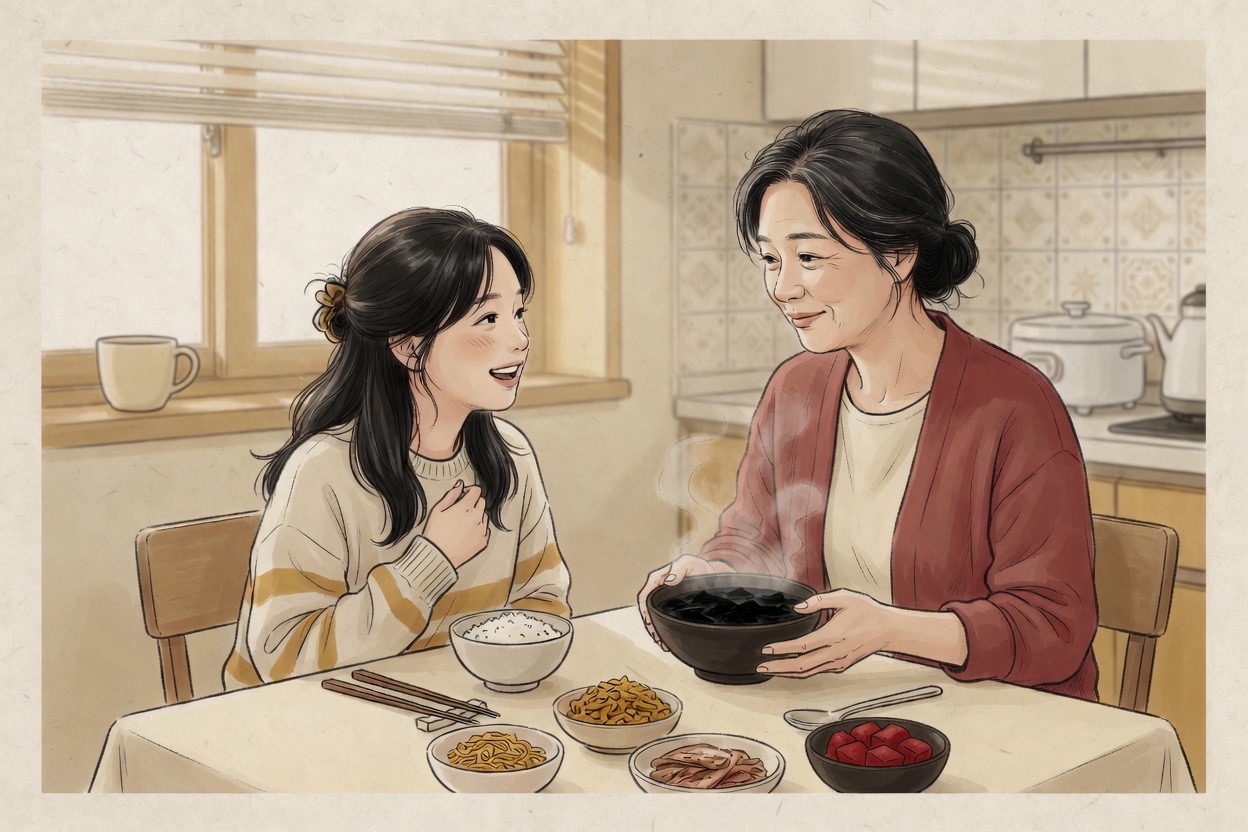
A Korean birthday table often includes 미역국 (미역국, miyeokguk)—seaweed soup—next to cake, fruit, and whatever the guest of honor actually wants to eat.
Why soup on a birthday?
The cultural thread runs through childbirth. Seaweed soup is a traditional postpartum food—associated with recovery after delivery—so many families serve miyeokguk on birthdays as a quiet nod to the day you were born. Not every modern party is strict about it, but the soup is still the classic birthday-breakfast signal at home.
The exam-day taboo (and the idiom)
The same soup has a second life as bad luck before a test. Students often avoid miyeokguk on exam mornings. The folk logic is slippery: seaweed is slick, so the grade might “slip.” The habit is real enough that “did you eat miyeokguk?” can be a joke after a bad score—and it became an idiom:
- 미역국 먹다 — literally “to eat seaweed soup,” idiomatically to fail a test
So: birthday = good miyeokguk day. Exam morning = maybe not. Same bowl, opposite calendar energy.
What to write in a card or KakaoTalk
Spoken wishes are short. Written ones can be short too.
Ready-to-send lines
Friends (banmal)
- 생일 축하해! 오늘 하루 진짜 행복하게 보내.
- 생일 축하해~ 맛있는 거 많이 먹어!
- 생축! 올해는 너 원하는 일 다 이뤄지길.
(생축 is chat shorthand for 생일 축하.)
Polite peers / coworkers
- 생일 축하해요! 즐겁고 행복한 하루 보내세요.
- 생일 축하합니다. 항상 건강하시고 좋은 일만 가득하시길 바랍니다.
Elders (생신)
- 생신 축하드립니다. 항상 건강하세요.
- 생신을 진심으로 축하드립니다. 더 건강하고 행복하시길 바랍니다.
Group chat / office thread
- 오늘 생일이신 ㅇㅇ 님 생일 축하합니다!
Match the spoken register: do not write 축하해 on a formal elder card. One sincere Korean line plus a short personal note in English is fine if your hangul is limited. Stickers are normal among friends; optional at work.

Milestone birthdays: 돌잔치, 환갑, 칠순
Not every birthday is equal weight on the Korean calendar. A few ages carry ceremony names English “big birthday” only approximates.
돌잔치 — the first birthday
돌 (돌) is a child’s first birthday; 돌잔치 (돌잔치, doljanchi) is the celebration around it. Historically, surviving the first year carried more weight than it does now, and the party kept its emotional volume.
You may also hear about 돌잡이 (돌잡이): the baby is placed near symbolic objects (brush, stethoscope, money—depending on the family), and whatever they grab first becomes a playful fortune. Treat it as festive theater, not prophecy. Guests eat, take photos, and say warm things to the parents as much as to a one-year-old who will remember none of the speeches.
환갑 and 칠순 — 60th and 70th
환갑 (환갑, hwangap) is the 60th birthday, traditionally tied to completing one full cycle of the sexagenary calendar. Longer lifespans mean some families now put bigger energy on later decades, but 환갑 still names a culturally marked milestone.
칠순 (칠순, chilsun) is the 70th. These events skew more formal, multi-generational, and 생신-coded than a friend blowing out candles at a bar. If you are invited, dress neatly, follow the family’s gift custom, and lead with 생신 축하드립니다—not the casual 생일 축하해 you used last week for a classmate.
Younger multigenerational tables still have age play—someone may still be the family maknae—but milestone language points upward, toward elders and longevity.
Office cakes and public wishes
Korean workplaces often celebrate with a small cake at the desk, a quick song, and a photo that will live forever in the team group chat.

Clap, smile, take one bite if offered, and wish in the register the team already uses for that person. If you are the birthday person, a short 감사합니다! is enough. Public wishes amplify register mistakes—whispering the wrong form to one friend is recoverable; announcing it into a silent open office is not.
Example dialogues
1. Friends after work, banmal
Itaewon side street. Two friends in their late twenties; one checked their phone calendar late.
- Jaeho: 야, 오늘 네 생일이지? 생일 축하해!
Ya, oneul ne saengiriji? Saengil chukahae!
Hey, today’s your birthday, right? Happy birthday! - Minjun: 고마워. 근데 이제 알았어?
Gomawo. Geunde ije arasseo?
Thanks. You only just realized? - Jaeho: 카톡은 아침에 보냈고, 저녁은 내가 산다.
Katogeun achime bonaetgo, jeonyeogeun naega sanda.
I sent the KakaoTalk this morning—and dinner’s on me.
Gloss: Pure banmal. 생일 축하해 + practical love (paying for dinner). No 생신 anywhere near this table.
2. Family morning, honorific for a parent
Apartment kitchen. Adult daughter, early thirties; mother in her late fifties; father entering with glasses already fogged from the soup steam.
- Daughter: 엄마, 생신 축하드려요. 미역국 맛있어요.
Eomma, saengsin chukadeuryeoyo. Miyeokguk masisseoyo.
Mom, happy birthday. The seaweed soup is delicious. - Mother: 고마워. 너도 밥 많이 먹어.
Gomawo. Neodo bap mani meogeo.
Thank you. You eat a lot too. - Father: 여보, 생일 축하해. 올해는 여행 가자.
Yeobo, saengil chukahae. Olhaeneun yeohaeng gaja.
Honey, happy birthday. Let’s take a trip this year.
Gloss: The daughter uses 생신 + polite humble 축하드려요. The father uses spouse-level 생일 with banmal (축하해 / 가자)—peers, not elders. The soup is doing cultural work without a lecture.
3. Office desk cake, polite team register
Open office, 3 p.m. A small cake appears; the team maknae-ish junior in their mid-twenties starts the song off-key on purpose.
- Team lead: 자, 우리 서연 씨 생일이에요. 다 같이 생일 축하합니다—
Ja, uri Seoyeon ssi saengirieyo. Da gachi saengil chukahamnida—
Okay, it’s Seoyeon’s birthday. Everyone together, happy birthday— - Team (singing): 생일 축하합니다~
Saengil chukahamnida~
Happy birthday to you~ - Seoyeon: 아이고, 부끄러워요. 감사합니다, 팀장님. 다들 감사해요!
Aigo, bukkeureowoyo. Gamsahamnida, timjangnim. Dadeul gamsahaeyo!
Oh no, I’m embarrassed. Thank you, team lead. Thank you, everyone!
Gloss: Polite workplace Korean. Song in 축하합니다; thanks with title for the lead. Nobody switches to 생신 for a peer coworker—that would sound oddly ceremonial.
Good nunchi / Zero nunchi
Good nunchi
You are invited to your Korean friend’s family dinner for their mother’s birthday. You greet the mother with a small bow and 생신 축하드립니다, hand over a simple gift, eat the miyeokguk without asking why soup is “birthday food,” and save 생일 축하해 for your friend in the hallway later. You matched nouns to people.
Zero nunchi
Same dinner. You boom 할머니, 생일 축하해! in banmal because a phrase app only taught one line. The room smiles the stiff smile. You then explain, in English, that “in my country we keep it casual with family.” You meant warmth. You announced that you could not hear hierarchy.
Do / Don’t
Do
- Learn three registers: 축하해 / 축하해요 / 축하합니다.
- Upgrade the noun to 생신 for parents, grandparents, and elders who clearly sit above you.
- Serve or accept 미역국 as birthday culture, not a weird side quest.
- Sing 생일 축하합니다 on the melody you already know.
- Keep KakaoTalk wishes short and relationship-matched.
Don’t
- Use 생일 축하해 for elders you should be speaking up to.
- Force 생신 on same-age friends to sound “more Korean.”
- Lecture the table about exam slang while people are trying to eat soup.
- Send a formal three-line business email wish into a pure sticker friend chat (or the reverse into your director’s thread).
- Confuse doljanchi fortune props with a career forecast you must announce out loud.
Nearby ideas
- Hello in Korean — same register logic for 안녕 / 안녕하세요
- Korean honorifics explained — titles and speech levels around the birthday table
- Nunchi — reading whether this cake moment wants banmal or a bow
- Maknae — youngest energy at family parties (not a birthday greeting, still a seating chart fact)
A closing line
Happy birthday in Korean is not one tattoo-ready phrase. It is 생일 or 생신, plus an ending that tells the truth about the relationship.
Say 생일 축하해요 when polite is right, 생일 축하해 when closeness is real, and 생신 축하드립니다 when age and respect share the same candle—then eat the soup, sing the tune you already know, and let your nunchi handle the second verse.
FAQ
How do you say happy birthday in Korean?
Casual is 생일 축하해, polite is 생일 축하해요, and formal is 생일 축하합니다. For parents, grandparents, and other elders, use the honorific birthday word 생신 and say 생신 축하드립니다.
What is the difference between 생일 and 생신?
생일 (saengil) is the everyday word for birthday. 생신 (saengsin) is the honorific form used for elders. Calling a grandparent’s day 생일 can sound blunt; 생신 is the respectful default.
How do you sing happy birthday in Korean?
The song is 생일 축하합니다, set to the same melody as the English Happy Birthday song. Verses keep repeating 생일 축하합니다 and usually name the person being celebrated.
Why do Koreans eat seaweed soup on birthdays?
Miyeokguk (미역국) is linked to postpartum recovery—mothers traditionally ate seaweed soup after giving birth—so many families serve it on birthdays as a nod to that day. The same soup is avoided before exams because “eating miyeokguk” is slang for failing.
How do you write happy birthday in a Korean card or KakaoTalk?
Match the relationship. Friends get 생일 축하해 plus a warm line; polite peers get 생일 축하해요; elders get 생신 축하드립니다. Keep it short, sincere, and free of forced English cake puns.
Do you have nunchi?
Get short Korean word lessons and social cues in your inbox.