How to Say Cheers in Korean: 건배, 짠, 위하여 & the Toast Rules That Matter
The word is easy. The pour, the turn, and the graceful no are the real test.
- Hangul
- 건배
- Romanization
- geonbae
- Pronunciation
- gun-beh
- Category
- Phrases
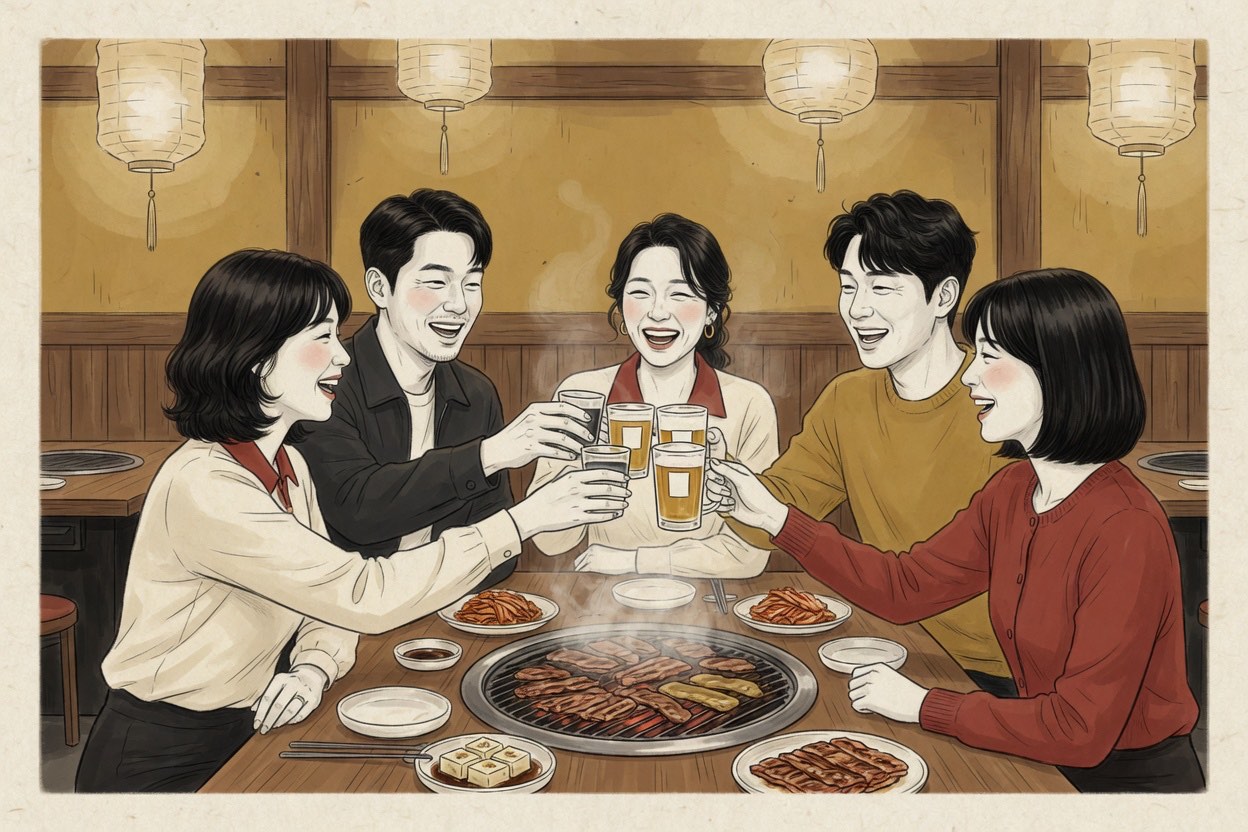
Cheers in Korean is 건배 (건배, geonbae, pronounced gun-beh)—the standard toast word for clinking glasses. With close friends, 짠 (짠, jjan) is the casual clink sound. At company dinners you will also hear 위하여 (위하여, wihayeo, “for ~!”) after someone names a reason. One-sentence definition: geonbae is the word; the pour, the turn of the head, and who drinks first are the social test.
Say the word cleanly and still fail the room if you pour soju for a boss with one hand, refill your own glass first, or stare straight at an elder while you drink. Lead with vocabulary if you must—then give etiquette the space it deserves.
Quick facts
| Hangul (default toast) | 건배 |
| Romanization | geonbae |
| Pronunciation | gun-beh |
| Literal sense | empty the cup / toast |
| Casual clink | 짠 (jjan) |
| Company-dinner cry | 위하여 (wihayeo) |
| “One shot” (Konglish) | 원샷 (wonsyat) |
| What actually ranks higher | pour etiquette, age rank, graceful decline |
How do you say cheers in Korean?
| Room | What you’ll hear | Feel |
|---|---|---|
| Mixed / polite / first dinner with someone older | 건배! | standard toast |
| Friends, same-generation hangout | 짠! | casual clink |
| Company dinner after a short speech | 위하여! or “for the team / project / year” + 위하여 | purpose toast |
| Peer pressure from an older drinking culture | 원샷! | drain it—still heard, less automatic than tourists fear |
If you only memorize one line: raise your glass, say 건배, clink gently, and take a sip. Everything else is how not to look like you studied a flashcard and skipped the table.
Reading who is senior, when to stand, and when silence is kinder than a speech is the same social radar as nunchi—and it sits next to titles and speech levels in Korean honorifics.
건배 vs 위하여 vs 짠
These three are not three equal “translations of cheers.” They are different tools for different rooms.
건배 — the classic toast word
건배 literally points at “empty cup.” In practice it is the default toast label: restaurants, family celebrations, polite mixed groups, and any table where you want one clean word. You can shout it or murmur it while glasses meet. It does not require a speech or draining the glass. It says: we are toasting now.
위하여 — “for ~!” at company dinners
위하여 means “for (the sake of) ~.” Alone it can sound incomplete in English; in Korean drinking culture it often lands after a reason—for the company, the project, the year, or the person who just got promoted. Someone stands, names the reason, and the table answers with 위하여. You will hear this a lot at 회식 (company dinners) and formal group nights. It is less dictionary “cheers” and more “we are sealing a purpose with alcohol.”
짠 — the casual clink
짠 is onomatopoeia: the sound of glasses meeting. Friends use it the way English speakers say “cheers” without ceremony—quick, light, no speech required.
Use 짠 with people already on banmal and same-generation ease. Using only 짠 with a stiff senior table can sound under-dressed, the way a casual hello can miss a formal room. Using only 건배 with close friends is fine—slightly stiffer, never rude.
Practical split: safe default 건배; purpose toast 위하여; friends only 짠.
What about 원샷? (and why it is losing favour)
원샷 (원샷, wonsyat) is Konglish for “one shot”—drink the glass in one go. Older drinking culture and some loud tables still love it. Tourists often learn it early because it is memorable.
Here is the part phrasebooks underplay: many modern rooms no longer treat full-glass 원샷 as mandatory hospitality. People still say the word and still pressure—especially if alcohol is the team’s social glue—but forcing someone to drain soju for sport increasingly reads as dated or simply exhausting.
What still works: a sip after the toast, matching pace without racing, not policing someone else’s glass. What ages badly: cornering a junior into 원샷 “for the team,” refilling the second a glass empties, treating refusal as mutiny.
If someone shouts 원샷 and the table is laughing, you can play along if you want. If your body or principles say no, see the decline section—participation in the gesture matters more than finishing the liquid.
The etiquette that outranks the word
A reader who says 건배 perfectly and pours with one hand for their boss has failed the room. Korean drinking etiquette is less about memorizing slang and more about hands, height, and direction.
Two hands when it matters
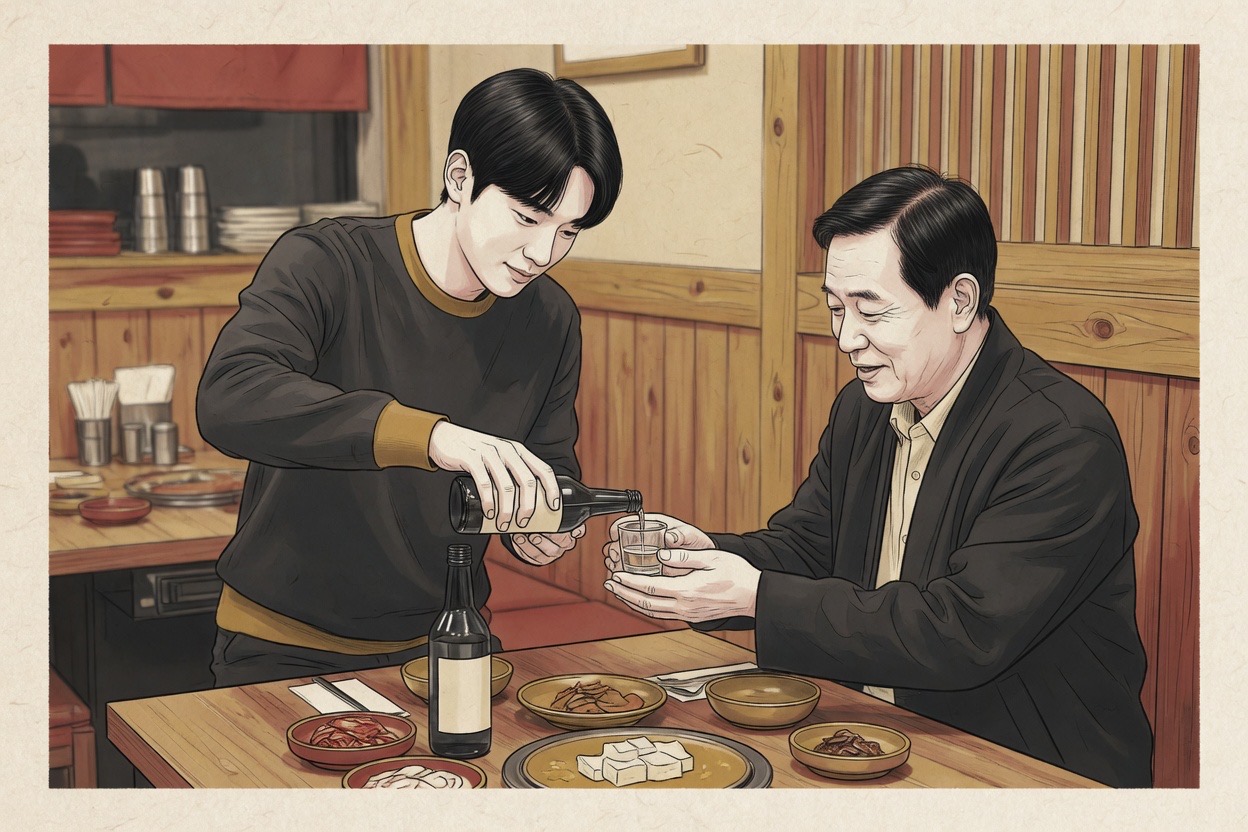
Pouring for a senior: hold the bottle with two hands, or one hand with the other lightly supporting your wrist or forearm. One-handed casual pours are fine among close same-age friends. They look sloppy toward a boss, a parent’s friend, or anyone clearly older in the Korean age system.
Receiving from a senior: hold your glass with two hands, or one hand on the glass and the other supporting your wrist. You are accepting care, not grabbing free alcohol.
Never pour only for yourself first
In many traditional tables, you do not top up your own glass while others sit empty-handed. Pour for others; let someone pour for you. Among young friends this softens—people refill themselves constantly. At a hierarchical dinner, self-service first still reads as tone-deaf. If nobody pours and the night is informal, a quiet self-refill is fine. If the room is formal, wait a beat, then offer to pour for the person next to you.
Turn your head when you drink in front of an elder
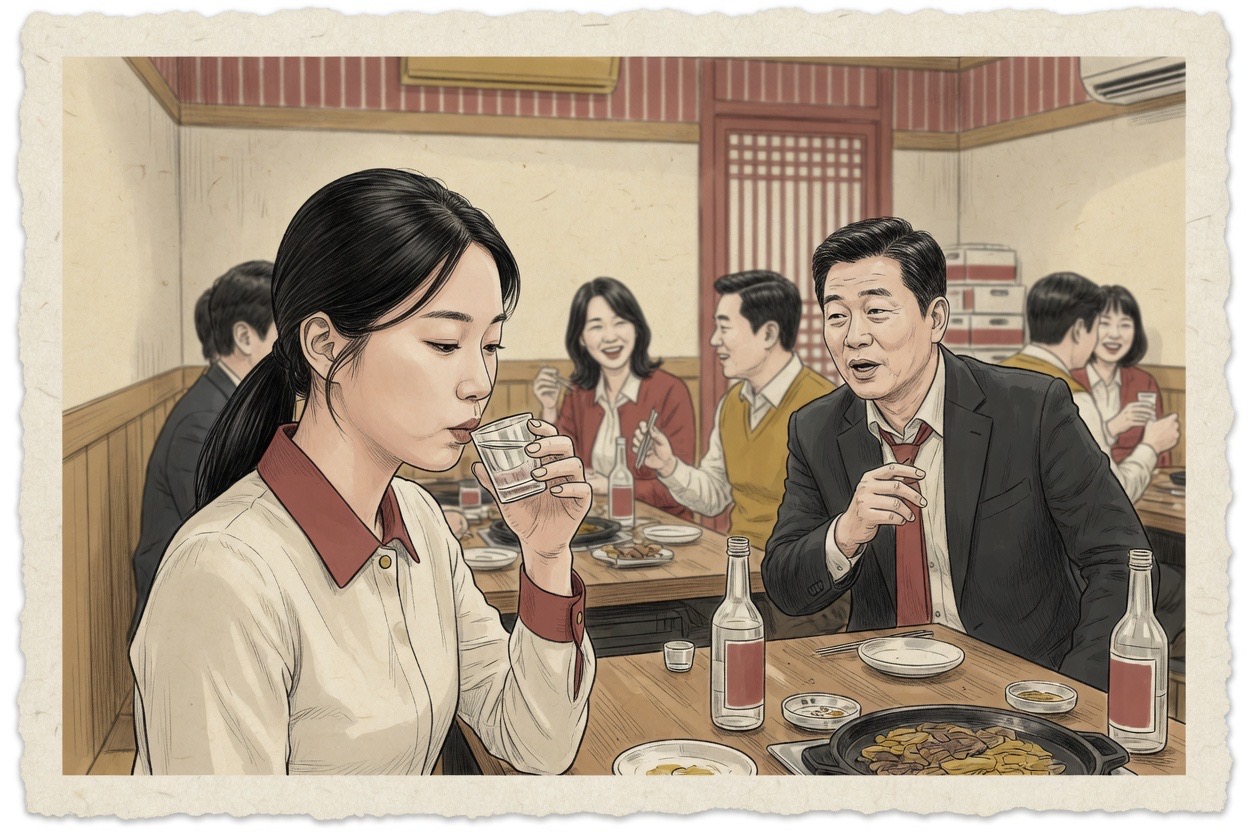
When an older person is watching—or when you are drinking “toward” them at a hierarchical table—many Koreans still turn the face slightly aside for the sip. It is a small modesty gesture: I am not drinking in your face. A soft turn is enough; you do not need a full swivel. Friends the same age usually skip this. Skip it with a grandparent or a CEO and some rooms will notice even if nobody lectures you.
Glass height and clink manners
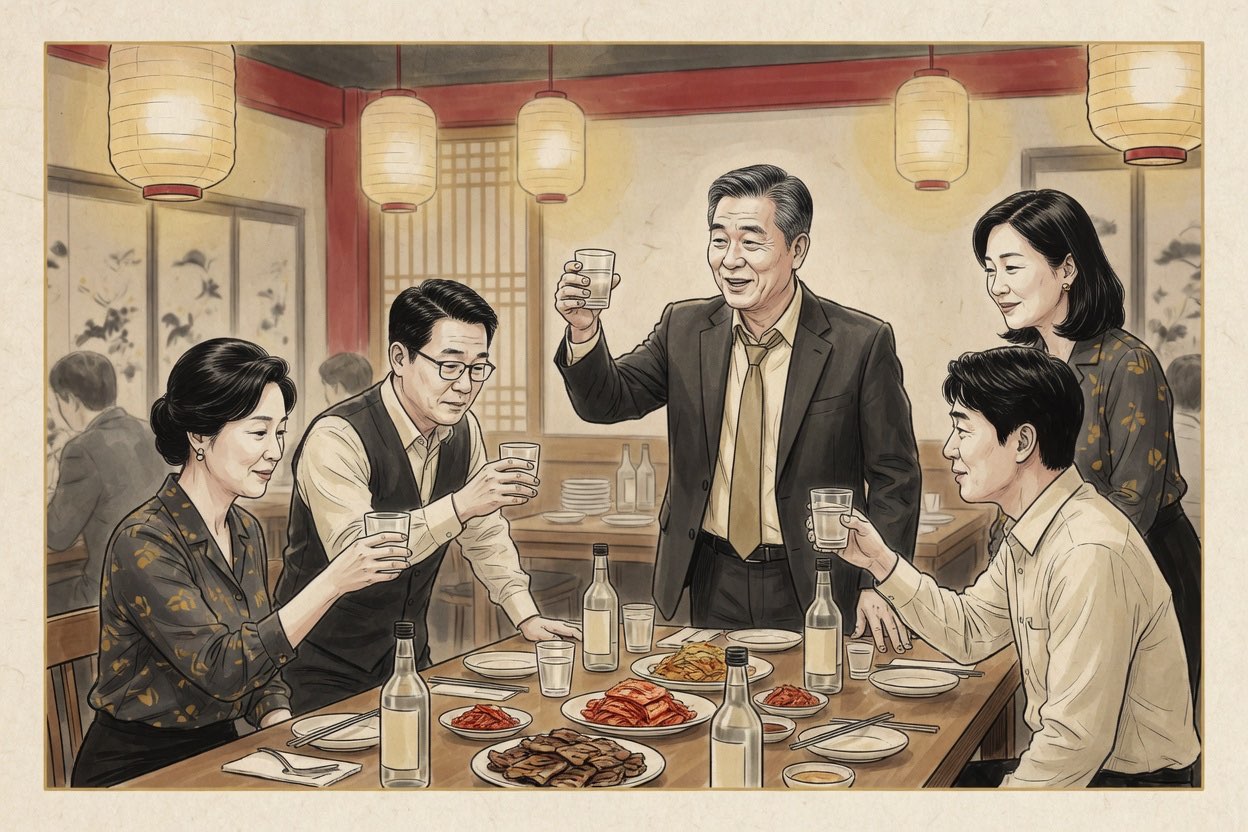
When you clink with someone senior, keep your glass a little lower than theirs. It is the same instinct as a slight bow: rank shows in the vertical line.
Do not slam soju glasses like a beer commercial. A light touch is enough. If someone is holding a soft drink while you hold soju, still meet the glass gently—excluding them from the clink is colder than the zero-alcohol choice.
Who toasts first, who drinks first
Rough order for many company and mixed-age tables:
- The host, the most senior person, or the person who called the dinner often opens—sometimes with a short thank-you or “for this project” line.
- The table raises glasses together.
- Seniors may drink first, or everyone sips after the shared word. Watch the room: if the oldest person has not lifted yet, do not race ahead like you are winning happy hour.
- After the first formal toast, the night becomes a series of smaller side-toasts—pair pours, small 짠 moments, more 위하여 rounds if speeches continue.
At a pure friend table, anyone can start. At a first dinner with someone’s parents or a client, do not invent yourself as toastmaster unless invited.
How to decline a drink without offense
This is the question many readers actually have—and many “cheers in Korean” pages skip.
You can refuse alcohol in Korea. You cannot always refuse participation in the social motion. The graceful pattern:
- Say it early, before the third refill war begins.
- Give one concrete reason—driving, medication, health, early work, pregnancy, religious practice, or “I don’t drink.” You do not owe a medical essay.
- Keep a glass in hand—water, tea, soda, non-alcoholic beer. An empty hand invites rescue pours.
- Still pour for others when the etiquette calls for it. Helping the table proves you are not rejecting the group.
- Join the toast motion—raise, clink, sip your non-alcohol, smile.
- Do not keep apologizing. One clear line is respectful. Five minutes of guilt theater makes everyone manage your feelings.
Useful soft lines (polite speech):
- 죄송한데, 오늘은 술을 못 마셔요. — Sorry, I can’t drink alcohol today.
- 제가 운전해서요. — I’m driving.
- 약은 먹고 있어서요. — I’m on medication.
- 음료수로 할게요. 건배는 같이 할게요. — I’ll do a soft drink. I’ll still cheers with you.
If someone pressures hard, repeat once, keep your soft drink visible, and let a Korean friend field the second wave if you have one. Thank-you language helps after someone accepts your limit: a simple 감사합니다 for respecting the boundary lands cleaner than a long English speech.
Zero-alcohol does not mean zero nunchi. It means you swapped the liquid, not the membership.
소맥 and other mixes as social ritual
소맥 (소맥, somaek) is soju + beer, usually layered or stirred in a beer glass. It is not a fancy cocktail program. It is a table ritual: someone mixes, someone times the slap-and-spin flourishes if the group is showy, everyone pretends the ratio is a science.
Why it matters: mixing is something people do for each other, not only for themselves. A shared-pitcher energy appears even with individual glasses. The “correct” ratio is a joke people argue about the way friends argue about spice levels.
You will also meet fruit soju mixes, highballs, and beer-only tables. The constant is not the recipe—it is pour reciprocity, hands moving toward other people’s glasses. If you skip soju, hold beer or soda while the theater continues. Mixing one for a friend who wants it is helpful; calling the mix “weird” is not.
When you’ll hear it
- Restaurant tables when the first bottles land
- Company dinners after the senior’s opening remarks
- Friend reunions where 짠 replaces any speech
- Weddings and family celebrations with a more formal 건배
- Karaoke afterparties where 원샷 jokes reappear
Ceremony needs a group. Solo convenience-store soju on a curb does not require a toast word.
Example dialogues
1. Company dinner — 위하여, polite speech
Private room, first round. The team lead stands; juniors half-rise with him.
- Team lead: 오늘 프로젝트 끝나서 모였습니다. 모두 수고하셨고요, 위하여!
Oneul peurojekteu kkeunnaseo moyeotseumnida. Modu sugohasyeotgoyo, wihayeo!
We gathered because the project finished. Everyone worked hard—for that! - Team (together): 위하여!
Wihayeo!
For that! - Junior (softly, after a sip): 팀장님, 잔 비셨네요. 제가 따라 드릴게요.
Timjangnim, jan bisyeonneyo. Jega ttara deurilgeyo.
Team lead, your glass is empty. I’ll pour for you.
Gloss: Jondaemal. The toast is purpose-shaped. The junior’s next move is the pour—not another speech.
2. Friends — 짠, banmal
Same-age friends, second bottle, no hierarchy to perform.
- Minho: 야, 일단 짠 하자.
Ya, ildan jjan haja.
Yo, let’s just clink first. - Sora: 짠! 오늘은 천천히 마시자.
Jjan! Oneureun cheoncheonhi masija.
Clink! Let’s drink slow today. - Minho: 응. 내가 소맥 만들어 줄게.
Eung. Naega somaek mandeureo julge.
Yeah. I’ll make you a somaek.
Gloss: Banmal only. 짠 replaces ceremony. Care still shows up as mixing for someone else.
3. Declining cleanly — polite, firm, still in the toast
Client dinner. Soft drink already ordered.
- Senior colleague: 한 잔 해요. 분위기 있잖아요.
Han jan haeyo. Bunwigi itjanayo.
Have a glass. It sets the mood, you know. - You: 감사합니다. 죄송한데 오늘은 운전해서 음료수로 할게요. 건배는 같이 하겠습니다.
Gamsahamnida. Joesonghande oneureun unjeonhaeseo eumnyosuro halkkeyo. Geonbaeneun gachi hagetseumnida.
Thank you. Sorry—I’m driving today, so I’ll stick to a soft drink. I’ll still cheers with you. - Senior colleague: 아, 그래요. 그럼 이건 물로. 건배!
A, geuraeyo. Geureom igeon mullo. Geonbae!
Ah, okay. Then this one’s with water. Cheers! - You: 건배!
Geonbae!
Cheers!
Gloss: One reason, one boundary, full participation in the word and the glass-raise. No essay. No second apology tour.
Good nunchi / Zero nunchi
Good nunchi
You arrive at a company dinner. You greet seniors first, wait for the opening toast, keep your glass slightly lower on the clink, pour soju with two hands for the oldest person at the table, and turn your face a little when you sip. You are not drinking much—soft drink after one polite sip—so you become useful with the bottle instead. Someone thanks you. The night forgets to test you.
Zero nunchi
Same dinner. You shout “원샷!” before the manager speaks, pour yourself a heroic first glass with one hand, clink higher than the CEO, and stare straight through an elder while you drink. When a junior says they are driving, you tell them “just one” three times. You knew the word 건배. You missed every other signal.
Do / Don’t
Do
- Default to 건배 when unsure; use 짠 with real friends; expect 위하여 at purpose-heavy dinners.
- Pour for others—two hands toward seniors—and let others pour for you.
- Keep your glass slightly lower when clinking up the hierarchy.
- Turn slightly aside when drinking in front of an elder.
- Decline early with one clear reason and a full non-alcoholic glass.
- Still raise, clink, and smile even when the liquid is soda.
Don’t
- Treat 원샷 as a loyalty test you administer to juniors.
- Pour with casual one-handed swagger for someone clearly senior.
- Top up only your own glass while elders sit empty.
- Force kinship drinking jokes on people who already said no.
- Confuse “I memorized cheers” with “I can run the table.”
Nearby ideas on Have Nunchi
- Nunchi — reading whether this toast wants ceremony or a quick 짠
- Korean honorifics — who is senior enough for two-handed pours
- Korean age system — why “who is older” still sorts the bottle
- Thank you in Korean — the line after someone respects your no
- Hello in Korean — register choice before the first glass even appears
A closing line
건배 is easy to pronounce. The hard part is the quiet choreography around it—who pours, whose glass sits lower, whose face turns, and how a soft no still keeps you inside the circle.
Learn the word, then practice the hands. That is how cheers in Korean stops being a phrase and starts being a room you can survive with your dignity—and your liver—intact.
FAQ
How do you say cheers in Korean?
The standard toast word is 건배 (geonbae). With friends, 짠 is the casual clink. At company dinners you will also hear 위하여, often after a short speech.
What is the difference between 건배, 위하여, and 짠?
건배 is the classic toast word (literally “empty cup”). 위하여 means “for ~!” and is common at company dinners after naming a reason. 짠 is the casual clink sound friends use.
Do you have to drink after a Korean toast?
You are expected to participate in the gesture—raise the glass, clink carefully, and take at least a sip if you can. If you cannot drink alcohol, hold a soft drink, explain once, and still join the motion.
How do you decline a drink in Korean without offense?
Say it early, once, and with a concrete reason: driving, medication, health, or tomorrow’s early start. Keep a full glass of water or soda in hand and still pour for others when appropriate.
What does 원샷 mean in Korean drinking?
원샷 is Konglish for “one shot”—drain the glass in one go. It still appears, but many rooms treat full-glass pressure as outdated. A sip after the toast is often enough.
Do you have nunchi?
Get short Korean word lessons and social cues in your inbox.