How to Say Sorry in Korean: 죄송합니다, 미안합니다 & the Full Ladder
Formal sorry for bosses, personal sorry for friends—and excuse me is a different word.
- Hangul
- 죄송합니다
- Romanization
- joesonghamnida
- Pronunciation
- jwe-song-ham-ni-da
- Category
- Phrases
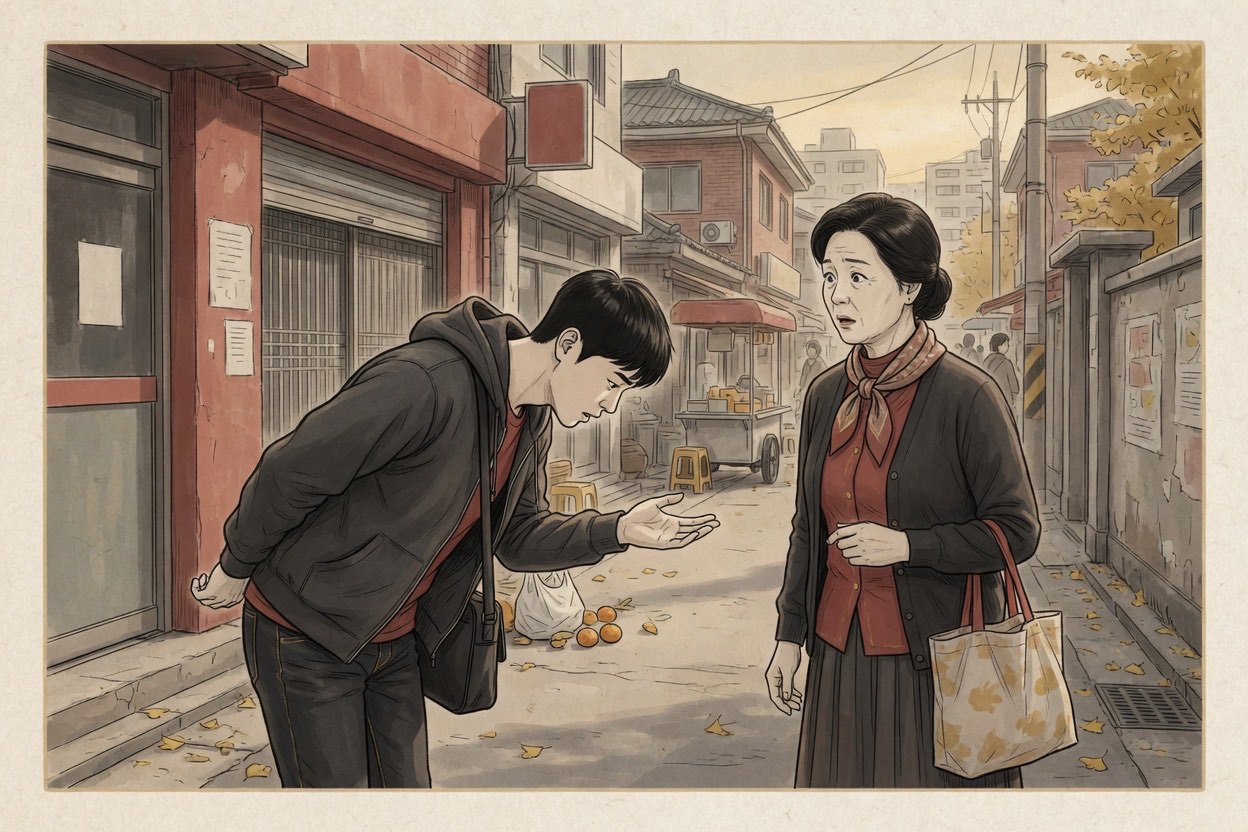
How to say sorry in Korean starts with two different tools, not one word. The safe default for strangers, elders, and work is 죄송합니다 (죄송합니다, joesonghamnida, pronounced jwe-song-ham-ni-da)—formal, deferential, “I take the blame seriously.” With friends and people your own age, 미안합니다 / 미안해요 / 미안해 sit closer and more personal. One-sentence definition: Korean apology splits formality from intimacy—죄송 for rank and distance, 미안 for closeness—and English “excuse me” is usually a third word entirely.
If you only keep one travel line: say 죄송합니다, add a small bow, and wait. The rest of this page—실례합니다 for passing, 잠시만요 in a crowd, 괜찮아요 as the reply—is the map that keeps a quick “sorry” from reading as dismissive.
Quick facts
| Safe default | 죄송합니다 (joesonghamnida) |
| Pronunciation | jwe-song-ham-ni-da |
| Personal / closer twin | 미안합니다 / 미안해요 / 미안해 |
| “Excuse me” (pass / interrupt) | 실례합니다 |
| Crowd tools | 잠시만요, 저기요 |
| Standard reply | 괜찮아요 |
| Body language | slight bow + full stop—not a fly-by mumble |
| Register ladder | banmal → polite -요 → formal -습니다 |
죄송합니다 vs 미안합니다 — the real split
English speakers search “how to say sorry in Korean” and get one phrase. Korean rooms run a two-family system:
| Family | Hangul core | Social feel | Typical room |
|---|---|---|---|
| 죄송 | 죄송 | formal, deferential, “I am at fault before you” | bosses, elders, clients, strangers, service recovery |
| 미안 | 미안 | personal, warm, “I feel bad toward you” | friends, peers, partners, siblings |
죄송합니다 is not merely “more polite 미안합니다.” It is the form that lifts the other person’s status and lowers yours. That is why a junior late to a meeting reaches for 죄송, not a breezy 미안—even if both are “sorry” in a bilingual dictionary.
미안합니다 still works as a full polite apology. It just carries more relational heat. With a close coworker or a friend, 미안 can sound more sincere precisely because it is less ceremonial. With a senior you barely know, that same warmth can land as under-dressed.
Getting this backwards is a real misstep
- 미안 to a boss for a serious mistake → can sound too light, like you are treating rank as optional.
- 죄송 to a best friend for being five minutes late to coffee → can sound stiff, like you put on a suit for a picnic.
- Either, muttered while already walking away → the words lose, the body wins. Koreans read apology weight from bow + pause + tone, not from flashcard speed.
This is the same social software as Korean honorifics: title, distance, and speech level have to move together. An apology is just another place the map shows.
The apology ladder
Think of Korean sorry as a ladder, not a single rung.
| Level | Phrases | When |
|---|---|---|
| Casual (banmal) | 미안해, 미안, 잘못했어 | close friends, siblings, partners who already banmal |
| Polite (-요) | 미안해요, 죄송해요 | everyday polite—shops, classmates, many peers |
| Formal (-습니다) | 미안합니다, 죄송합니다 | work, elders, strangers, serious harm |
미안해 — casual, close only
미안해 (미안해, mianhae) is the form English speakers steal from dramas. It is real—and relationship-locked. Use it only where banmal already lives. Firing 미안해 at a professor or a store manager is not cute fluency; it is status freelancing.
Friends often stack responsibility on top:
- 미안해. 내 잘못이야. — Sorry. It’s my fault.
- 진짜 미안해. — I’m really sorry.
미안해요 · 죄송해요 — the polite middle
-요 endings are the everyday public gear. 미안해요 softens personal regret; 죄송해요 keeps a deferential flavor without full formal armor. Both appear constantly in shops, classrooms, and soft work chat.
If you are unsure whether the room wants full formal, 죄송해요 is often a strong default for light collisions and small mistakes with people you do not banmal with.
죄송합니다 · 미안합니다 — formal weight
죄송합니다 is the line you want for:
- bumping an elder
- being late to a client
- interrupting a senior
- any situation where hierarchy is loud
미안합니다 is formal on the surface but still carries the 미안 personal root. It can sound very sincere among adults who are not intimate enough for banmal, yet not distant enough for pure 죄송 theater. Listen for what the room already uses—copying the local apology family is cheap nunchi.
Extra weight words (use sparingly)
| Add-on | Rough sense | Caution |
|---|---|---|
| 정말 / 너무 | really / so | fine in moderation |
| 대단히 죄송합니다 | deeply / greatly sorry | heavy—save for serious harm |
| 제가 잘못했습니다 | I was wrong / it was my fault | strong ownership; good when facts matter |
| 다신 안 그럴게요 | I won’t do it again | only if you mean the promise |
Do not stack every intensifier at once. One clear apology plus ownership beats a monologue of superlatives.
실례합니다 is not “sorry” — highest-value correction
English collapses sorry and excuse me into one mouth-habit. Korean splits them.
실례합니다 (실례합니다, sillyehamnida) means roughly “excuse me” / “pardon the intrusion.” It is for:
- squeezing past someone on a subway
- stepping into a conversation
- entering a room mid-meeting
- getting past a blocked aisle
It is not the right tool for “I spilled coffee on your laptop” or “I forgot your birthday.” Using only 실례합니다 for real harm can sound like you treated damage as traffic management.
| English habit | Korean tool | Job |
|---|---|---|
| “Sorry!” while squeezing past | 실례합니다 / 잠시만요 | clear a path, mark interruption |
| “Sorry I hurt you / broke this / was late” | 죄송합니다 / 미안… | accept fault |
| “Sorry—what?” (didn’t hear) | often 네? / 다시 한 번요 | repair hearing, not morality |
Learners who map every English “sorry” onto 죄송 end up over-apologizing for existing in space—and under-apologizing when they actually owe something. Split the jobs and both words get sharper.
잠시만요 and 저기요 — the crowd phrases you actually need
In dense Seoul transit and market aisles, the phrases that keep peace are often not full apologies.
잠시만요
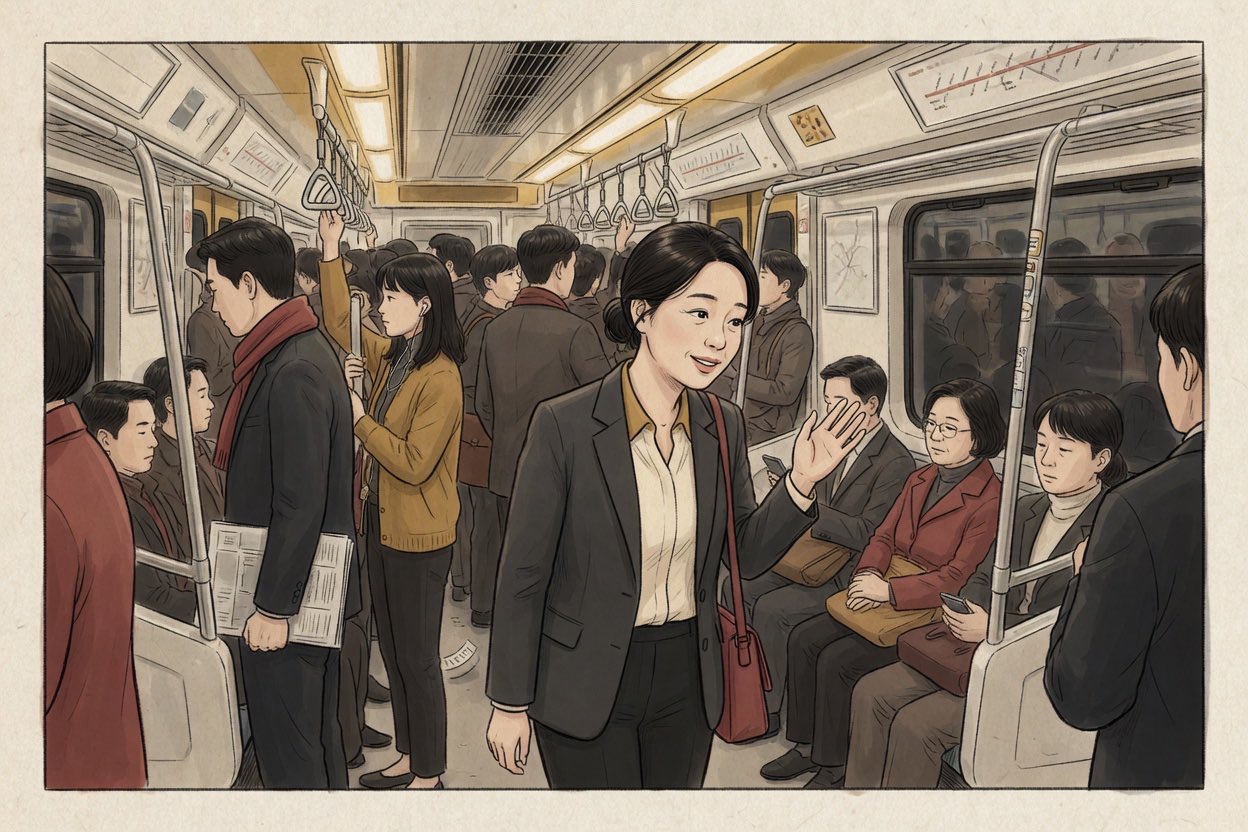
잠시만요 (잠시만요, jamsimanyo) — “just a moment” / “excuse me for a second.” Raised hand optional. Perfect when you need someone to shift half a step so you can exit a train car. Soft, practical, low drama.
Casual twin among friends: 잠깐만.
저기요
저기요 (저기요, jeogiyo) — attention-getter: “excuse me (over there).” Use it to call a server, stop a stranger for directions, or flag someone who dropped a card. Tone decides everything: warm and clear is polite; sharp and loud is a fight invitation.
저기요 is not an apology. Pair it with a request:
- 저기요, 이 버스 시청 가나요? — Excuse me, does this bus go to City Hall?
- 저기요, 메뉴판 하나 주세요. — Excuse me, could I get a menu?
Mini crowd kit
| Need | Say |
|---|---|
| Squeeze past | 실례합니다 or 잠시만요 |
| Get attention | 저기요 |
| Real fault (stepped on foot hard, spilled drink) | 죄송합니다 + slight bow |
| Reply to their apology | 괜찮아요 |
Apology weight: bows, repetition, and why a quick “sorry” can feel cold
In many English-speaking rooms, a fast “sorry!” while still moving is social grease. In Korean rooms, that same fly-by can read as dismissive—especially upward in hierarchy.
What carries weight:
- Stop moving for half a beat. Plant your feet.
- Slight bow for everyday mistakes; deeper for serious ones or elders.
- Clear phrase at full volume for the distance—not a swallowed mumble.
- Own the fact when needed: late, wrong file, broken glass.
- Wait for 괜찮아요 or a nod before you sprint away.
Repetition is real. People often say 죄송합니다 more than once, or pair it with 제가 실수했습니다 (“I made a mistake”). That is not melodrama by default; it is showing the apology is not a speed bump. Overdo it for a paper cut and you look theatrical. Underdo it for a damaged laptop and you look careless.
Body language also interacts with greeting culture. The same slight bow you use with hello in Korean reappears here—shoulders ease forward, eyes soft, not a ninety-degree performance for every grocery cart bump.
Workplace note
Juniors apologizing to managers usually choose 죄송 forms, stand if the room is formal enough, and keep banmal out of the sentence. A soft 미안 among same-generation peers after a tiny mix-up can be fine if that peer culture already lives on casual speech—but do not invent that culture on day one with the team maknae energy or a manager who still uses full titles.
괜찮아요 — the standard reply
When someone apologizes to you, the default soft landing is 괜찮아요 (괜찮아요, gwaenchanayo) — “it’s okay / I’m fine / no worries.”
| Reply | Register | Feel |
|---|---|---|
| 괜찮아요 | polite default | releases tension cleanly |
| 괜찮습니다 | more formal | same meaning, stiffer coat |
| 괜찮아 | banmal | friends only |
| 신경 쓰지 마세요 | polite | “don’t worry about it” |
| 아니에요 | polite | “no (it’s nothing)” — common soft deflect |
You do not have to forgive real harm with 괜찮아요. The phrase is a social tool for ordinary bumps, not a legal waiver. If something is not okay, a calm factual response beats fake cheer.
When you’ll hear each form
- Crowded subway, brushing past: 실례합니다 / 잠시만요
- Stepped hard on a stranger’s foot: 죄송합니다 + bow
- Late to a meeting with a manager: 죄송합니다. 늦었습니다.
- Forgot a friend’s plan: 미안해 / 미안해요 depending on speech level
- Calling a server: 저기요
- They apologize to you for a tiny bump: 괜찮아요
- Service recovery at a shop: staff often lead with 죄송합니다
Example dialogues
1. Subway squeeze — 실례합니다, not a full moral apology
Rush hour. A commuter needs to exit; someone blocks the door path.
- Commuter: 실례합니다. 내려야 해서요.
Sillyehamnida. Naeryeoya haeseoyo.
Excuse me. I need to get off. - Passenger: 아, 네—죄송해요.
A, ne—joesonghaeyo.
Oh, right—sorry. - Commuter: 괜찮아요. 감사합니다.
Gwaenchanayo. Gamsahamnida.
It’s fine. Thank you.
Gloss: The person needing space leads with 실례합니다 (passage). The person who was blocking answers with a light 죄송해요 (small fault). 괜찮아요 closes the loop. No banmal between strangers.
2. Office lateness — 죄송 with ownership
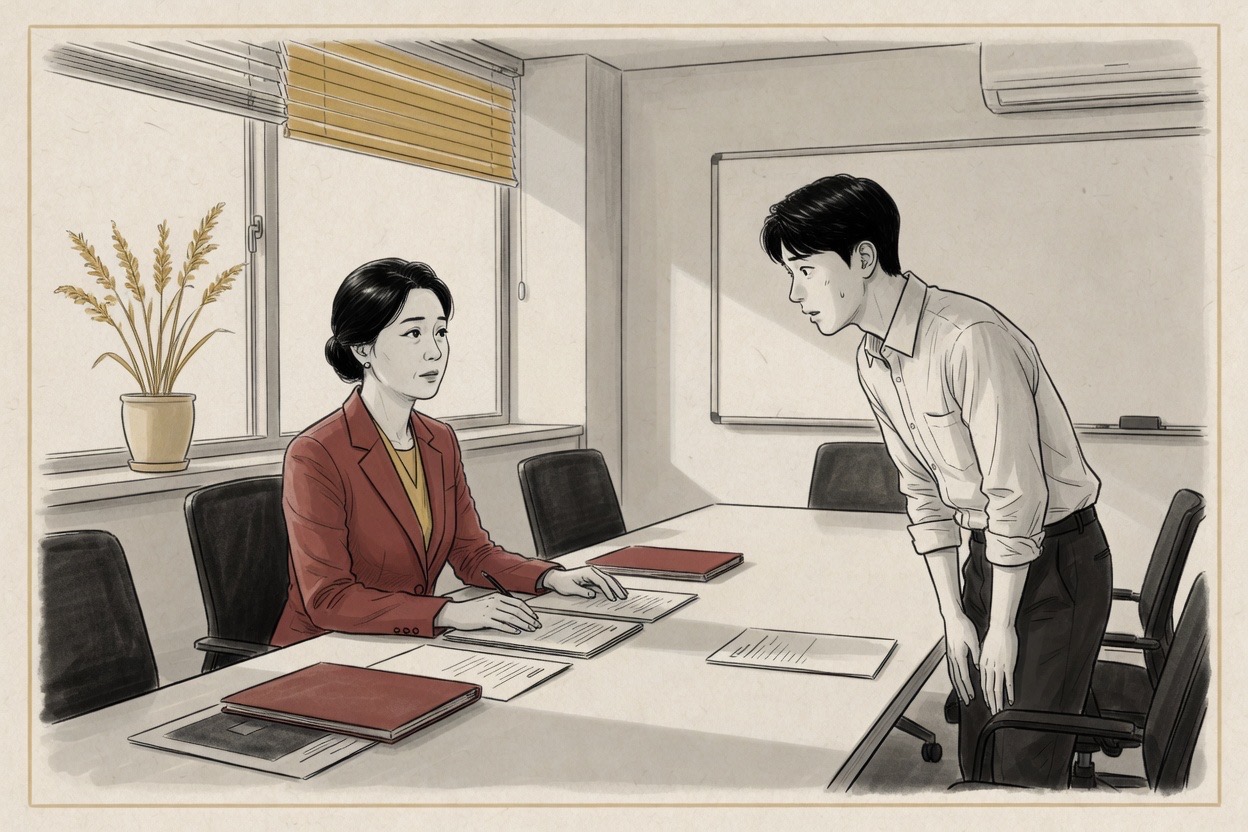
Meeting room. Junior arrives two minutes after start. Manager already seated.
- Junior: 죄송합니다. 조금 늦었습니다.
Joesonghamnida. Jogeum neujeotseumnida.
I’m sorry. I’m a little late. - Manager: 다음부터는 조금 일찍 와 주세요.
Daeumbuteoneun jogeum iljjik wa juseyo.
From next time, please come a bit earlier. - Junior: 네, 명심하겠습니다.
Ne, myeongsimhagetseumnida.
Yes—I’ll keep that in mind.
Gloss: Full formal 죄송합니다, fact named, no cute 미안해. The junior does not over-explain traffic for three minutes. Short ownership reads cleaner than a monologue.
3. Friends after a flaky cancel — banmal 미안
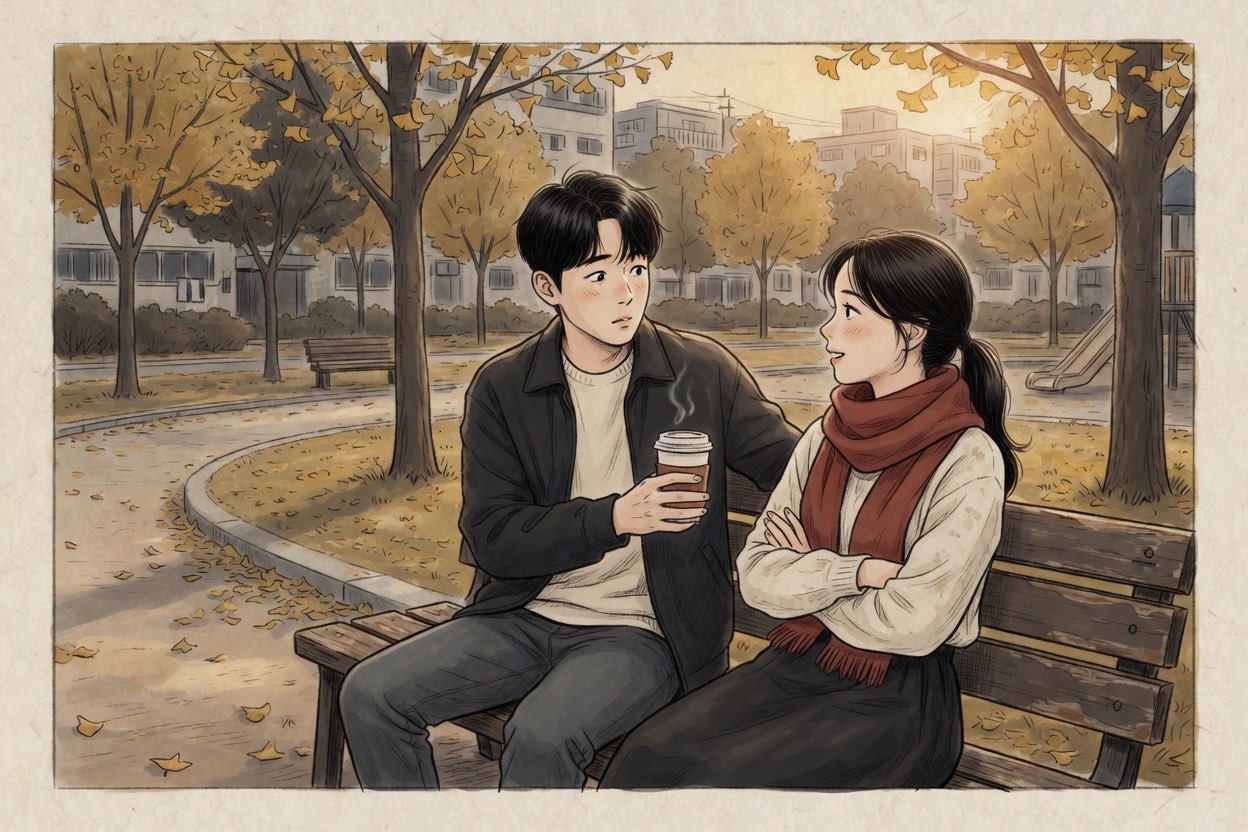
Park bench. One person brought coffee as a peace offering.
- Jisoo: 어제 갑자기 취소해서 미안해. 내가 잘못했어.
Eoje gapjagi chwisohaeseo mianhae. Naega jalmothaesseo.
Sorry for canceling suddenly yesterday. That was on me. - Minho: 진짜 속상했어. 다음엔 미리 말해.
Jinjja soksanghaesseo. Daeumen miri malhae.
I was really upset. Next time, tell me in advance. - Jisoo: 알겠어. 이건 사과 커피야.
Algesseo. Igeon sagwa keopiya.
Got it. This is apology coffee.
Gloss: Banmal throughout—미안해, 잘못했어, no polite -요 endings mixed in. The hurt person does not fake instant 괜찮아; they name the feeling, then set a boundary. That is still a working apology dialogue.
Good nunchi / Zero nunchi
Good nunchi
You bump an older woman’s shopping bag on a side street. You stop, face her, bow slightly, and say 죄송합니다 clearly. She says 괜찮아요. You nod once more and move on. Later, on the subway, you need to pass standing passengers: 잠시만요, soft voice, no dramatic guilt performance. You used apology for harm and crowd phrases for traffic.
Zero nunchi
Same bag bump. You toss a cheerful 미안해~ over your shoulder while still walking, then on the train you announce 죄송합니다 every time you shift two centimeters, as if existing near people were a crime. At work the next day you tell your manager 미안해, 오빠 for a missed deadline. The room goes polite and cold. You collected drama lines. You skipped the map.
Do / Don’t
Do
- Default to 죄송합니다 with strangers, elders, and work.
- Use 미안 forms where closeness already exists.
- Keep 실례합니다 / 잠시만요 / 저기요 for passage and attention—not for real fault.
- Pair serious apologies with a bow, a pause, and a fact when needed.
- Reply to small apologies with 괜찮아요 when you mean it.
Don’t
- Fire banmal 미안해 at bosses and shop clerks.
- Treat every English “sorry” as 죄송—English “excuse me” often wants 실례 or 잠시만.
- Mumble while jogging past the person you just hit.
- Stack empty intensifiers instead of owning the mistake.
- Force fake 괜찮아요 when something is genuinely not okay—calm honesty beats forced sugar.
Nearby ideas on Have Nunchi
- Hello in Korean — the polite default greeting that often shares the same small bow
- Korean honorifics explained — why rank and closeness change which apology family fits
- Nunchi — reading whether this room wants a deep bow or a light 잠시만요
- Maknae — age position in a group, which often predicts who apologizes first and deeper
A closing line
Sorry in Korean is not a single souvenir phrase. It is a small kit: 죄송 for deference, 미안 for closeness, 실례 for interruption, 괜찮아요 for release.
Pick the tool that matches the harm and the relationship—then let your feet stop long enough for the bow to mean something.
FAQ
How do you say sorry in Korean?
The safe default is 죄송합니다 (joesonghamnida) for strangers, elders, and work. With friends, 미안해 or 미안해요 fits better. 실례합니다 is for interrupting or passing, not a real apology.
What is the difference between 죄송합니다 and 미안합니다?
죄송 is more formal and deferential—use it with bosses, elders, and people you do not know well. 미안 is closer and more personal—friends, peers, and people you already share warmth with. Using 미안 with a boss can sound too light; using 죄송 with a close friend can sound stiff.
Does 실례합니다 mean sorry?
Not really. 실례합니다 means roughly “excuse me” for interrupting, squeezing past, or entering a space. It is not the word for “I hurt your feelings” or “I broke your thing.” For true apologies, use 죄송 or 미안 forms.
How do you reply when someone says sorry in Korean?
The standard soft reply is 괜찮아요 (gwaenchanayo)—“it’s okay / I’m fine.” Close friends may say 괜찮아. You can add 신경 쓰지 마세요 (“don’t worry about it”) when you want to fully release the tension.
Is 미안해 too casual for work?
Usually yes. 미안해 is banmal—close friends, siblings, partners. At work, default to 죄송해요 or 죄송합니다 with seniors and clients. Peers who already speak casually may use 미안, but do not freestyle banmal apologies at a manager.
Do you have nunchi?
Get short Korean word lessons and social cues in your inbox.