What Does “Maknae” Mean? The Youngest, Explained
Youngest in the room—family table, office kitchen, or the stage lights.
- Hangul
- 막내
- Romanization
- maknae
- Pronunciation
- mahng-nae
- Category
- Words
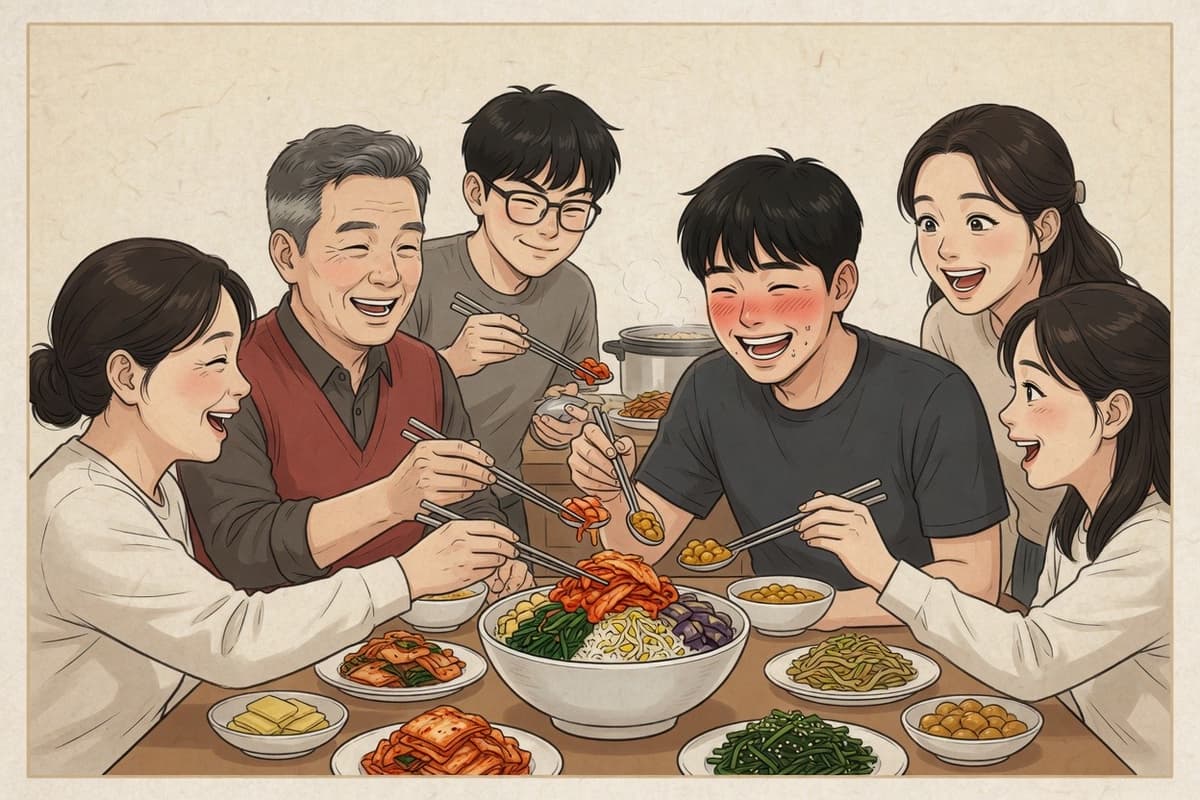
Maknae (막내, pronounced mahng-nae) is the Korean word for the youngest person in a group—a family, a friend circle, an office team, or a K-pop lineup. It is not a gendered title like oppa. A forty-year-old can be the maknae of a work team if everyone else is older. One-sentence definition: maknae marks relative youth inside a specific group, not absolute age.
English “youngest child” only covers part of it. The word travels from the family table to the conference room to the encore bow—care and teasing rights when used well, costume language when every younger Korean gets labeled “the maknae.”
Quick facts
| Hangul | 막내 |
| Romanization | maknae |
| Pronunciation | mahng-nae (see note below) |
| Literal sense | the youngest in a group |
| Gender | not gendered |
| Scope | family, friends, workplace, clubs, K-pop, any ranked-by-age set |
| Related roles | hyung / oppa / unnie / noona for older siblings and friends; maknae is the other end of the age stick |
How do you pronounce maknae?
Spelling suggests mak-nae. Spoken Korean usually assimilates the first syllable: 막내 often lands closer to [망내] — mahng-nae. The k sound softens into an ng-like blend before the next consonant. Most English explainers skip this; native speech does not.
Say mahng-nae with even stress, not MAK-nay like a brand name. If you hear something between “mak” and “mang,” you are hearing the real word, not a mispronunciation.
What does maknae mean in a family?
At home, the maknae is the youngest sibling (or the youngest adult still treated that way at holidays). The role is both privilege and job description:
- Extra side dishes appear on their plate without asking.
- Older siblings get teasing rights—and protective instincts.
- Parents may soften rules, then expect the maknae to stay “the baby” longer than feels fair.
Being maknae is not pure luxury. You get care and you get managed. You are loved loudly and corrected publicly. In many families the maknae is the emotional center of the table: the person everyone still checks on first.
What does maknae mean at work?
Korean offices and team cultures often carry family-age logic into non-family rooms. The team maknae—the youngest hire or the youngest on a project—may become the default person for small logistics:
- collecting lunch orders
- coffee or snack runs
- printing, booking rooms, coordinating group gifts
That pattern is not written in every company handbook, and many workplaces are less hierarchical than the stereotype. Still, the expectation shows up enough that “our team’s maknae” is ordinary office talk. The job is not only chores. It is quick nunchi: noticing when seniors are done speaking, when the mood drops, when volunteering helps more than waiting to be ordered.
A forty-year-old joining a team of fifty-year-olds can still be “the maknae.” Absolute age is not the point. Relative age inside that group is.

What does maknae mean in K-pop?
If you searched “what does maknae mean in kpop,” this is the section you wanted. In idol groups, the maknae is the youngest member. The label is structural—birth year (or legal age rank) decides it—but fandom speech builds a whole vocabulary on top.
Golden maknae meaning
A golden maknae is a youngest member who seems good at everything: vocals, dance, variety, visuals, sports jokes on variety shows. BTS’s Jungkook made the English phrase explode; the Korean idea is older than any one fandom. It is praise, not a government title. “Golden” means multi-talented maknae energy, not a second official position next to leader and main dancer.
Evil maknae
An evil maknae is affectionate shade. The youngest who:
- teases hyungs and unnies without full apology face
- steals the remote, the last snack, the punchline
- plays spoiled on camera because the group lets them
“Evil” here is mostly theater. The joke only works because the group is close enough that cheekiness reads as love, not mutiny.
Maknae line
The maknae line is the cluster of youngest members treated as a soft subunit—shared variety bits, unit photos, “babies of the group” framing. Lines (maknae line, hyung line, vocal line) are fandom sorting tools as much as company org charts.
Maknae on top
Maknae on top flips the hierarchy for fun and for real influence: the youngest runs the joke, the concept, or the group’s emotional weather. The phrase got wide pop-culture volume around 2NE1 and still gets pasted onto any group where the baby of the lineup is clearly in charge of the chaos. Age rank says bottom. Stage dynamics say ceiling.

Why age hierarchy makes the word stick
Korean address culture cares about who is older relative to whom. Kinship titles like oppa and hyung encode speaker gender and direction of age. Maknae is different: it names the bottom of the age stack inside one group, without saying whether the speaker is male or female.
That is why:
- You can be maknae at home and senior at work.
- You can be maknae in your friend group and hyung to someone else’s younger brother.
- A middle-aged newcomer can inherit the maknae chores on a veteran team.
The word is a position, not a personality type. Personality shows up in how people play the position—golden, evil, quiet, overloaded, or “on top.”
When you’ll hear it
- Parents introducing kids: “This is our maknae.”
- Cousins sorting seating and chores by age without a spreadsheet.
- Office chat: “Ask the maknae to order; they already have everyone’s preferences.”
- Variety shows labeling idol members for international fans.
- Friend groups roasting the youngest for stealing the aux cord.
You will not typically hear someone call a stranger “maknae” the way English speakers toss around “kiddo.” It needs a group boundary.
Example dialogues
1. Family table, banmal, love with side dishes
Sunday dinner. Everyone is already full except the parental mission.
- Mom: 막내야, 반찬 더 먹어.
Maknae-ya, banchan deo meogeo.
Maknae, eat more side dishes. - Youngest: 엄마, 이미 배가 불러.
Eomma, imi baega bulleo.
Mom, I’m already full. - Older sibling: 그래도 먹어. 네가 안 먹으면 엄마가 속상해.
Geuraedo meogeo. Nega an meogeumyeon eommaga soksanghae.
Eat anyway. If you don’t, Mom will be upset.
Gloss: Casual speech. “Maknae-ya” is address + soft call. The food pile is affection with pressure.
2. Office lunch run, polite speech
Open office, noon. The team’s youngest is already holding a notepad.
- Team lead: 민지 씨, 점심 메뉴 좀 받아 줄래요?
Minji ssi, jeomsim menyu jom bada jullaeyo?
Minji, could you take the lunch orders? - Minji: 네, 팀장님. 뭐로 할까요?
Ne, timjangnim. Mworo halkkayo?
Yes, team lead. What should we get? - Team lead: 아무거나 괜찮아요. 막내가 골라 주세요.
Amugeona gwaenchanayo. Maknaega golla juseyo.
Anything’s fine. Maknae, you pick for us.
Gloss: Jondaemal (polite). “Our maknae” here is role talk, not mockery—though the chores still land on the same person.
3. Sibling living room, evil-maknae energy
Remote control crisis.
- Older brother: 막내가 또 리모컨 가져갔지?
Maknaega tto rimokeon gajyeogatji?
The maknae took the remote again, didn’t they? - Middle sibling: 응. 그리고 소파 다 차지했어.
Eung. Geurigo sopa da chajihaesseo.
Yeah. And they took over the whole sofa. - Maknae: 형이 양보하는 거지, 뭐.
Hyeong-i yangbohaneun geoji, mwo.
Hyung’s just being generous, that’s all.
Gloss: Banmal among siblings. Classic evil-maknae staging: no apology, maximum sprawl.

Good nunchi / Zero nunchi
Good nunchi
You join a Korean friend’s hangout. Someone laughs, “Meet our maknae.” You smile, learn names, and do not immediately assign them every errand or baby-talk them in English. Later, when they volunteer to order food, you thank them and offer to take the next round. You treated youngest as a group fact, not a servant class.
Zero nunchi
Same hangout. You hear “maknae” once and spend the night pinching cheeks, calling them “baby,” and demanding a cute self-introduction for your camera. They are twenty-seven. The room goes polite and quiet. You thought you were fluent in K-pop. You performed hierarchy without the relationship.
Do / Don’t
Do
- Use maknae for the youngest inside a named group you actually share.
- Remember it is not gendered—unlike oppa/hyung.
- Learn the K-pop extensions (golden, evil, line, on top) as fandom dialect layered on a plain age word.
- Watch how the group treats their maknae before you pile on chores or jokes.
Don’t
- Call random younger strangers maknae.
- Assume the maknae always wants the baby role in public.
- Confuse “golden maknae” with an official company rank.
- Treat office maknae logistics as free labor with no reciprocity.
Nearby ideas (for later on Have Nunchi)
- Oppa (오빠) — older male, from a female speaker
- Hyung (형) — older male, from a male speaker
- Unnie / eonni (언니) — older female, from a female speaker
- Noona / nuna (누나) — older female, from a male speaker
- Korean honorifics explained — the rest of the age-and-gender map
- Chuseok — holiday tables where the maknae gets extra food and extra errands
- Nunchi (눈치) — reading whether this room wants teasing, titles, or quiet respect
A closing line
Maknae is not “young person” as a vibe. It is youngest in this circle—with the care, the chores, and the jokes that come with a known bottom of the age stack.
Hold the word to the group that earned it, and keep your nunchi for when the baby of the lineup is already running the room.
FAQ
What does maknae mean in Korean?
Maknae (막내) means the youngest person in a group—a family, friend circle, office team, or K-pop group. It is not gendered; anyone can be the maknae.
What does maknae mean in K-pop?
The maknae is the youngest member of the group. Fans also talk about golden maknae, evil maknae, maknae line, and maknae on top—roles built on that age rank.
What is a golden maknae?
A youngest member who is unusually skilled at many things. BTS’s Jungkook made the phrase famous, but the idea is “talented maknae,” not a formal title.
What does evil maknae mean?
An affectionate joke for a youngest who teases elders, breaks soft rules, or acts cheeky on purpose—spoiled-brat energy with affection attached.
What is maknae on top?
When the youngest is the one actually running the vibe, decisions, or chaos of the group. The phrase got pop-culture volume around 2NE1 and still gets used for any youngest who leads from the bottom of the age chart.
Sources
Primary and authoritative references used for definitions and context on this page.
- Korean Basic Dictionary — 막내 — National Institute of Korean Language
Read next
Do you have nunchi?
Get short Korean word lessons and social cues in your inbox.