Korean Words in English — Food, Pop Culture, Concepts & More
How kimchi, hallyu, nunchi, and skinship crossed into English—and which ones never really left Korea.
- Hangul
- 외래어
- Romanization
- oeraeeo
- Pronunciation
- weh-reh-uh
- Category
- Words
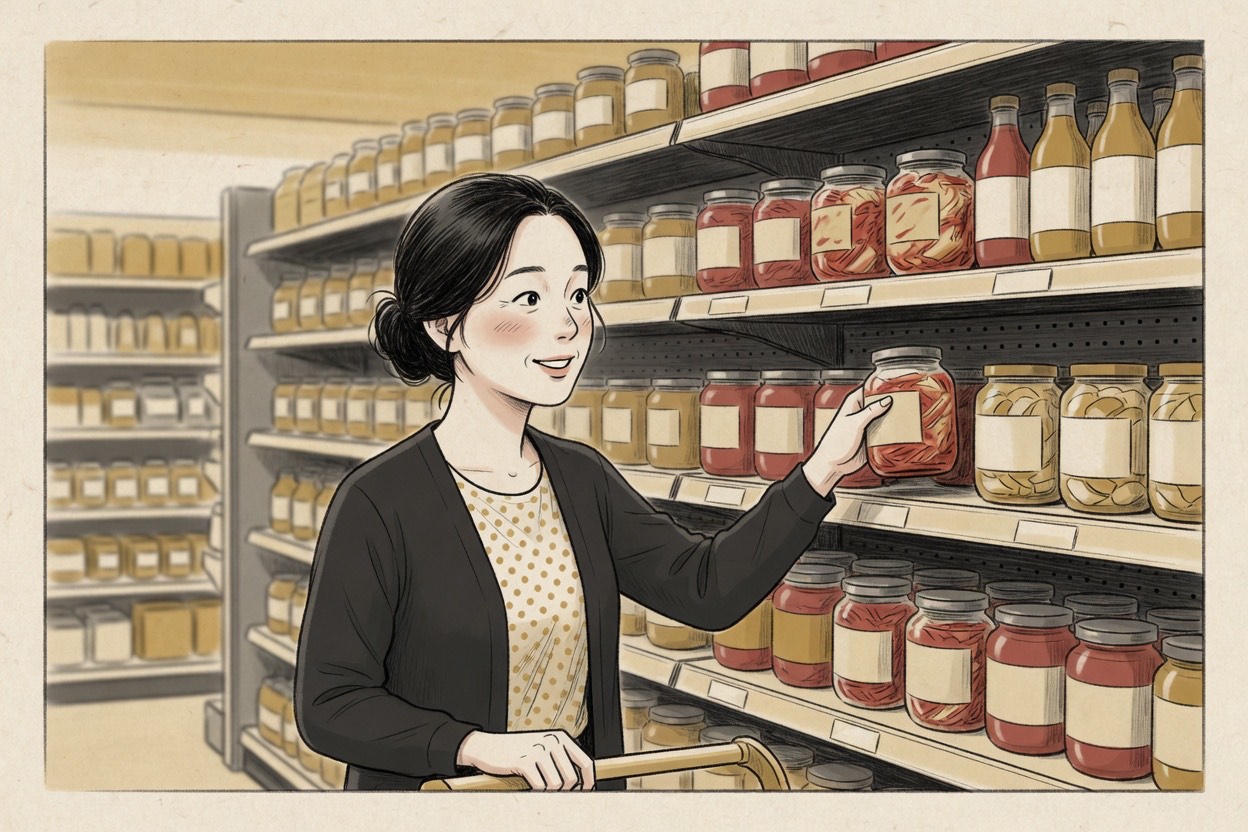
Korean words in English are Korean-origin labels that English speakers now use without a translation—kimchi, bulgogi, soju, K-pop, hallyu, mukbang, webtoon, nunchi, jeong, chaebol, and more. Hangul speakers still say these words as ordinary Korean; English speakers mostly meet them as menu names, fandom shorthand, news jargon, or social-media labels. One-sentence definition: Korean words enter English through food, pop culture, and social concepts—not as a tidy vocabulary list, but as traffic that sticks when people need a name for something Korea already had.
If you searched “korean words in english,” this page is the map. It is not an A-to-Z dictionary dump. It groups words by how they arrived, notes when major dictionaries started treating some of them as settled English, flags Konglish moving the other way, and shows how English mouths reshape Korean sounds.
Quick facts
| Hangul frame | 외래어 (oeraeeo) — loanwords; here, Korean loans into English |
| Main arrival routes | food · pop culture · social concepts · media/news |
| English first contact | menus, grocery aisles, fandom English, headlines |
| Dictionary signal | OED added a batch of Korean-origin words in 2021 |
| Reverse traffic | Konglish (English-looking words Koreans use; natives often don’t) |
| Best way to learn them | by route and context, not alphabet |
How do Korean words enter English?
English does not “import” Korean in one package. Words hitch a ride on something people already want: dinner, a drama, a fandom joke, a news story about power, a feeling that English only half-names.
| Route | What travels | Why English keeps the Korean label |
|---|---|---|
| Food | kimchi, bulgogi, bibimbap, gochujang, soju, makgeolli, banchan | The dish or drink is the name; “spicy fermented cabbage” loses the brand of the thing |
| Pop culture | K-pop, hallyu, aegyo, mukbang, manhwa, webtoon, chaebol | Fandom, platforms, and news need short labels that point to Korean forms |
| Behaviour / concepts | nunchi, jeong, han, skinship, hoesik | English has near-neighbors (EQ, affection, grief, PDA, work drinks) but not exact matches |
| Dictionary stage | selected words already in wide English use | Lexicographers record traffic; they do not create it |
Think of each loan as a visa stamp, not a citizenship ceremony. Some words stay food-aisle only. Some become full social vocabulary. A few reverse-commute as Konglish and never become native English at all.
Food — the grocery and menu pipeline
Food is still the thickest cable. English speakers meet Korean first as something edible with a Korean name on the package.
| Word | Hangul | Rough English job |
|---|---|---|
| kimchi | 김치 | fermented vegetable banchan; the global gateway word |
| bulgogi | 불고기 | marinated grilled meat; often the “safe” entry dish |
| bibimbap | 비빔밥 | mixed rice bowl with toppings and sauce |
| gochujang | 고추장 | fermented chili paste; now a pantry loan in many kitchens |
| soju | 소주 | clear Korean spirit; bar menus worldwide |
| makgeolli | 막걸리 | milky rice wine; later, nicher, still rising |
| banchan | 반찬 | the side-dish system, not one single recipe |
Once a word sits on a menu without italics, it has already started living as English. Kimchi no longer needs “Korean pickled cabbage” as a chaperone in most cities. Gochujang shows up in fusion recipes that never mention Korea. Soju becomes a cocktail base.
Pronunciation drift on the plate: English often says KIM-chee, bull-GO-ghee, bee-BIM-bop, go-choo-JANG, SO-joo, mak-GOH-lee, BAHN-chahn. Korean keeps them shorter and more level—gim-chi, bul-go-gi, bi-bim-bap, go-chu-jang, so-ju, mak-geol-li, ban-chan—with softer starts and less commercial stress.
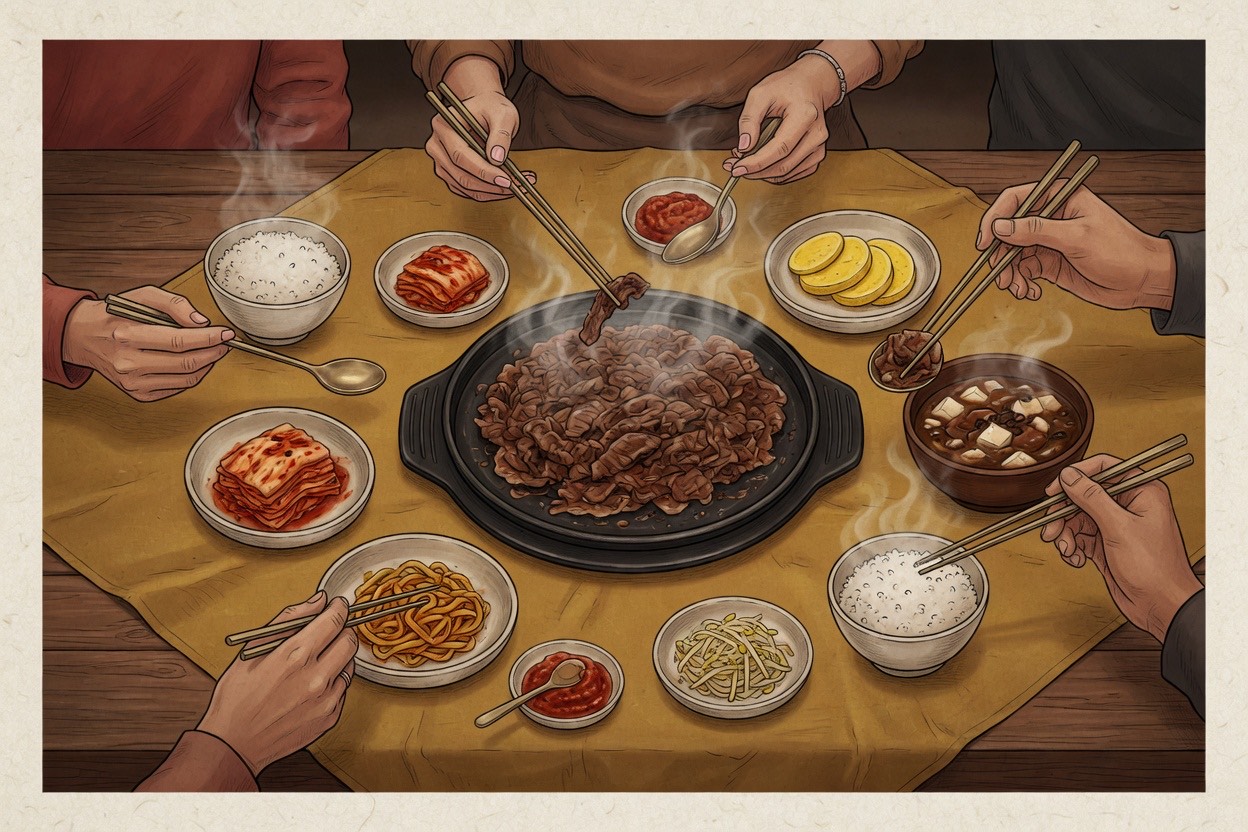
Food loans teach a wider rule: English keeps the Korean word when the thing is specific enough that a paraphrase feels like a demotion.
Pop culture — the screen pipeline
If food put Korean on the tongue, screens put Korean in the timeline. This is the second major route: K-culture English.
| Word | Hangul / form | What English uses it for |
|---|---|---|
| K-pop | often kept as K-pop | idol music industry + fandom culture as a global category |
| hallyu | 한류 | the Korean Wave as an umbrella—not just music |
| aegyo | 애교 | cute performance, soft voice, affectionate charm—on purpose |
| mukbang | 먹방 | eating on camera as a format, not “food video” in general |
| manhwa | 만화 | Korean comics; often distinguished from manga in English talk |
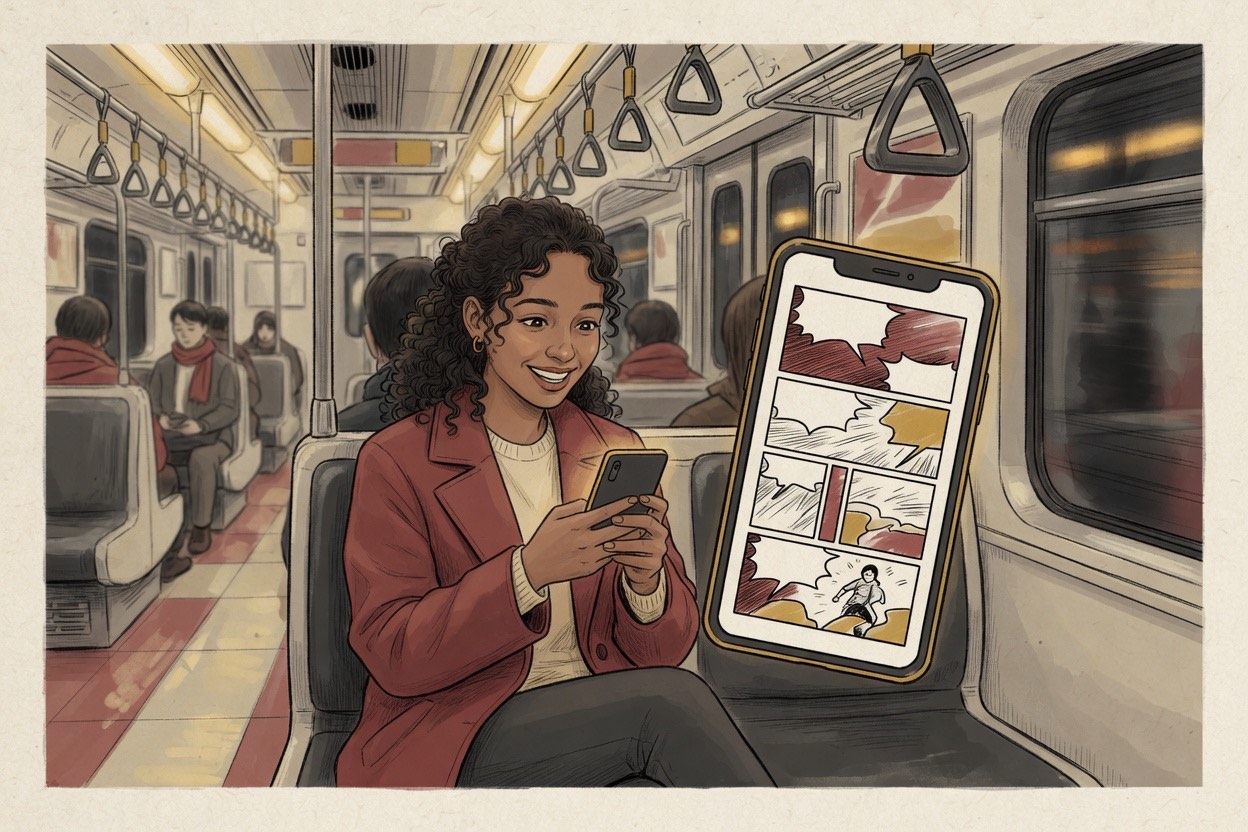
| webtoon | 웹툰 | vertical, scroll-native comics (and the platform culture around them) |
| chaebol | 재벌 | family-controlled conglomerate power—news and drama both |
Quick map: K-pop is category branding; hallyu is the wider wave (drama, film, beauty, food, webtoons—not music alone); aegyo is performed cuteness English only half-names; mukbang is a format, not “any food video”; manhwa and webtoon sort comics by origin and scroll interface; chaebol carries family-control weight that plain “conglomerate” misses.
Pronunciation drift on the feed: English often says HAHL-yoo, AY-gyoh/EGG-yo, MOOK-bang, MAN-hwa, WEB-toon, CHAY-bol. Korean stays lighter—hal-lyu, ae-gyo, muk-bbang, man-hwa, wep-tun, jae-beol.
Beauty rides the same cable. Airport shelves and bathroom counters export Korean routine talk even when captions never use hangul. The words stick because the routine sticks.

Behaviour and concepts — the hard-to-translate pipeline
Some Korean words enter English because English already has feelings and still lacks the exact social tool.
| Word | Hangul | English job (approximate) |
|---|---|---|
| nunchi | 눈치 | reading the room—fast, situational, hierarchical |
| jeong | 정 | sticky affection built by shared time, not pure romance |
| han | 한 | a layered grief/resentment/longing complex—handle carefully, do not romanticize as a national costume |
| skinship | 스킨십 | physical affection range (friend touch to couple touch); looks English, isn’t native English |
| hoesik | 회식 | after-work group dinner/drinks culture tied to team life |
English often labels these “untranslatable,” which is half right. You can paraphrase them; you cannot fully replace them with one tidy English noun and keep the social software.
- Nunchi is not just emotional intelligence—it is situational, often hierarchical, tested in real rooms.
- Jeong is not only love; it is glue from repeated care, meals, favors, and history.
- Han is easy to exoticize in English essays. In Korean it is a real word with history, not a tourist souvenir emotion—prefer careful description over mythology.
- Skinship looks English and fails native English (see Konglish below).
- Hoesik is more specific than “work drinks”: team ritual with attendance politics, not just happy hour.
Pronunciation drift: English often NUN-chee/NOON-chee, jung, long han, HOY-sik. Korean prefers noon-chi (also noonchi once), compact jeong, short han, hoe-sik with a rounded first beat.
In dictionaries — recognition after traffic
Major English dictionaries do not invent Korean loans for fun. They record words that English speakers already use with stable meaning.
In 2021, the Oxford English Dictionary added a batch of Korean-origin words. That mattered as a signal: several Korean labels had enough English currency to document. Do not treat dictionary day as the birthday of the loan. Kimchi was already grocery English. K-culture terms were already fandom English. The dictionary is a photograph of traffic, not the road.
Other dictionaries and style guides have also normalized Korean food and culture terms over time—usually after restaurants, headlines, and platforms did the real work. When you see a Korean word lose its italics in serious English prose, that is often the quiet middle stage: still foreign-origin, already domesticated in practice.
Konglish going the other way
Not every English-looking Korean word is a gift to English. Some are Korean-made hybrids that English speakers do not actually use.
| Konglish item | What Koreans mean | What native English does instead |
|---|---|---|
| skinship | physical affection / touch culture | physical affection, PDA, touch—not “skinship” |
| hand phone | mobile phone | cell phone / mobile |
| one-shot | drink it all in one go (cheers culture) | bottoms up / cheers / down it—not “one-shot” as default toast talk |
Skinship is the star case for this site because English speakers keep meeting it in dramas and variety clips, then try it in pure English conversation and get blank stares. It is ordinary Korean slang built from English parts. It is not ordinary English.
This reverse traffic is useful nunchi: looking English is not the same as being English. If your audience is Seoul, Konglish lands. If your audience is Chicago with no K-context, translate.
Pronunciation drift — a compact cheat sheet
English does three reliable things to Korean loans:
- Stress trumpet — one syllable gets louder than Korean needs
- Vowel stretch — short Korean vowels become English diphthongs
- Consonant harden — soft or tensed Korean stops become hard English letters
| English-ish say | Closer Korean feel | Notes |
|---|---|---|
| KIM-chee | gim-chi | initial is lighter than English K |
| SO-joo | so-ju | two short beats, no cowboy drawl |
| MOOK-bang | muk-bbang | second beat tensed |
| NUN-chee | noon-chi | first vowel closer to “oo” in “book,” not “nun” |
| CHAY-bol | jae-beol | not “cable” with a ch |
| AY-gyoh | ae-gyo | not “egg-yo” |
| WEB-toon | wep-tun | English keeps the English shape; fine for the loan |
You do not need perfect Seoul phonetics to use the words respectfully. You do need to know when you are saying the English loan versus attempting the Korean original.
Example dialogues
1. Grocery aisle — food loan already English
Weekend supermarket. Two friends in their thirties, shopping in English with one Korean dish name fully naturalized.
- A: Should we get kimchi for the dumplings?
- B: Yeah—and if they have gochujang, grab the small tub.
- A: 이거 매운맛인데, 괜찮아?
Igeo maeunmatinnde, gwaenchana?
This one’s the spicy version—okay with you? - B: 응, 그걸로 하자.
Eung, geugeollo haja.
Yeah, let’s do that one.
Gloss: English handles the loanwords; Korean slips in between friends who share both languages. No one says “fermented chili paste” unless they are writing a recipe headnote.
2. Office kitchen — concept word + work ritual
Friday, open office. Coworkers deciding whether to join the team dinner.
- Minho: 오늘 회식 있는데, 갈 거야?
Oneul hoesik inneunde, gal geoya?
There’s a hoesik today—are you going? - Sora: 팀장님 눈치 보면… 가는 게 맞지?
Timjangnim nunchi bomyeon… ganeun ge matji?
If we read the team lead’s nunchi… we should go, right? - Minho: 응. 너무 일찍 빠지면 분위기 이상해져.
Eung. Neomu iljjik ppajimyeon bunwigi isanghaejyeo.
Yeah. If you duck out too early, the mood gets weird.
Gloss: Banmal between peers. Hoesik and nunchi are doing social work English would need a longer paraphrase for. No polite endings mixed into this peer banmal.
3. Group chat — pop culture loan + Konglish trap
Friends planning a weekend, half fandom, half real life.
- Yuna: 그 웹툰 정주행했어? 대박이야.
Geu weptun jeongjuhaenghaesseo? Daebagiya.
Did you binge that webtoon? It’s daebak. - Chris (learning): We should do more skinship at the meetup so everyone feels close!
- Yuna: 야, 그건 영어로 말하면 이상해. 그냥 “be friendly”라고 해.
Ya, geugeon yeongeoro malhamyeon isanghae. Geunyang “be friendly”-rago hae.
Dude, that sounds weird in English. Just say “be friendly.” - Chris: …Right. Webtoon stays. Skinship stays in Korean.
Gloss: Webtoon already works as English. Skinship does not. Yuna’s correction is pure route-awareness: same friend group, different loan status.
Good nunchi / Zero nunchi
Good nunchi
You order bibimbap without a speech about authenticity, call the soju soju, and ask one clean question when a Korean friend uses jeong or nunchi in a story. You use mukbang for the format, not as a joke accent. When someone says skinship, you understand the Korean meaning and do not force the word into a pure English office email. You treated loans as tools, not costumes.
Zero nunchi
Same weekend. You correct a Korean waiter’s English pronunciation of “kimchi,” announce that you “collect untranslatable Korean words,” drop aegyo on a stranger as a command, and write “please increase skinship with clients” in a deck. You thought loanwords were personality. The room heard a scavenger hunt.
Do / Don’t
Do
- Learn Korean loans by arrival route (food / screen / concept / Konglish).
- Keep dictionary history humble: OED’s 2021 batch recognized traffic; it did not invent it.
- Link concept words to real social software—especially nunchi and jeong.
- Use English paraphrases when your audience has zero K-context.
- Notice when a word is Korean slang made of English parts (skinship).
Don’t
- Treat every drama subtitle word as everyday Seoul speech.
- Exoticize han into a single “Korean sadness” brand.
- Assume Konglish works in native English rooms.
- Over-trumpet stress on every food word like a commercial voiceover.
- Invent dictionary counts, entry dates, or “top 50 lists” you cannot verify.
Nearby ideas on Have Nunchi
- Hallyu — the Korean Wave as an umbrella, not a band name
- Nunchi — reading the room as social skill
- Jeong — sticky affection built over time
- Mukbang — eating as broadcast format
- Aegyo — performed cuteness with intent
- Chaebol — family-controlled conglomerate power
- Skinship — touch vocabulary that looks English and isn’t
- Maknae — youngest-in-group role English keeps borrowing from fandom talk
A closing line
Korean words in English are not a quiz deck. They are routes—plates, screens, offices, and chats—where Korean already had a precise name and English decided to keep it.
Learn the route before you collect the sticker, and your mouth will sound less like a souvenir shop and more like someone who actually knows how the word got here.
FAQ
What Korean words are commonly used in English?
The ones English speakers meet first are often food labels—kimchi, bulgogi, bibimbap, gochujang, soju—then pop-culture terms like K-pop, hallyu, mukbang, and webtoon, plus social words like nunchi, jeong, and chaebol.
How did Korean words enter English?
Mostly through food menus and grocery shelves, then through K-drama and K-pop fandom English, internet formats like mukbang, and news coverage of Korean business and social life. Dictionaries later recorded words that had already stuck.
Did the OED add Korean words?
Yes. In 2021 the Oxford English Dictionary added a batch of Korean-origin words, a sign that English usage had already made several of them ordinary enough to document. Treat that as recognition after the fact, not the start of the loan.
What is Konglish?
Konglish is Korean-made vocabulary that looks or sounds English but is not how native English speakers talk—skinship, hand phone, one-shot. These travel well in Korean rooms and often confuse pure English rooms.
How do you pronounce Korean loanwords in English?
English usually flattens vowels, hardens consonants, and shifts stress. Kimchi becomes KIM-chee; soju becomes SO-joo; nunchi often becomes NUN-chee. The Korean originals are shorter, lighter, and less trumpet-like.
Do you have nunchi?
Get short Korean word lessons and social cues in your inbox.