What Does “Aegi” Mean? Baby Word, Grown-Up Nickname
Literal baby, couple pet name, parental soft spot—same word, different rooms.
- Hangul
- 애기
- Romanization
- aegi
- Pronunciation
- eh-gi
- Category
- Words

Aegi (애기, pronounced eh-gi) is Korean for baby—and that is only the first layer. One-sentence definition: aegi is the everyday “baby” word that also becomes an affectionate name for a partner or a grown child when the relationship already allows soft talk. The standard spelling is 아기 (agi); 애기 is the colloquial softening you will hear in speech, chat, dramas, and family kitchens. The split learners miss is this: literal infant on one side, grown adult treated as “my baby” on the other—same hangul, different social heat.
Search “aegi meaning” and you want that full map: spelling, couple talk, parents and adult kids, fandom speech, and the nunchi line between warmth and condescension.
Quick facts
| Hangul | 애기 (colloquial) / 아기 (standard) |
| Romanization | aegi (agi for the standard form) |
| Pronunciation | eh-gi (two short syllables) |
| Literal sense | baby / infant |
| Extended sense | affectionate nickname for a partner or adult child |
| Not the same as | aegyo (애교, cute performance); maknae (youngest in a group) |
| Common settings | parents, couples, close friends, dramas, fandom talk |
How do you pronounce aegi?
Say eh-gi—not “ay-gee” and not a long English “eye.” First syllable like eh in “pet,” second like gi in “geese” without stretching. Keep both short and even.
You will also see agi for 아기. Spoken, the two forms sit close; the spelling difference is cultural more than acoustic. If you have practiced hello in Korean, use the same clean vowels—no cartoon baby voice unless you are deliberately performing one.
Aegi vs agi — what is the spelling difference?
This is the first autocomplete trap.
- 아기 (agi) — standard spelling. Dictionaries, school writing, formal captions, and careful prose prefer this form for “baby.”
- 애기 (aegi) — colloquial softening. Everyday talk, text messages, couple nicknames, parental fussing, and drama scripts lean hard this way.
They are the same word family, not two unrelated nouns. Think “going to” vs “gonna”: one is the careful form, the other is how mouths actually run. Calling one “wrong” misses how Korean softens vowels and syllables in intimacy talk.
Here, aegi tracks the form most searchers type and most speakers use for endearment. When formality matters, expect 아기 in writing.
Quick comparison
| Form | Hangul | Feel | Typical place |
|---|---|---|---|
| agi | 아기 | neutral, standard | formal writing, careful speech |
| aegi | 애기 | soft, everyday | chat, home, couple talk, drama lines |
| aegi-ya | 애기야 | calling form | addressing someone as “baby” |
| uri aegi | 우리 애기 | “our baby” | parents (infant or adult child) |
Literal baby — the first meaning
At base, aegi / agi means an infant or very young child. Hospitals, family albums, and “we had a baby” announcements all use this sense without romance or sarcasm.
You will hear:
- 아기가 태어났어요 — a baby was born (polite, standard spelling)
- 애기 재워야 해 — I have to put the baby to sleep (casual)
- 우리 애기 봐 — look at our baby (proud parent pointing)
Nothing fancy. The word works like English “baby” before English loaded it with boyfriend/girlfriend energy. Korean loaded it the same way—later, on top of the infant meaning.
The split learners miss — grown partner as “aegi”
English speakers often freeze aegi at “infant.” Korean couples do not.
Inside dating and marriage, aegi becomes a pet name. Someone calls their adult partner 애기 or 애기야 the way English uses “baby,” “babe,” or “honey”—except the Korean version still carries the literal baby image more openly. That is the charm and the risk.
What the nickname usually signals:
- Intimacy already exists. Strangers do not earn this word on first coffee.
- Soft hierarchy of care. The speaker is being protective, teasing, or spoiling—not filing a birth certificate.
- Play mode is on. Banmal (casual speech) almost always rides along. A stiff formal ending with “aegi-ya” is a tone crash.
You might hear a woman call her boyfriend aegi; a man call his girlfriend aegi; same-gender couples use it too when the relationship has that soft register. The word is not locked to one gender the way oppa is. It is locked to closeness.
Why this confuses drama watchers
K-dramas sell the moment: adult faces, soft voices, 애기야 over ramen at midnight. Learners copy the line into real life with someone they met last week. The subtitle said “baby.” The room needed three more months of trust.
Rule of thumb: if you would not use “baby” with this person in English without cringing, do not import aegi as a shortcut to chemistry.
우리 애기 — parents and adult children
우리 애기 means “our baby.” Parents use it for newborns. They also use it for a son or daughter who is twenty-eight, thirty-five, or still the emotional baby of the house at forty.
That second use is not sarcasm by default. It is:
- pride at the dinner table (“our baby got the job”)
- worry wrapped as food (“our baby looks thin”)
- soft scolding after a long week (“our baby never calls”)
English has “my baby” for grown kids in some families. Korean 우리 애기 does that work with less embarrassment in many homes. The parent is not denying the child’s age. They are claiming a permanent care lane.
How it lands on the adult child
Some adults lean into it—extra banchan, free emotional refill, holiday VIP status. Some roll their eyes and still answer the phone. Some feel trapped in permanent youngest-child mode, especially if they are also the family maknae.
Maknae names relative age rank in a group. Aegi names softness of address. You can be both: the youngest sibling and “our baby” in Mom’s mouth. You can also be the oldest child and still hear 우리 애기 when Mom is in full care mode. Age stack and baby-talk are related tools, not identical ones.
Aegi in K-drama and K-pop fandom speech
Dramas
Romance scripts love aegi because it compresses intimacy into two syllables. Late-night convenience-store scenes, hospital waiting rooms, rainy car confessions—someone says 애기야 and the soundtrack does the rest.
Useful watching tip: notice who is allowed to say it. The word tracks relationship permission more than vocabulary level. A character who says it too early is either bold, tone-deaf, or the show wants you to feel the overstep.
Fandom talk
English-speaking fans borrow aegi / “aegi” / “agi” as soft nicknames for idols, bias wreckers, or “babies of the group.” That fandom dialect sits next to maknae talk and cute-performance talk. Important separations:
| Word | Hangul | Job |
|---|---|---|
| aegi | 애기 | baby / endearment noun |
| aegyo | 애교 | cute performance (voice, face, gestures) |
| maknae | 막내 | youngest member of a group |
Fans sometimes blur all three into one “baby of the group” cloud. Native conversation keeps them cleaner: aegi is who you call baby; aegyo is cute you perform; maknae is who is youngest on the roster.
Variety and social media
Idols and influencers may call fans soft names, or fans may paste aegi under photos. That is stage affection—real as entertainment, not a free license to baby-talk every Korean person you meet. Stage permission is not street permission.
When calling an adult aegi is warm — and when it is condescending
This is the nunchi question.
Warm (usually)
- Romantic partners who already use banmal and pet names
- Parents talking about (or to) their own children with clear love
- Extremely close friends who trade baby-talk as a joke both sides enjoy
- Comforting someone in a private, equal, already-soft relationship
Warm aegi feels like a blanket someone asked for.
Cold or condescending (often)
- A coworker using baby voice on a peer in the break room
- Someone older in rank but not in intimacy “softening” a junior into smallness
- Flirting that skips consent and goes straight to infant framing
- Correcting, dismissing, or winning an argument by shrinking the other person into “baby”
- Foreign-learner cosplay: collecting cute Korean for content while the target looks frozen
Cold aegi feels like a high chair you did not order.
The office test
Korean workplaces already run on titles, age, and speech levels—see Korean honorifics explained. Dropping aegi into that system is high voltage. A teasing couple nickname at home can become humiliation in an open office. If two coworkers exchange an awkward glance, the word already failed.
Ask yourself three questions before you say it:
- Are we already close enough for banmal and soft nicknames?
- Would this person use the same word back without flinching?
- Is this private care—or a performance for an audience?
If any answer is no, pick a name, a title, or silence.
When you’ll hear it
- New parents narrating every nap and first step
- Couples texting 애기야 뭐 해? at lunch
- Moms on the phone to adult kids with food logistics and weather reports
- Drama subtitles rendering “baby” while the hangul says aegi
- Fandom comments calling a bias “aegi” under a soft photo
- Rare, risky office teasing that either bonds a tight team or ages badly in Slack screenshots
You will not typically hear aegi as a neutral address for strangers, teachers, clients, or first-meeting peers. That is name + 씨 territory, not baby territory.
Example dialogues
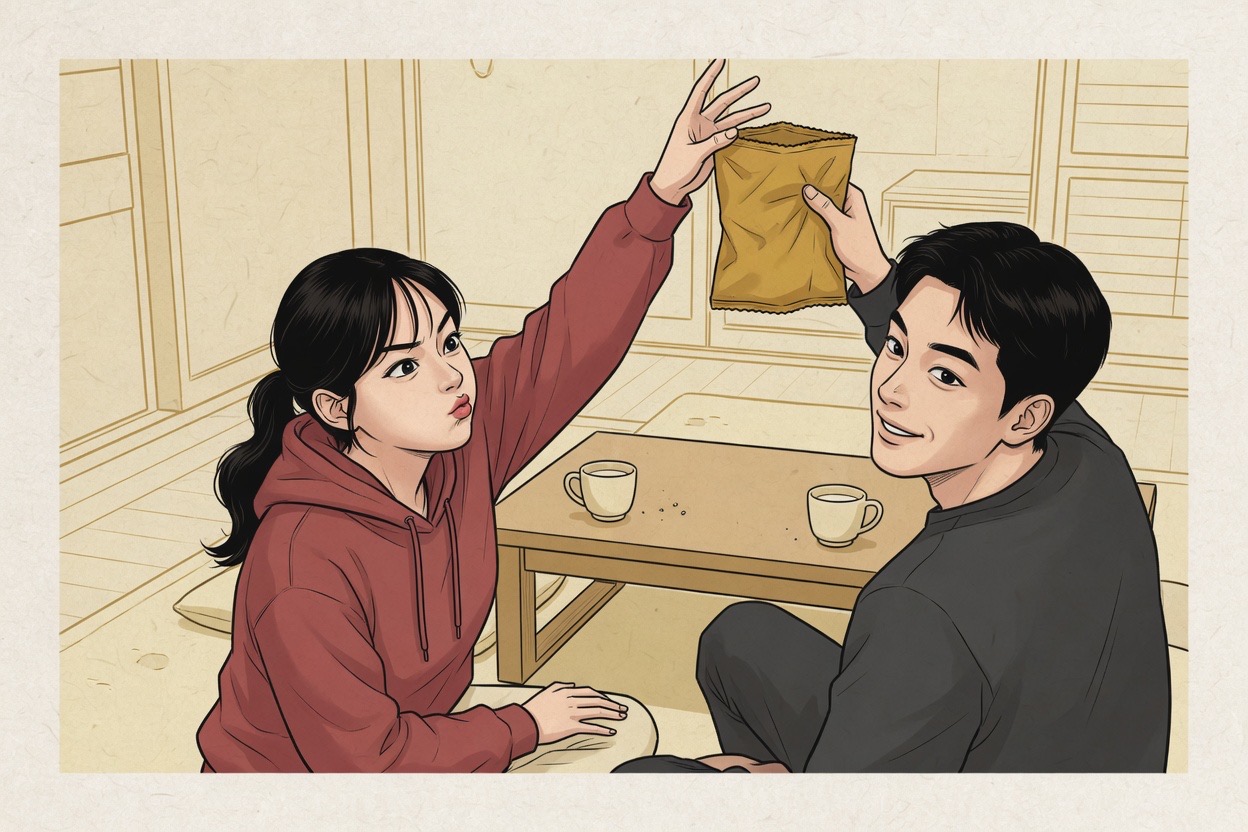
1. Couple sofa, banmal, pure pet name
Friday night. Two adults, zero infants, maximum snack politics.
- Partner A: 애기야, 과자 하나만 줘.
Aegi-ya, gwaja hanaman jwo.
Baby, give me just one snack. - Partner B: 싫어. 내 거야.
Sireo. Nae geoya.
No. It’s mine. - Partner A: 에이, 우리 애기 너무하다.
Ei, uri aegi neomuhada.
Hey, our baby is being too much.
Gloss: Full banmal. 애기야 is the call form; 우리 애기 flips into mock-parent teasing. Warm only because both already play this game.
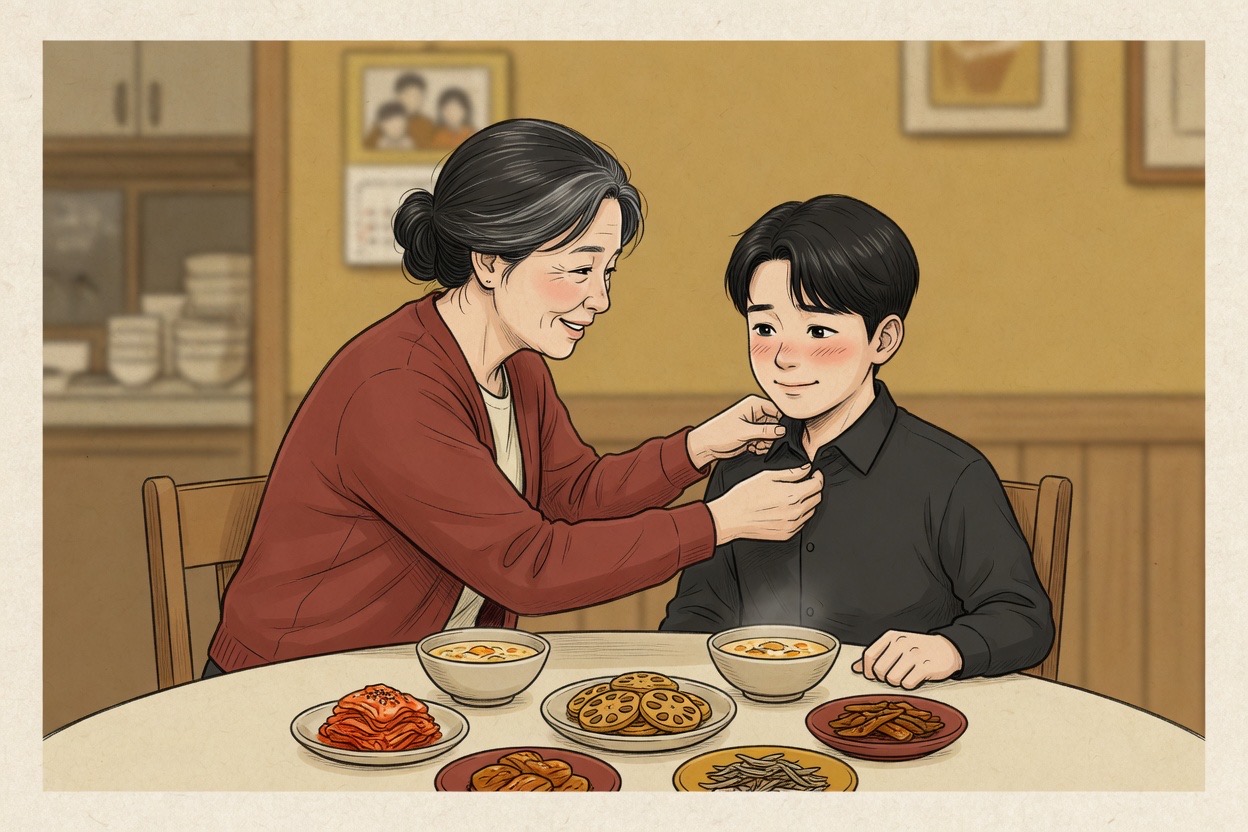
2. Family dinner, parent and grown son
Home table. Son is late twenties; Mom still runs the collar inspection.
- Mom: 우리 애기 옷 왜 이렇게 구겨졌어?
Uri aegi ot wae ireoke gugyeojyeosseo?
Why is our baby’s clothes all wrinkled like this? - Son: 엄마, 나 벌써 스물여덟이야.
Eomma, na beolsseo seumuryeodeolbiya.
Mom, I’m already twenty-eight. - Mom: 그래도 내 애기지. 밥 더 먹어.
Geuraedo nae aegiji. Bap deo meogeo.
Still my baby. Eat more rice.
Gloss: Casual family speech. The age protest is half-real, half ritual. Mom claims care rights; food is the enforcement mechanism.
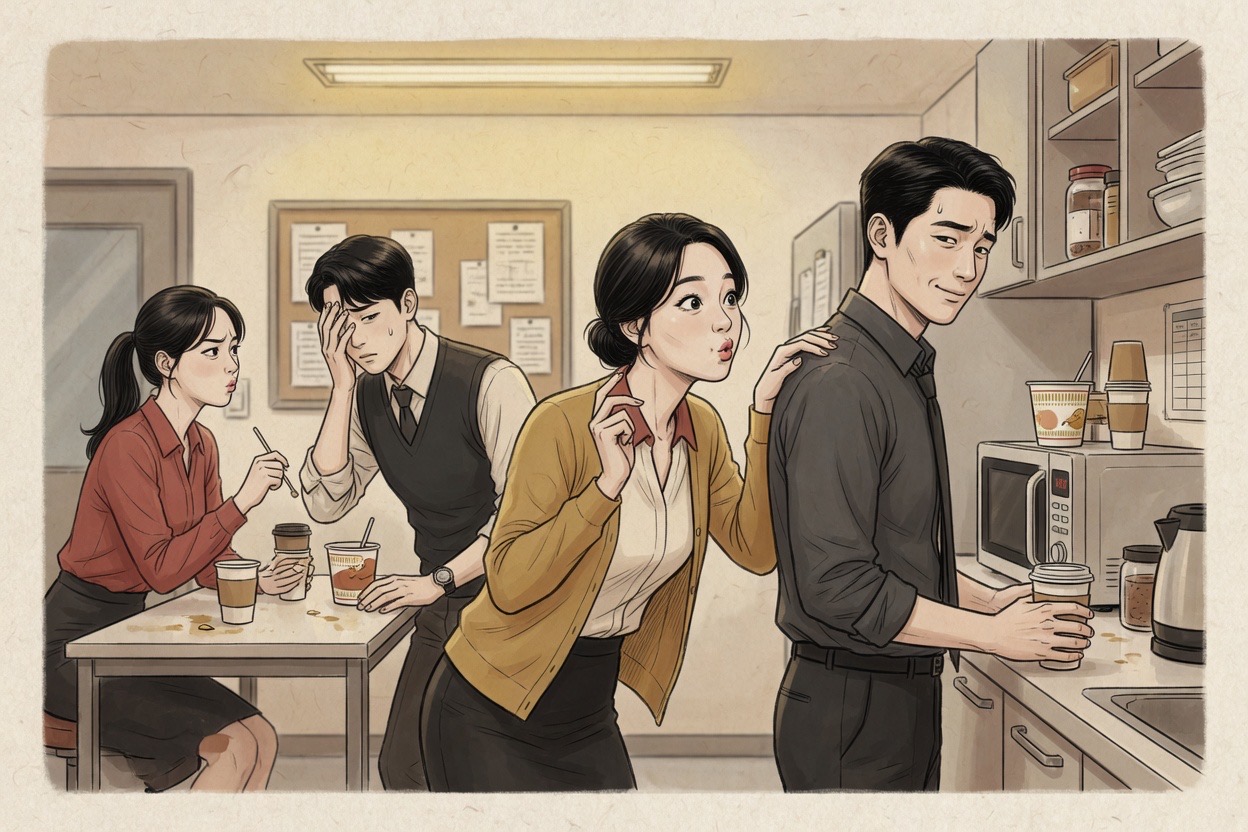
3. Office break room — tone crash
Same generation colleagues. One person pushes couple energy into a public kitchen.
- Colleague A: 아이고, 우리 애기 커피 또 쏟았네?
Aigo, uri aegi keopi tto ssodatne?
Oh no, did our baby spill coffee again? - Colleague B: …그냥 휴지 주세요.
…Geunyang hyuji juseyo.
…Just give me a napkin, please. - Coworker nearby (quiet): 분위기 왜 이래.
Bunwigi wae irae.
Why does the vibe feel like this.
Gloss: B shifts toward cooler polite distance. The aegi was not shared intimacy—it was public shrinking. The room heard the hierarchy even if A meant “joke.”
Good nunchi / Zero nunchi
Good nunchi
Your Korean partner already calls you aegi in private. You return the register with the same softness, keep it off group chats with their boss, and drop it instantly if they say they are not in the mood. You treated the word as a shared blanket, not a party trick.
Zero nunchi
You learned “aegi = baby” from a drama clip and try it on a classmate, a coworker, or a barista for cute points. They laugh with their mouth only. You film the reaction. You thought you were fluent in affection. You performed infant framing without the relationship that makes it love.
Do / Don’t
Do
- Learn agi / aegi as one word with a standard form and a soft everyday form.
- Keep couple aegi inside mutual banmal and real closeness.
- Expect parents to say 우리 애기 about adults without meaning “you are incompetent.”
- Separate aegi (noun/endearment), aegyo (cute performance), and maknae (youngest rank).
- Watch faces: if the other person stiffens, retire the nickname.
Don’t
- Use aegi on strangers, clients, or first-week coworkers.
- Assume every soft Korean word is free vocabulary for flirting practice.
- Baby-talk someone to win an argument or make them smaller in public.
- Confuse drama timing with real-life permission.
- Mix a cute nickname with the wrong speech level—warm word, cold grammar, weird room.
Nearby ideas
- Nunchi (눈치) — reading whether soft talk is welcome right now
- Maknae (막내) — youngest in a group, not automatically “baby” as a pet name
- Oppa (오빠) — older-male kinship title from a female speaker; different intimacy track
- Korean honorifics — titles and speech levels that decide whether any nickname is safe
- Aegyo (애교) — performing cute; adjacent vibe, separate tool
A closing line
Aegi is a small word with a long leash: infant, partner, adult child, fandom soft name—and a fast way to sound either beloved or belittling.
Hold it for people who already handed you the soft register. Everyone else gets a name, a title, and your best nunchi—not a high chair in the break room.
FAQ
What does aegi mean in Korean?
Aegi (애기) means baby. It is the everyday soft spelling of 아기 (agi). People also use it as an affectionate nickname for a partner or adult child—not only for infants.
What is the difference between aegi and agi?
아기 (agi) is the standard dictionary spelling for baby. 애기 (aegi) is the common colloquial softening of the same word. In casual speech and text, 애기 is everywhere; formal writing often prefers 아기.
Can you call an adult aegi?
Yes, inside close relationships. Partners say 애기야; parents say 우리 애기 about grown kids. Outside that bond—or in a workplace with a peer—it can sound baby-talking or condescending.
What does 우리 애기 mean?
우리 애기 literally means “our baby.” Parents use it for actual infants and, just as often, for adult children they still fuss over with pride and soft scolding.
Is aegi the same as aegyo?
No. Aegi (애기) is the baby/endearment noun. Aegyo (애교) is performed cute charm—voice, face, gestures. Related vibe, different words and different jobs.
Do you have nunchi?
Get short Korean word lessons and social cues in your inbox.