What Does “Oppa” Mean in Korean? (And When Not to Say It)
Older brother, boyfriend, idol crush—same word, very different rooms.
- Hangul
- 오빠
- Romanization
- oppa
- Pronunciation
- oh-ppa
- Category
- Words
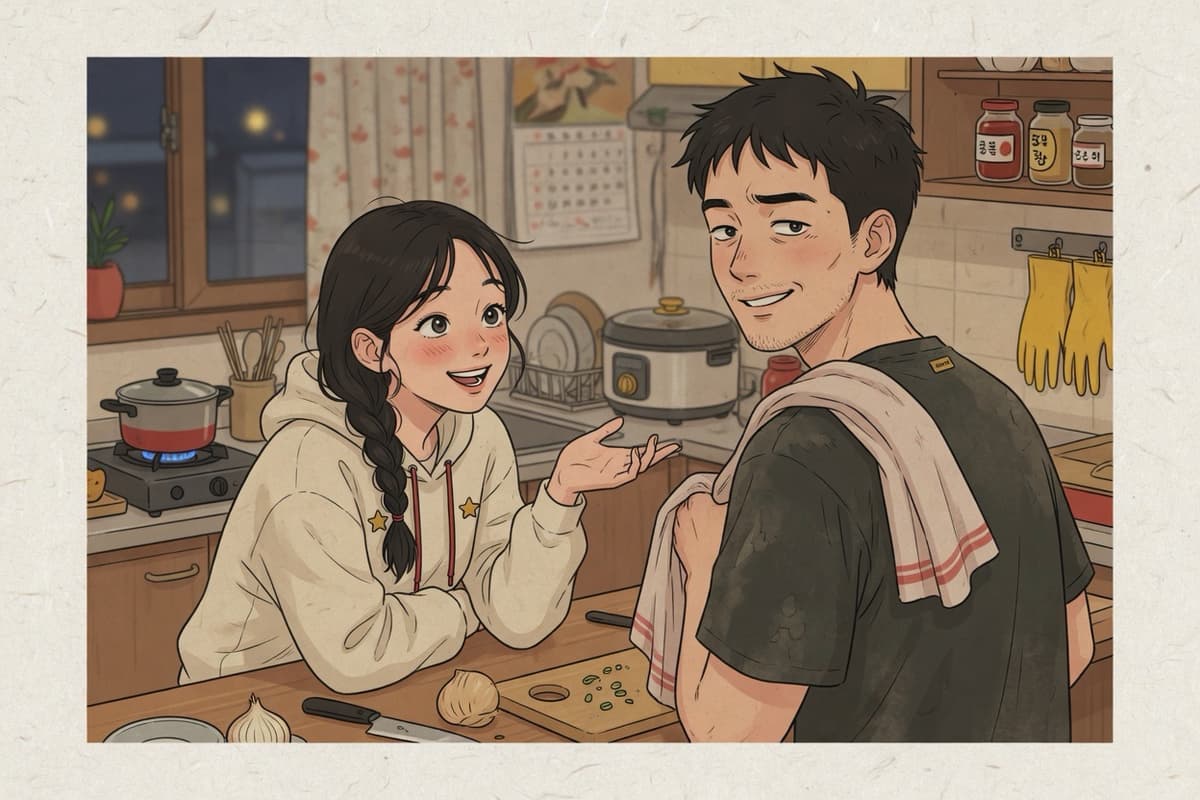
Oppa (오빠, pronounced oh-ppa) is a Korean kinship title a woman or girl uses for an older brother—and, by extension, for older male friends, boyfriends, and sometimes male celebrities. In the conventional kinship system, men and boys use hyung (형) for an older male instead. Queer, playful, and community-specific uses exist, but the conventional learner rule is: oppa is from a female speaker to an older male.
That is why English “brother” is a half-translation. Oppa carries age hierarchy, the speaker’s gender, and often a tone of closeness or soft affection. Used well, it warms a relationship. Used on a stranger, a boss, or every male idol in the room, it can sound less charming than the speaker hopes.
Quick facts
| Hangul | 오빠 |
| Romanization | oppa (nonstandard obba appears online) |
| Pronunciation | oh-ppa (double p—a brief hold, not “oh-bah”) |
| Literal sense | older brother (from a sister’s perspective) |
| Speaker | woman / girl |
| Addressee | older male (brother, friend, boyfriend, sometimes idol) |
| Male equivalent | hyung (형) |
| Female equivalents | unnie / eonni (언니), noona / nuna (누나) |
Why do Koreans say oppa?
Korean everyday speech leans hard on relative age and relationship type. Where English might settle for a first name or “hey,” Korean often slots people into a kinship grid—even when they are not blood relatives.
Oppa sits in that grid:
- Blood: a woman’s older brother.
- Social: an older male friend she is close enough to address casually.
- Romantic: many women call an older boyfriend oppa; it can sound intimate, protective, or playfully soft.
- Media / fandom: fans address male stars as oppa; more on that below.
Parent titles are a different branch of the same kinship habit—father in Korean is not a synonym for oppa.
The point is not that Koreans are obsessed with genealogy. The point is that who may call whom what is social software. Age is not a fun fact—it is part of the address system. Getting the title wrong is not only a vocabulary error; it is a small status error.
If you care about sounding socially tuned, this is the same family of instincts as nunchi—reading who is older, how close you are, and whether the room wants formality or warmth.
Oppa vs hyung (and the rest of the set)
People search “oppa vs hyung” because both get glossed as “older brother.” The real split is who is speaking.
| Title | Hangul | Who says it | To whom |
|---|---|---|---|
| oppa | 오빠 | woman / girl | older male |
| hyung | 형 | man / boy | older male |
| unnie / eonni | 언니 | woman / girl | older female |
| noona / nuna | 누나 | man / boy | older female |
So:
- A younger sister → older brother: oppa
- A younger brother → older brother: hyung
- A woman to her slightly older male friend: often oppa once they are close
- A man to that same older male friend: conventionally hyung, not oppa
Do
- Use oppa only if you are speaking as a woman/girl (or knowingly performing that role in play/fandom).
- Check age and closeness. Oppa is warm; it is not a universal male honorific.
- Accept correction gracefully. Titles are renegotiated as relationships change.
Don’t
- Call your male coworker oppa on day one of the job.
- Assume every Korean man wants to be anyone’s oppa.
- Use it as a random “Korean flavor” word for any male person.
Can I call my boyfriend oppa?
Often, yes—if he is older (or you both treat a tiny gap as playful) and he likes it.
In dating, oppa can mean:
- affection with a soft hierarchy (“you’re a little older, I like leaning on that”)
- aegyo-adjacent sweetness (cute, teasing, slightly babyish tone—not required, but common)
- a relationship nickname that replaces a first name in private
It can also feel wrong if:
- he is younger (technically not “oppa territory,” unless you both invent a joke)
- he prefers equal, name-first English-style intimacy
- you use it only as a K-drama performance he never signed up for
Ask, or mirror what he already accepts. Romantic oppa is consent plus chemistry, not a rule you impose after three dates.
What does oppa mean in K-pop?
In fandom English and Korean fan speech, oppa often means “male idol I adore,” not “my biological older brother.” Fans chant it, caption it, and use it in fan letters the way English speakers once said “dream boat”—affectionate, slightly silly, and group-coded.
A few useful boundaries:
- Fan oppa ≠ personal claim. Calling BTS’s Jungkook “oppa” online does not make you family, and most fans know that.
- Age math gets fuzzy. Idols younger than the fan still get “oppa” in some communities because fandom speech drifts from kinship logic.
- Tone ranges. Soft crush, playful scream, or ironic meme—all coexist.
- Not every Korean uses fan-oppa. Some people find public “oppa!” at idols endearing; others find it noisy. Context is everything.
If your only exposure to the word is K-pop Twitter, remember: the kinship core still matters in real rooms with real people.

When you’ll hear it
- A younger sister yelling for her brother to open the door.
- Friends at a café: she is 24, he is 27, and she has been calling him oppa for years.
- A couple texting; she opens with 오빠 뭐 해?
- Concert lightsticks and fan cams: “Oppa!” as collective affection.
- A foreign learner trying it once, then freezing when the room goes quiet.
You will not typically hear a man call another man oppa unless he is joking, quoting a meme, or performing a bit.
How it sounds (and why “Gangnam Style” stuck)
Psy’s global hit Gangnam Style made the English-speaking world hear a version of the line about “oppa” long before most people knew the kinship chart. The song did not invent the word—it just made one use extremely recognizable: stylish guy, playful address, pop culture volume.
That fame cut both ways. More people learned the sound of oppa. More people also started using it as a costume piece—loud, generic, detached from who may say it to whom. Recognizability is not the same as fluency.
Pronunciation tip: oh-ppa, with a tensed pp. Online obba is a spelling drift, not the standard romanization.
Example dialogues
1. Real brother, casual home speech
Kitchen, evening. Younger sister wants a ride.
- Sister: 오빠, 나 역까지 좀 데려다 줄 수 있어?
Oppa, na yeok-kkaji jom deryeoda jul su isseo?
Oppa, can you drop me off at the station? - Brother: 지금? 나 샤워해야 하는데.
Jigeum? Na syawo haeya haneunde.
Right now? I still need to shower. - Sister: 십 분만. 부탁해.
Sip bun-man. Butakhae.
Just ten minutes. Please.
Gloss: Banmal (casual speech). Blood-oppa is ordinary furniture of home life—not flirty by default.
2. Older boyfriend, soft check-in
Texting after work.
- Girlfriend: 오빠, 오늘 야근이야?
Oppa, oneul yageuniya?
Oppa, are you working late today? - Boyfriend: 한 시간만 더. 끝나고 뭐 먹을까?
Han sigan-man deo. Kkeutnago mwo meogeulkka?
Just one more hour. What should we eat after?
Gloss: Romantic oppa often replaces his name. Warm, not formal.

3. Friend group, age clear, closeness earned
Cafe, two women and one slightly older male friend.
- Minji: 준호 오빠, 다음에 보드게임 할 때 와.
Junho oppa, daeume bodeugeim hal ttae wa.
Junho oppa, come next time we do board games. - Junho: 그래. 내가 질 준비는 됐어.
Geurae. Naega jil junbineun dwaesseo.
Sure. I’m ready to lose.
Gloss: First-name + oppa is common among close friends. She would not use this with a professor she just met.
Good nunchi / Zero nunchi
Good nunchi
You are a woman at a Korean friend’s hangout. Your friend introduces her older brother. She already calls him oppa; after a warm conversation, she laughs and says you can too. You try it once, lightly. The room stays easy. You did not force intimacy—you accepted an invitation.
Zero nunchi
Same hangout. You have never met the man. You greet him with a loud “Oppa~!” because a drama taught you it was cute. He freezes. Your friend does the smile that is not a smile. You meant charm. The room heard stranger-level overfamiliarity with a kinship title.

When it is endearing vs when it is cringe
Often fine
- Real older brother
- Close older male friend who already accepts the title
- Older boyfriend who likes it
- Fandom spaces where “oppa” is the local dialect
Often awkward
- Workplace seniors, clients, professors (default to names + polite titles / speech levels)
- Male strangers on the street or in shops
- Any man who has not opened that door
- Foreign-speaker overuse: every male becomes “oppa,” every sentence becomes a performance
Age hierarchy makes the word powerful. Power without closeness is how sweetness turns sticky.
Men do not “upgrade” to oppa by being handsome. In the conventional system they use hyung among men for older males, and polite forms or names elsewhere. Individual identity and community usage can remap the conventional grid; learners should follow how the person and group actually speak rather than turning an exception into a generic address.
Nearby ideas (for later on Have Nunchi)
- Hyung (형) — older male, from a male speaker
- Unnie / eonni (언니) — older female, from a female speaker
- Noona / nuna (누나) — older female, from a male speaker
- Korean honorifics explained — the full title map this grid sits inside
- Father in Korean — parent address; not interchangeable with oppa
- Banmal vs jondaemal — the title and the verb endings have to match
- Nunchi — knowing whether this room wants warmth or distance
A closing line
Oppa is not a free costume. It is a relationship label with age and gender baked in.
Use it where closeness already lives—and keep your nunchi for the rooms where a first name, or polite silence, is kinder.
FAQ
What does oppa mean in Korean?
Oppa (오빠) is what a woman or girl calls an older brother, or an older male friend or boyfriend. Men and boys use hyung (형) for the same relationship instead.
Why do Koreans say oppa?
Korean kinship titles mark relative age and gender of the speaker. Oppa isn’t just “bro”—it encodes “I am female, you are male and older than me.”
Can I call my boyfriend oppa?
Yes—many Korean couples use it as a warm, slightly soft nickname. It only works if he is older (or you both treat the age gap as playful), and he is fine with it.
What does oppa mean in K-pop?
Fans often call male idols oppa as affectionate fandom speech, even without a real age relationship. It is fan language, not a real sibling claim.
Oppa vs hyung—what’s the difference?
Same idea (older male), different speakers. Women and girls say oppa; men and boys say hyung. Mixing them up marks you as still learning the system.
Sources
Primary and authoritative references used for definitions and context on this page.
- Korean Basic Dictionary — 오빠 — National Institute of Korean Language
Read next
Do you have nunchi?
Get short Korean word lessons and social cues in your inbox.