What Does “Unnie” Mean in Korean? Older Sister, Explained
Older sister, salon warmth, K-pop “unnie line”—same word, different rooms.
- Hangul
- 언니
- Romanization
- unnie
- Pronunciation
- uhn-nee
- Category
- Words
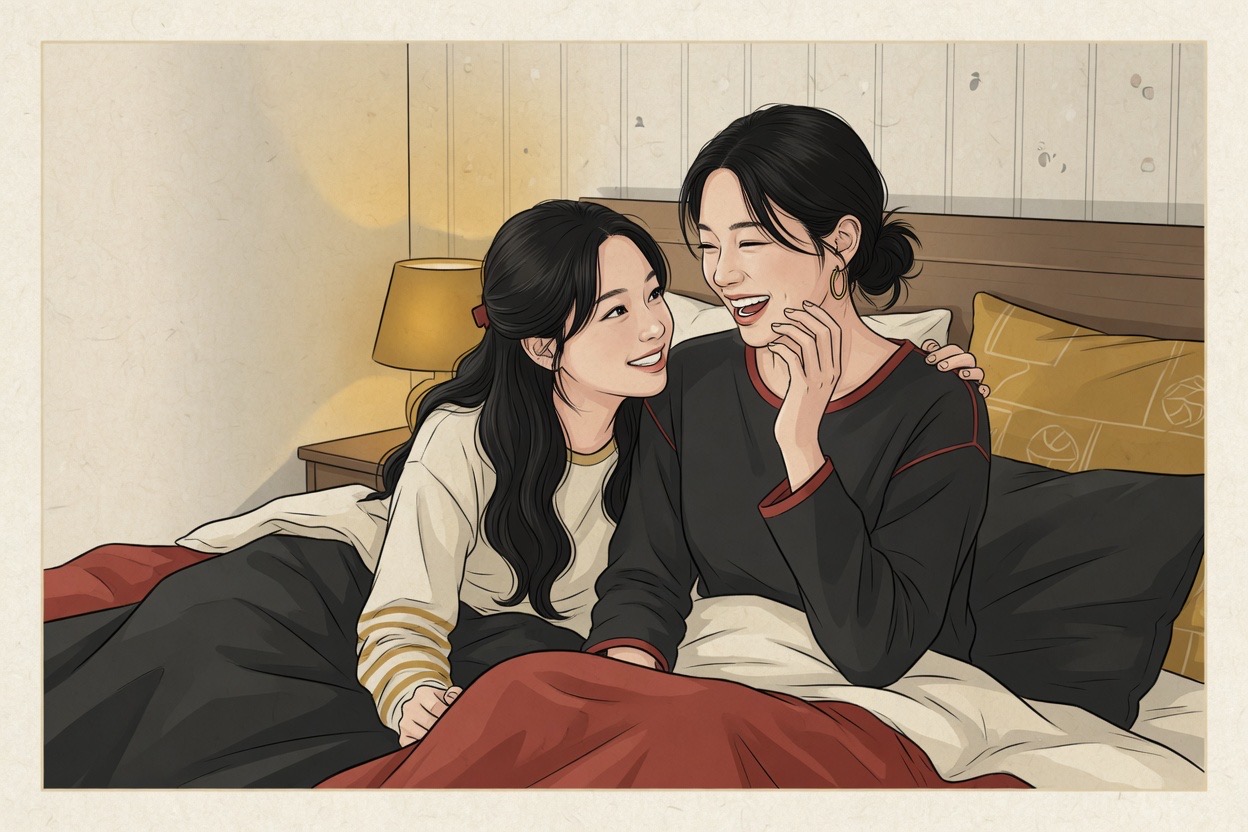
Unnie (언니, pronounced uhn-nee) is a Korean kinship title a woman or girl uses for an older sister—and, by extension, for older female friends, coworkers she is close to, and sometimes older female celebrities. Men and boys do not use unnie in ordinary speech; they say noona (누나) for an older female instead. If you only remember one rule: unnie is from a female speaker to an older female.
English “older sister” only covers the blood case. Unnie also carries age hierarchy, speaker gender, and a tone that can be warm, slightly soft, or service-polite depending on the room. Used well, it builds sisterly closeness. Used on the wrong person, at the wrong distance, it can sound pushy or oddly intimate.
Quick facts
| Hangul | 언니 |
| Romanization | unnie (fan spelling); official eonni |
| Pronunciation | uhn-nee (even stress; not “you-knee”) |
| Literal sense | older sister (from a younger woman’s / girl’s perspective) |
| Speaker | woman / girl |
| Addressee | older female (sister, friend, sometimes salon staff, idol) |
| Male equivalent (same direction) | noona / nuna (누나) |
| Related titles | oppa (older male, female speaker); hyung (older male, male speaker) |
Unnie or eonni—why two spellings?
People search both unnie meaning and eonni meaning for the same word: 언니.
- Eonni is the standard romanization under the Revised Romanization of Korean (the system used in official documents and many textbooks). The hangul vowel 어 maps to eo, so the textbook form is eonni.
- Unnie is the spelling that won the internet—K-pop captions, drama subtitles in fan spaces, Twitter/X, and Google search volume. English speakers hear something closer to “uhn-nee,” and “unnie” stuck.
Neither spelling changes the hangul or the meaning. If you are writing for English readers online, unnie is the form they will recognize. If you are reading a language textbook, expect eonni. Same sister, two passport stamps.
Pronunciation tip: uhn-nee, with a light double n—a brief hold, not a long English “knee.” The first vowel is closer to the u in but than the oo in food.
Why do Koreans say unnie?
Korean everyday speech leans hard on relative age and relationship type. Where English might use a first name or “hey,” Korean often slots people into a kinship grid—even when they are not blood relatives.
Unnie sits in that grid:
- Blood: a woman’s older sister.
- Social: an older female friend she is close enough to address casually.
- Workplace: a slightly older female colleague once the relationship has warmed past pure titles.
- Service: in some shops and salons, friendly customer address to an older female worker.
- Media / fandom: older female idols and characters.
Who may call whom what is social software. Age is not a fun fact—it is part of the address system. Getting the title wrong is not only a vocabulary error; it is a small status error. If you care about sounding socially tuned, this is the same family of instincts as nunchi—reading who is older, how close you are, and whether the room wants formality or sisterly warmth.
Unnie vs noona (and the rest of the set)
People search “unnie vs noona” because both get glossed as “older sister” or “older woman.” The real split is who is speaking.
| Title | Hangul | Who says it | To whom |
|---|---|---|---|
| unnie / eonni | 언니 | woman / girl | older female |
| noona / nuna | 누나 | man / boy | older female |
| oppa | 오빠 | woman / girl | older male |
| hyung | 형 | man / boy | older male |
So:
- A younger sister → older sister: unnie
- A younger brother → older sister: noona
- A woman to her slightly older female friend: often unnie once they are close
- A man to that same older female friend: noona, never unnie (in normal use)
The addressee can be the same person. The speaker’s gender flips the title. That is the whole trick—and the part English “older sister” flattens.
Do
- Use unnie only if you are speaking as a woman/girl (or knowingly performing that role in play/fandom).
- Check age and closeness. Unnie is warm; it is not a universal female honorific.
- Accept correction gracefully. Titles are renegotiated as relationships change.
Don’t
- Call your female manager unnie on day one of the job.
- Assume every Korean woman wants to be anyone’s unnie.
- Use it as random “Korean flavor” for any older woman you meet.
Can a man say unnie?
Short answer: not in the normal system.
A man or boy who wants to address an older female uses noona (누나). Unnie is coded for a female speaker. If a man says unnie unironically in daily life, something else is usually going on:
- Joke or quote — repeating a drama line, roasting a friend, mimicking a sister
- Comedy / drag / performance — playing a female-coded bit on purpose
- Fandom English drift — some international fans of any gender paste “unnie” onto idols as English fandom dialect, detached from Korean speaker rules
None of that rewrites the kinship chart for ordinary Korean rooms. If you are a man learning Korean for real life, default to noona for older females, or skip the kinship title and use names + polite speech until invited closer. Do not “upgrade” to unnie because it sounds cuter online.
What does unnie mean in K-pop and K-drama?
In idol groups and drama fandom, unnie often means “older female member / actress I adore or rank as senior,” not only “my biological older sister.”
In K-pop
- Group members who are women call slightly older members unnie in interviews, lives, and variety bits—real age rank, real closeness.
- Fans talk about an unnie line the way they talk about a maknae line: a soft cluster of older members framed as the “big sisters” of the group.
- International fan captions use “unnie” as affectionate English dialect for female idols, sometimes with fuzzy age math (younger fans calling younger idols unnie because the word feels soft, not because the kinship math checks out).
Useful boundaries: fan unnie is not a personal claim—captioning a photo “unnie 💕” does not make you family. Tone ranges from soft admiration to playful scream. Some Koreans find public “unnie!” endearing; others find it noisy. Context is everything.
In K-drama
Dramas train the ear: younger female characters call older friends, mentors, and sister-figures unnie in living rooms and late-night convenience stores. Useful exposure—and a trap if you copy the softest scenes onto real strangers. Drama closeness is compressed. Real life still wants age math and relationship permission.
Calling a stranger unnie—salons, shops, restaurants
This is the use case that confuses learners most. You will hear younger women call older female service workers unnie in places like:
- hair and nail salons
- small clothing shops
- casual restaurants and cafés
- market stalls with a friendly owner
Here unnie is not “you are my sister.” It is warm, slightly soft customer address—friendlier than pure formal titles, less stiff than full workplace formality.
- Warm when the age gap is plausible (she seems a few years older), the tone is light, and the setting is already informal.
- Presumptuous when she is clearly much older, when you sound too familiar too fast, or when the setting is formal (hospital desk, bank, government office).
Rules of thumb: service + casual + female-to-female + small age gap can work; a large age gap upward often wants more respectful forms; workplace seniors, professors, and clients are not day-one unnie territory. If she calls you unnie first, that is her reading of the age stack—not a free pass to flatten hierarchy everywhere else.
When unsure, names and polite endings beat a forced kinship title. Warmth without nunchi is how sweetness turns sticky.
When you’ll hear it
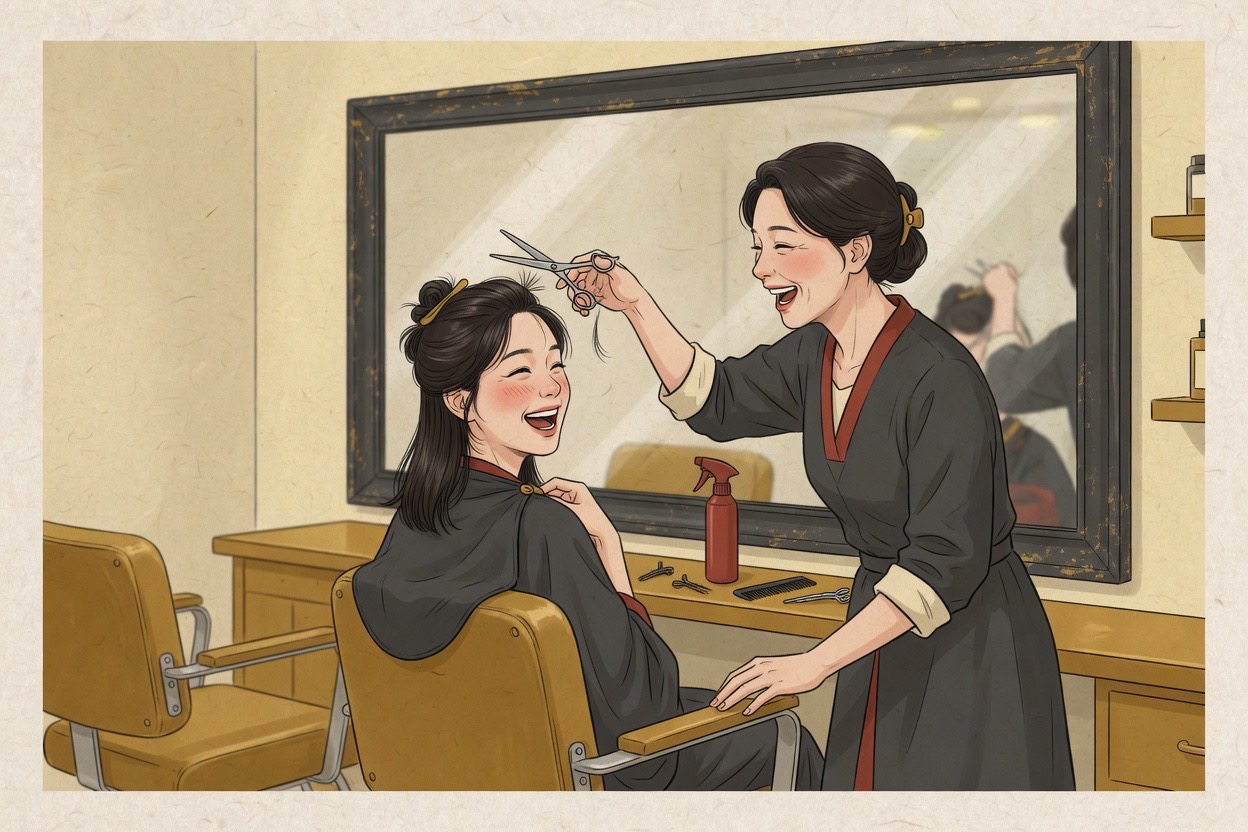
- A younger sister yelling for her older sister to open the bathroom door.
- Two women at a café: one is 24, one is 27, and “unnie” has been the default for years.
- A salon client laughing, 언니, 조금만 짧게 해 주세요.
- Idol lives: younger members teasing, “Unnie~,” with maximum aegyo or zero aegyo depending on the bit.
- Office kitchen: a junior woman asking a slightly older female colleague for help after months of trust.
You will not typically hear a man call a woman unnie unless he is joking, quoting, or performing a bit—and you will not hear unnie as a random greeting for every older woman on the subway.
Example dialogues
1. Real sisters, morning kitchen, banmal
Small apartment, weekend morning. The older sister has the coffee.
- Younger: 언니, 나 커피도 한 잔만.
Eonni, na keopi-do han jan-man.
Unnie, a cup of coffee for me too, please. - Older: 컵 가져와. 네가 씻은 거 맞아?
Keop gajyeowa. Nega ssiseun geo maja?
Bring a cup. Did you actually wash that one? - Younger: 대충 씻었어. 괜찮아.
Daechung ssiseosseo. Gwaenchana.
I rinsed it enough. It’s fine.
Gloss: Casual speech. Blood-unnie is ordinary furniture of home life—not flirty, not fandom, just sister logistics.
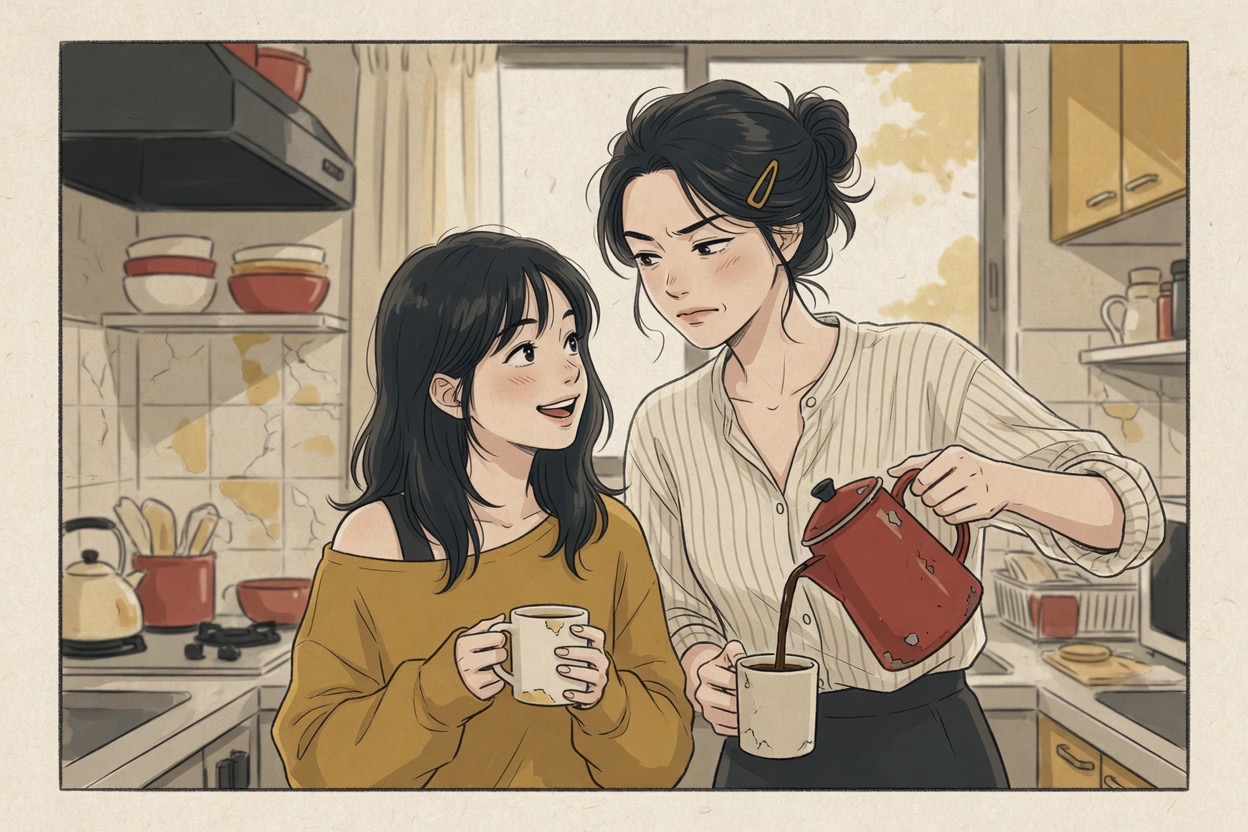
2. Salon client, warm but still a customer
Hair salon, mid-appointment. Scissors pause for a style check.
- Client: 언니, 앞머리 조금만 더 짧게 해 주실래요?
Eonni, apmeori jogeumman deo jjalge hae jusillaeyo?
Unnie, could you make the bangs a little shorter? - Stylist: 얼마나 짧게요? 눈 위로 올라오게?
Eolmana jjalgeyo? Nun wiro ollaoge?
How much shorter? Above the eyes? - Client: 네, 그 정도면 좋을 것 같아요.
Ne, geu jeongdomyeon joeul geot gatayo.
Yes, about that much would be good.
Gloss: Mixed warmth—kinship title + polite verb endings. Common in salons when the stylist is a woman who seems a bit older and the vibe is friendly. Not the same as calling your lawyer unnie.
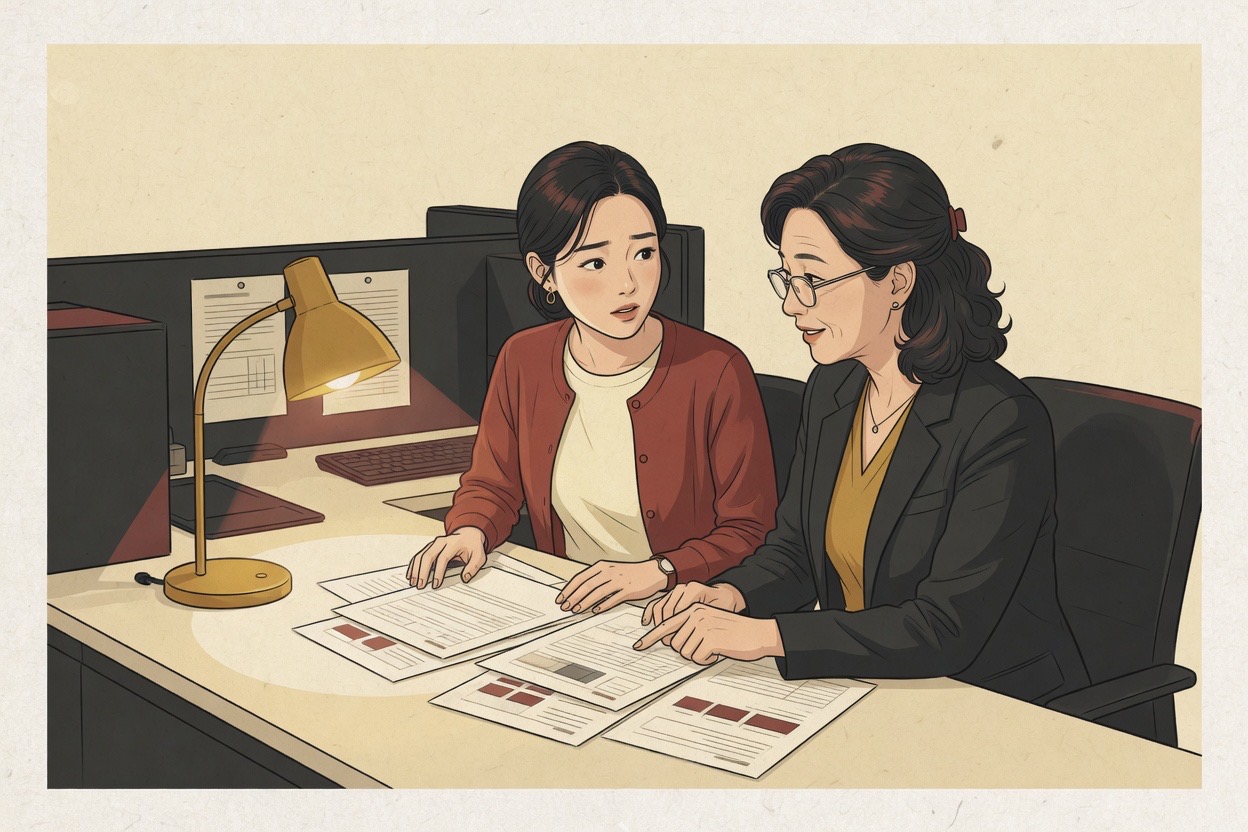
3. Work, closeness earned, not day-one
Open office, late afternoon. A junior asks a slightly older female colleague.
- Junior: 수진 언니, 이 보고서 형식 맞는지 잠깐만 봐 줄 수 있어요?
Sujin eonni, i bogoseo hyeongsik manneunji jamkkanman bwa jul su isseoyo?
Sujin unnie, could you take a quick look at whether this report format is right? - Sujin: 응. 어디 보자. 표만 조금 고치면 돼.
Eung. Eodi boja. Pyoman jogeum gochimyeon dwae.
Sure. Let me see. You only need to fix the table a bit. - Junior: 감사해요, 언니.
Gamsahaeyo, eonni.
Thank you, unnie.
Gloss: First-name + unnie among women who already share trust. She would not open with this on a brand-new hire’s first Monday with a director.
Good nunchi / Zero nunchi
Good nunchi
You are a woman at a Korean friend’s hangout. Your friend introduces her older sister. She already calls her unnie; after a warm conversation, she laughs and says you can too. You try it once, lightly. The room stays easy. You did not force intimacy—you accepted an invitation.
Zero nunchi
Same city, different day. You walk into a quiet boutique and greet the elegant owner—who looks old enough to be your aunt—with a loud “Unnie~!” because a drama taught you it was cute. She freezes into customer-service smile. You meant warmth. The room heard stranger-level overfamiliarity with a kinship title and the wrong age math.
Do / Don’t
Do
- Use unnie for an older female when you are a woman/girl and closeness (or soft service custom) supports it.
- Remember unnie vs noona is speaker gender, not “which sister is nicer.”
- Learn the K-pop / drama extensions as fandom dialect layered on a plain kinship word.
- Watch how local women address salon staff and friends before you copy the softest version.
Don’t
- Call random older women unnie on the street.
- Use unnie for your boss, professor, or client on day one.
- Assume men can swap into unnie because the English internet did.
- Treat fan captions as a free pass for real rooms.
Nearby ideas (for later on Have Nunchi)
- Oppa (오빠) — older male, from a female speaker
- Hyung (형) — older male, from a male speaker
- Noona / nuna (누나) — older female, from a male speaker
- Maknae (막내) — youngest in a group; the other end of the age stick
- Nunchi (눈치) — reading whether this room wants sisterly warmth or polite distance
For a soft entry point beyond titles, see hello in Korean—greetings and kinship words often travel together when you are still mapping the room.
A closing line
Unnie is not a free costume. It is a relationship label with age and speaker gender baked in.
Use it where sisterly closeness already lives—or where soft service custom has opened the door—and keep your nunchi for the rooms where a first name, or quiet politeness, is kinder.
FAQ
What does unnie mean in Korean?
Unnie (언니) is what a woman or girl calls an older sister, or an older female friend. Men and boys use noona (누나) for the same relationship instead.
Is it unnie or eonni?
Both spell the same hangul, 언니. Eonni is the official romanization; unnie is the fan-culture spelling that dominates English search and social media.
Unnie vs noona—what’s the difference?
Same idea (older female), different speakers. Women and girls say unnie; men and boys say noona. The addressee’s age is not the only switch—the speaker’s gender is.
Can a man say unnie?
Not in the normal kinship system. Men use noona. You may hear unnie from men in jokes, drag/comedy bits, or quoted fandom speech—not as default daily address.
Can I call a stranger unnie?
Sometimes, in soft service settings—salons, small shops, restaurants—when the worker is a woman who seems a bit older and the vibe is friendly. It can also feel presumptuous if the age gap is wrong or the tone is too casual.
Do you have nunchi?
Get short Korean word lessons and social cues in your inbox.