Korean Honorifics Explained — Oppa, Unnie, Hyung, Noona & More
Who is older, who is speaking, and how close you are—Korean address in one map.
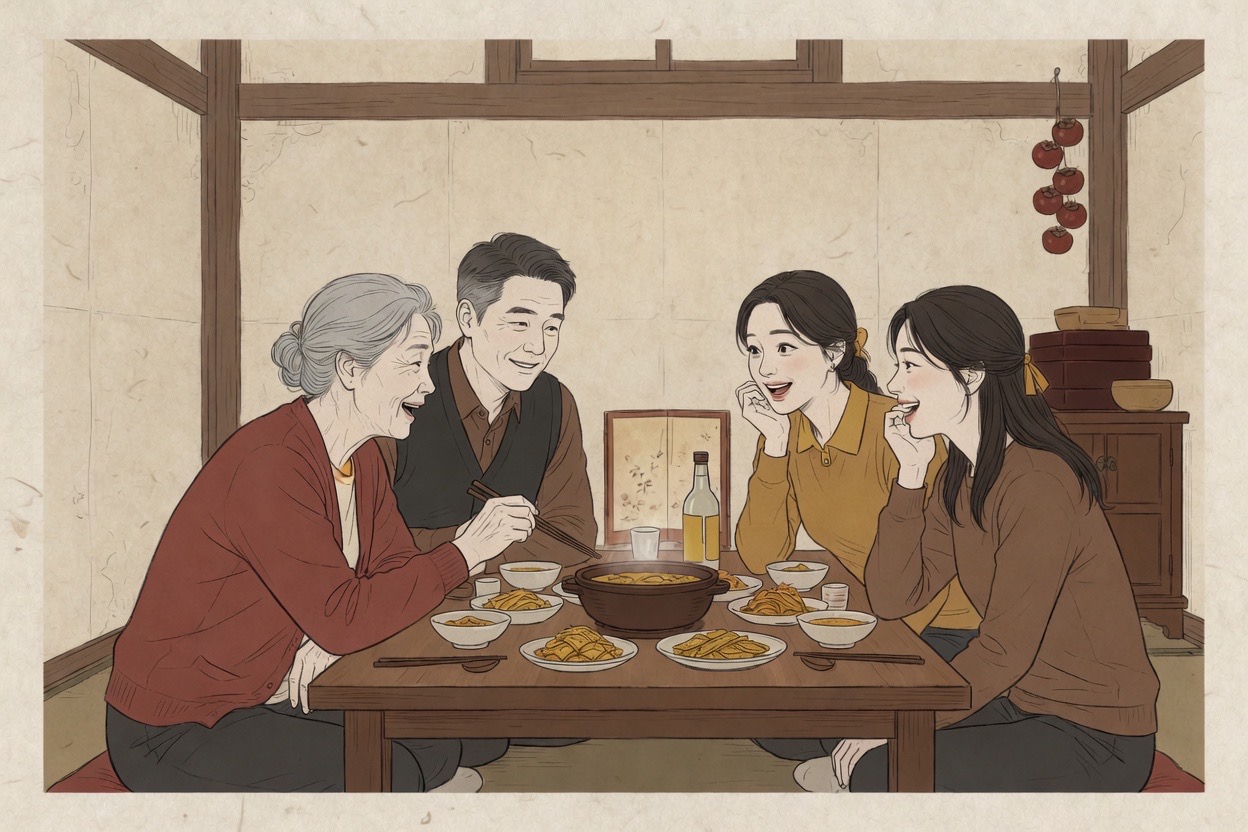
Korean honorifics are the everyday system for showing who is older, what role someone holds, and how close you are allowed to sound. English mostly leans on first names and tone of voice. Korean leans on titles, name endings, and speech levels—and those three pieces have to move together.
In plain terms: honorifics are not a dusty grammar chapter. They are social software. Kinship words like oppa, unnie, hyung, and noona mark an older person you are close enough to treat like family. Name endings like 씨 (-ssi) and 님 (-nim) mark polite distance. Job titles like 팀장님 and 사장님 mark role. And jondaemal / banmal decide how formal your sentences sound. Get the map once, then click into the title you actually need.
What are Korean honorifics?
When people search “what are Korean honorifics,” they usually want one sentence and then a chart. Here is the sentence: Korean honorifics are the words and endings that encode relative age, hierarchy, and intimacy so a simple hello already says who you are to each other.
That system covers more than kinship:
| Layer | What it does | Everyday examples |
|---|---|---|
| Kinship / age titles | Mark “older + close enough” with speaker gender baked in | oppa, unnie, hyung, noona; maknae for youngest |
| Name suffixes | Attach respect or neutrality to a name | 민지 씨, 김 선생님 style respect |
| Role / job titles | Address the position, not the person-as-friend | 팀장님, 사장님, 기사님 |
| Speech levels | How formal the verb endings and overall tone are | jondaemal (polite/formal) vs banmal (casual) |
English speakers often collapse all of this into “honorifics = fancy words.” The better mental model is three knobs: title, name ending, speech level. Twist only one and leave the others frozen, and the room notices—even if nobody corrects you out loud.
This is also where nunchi shows up. Nunchi is not a title. It is the skill of reading whether this room wants warmth, distance, or titles left alone for now.
Korean honorifics list / chart — the four-way grid
If you only memorize one thing on this page, make it this. Oppa, unnie, hyung, and noona are not four random “Korean words for friend.” They are one grid: speaker gender × older target gender, with closeness required.
| Older male | Older female | |
|---|---|---|
| Male speaker | hyung (형) | noona (누나) |
| Female speaker | oppa (오빠) | unnie (언니) |
Read the grid as software, not vocabulary flashcards:
- Same older man: a younger woman says oppa; a younger man says hyung.
- Same older woman: a younger woman says unnie; a younger man says noona.
- Mixing speaker genders (a man calling someone oppa, a woman calling someone hyung as default daily address) marks you as still learning—or joking on purpose.
Maknae — the other end of the age stack
The four titles above point up the age ladder. Maknae (막내) names the youngest person inside a specific group—family, team, friend circle, idol lineup. It is not gendered. A forty-year-old can be the maknae of a veteran office team. You do not call random younger strangers maknae; the word needs a group boundary.
Together, the four-way grid plus maknae is the core of what English speakers mean when they search “oppa unnie hyung noona explained.” The rest of Korean honorifics (suffixes, job titles, speech levels) sits around that center.
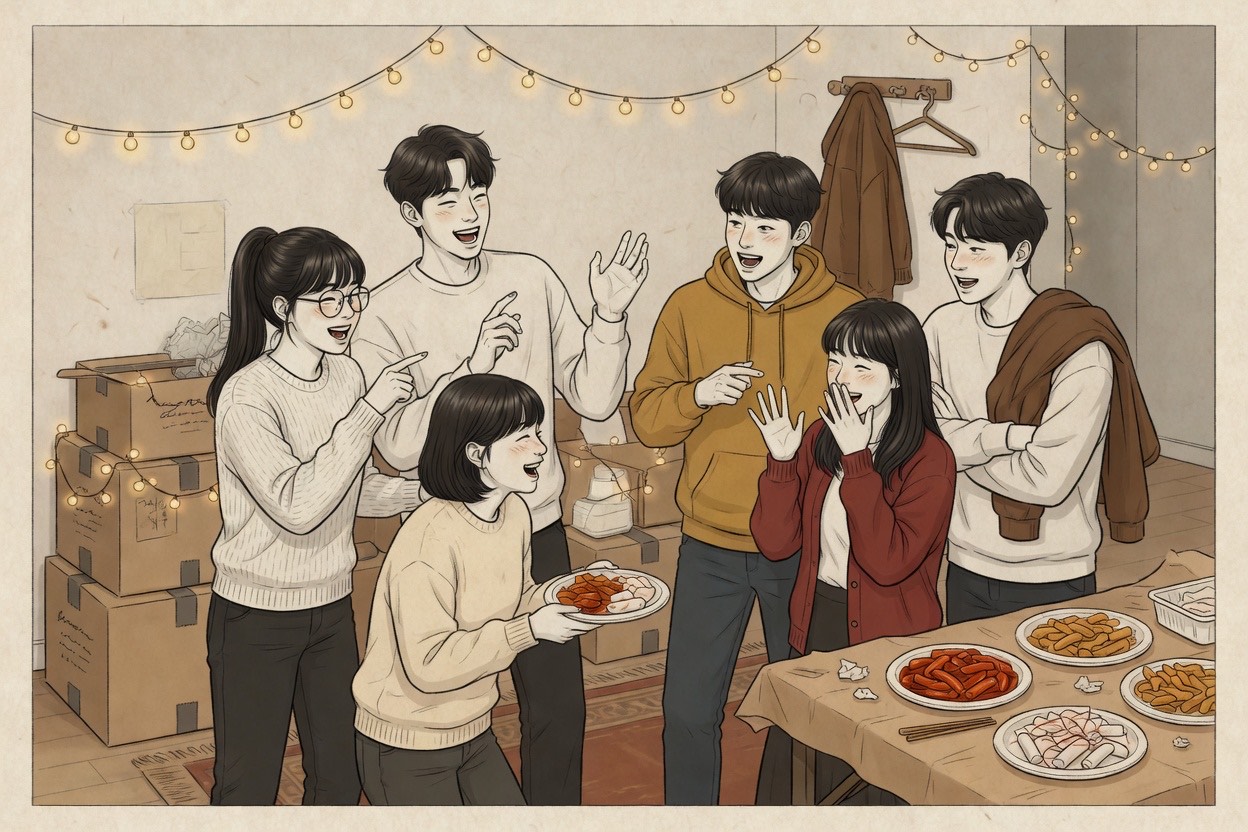
Which Korean honorific do I use? A decision walk-through
Use this as a short sequence, not a personality quiz.
-
Are you actually younger?
Kinship titles like oppa/hyung/unnie/noona point to someone older (or treated as older in a playful, mutual way). If you are older, you do not become their “oppa” by being friendly. You may still use a name, a role title, or nothing special. -
Is this person male or female?
That picks the column of the grid: older male → oppa or hyung; older female → unnie or noona. -
What is your speaker gender in this system?
That picks the row. Women/girls → oppa / unnie. Men/boys → hyung / noona. (Queer, joking, or community-specific uses exist as real edges; they are not the default map tourists need first.) -
Are you close enough?
Blood family often gets the title automatically. Friends and partners earn it. Workplace peers sometimes earn it after real warmth. Strangers almost never get kinship titles on first contact. -
If kinship feels wrong, drop down a gear.
Safe defaults for many rooms: full name or given name + 씨, a job title + 님, or plain polite speech with no kinship word at all. -
Match the speech level to the title.
Warm title + stiff formal endings, or banmal without permission, both scrape. More on that axis below.
If step 4 is fuzzy, you already have your answer: do not force a kinship title. Polite distance is not coldness. It is waiting until the relationship asks for warmth.
Korean honorifics for names: -ssi, -nim, -yah/-ah
Kinship titles are only one branch. Name endings are the branch you will use more often with acquaintances, classmates, and coworkers.
-ssi (씨)
-Ssi is the everyday neutral-polite tag after a name: 민지 씨, 준호 씨. It says “I am being civil; we are not in banmal sibling mode.” Common with:
- coworkers of similar rank
- classmates and activity peers
- service and admin settings where a first name alone would feel too bald
Safe pattern: given name + 씨 among adults who are not already on kinship terms. Avoid slapping 씨 on every English-style nickname as decoration.
-nim (님)
-Nim is higher respect. You hear it most cleanly on roles:
- 선생님 — teacher / instructor / often a respectful default for professionals in education-adjacent roles
- 사장님 — boss / owner
- 팀장님 — team lead
- 기사님 — driver (taxi, bus, delivery contexts)
As a name ending, -nim can sound more elevated or customer-service formal than -ssi. Do not invent stacks like “Kim ssi-nim.” Pick one respectful frame.
-yah / -ah (야 / 아) — vocative particles
These are not honorifics. They are casual call endings on names in banmal:
- Names ending in a vowel often take 야: 민지야, 준호야
- Names ending in a consonant often take 아: 하준아, 석진아
Only use -yah/-ah with people you already speak casually with. Attaching a cute vocative to a senior’s name is how “friendly foreigner” becomes “zero nunchi” in one syllable. When unsure of the particle, do not invent one—call the name the way friends already do, or skip the ending.
Quick safety ladder for names
| Ending | Warmth | Typical room |
|---|---|---|
| given name only (among equals who already banmal) | high closeness | friends, partners, some teams |
| given name + 야/아 | high closeness, calling out | same, when already casual |
| given name + 씨 | polite neutral | many workplaces, new peers |
| role + 님 | respectful, hierarchical | offices, shops, schools, clients |
| kinship title (oppa/unnie/…) | warm hierarchy | family, close friends, some dating |
When unsure, climb toward 씨 or role+님, not toward oppa.
A practical tip for English speakers: if you only learned kinship titles from dramas, you will overuse them. In real offices and classrooms, name + 씨 and role + 님 do more daily work than oppa ever will. Save the four-way grid for people who already share a warm age relationship with you.
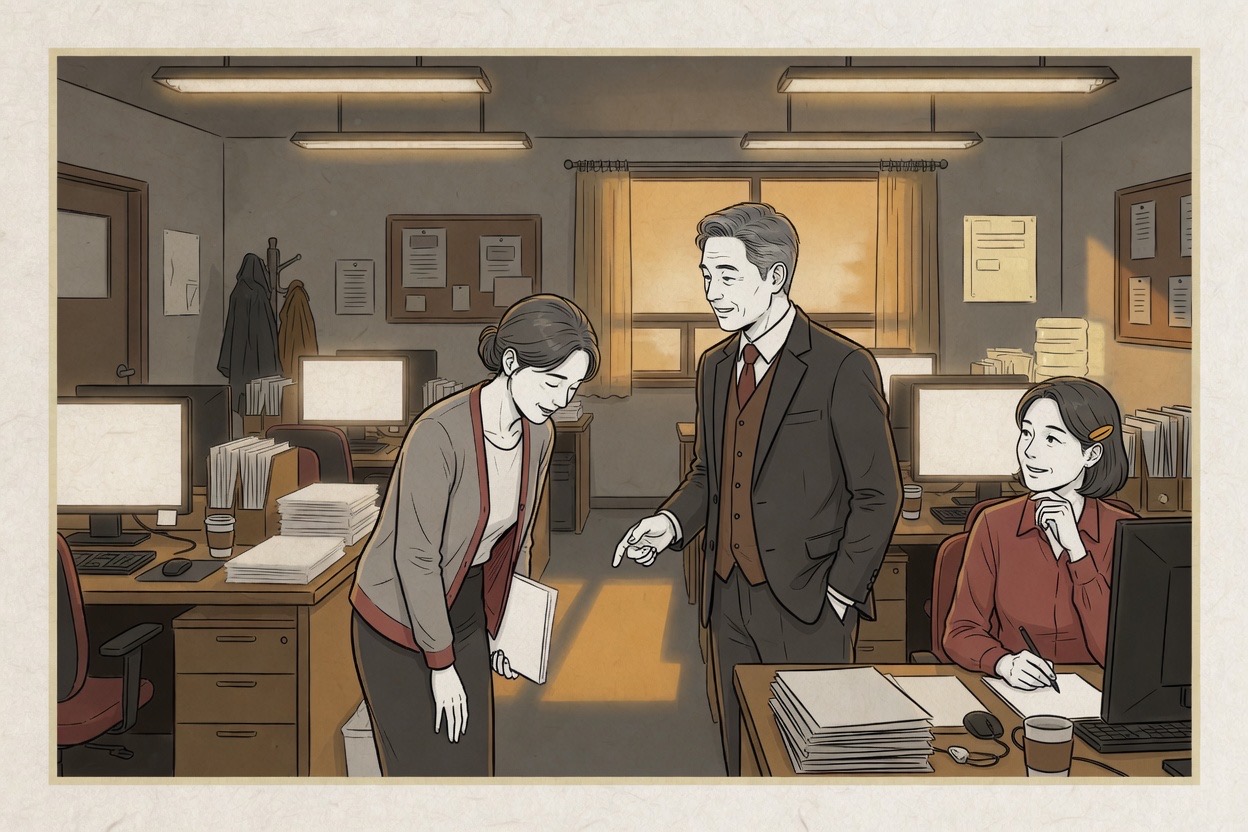
Titles at work and in shops
Searchers looking for a Korean honorifics list often want the office and restaurant layer—the words you hear while ordering coffee or surviving your first week on a Korean team.
Office defaults
- 팀장님 (팀장님) — team lead. Common, safe, role-first.
- 사장님 (사장님) — company head / owner. Also used more loosely for small-business owners.
- 선생님 (선생님) — teacher, and by extension a respectful address in several professional contexts.
- Name + 씨 for peers when hierarchy is flat and nobody has moved to kinship titles.
- Kinship titles at work only after real closeness—and still not with clients on day one.
Many modern teams mix English first names with Korean polite endings. That hybrid is fine when the room already uses it. What still fails is inventing a kinship title because you want the conversation to feel “more Korean.” Role titles exist so you can be respectful without pretending you grew up in the same house.
Shops, taxis, restaurants
- 기사님 for drivers is ordinary politeness, not flattery.
- 사장님 for the owner of a small shop or restaurant is common.
- Staff may call customers with polite forms; customers usually answer with polite speech and role titles, not sudden kinship. If you do not know the owner’s name, 사장님 or a simple polite request is safer than inventing a family role for a stranger behind the counter.
The “이모” phenomenon — honest version
In some restaurants and neighborhood spots, regulars call a familiar older woman staff 이모 (이모, “auntie”)—and the warmth can be real. It can also be presumptuous if:
- you are not a regular
- the age/role read is wrong
- the staff never offered that intimacy
- you are performing “I know Korean culture” for your friends
Same caution applies to casual uncle/auntie-style address. Warm when earned. Sticky when forced. If the ajumma running the place already treats you like family, follow her lead. If you walked in for the first time, order with politeness and leave kinship for people who share a history with you.
Speech levels vs titles — two axes, not one
This is the mistake that survives longest in intermediate speech: treating titles and speech levels as the same thing.
They are not.
| Axis | Question it answers | Examples |
|---|---|---|
| Title / address | What do I call you? | oppa, 팀장님, 민지 씨, first name |
| Speech level | How formal are my endings and distance? | jondaemal (존댓말) vs banmal (반말) |
Jondaemal is the polite/formal side—endings like 요 and more formal styles depending on setting. Banmal is casual speech among equals or toward someone junior when the relationship allows it.
The rule of thumb:
- A kinship title usually lives with closeness, which often (not always) pairs with banmal among young friends—or with soft polite speech if the older person still prefers distance.
- A workplace role title usually lives with jondaemal.
- You can use someone’s name + 씨 and still speak polite jondaemal all day—that is a stable, safe pair.
- You should not drop into banmal with a stranger just because you learned their age.
Titles and speech levels must move together. “Oppa” with stiff client-level formality can sound theatrical. Banmal to a 팀장님 who never offered it can sound mutinous. When someone older says “drop the formality” (or starts using banmal with you and invites reciprocity), that is the green light—not a drama subplot you invent.
Common mismatch patterns:
| What you do | How it can land |
|---|---|
| Kinship title + full formal distance | Like wearing pajamas to a board meeting—or a suit to a sleepover |
| Banmal + no title, to someone older who never offered casual speech | Too fast, too flat, sometimes rude |
| Role title + sudden banmal | Confusing hierarchy; the title says “respect,” the endings say “we’re equals now” |
| Name + 씨 + steady jondaemal | Stable, polite, hard to mess up |
If you only fix one habit after reading this hub: stop collecting kinship words as stickers, and start matching what you call someone with how you conjugate the rest of the sentence.
When not to use honorific titles
This section is as important as the chart.
Skip kinship titles when:
- You just met the person (shop, street, networking event, first class).
- The setting is formal business, client work, or anything with a power imbalance you do not control.
- You only know their age from a profile, not from a relationship.
- They have not offered the title, modeled it, or laughed and opened the door.
- You are guessing gender or age out loud in public—wrong guess plus wrong title is a double miss.
Prefer instead:
- Polite speech with no kinship word
- Given name + 씨 once you know how they are addressed
- Role + 님 when the role is clear (선생님, 팀장님, 기사님)
- Silence on titles while you listen for what the group already uses
Fandom speech is a separate dialect. Calling an idol oppa online does not train your mouth for a Korean office kitchen. Treat concert captions and real rooms as different software.
Example dialogues
1. Title working — friends who already share the grid
Cafe, two women and one slightly older male friend. Age is known; closeness is real.
- Sora: 준호 오빠, 다음 주에 집들이 오지?
Junho oppa, daeum jue jipdeuri oji?
Junho oppa, you’re coming to the housewarming next week, right? - Junho: 당연하지. 뭐 가져가면 돼?
Dangyeonhaji. Mwo gajyeogamyeon dwae?
Of course. What should I bring? - Hyejin: 언니는 음료수 맡기로 했어. 오빠는 과일 어때?
Eonnineun eumnyosu matgiro haesseo. Oppaneun gwail eottae?
Unnie’s covering drinks. Oppa, how about fruit?
Gloss: Female speakers use oppa for the older man and unnie between the women. Banmal fits because the friendship already holds the weight. A first-day coworker version of this dialogue would be wrong even if the ages matched.
2. Title landing wrong — kinship on a stranger
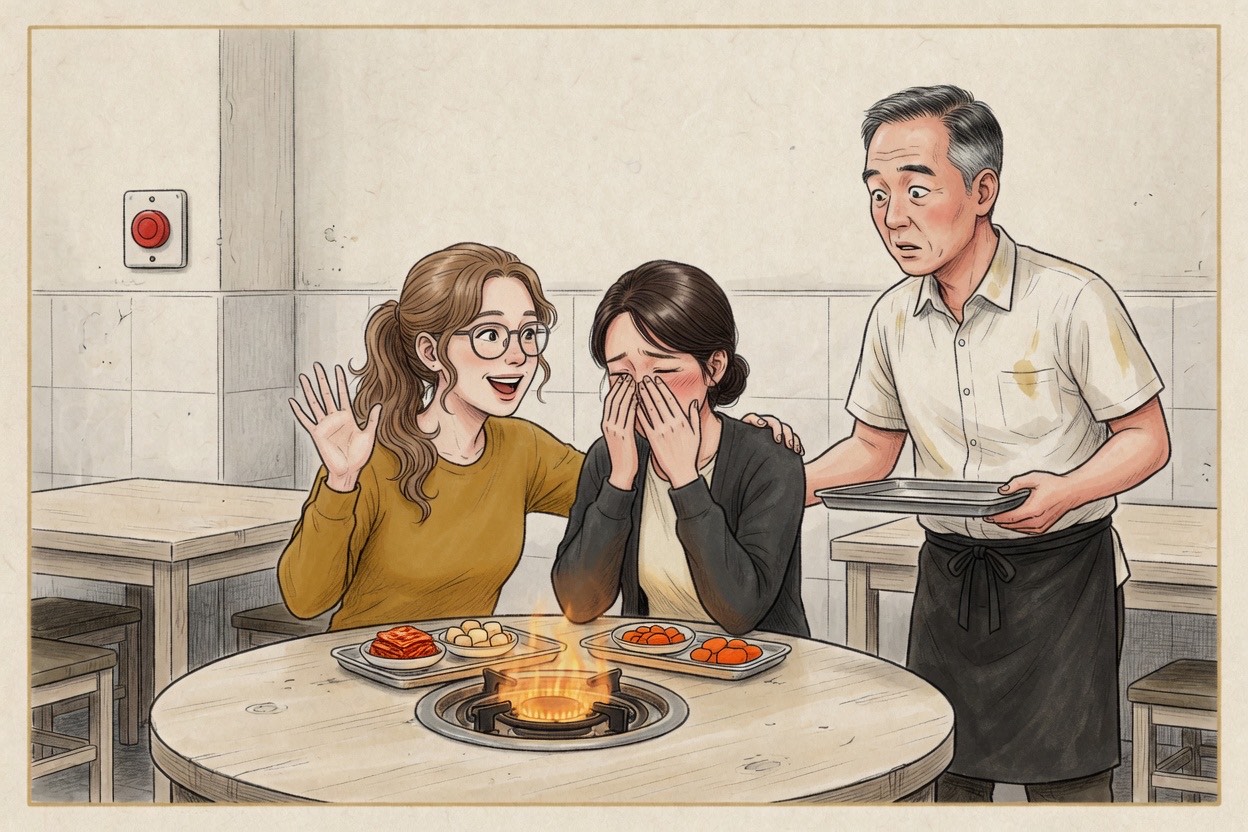
Restaurant table. A visitor has learned the four words and wants to practice.
- Visitor (brightly): 아저씨, 아니… 오빠! 물 더 주세요!
Ajeossi, ani… oppa! Mul deo juseyo!
Mister—wait—oppa! More water, please! - Server (startled): …네. 물 갖다 드릴게요.
…Ne. Mul gatda deurilgeyo.
…Right. I’ll bring water. - Korean friend (under breath): 야, 그건 좀…
Ya, geugeon jom…
Hey, that was a bit…
Gloss: Age-guessing a male stranger into oppa is not charm. Polite request language without a forced kinship title would have been enough. The friend winces because the room heard intimacy the relationship never earned.
Good nunchi / Zero nunchi
Good nunchi
You join a Korean friend’s hangout. People casually establish birth years. Your friend introduces her slightly older brother; she already calls him oppa. After an easy conversation, she laughs and says you can too—if you want. You try it once, lightly, with normal volume. Later, with her manager who stops by for five minutes, you stick to polite speech and no kinship title. You used the grid where the room already used it.
Zero nunchi
Same night. You greet every slightly older man with “oppa,” call the host’s older sister “noona” even though you are a woman (the host flinches—unnie was the word), and drop banmal with the one person still using full jondaemal. You collected vocabulary. You skipped the map.
Do / Don’t
Do
- Learn the four-way grid before collecting more slang.
- Default to name + 씨 or role + 님 when closeness is unclear.
- Let age and invitation decide kinship titles.
- Move speech level when the title moves—especially at work.
- Use this hub as a map, then read the deep pages for oppa, unnie, hyung, noona, and maknae.
Don’t
- Call strangers oppa/unnie/hyung/noona as Korean flavor.
- Assume K-pop fandom speech equals real-room rules.
- Pair banmal with a boss title you still need.
- Correct someone’s title loudly in front of a group unless they asked for help.
- Treat maknae as a personality costume for any younger Korean.
Nearby ideas on Have Nunchi
- Oppa — older male, female speaker
- Unnie — older female, female speaker (also eonni)
- Hyung — older male, male speaker (and hyungnim)
- Noona — older female, male speaker
- Maknae — youngest in a named group
- Nunchi — reading whether this room wants a title, a suffix, or quiet politeness
A closing line
Korean honorifics are not a scavenger hunt for cute words. They are a map of age, role, and permission.
Hold the four-way grid in one hand, the safe name endings in the other, and keep speech levels on the same street as your titles—then your nunchi has somewhere useful to stand.
FAQ
What are Korean honorifics?
Korean honorifics are the titles, name endings, and speech choices that mark relative age, social role, and closeness. Kinship words like oppa and hyung, suffixes like -ssi and -nim, and job titles like 팀장님 all sit in that system.
What is the difference between oppa, unnie, hyung, and noona?
All four mark someone older and close enough for a kinship title. Speaker gender and target gender decide which word you use: women say oppa (older male) and unnie (older female); men say hyung (older male) and noona (older female).
When should I use -ssi vs -nim in Korean?
-Ssi (씨) is a neutral polite ending after a name for peers and many workplaces. -Nim (님) is higher respect—attached to roles (선생님, 사장님) or as a respectful name ending. Do not stack them as “Kim ssi-nim.”
Are jondaemal and banmal the same as honorific titles?
No. Titles name the relationship; jondaemal (존댓말) and banmal (반말) are speech levels—how formal your verb endings sound. A warm title with cold formal speech, or banmal without a title when the room still wants distance, both feel off.
When should I not use Korean honorific titles?
Skip kinship titles with strangers, most formal business first contacts, and anyone who has not opened that door. Default to a name plus -ssi, a role title, or plain polite speech until the relationship earns something warmer.
Do you have nunchi?
Get short Korean word lessons and social cues in your inbox.