How to Say Mom in Korean — 엄마 (Eomma) vs 어머니 (Eomeoni)
The word you use for mother changes with warmth, formality, and whose mother she is.
- Hangul
- 어머니
- Romanization
- eomeoni
- Pronunciation
- uh-muh-nee
- Category
- Words
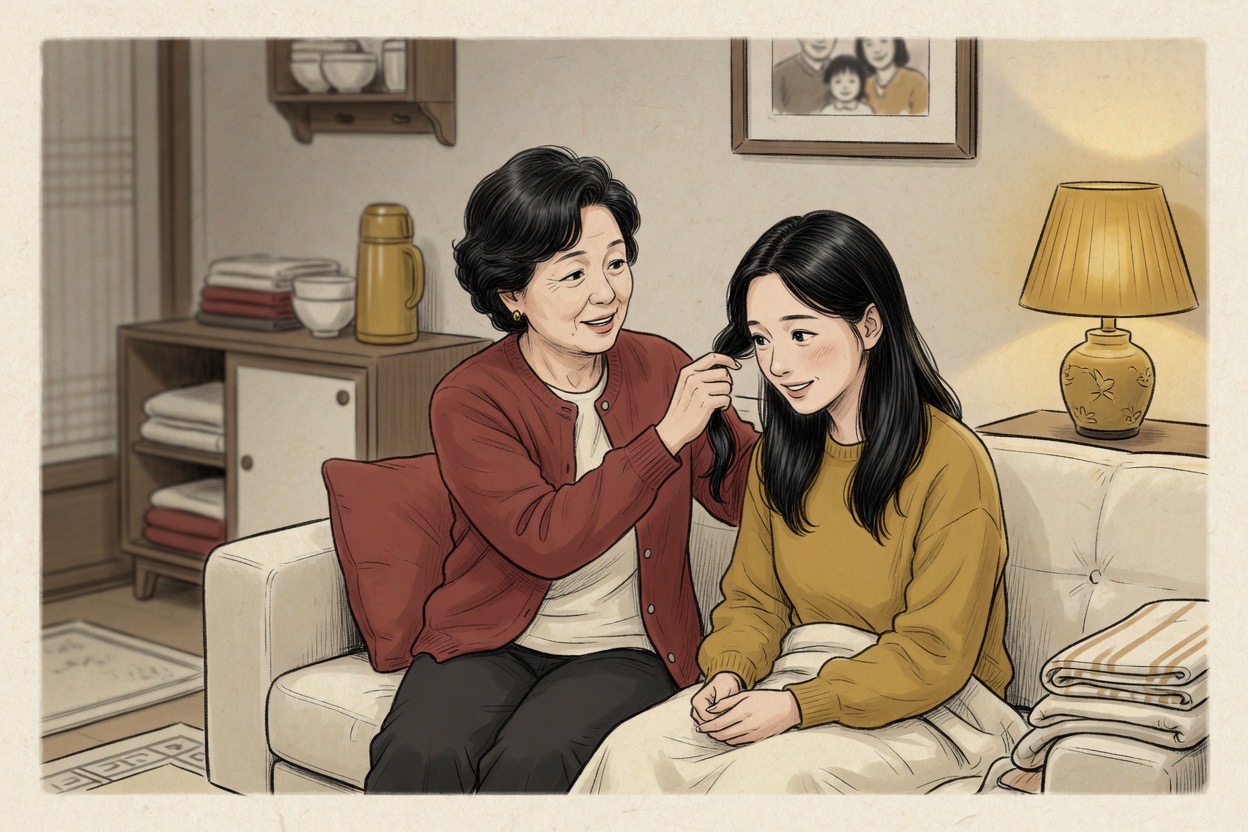
Mom in Korean is usually 엄마 (엄마, eomma, roughly uhm-ma) when you are talking to—or about—your own mother with everyday warmth, and 어머니 (어머니, eomeoni, roughly uh-muh-nee) when you want formal respect. Both mean “mother.” The difference is register, not two different people. Adults do not “graduate” out of 엄마 the way English speakers sometimes age out of “Mommy”; many people keep calling their mother 엄마 for life. One-sentence answer: eomma is the warm default at home; eomeoni is the respectful form.
If you only need the travel-card version: say 엄마 when you mean your mom in casual life, and reach for 어머니 when the room is formal, careful, or public. The rest of this page maps someone else’s mother, mother-in-law terms, emotional phone speech, and the real expression 엄마 손맛.
Quick facts
| Warm everyday | 엄마 · eomma · uhm-ma |
| Formal / respectful | 어머니 · eomeoni · uh-muh-nee |
| Someone else’s mother | 어머님 · eomeonim |
| Wife’s mother (from husband) | 장모님 · jangmonim |
| Husband’s mother (from wife) | 시어머니 / 시어머님 · sieomeoni / sieomeonim |
| Famous collocation | 엄마 손맛 · eomma sonmat · mom’s cooking touch |
| Category | kinship / family address |
| Related system | Korean honorifics — titles and speech levels move together |
How do you say mom in Korean? 엄마 vs 어머니
This is the core of the page. Searchers type “mom in Korean” or “mother in Korean” expecting a single flashcard. Korean gives you a pair, and the pair is social.
엄마 (eomma) — warm, everyday, lifelong
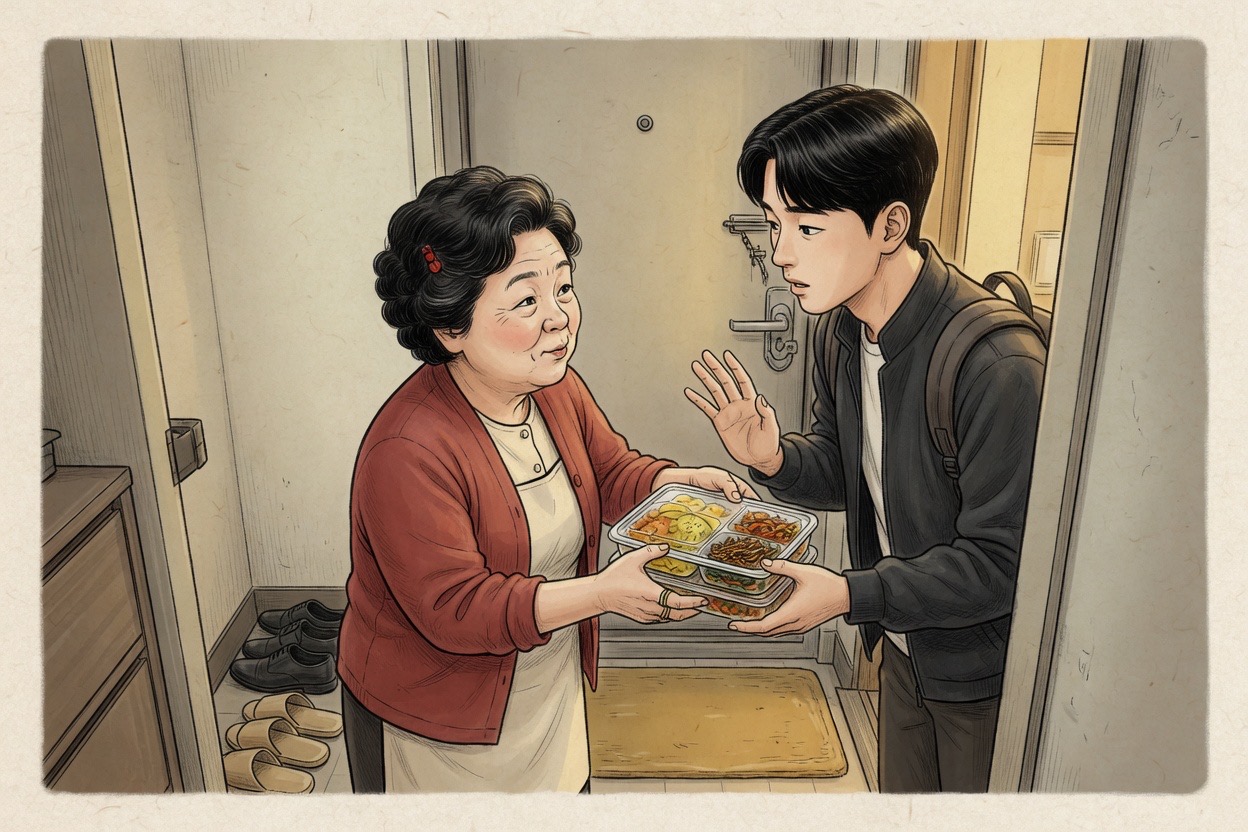
엄마 is the word you hear in kitchens, on late-night phone calls, in hospital waiting rooms, and when someone drops a bag of side dishes at the door. It is intimate without being babyish. A thirty-five-year-old can stand in a convenience store and mutter 엄마… into the phone the same way a child does—and nobody finds it strange.
What 엄마 carries:
- Direct address to your own mother at home
- Talking about your own mother with friends in casual speech
- Emotional texture: comfort, exasperation, longing, food worry
- Everyday collocations like 엄마 밥 (mom’s cooking / a meal from mom) and 엄마 손맛
You will also hear 엄마 as a reflex sound—a short cry when something startles or hurts, the way English speakers sometimes say “Mom!” even when she is not in the room. That is not grammar class material. It is how the word lives in the body.
어머니 (eomeoni) — formal, respectful, careful
어머니 is the same person at a higher register. It shows up when:
- You are speaking carefully in front of outsiders
- You are writing a formal message, speech, or letter
- You want dignity rather than kitchen warmth
- You are elevating the relationship in a serious or emotional moment
A son who always says 엄마 at home might still say 어머니 in a toast, a memorial, or a polite conversation with someone outside the family. The switch is not hypocrisy. It is the same honorific instinct that chooses speech levels: the relationship stays; the surface of the word changes with the room.
Adults keep using 엄마
English often pressures people toward “Mom” or first names as they age. Korean does not demand that graduation for 엄마. Many adults—married, parenting, middle-aged—still call home and open with 엄마. 어머니 is available; it is not a mandatory promotion.
If you learned textbook “mother = 어머니” only, you will sound stiff at the family table. If you learned only 엄마 and use it for every older woman, you will sound intimate in the wrong direction. Hold both.
Quick reference: which word for which mother?
| Situation | Word | Notes |
|---|---|---|
| Talking to your own mom (casual home life) | 엄마 | Default for most families |
| Talking about your own mom to friends | 엄마 | Casual; still warm |
| Formal / careful reference to your own mother | 어머니 | Speeches, outsiders, elevated tone |
| Someone else’s mother (friend’s mom, polite address) | 어머님 | Respect + distance |
| Wife’s mother, husband speaking | 장모님 | Standard respectful term |
| Husband’s mother, wife speaking / referring | 시어머니 · 시어머님 | High cultural and drama weight |
| Meeting parents for the first time | often 어머님 | Polite, safe, not too familiar |
When unsure between 엄마 and 어머니 for your own mother, listen to how the family already talks. Do not upgrade everyone to 어머니 because a textbook looked formal. Do not call a stranger’s mother 엄마 because it feels cute.
어머님 (eomeonim) — someone else’s mother
어머님 (어머님, eomeonim) adds the respectful ending -nim. Think of it as “mother, with distance and honor.”
Use 어머님 when:
- You meet a friend’s mother
- You address a partner’s mother politely (especially early on)
- You need a respectful form that is not your own 엄마
It is warmer than a job title and cooler than family banmal. You might greet her with a small bow and a careful hello—the word choice and the greeting register should match. Calling her 엄마 on first meeting is too close unless she has already pulled you into that circle.
Mother-in-law terms: 장모님 and 시어머니
Korean does not use one gender-neutral “mother-in-law” the way casual English often does. Whose mother and who is speaking matter.
장모님 (jangmonim) — wife’s mother, from a husband
A husband typically refers to and addresses his wife’s mother as 장모님 (장모님, jangmonim). The -님 keeps it respectful. In dramas and real life, the relationship can be warm, awkward, comic, or all three at once—but the default word is not 엄마.
시어머니 / 시어머님 — husband’s mother, from a wife
A wife refers to her husband’s mother as 시어머니 (시어머니, sieomeoni) and often addresses her with the more respectful 시어머님 (시어머님, sieomeonim).
This relationship carries disproportionate cultural weight—not because every household is a battlefield, but because Korean media and everyday humor treat it as a known pressure point: new household, new hierarchy, food, holidays, care work, and the old question of whose son she still is. Dramas amplify it for plot. Real families vary wildly. Some daughters-in-law and mothers-in-law become allies. Some stay polite and slightly stiff for years. Some laugh about the stereotype at the same table.
Write this relationship as a recognizable social pattern, not a verdict on Korean women. The friction is real enough to be a staple of comedy and late-night conversation; the warmth is real enough that countless households run on mutual care. Good nunchi here is noticing what this family wants—closeness, formality, or careful middle ground—rather than performing a drama script you saw on Netflix.
If you are learning Korean as a partner marrying into a family, do not invent cute nicknames. Learn the term your partner’s family actually uses, and match the speech level they model.
Addressing your mother vs referring to her
Korean often splits what you call someone to their face from how you name them when talking to others.
| You are… | Likely form |
|---|---|
| Speaking to Mom at home | 엄마 |
| Telling a friend “my mom said…” | still often 엄마 |
| Speaking carefully to a stranger about your mother | 어머니 or 저희 어머니 |
| Introducing her formally | 저희 어머니이십니다 style framing (polite) |
저희 어머니 (jeohui eomeoni, “our/my mother” with humble “our”) is a polite way to refer to your own mother to outsiders. 우리 엄마 (uri eomma) is the warm everyday “our mom” you hear among friends. Same person. Different room.
This is the same social software behind sibling titles and age words like maknae: the label is not only vocabulary; it is position in the room.
엄마 in everyday emotional speech
If you only memorize dictionary entries, you miss how 엄마 actually sounds.
The exasperated call
엄마—! stretched, half-laugh, half-complaint. Something broke, someone is late, the Wi-Fi died, the side dish container will not open. Not always anger. Often fond frustration.
The phone check-in
Parents call. Adult children answer with a mix of love and mild defense:
- Did you eat?
- Are you wearing a coat?
- When are you coming home?
- Why didn’t you answer earlier?
The content is logistics. The emotion is attachment. A young person living alone in a one-room apartment may roll their eyes and still smile—because the call means someone is still tracking whether they are okay.
The food question
밥 먹었어? (Bap meogeosseo? — “Have you eaten?”) is classic parental care-speech. It can come from 엄마 as a stand-in for “Are you alive and functional?” Food is love language with leftovers. That is also why side-dish deliveries and weekend rice taste like more than calories.
엄마 손맛 — mom’s cooking touch
엄마 손맛 (엄마 손맛, eomma sonmat) is a real, common expression. Literally “mom’s hand taste”—the flavor that comes from a mother’s hands, not a recipe card.
People use it to mean:
- The irreplaceable taste of home cooking
- Why restaurant kimchi is “fine” but not the same
- A compliment: “This has 엄마 손맛”
- Nostalgia: leaving home and realizing the seasoning was never written down
It is not marketing copy invented for tourists. It is ordinary praise and ordinary longing. If someone says a dish has 엄마 손맛, they are not mainly rating spice levels. They are talking about care made edible.
Example dialogues
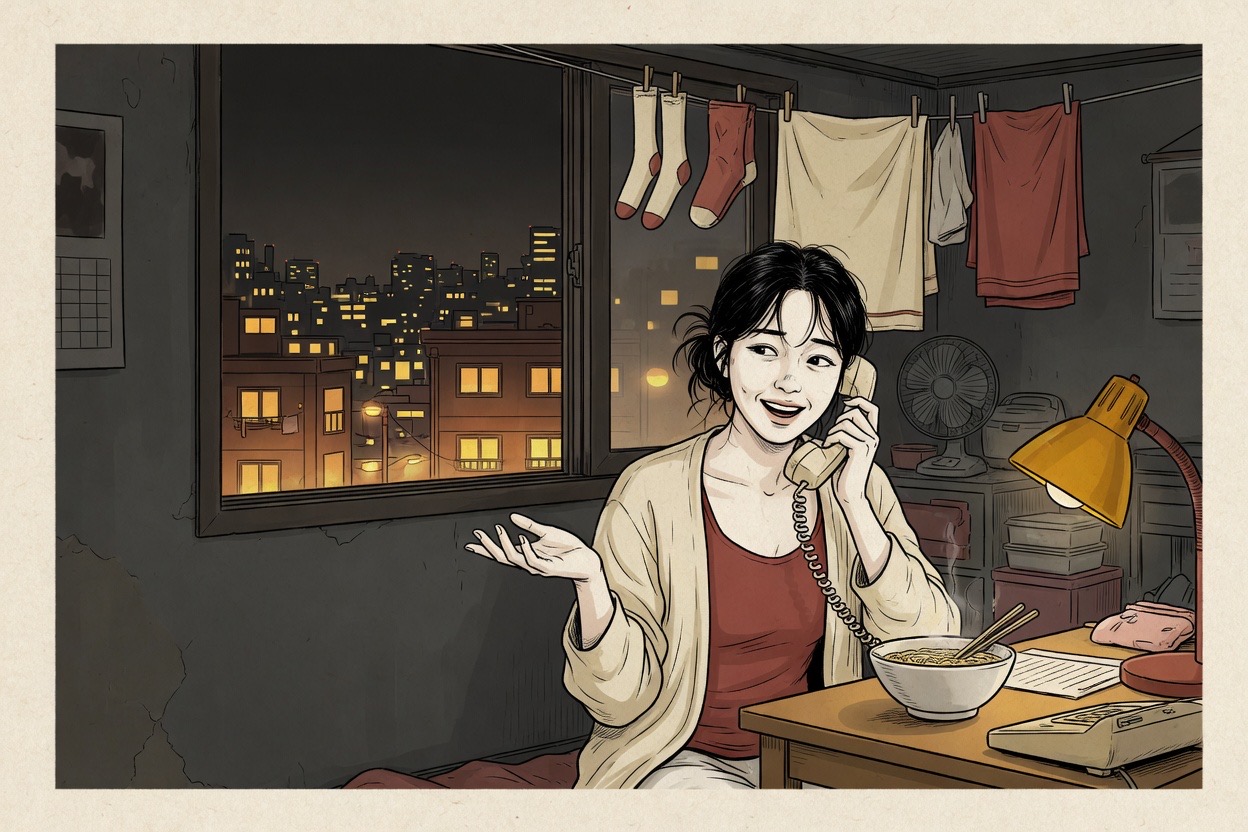
1. Phone check-in with 엄마
10:40 p.m. Instant noodles cooling on a small table. One-room apartment. The phone lights up.
- Mom: 뭐 해? 밥은 먹었어?
Mwo hae? Babeun meogeosseo?
What are you doing? Have you eaten? - Daughter: 엄마, 지금 먹으려고. 걱정 마.
Eomma, jigeum meogeuryeogo. Geokjeong ma.
Mom, I’m about to eat. Don’t worry. - Mom: 라면만 먹지 말고. 야채도 좀 먹고.
Ramyeonman meokji malgo. Yachaedo jom meokgo.
Don’t just eat ramen. Have some vegetables too. - Daughter: 알아, 알아. 엄마도 일찍 자.
Ara, ara. Eommado iljjik ja.
I know, I know. You sleep early too, Mom.
Gloss: Banmal between mother and adult child. Care arrives as food questions. The daughter is slightly exasperated and still soft.
2. Formal / emotional moment with 어머니
Family gathering. Someone is thanking their mother in front of relatives—not kitchen banter, not a textbook, just a careful public voice.
-
Son: 어머니, 정말 감사해요. 항상 저희를 챙겨 주셔서.
Eomeoni, jeongmal gamsahaeyo. Hangsang jeohuireul chaenggyeo jusyeoseo.
Mother, thank you so much—for always looking after us. -
Mother: 뭘. 너희가 건강한 게 제일이지.
Mwol. Neohuiga geonganghan ge jeiriji.It’s nothing. You kids being healthy is what matters most.
-
Relative: 어머니 덕분에 다들 잘 컸네.
Eomeoni deokbune dadeul jal keonne.
Thanks to Mother, everyone grew up well.
Gloss: Elevated address from the son; the room follows the respectful frame. Same woman who is 엄마 at breakfast can be 어머니 in a toast.
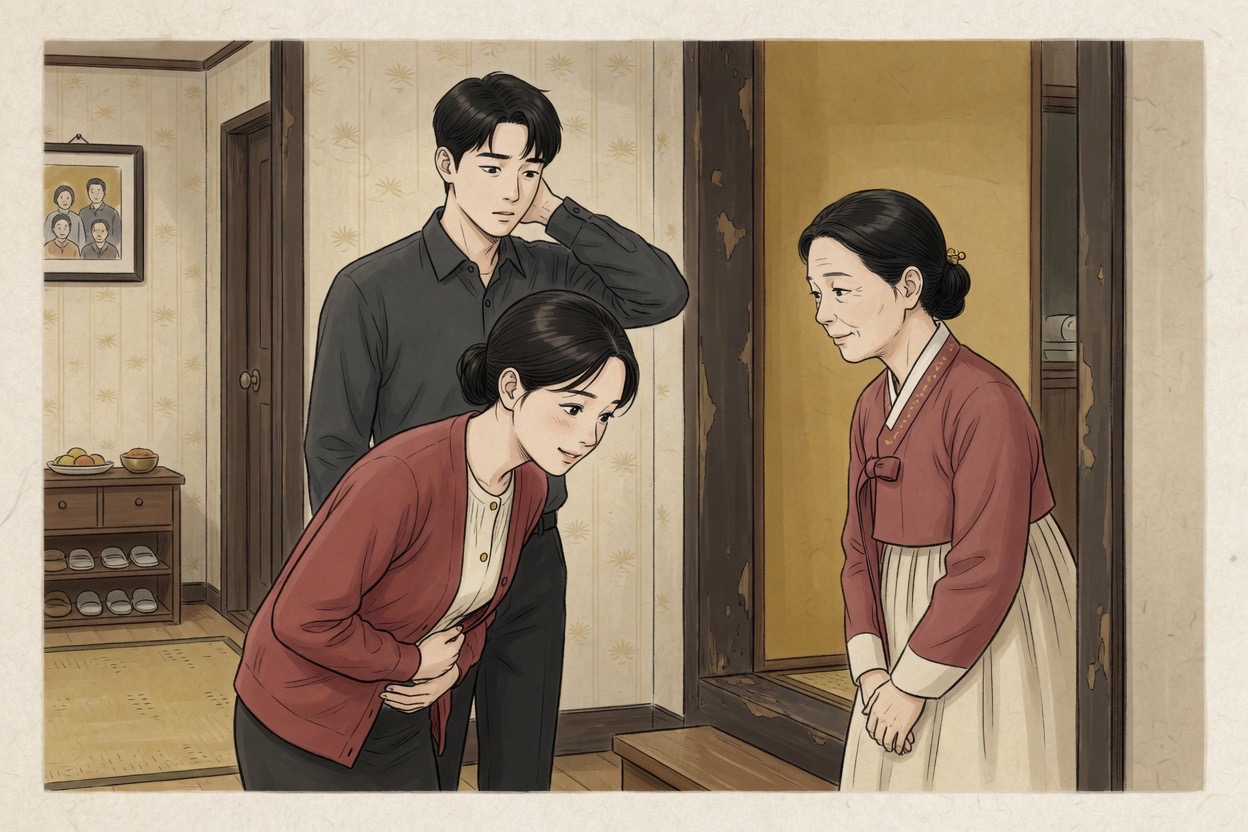
3. Meeting the parents with 어머님
Living room doorway. First formal visit. Shoes off, shoulders a little tight, everyone polite.
- Partner: 어머님, 안녕하세요. 저희 왔어요.
Eomeonim, annyeonghaseyo. Jeohui wasseoyo.
Hello, ma’am—we’re here. - Mother: 어서 와. 먼 길 오느라 고생했어.
Eoseo wa. Meon gil oneura gosaenghaesseo.
Come in. You’ve come a long way—thank you for the effort. - Partner: 아니에요. 반갑습니다, 어머님.
Anieyo. Bangapseumnida, eomeonim.
Not at all. It’s good to meet you.
Gloss: Polite jondaemal + 어머님. Early relationship energy: respect first, nicknames later if ever. A small bow usually travels with the greeting.
Good nunchi / Zero nunchi
Good nunchi
You meet your partner’s mother. You use 어머님, polite speech, and a small bow. You accept fruit you do not need. You do not call her “Mom” in English or 엄마 in Korean on day one. You watch how the family talks and follow their lead. Warmth is earned; respect is the door.
Zero nunchi
Same living room. You heard “Korean moms love aegyo” online, so you baby-talk, use 엄마 immediately, and film the introduction for social media. The room goes bright and quiet. You thought you were being friendly. You skipped the relationship and performed a stereotype.
Do / Don’t
Do
- Default to 엄마 for your own mother in everyday life, if that is how the family already talks.
- Keep 어머니 ready for formal, public, or carefully respectful moments.
- Use 어머님 for someone else’s mother until invited closer.
- Learn 장모님 vs 시어머니 / 시어머님 by who is married to whose child.
- Treat 엄마 손맛 as real cultural speech, not a cute slogan.
Don’t
- Call every older Korean woman 엄마.
- Assume adults must switch permanently from 엄마 to 어머니.
- Use mother-in-law drama tropes as a script for a real first meeting.
- Translate everything as plain English “Mom” and ignore register.
- Force banmal intimacy because food was offered once.
Nearby ideas
- Korean honorifics explained — how titles, name endings, and speech levels fit together
- Hello in Korean — 안녕하세요 and the greeting register that pairs with 어머님
- Maknae — youngest in the family stack, often still managed by 엄마
- Oppa — another kinship title where speaker gender and closeness matter
- Nunchi — reading whether this family wants 엄마 warmth or 어머님 distance
A closing line
Mom in Korean is not one sticker on a suitcase. It is 엄마 when the phone lights up and the noodles are still hot, 어머니 when the room wants dignity, 어머님 when she is not yours to claim yet, and a container of side dishes you pretended you did not need.
Use the warm word when the relationship is warm. Use the respectful word when the room asks for it. That gap—knowing which mother-word fits—is half vocabulary, half nunchi.
FAQ
How do you say mom in Korean?
Everyday mom is 엄마 (eomma). The more formal, respectful word is 어머니 (eomeoni). Adults often keep saying 엄마 their whole lives at home.
What is the difference between 엄마 and 어머니?
엄마 is warm and everyday—what children and many adults say to their own mother. 어머니 is formal and respectful, used in careful speech, public reference, or emotional distance with dignity.
How do you say someone else's mother in Korean?
Use 어머님 (eomeonim)—a respectful form for another person's mother, and a common polite address for a mother-in-law or a friend's mom.
What is the Korean word for mother-in-law?
A husband often says 장모님 (jangmonim) for his wife's mother. A wife refers to her husband's mother as 시어머니 or addresses her as 시어머님—a relationship with real cultural weight.
What does 엄마 손맛 mean?
엄마 손맛 (eomma sonmat) means mom's cooking touch—the irreplaceable taste of food made by your mother's hands. It is a common compliment and a genuine cultural idea, not a slogan.
Do you have nunchi?
Get short Korean word lessons and social cues in your inbox.