How to Say Grandma in Korean — 할머니 (Halmeoni), Plus 외할머니 & 친할머니
One warm default word—and a split by father’s side vs mother’s side you will need at holidays.
- Hangul
- 할머니
- Romanization
- halmeoni
- Pronunciation
- hal-muh-nee
- Category
- Words
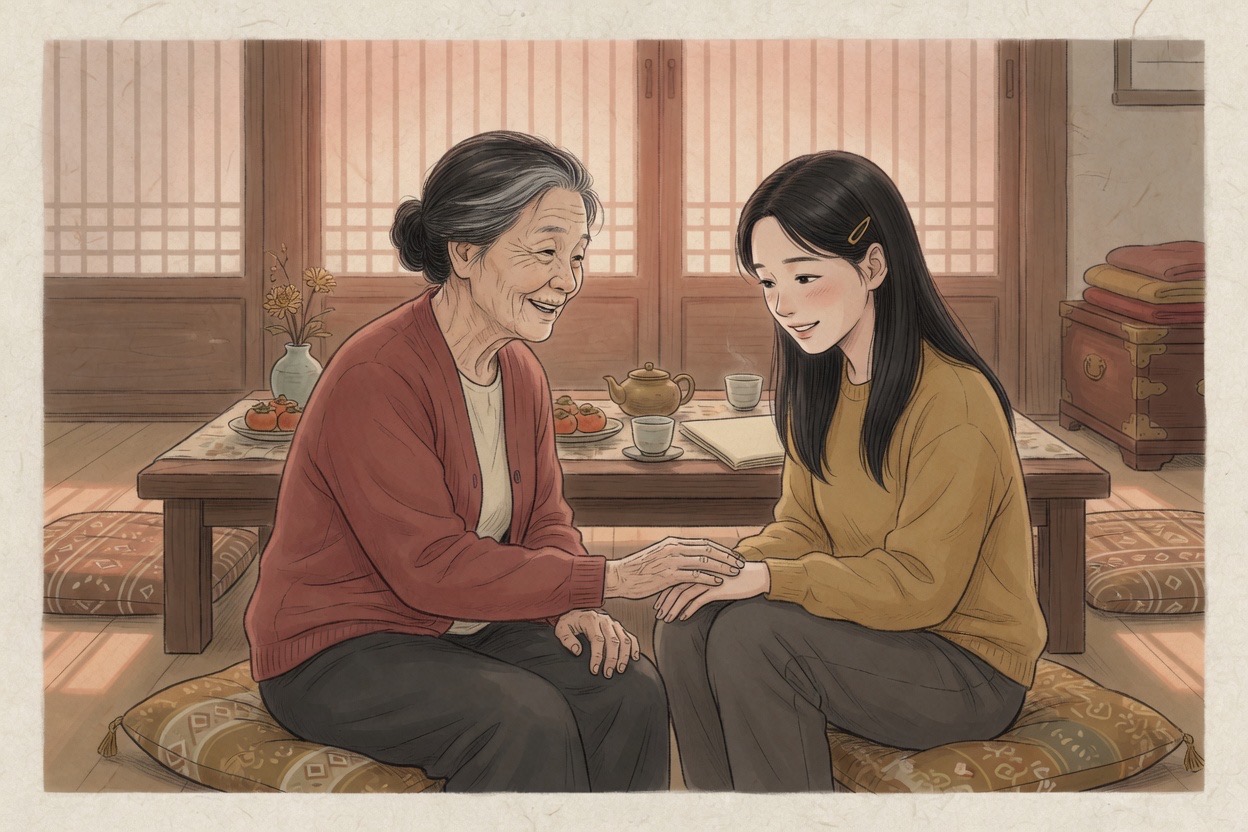
Grandma in Korean is 할머니 (할머니, halmeoni, roughly hal-muh-nee). That is the word you want for “grandmother,” the word grandchildren shout when they walk through the door, and a common polite way to address many elderly women who are not related to you at all. When the family tree needs precision, Korean also splits the role: 친할머니 is your father’s mother; 외할머니 is your mother’s mother. One-sentence answer: halmeoni means grandma—and the 친 / 외 pair tells you which side of the family.
If you only need the travel-card version: say 할머니. Then learn the side-of-family words before Chuseok seating, the affectionate dialect form 할매, and the foreigner trap of calling every woman over forty 할머니 when 이모 or 아주머니 would land softer.
Quick facts
| Default “grandma” | 할머니 · halmeoni · hal-muh-nee |
| Paternal grandmother | 친할머니 · chinhalmeoni · father’s mother |
| Maternal grandmother | 외할머니 · oehalmeoni · mother’s mother |
| Affectionate / dialect | 할매 · halmae |
| Great-grandmother | 왕할머니 · wanghalmeoni (everyday) |
| Polite address (elderly woman) | often still 할머니 |
| Middle-aged woman (not elderly) | 아주머니 · ajumeoni / sometimes 이모 · imo |
| Category | kinship / family address |
| Related system | Korean honorifics — age, role, and closeness move together |
How do you say grandma / grandmother in Korean?
Searchers type “grandma in Korean” or “how to say grandmother in Korean” expecting one sticker. Korean gives you a strong default and a few necessary forks.
할머니 (halmeoni) — the word you came for
할머니 is:
- Your grandmother (either side, when context is clear)
- A respectful, ordinary address for many elderly women in shops, neighborhoods, and buses
- The root of compound forms: 외할머니, 친할머니, 왕할머니
Pronunciation lands near hal-muh-nee. The first syllable is not a hard English “hal” like Halloween; keep it light. The middle is closer to a soft muh than a sharp me. Even stress across the three beats works better than shouting the first syllable.
Unlike sibling titles such as oppa or unnie, 할머니 is not filtered by the speaker’s gender. Grandsons and granddaughters use the same word. What changes is speech level—banmal warmth at home, careful polite speech with someone else’s grandmother—not a different kinship title.
Grandma vs grandmother — same Korean word
English sometimes splits grandma (warm) from grandmother (formal). Korean does not force that pair onto two different everyday words. 할머니 covers both the kitchen hug and the careful introduction. Formal writing or genealogy charts may lean on fuller kinship terms, but the living language of phones, markets, and holidays is still 할머니.
친할머니 vs 외할머니 — father’s side vs mother’s side
This is the structural fact many readers actually need. Korean marks which grandmother when it matters.
| Word | Hangul | Side | Literal feel |
|---|---|---|---|
| 친할머니 | 친할머니 | Father’s mother | “blood / paternal-line grandma” in everyday talk |
| 외할머니 | 외할머니 | Mother’s mother | “outer / maternal-line grandma” |
Why the split exists in speech
Traditional Korean kinship language tracks the paternal line carefully. You do not need a history lecture to use the words—but you do need the map:
- 친할머니 (chinhalmeoni): your dad’s mom
- 외할머니 (oehalmeoni): your mom’s mom
외 (oe) shows up across maternal relatives: 외할아버지 (maternal grandfather), 외삼촌 (mother’s brother), and so on. 친 (chin) in 친할머니 marks the paternal grandmother in contrast—especially when both grandmothers are in the conversation and you must not mix them up.
When people just say 할머니
In real life, many families default to plain 할머니 for the woman they see most, or for whoever is currently on the phone. The 친 / 외 labels light up when:
- Both grandmothers are alive and active in the family
- Holiday logistics, gifts, or visits need a clear name
- Cousins from different sides are sorting “which grandma?”
- You are introducing family to a partner who does not know the tree yet
A child who grows up closer to mom’s parents may still say 외할머니 with full affection—the “외” is structure, not emotional demotion. Love is not assigned by the prefix. The prefix is a filing system.
친할머니 is not “realer”
English speakers sometimes misread 친 as “the real one” and 외 as “the other one.” Do not import that hierarchy into your manners. Both women are grandmothers. The words tell you which branch, not which love is legitimate. Good holiday nunchi is remembering both names and both side-dish preferences without turning genealogy into a ranking contest.
할매, 할멈, and other warm variants
할매 (halmae) — dialect and affection
할매 (할매, halmae) is widely heard as a dialectal / affectionate form of 할머니, especially linked to southeastern speech (including Busan and Gyeongsang flavor in media). It can sound:
- Folksy and warm
- Regional and familiar
- Softer or funnier than textbook 할머니, depending on tone
You will hear it in family banter, comedy, and stories about hometowns. It is not automatically rude. It can feel more intimate than 할머니 when the relationship is close. Using 할매 with a stranger elderly woman in Seoul, in stiff polite mode, can sound odd—like performing a dialect you do not share. Follow the family’s mouth, not a variety-show catchphrase.
할멈 (halmeom)
할멈 (할멈) shows up in older or folksy speech. Modern learners will meet 할머니 and 할매 far more often—know 할멈 exists; do not force it on first meetings.
Families also invent private nicknames. Those are household passwords. The public-facing word to learn first is still 할머니.
Great-grandmother: 왕할머니
Great-grandmother in everyday Korean is often 왕할머니 (왕할머니, wanghalmeoni)—the generation above grandma. More formal kinship vocabulary includes 증조할머니 (증조할머니, jeungjohalmeoni). Family chat leans toward 왕할머니. If both 할머니 and 왕할머니 are in the room, the extra syllable keeps the generations from collapsing into one title.
Calling an unrelated elderly woman 할머니
Here is where foreigners get brave—and sometimes get it right.
When 할머니 is polite
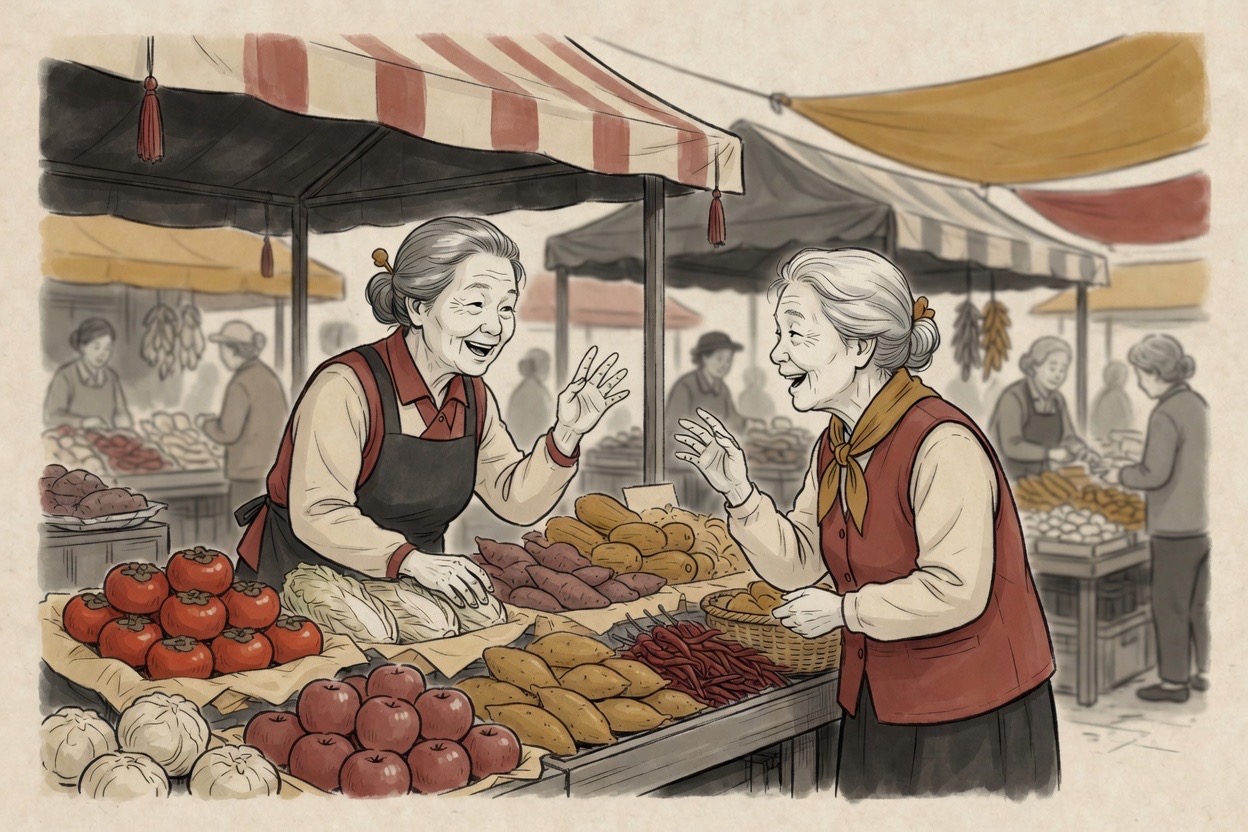
In Korea, 할머니 is not reserved for DNA. Addressing an elderly woman as 할머니 can be ordinary respect. You will hear it helping someone on the subway, buying produce from an elderly vendor, speaking to a neighbor who is clearly of grandmother age, or kids addressing elderly women in the neighborhood.
The tone should be respectful and light, usually with polite verb endings. A small bow or careful hello often travels with the word. You are not claiming her as family; you are placing her in an age-respect category Korean already uses in public.
When it stings
할머니 can sting when the woman does not read as elderly—or does not want to. She may be in her forties or fifties and still firmly “ajumma generation” in her own head. A “cute old lady” voice, a social-media camera, or warm intent delivered as age judgment all scrape.
In Korean address culture, mis-aging someone into grandmother territory is a classic foreigner mistake. If she looks middle-aged, do not reach for 할머니 to sound “more Korean.”
이모 and 아주머니 — the safer middle
When she is older than you but not elderly, these often fit better:
| Word | Hangul | Feel | Use when |
|---|---|---|---|
| 아주머니 | 아주머니 | Polite “ma’am” for a married / middle-aged woman | Shops, neighbors, service, polite strangers |
| 이모 | 이모 | “Auntie” warmth | Familiar restaurants, neighborhood spots, when the room already uses it |
아주머니 (ajumeoni) is the safer neutral for many middle-aged women you do not know well. 이모 (imo) can be affectionate with a familiar ahjumma at a local restaurant—and presumptuous if you walk in cold and crown her your aunt on minute one. The honorifics map is the same social software as elsewhere: warmth is earned; distance is allowed.
If you are unsure, polite speech without a kinship title still works. A clean request and a respectful tone beat a wrong family word every time.
The emotional weight of Korean grandmothers
Vocabulary pages sometimes stop at flashcards. 할머니 deserves one more layer—not folklore, just how the role often feels.
Food as love that packs leftovers
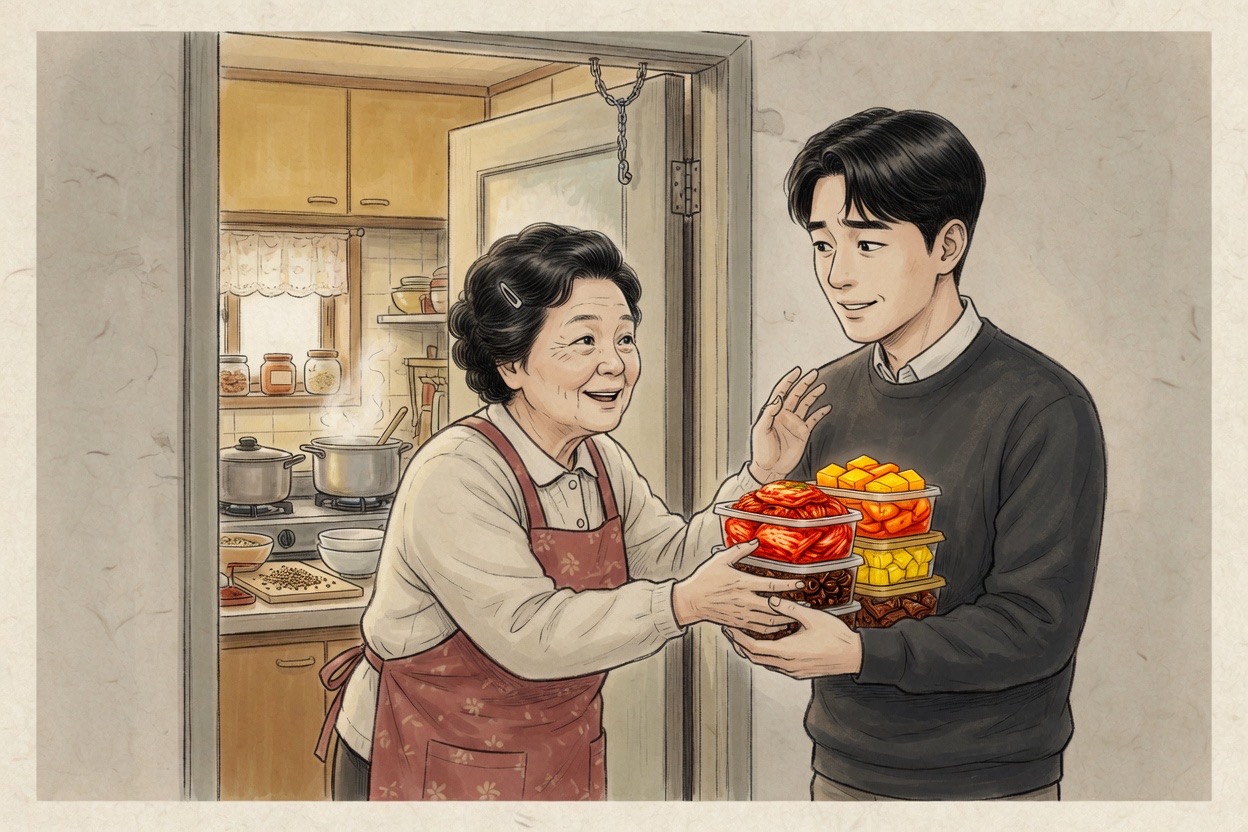
Korean grandmothers are frequently the keepers of banchan logistics: kimchi schedules, soup that appears without ordering, plastic containers pressed into adult hands at the door. You say you are full. She packs more anyway. Refusal is part of the dance; acceptance is usually the end state. The love is practical. It weighs something in a shopping bag.
Memory as a living archive
Grandmothers often hold family memory: who married whom, which cousin is whose child, how a holiday used to taste. Younger adults may roll their eyes at long stories and still call later when they need the recipe that was never written down.
Unconditional partiality
If maknae is the youngest with soft rules, grandchildren are often the people for whom grandmothers invent extra soft rules. Parents scold; grandparents sometimes smuggle snacks. That partiality can frustrate parents and delight kids. It is not universal law—but it is a recognizable pattern in Korean family comedy and real living rooms: a woman who raised people is still feeding people, still tracking people, still taking sides when the grandchild looks hungry.
When you’ll hear 할머니
- Grandchildren arriving home: 할머니! at the door
- Family meetings sorting 외가 (maternal side) vs 친가 (paternal side) visits
- Market talk with elderly vendors
- Kids being told, “Greet grandma properly”
- Adult children calling to ask if she ate, slept, took medicine
- Strangers helping an elderly woman and using 할머니 as respectful address
You will not typically use 할머니 for a stylish woman in her early forties who is clearly not presenting as elderly. That is where 아주머니—or no title—belongs.
Example dialogues
1. Grandchild at the door
Saturday afternoon. Shoes off, bags down, the smell of soup already arguing with your diet plan.
- Granddaughter: 할머니, 저 왔어요!
Halmeoni, jeo wasseoyo!
Grandma, I’m here! - Grandma: 아이고, 우리 강아지. 밥은 먹었어?
Aigo, uri gangaji. Babeun meogeosseo?
Oh, my little puppy. Have you eaten? - Granddaughter: 아직요. 할머니 집이 제일 좋아요.
Ajikyo. Halmeoni jibi jeil joayo.
Not yet. Grandma’s house is the best. - Grandma: 그럼 손 씻고 앉아. 금방 줄게.
Geureom son sitgo anja. Geumbang julge.
Then wash your hands and sit. I’ll give you something right away.
Gloss: Warm household mix—polite edges from the adult grandchild, intimate care from grandma. Food is the greeting’s second sentence.
2. Sorting which grandma before a holiday
Group chat energy, kitchen table version. Two grandmothers, one weekend, limited train tickets.
- Mom: 이번 주말에 외할머니 댁 가자.
Ibeon jumare oehalmeoni daek gaja.
Let’s go to maternal grandma’s place this weekend. - Dad: 친할머니도 보고 싶어 하시는데.
Chinhalmeonido bogo sipeo hasineunde.
Paternal grandma wants to see us too, though. - Daughter: 그럼 토요일 외가, 일요일 친가 어때?
Geureom toyoil oega, iryoil chinga eottae?
Then how about maternal side Saturday, paternal side Sunday? - Mom: 그래. 양쪽 다 연락해 놓을게.
Geurae. Yangjjok da yeollakhae noeulge.
Okay. I’ll message both sides.
Gloss: 외 / 친 are scheduling tools here, not emotional rankings. Adult planning speech, family banmal among the nuclear unit.
3. Helping an elderly stranger — polite public 할머니
Subway platform. A bag tilts; a younger passenger steadies it.
- Young man: 할머니, 괜찮으세요? 들어 드릴게요.
Halmeoni, gwaenchanaseyo? Deureo deurilgeyo.
Grandma—are you all right? I’ll carry that for you. - Elderly woman: 아이고, 고마워요. 수고하네.
Aigo, gomalwoyo. Sugohane.
Oh my, thank you. That’s kind of you. - Young man: 어디까지 가세요?
Eodikkaji gaseyo?
How far are you going? - Elderly woman: 다음 역에서 내려요.
Daeum yeogeseo naeryeoyo.
I get off at the next station.
Gloss: Public jondaemal. 할머니 here is respectful address, not a claim of kinship. No baby-talk, no photos.
4. The foreigner trap — wrong age title
Neighborhood café. A woman in her late forties behind the counter. A learner overshoots.
- Learner: 할머니, 아메리카노 주세요.
Halmeoni, amerikano juseyo.
Grandma, an Americano please. - Woman: …네. (웃음) 저 아직 할머니 아닌데요.
…Ne. (useum) Jeo ajik halmeoni anindeyo.
…Sure. (laughs) I’m not a grandma yet, though. - Friend (whispering): 아줌마—아니, 아주머니라고 하지.
Ajuma—ani, ajumeonirago haji.
Say ajumma—wait, ajumeoni.
Gloss: The coffee still arrives. The air gets lightly awkward. Age titles are not random flavor text; they estimate a life stage out loud.
Good nunchi / Zero nunchi
Good nunchi
You visit your partner’s family. You greet his 외할머니 with a careful bow, polite speech, and 안녕하세요, 할머니. You accept fruit. You do not correct her English. You remember which side of the family she is on when gifts and weekend plans come up later. Respect first; nicknames only if the house offers them.
Zero nunchi
Same living room. You call every woman over thirty-five 할머니, use a baby voice, and ask for a “traditional grandma selfie” before shoes are off. You mix up 외할머니 and 친할머니 while explaining their own family tree back to them. You thought you were charming. You performed age and kinship without reading the room.
Do / Don’t
Do
- Learn 할머니 as the default for grandma / grandmother.
- Use 외할머니 / 친할머니 when both sides matter.
- Treat public 할머니 as respectful address for clearly elderly women.
- Default to 아주머니 (or no title + polite speech) for middle-aged women.
- Accept that food containers are often part of the relationship.
Don’t
- Call every older Korean woman 할머니.
- Treat 외 as “lesser grandma.”
- Use 할매 as a costume dialect with strangers.
- Baby-talk elderly women for content.
- Confuse warm titles with permission to drop all politeness.
Nearby ideas
- Korean honorifics explained — how age titles, name endings, and speech levels fit together
- Hello in Korean — the greeting register that should match 할머니
- Maknae — the youngest end of the family age stack grandmothers often spoil
- Unnie — another female kinship title where closeness and age both matter
- Nunchi — reading whether this room wants 할머니 warmth, 아주머니 distance, or no title at all
A closing line
Grandma in Korean is 할머니 when a child runs through the door, 외할머니 or 친할머니 when the family tree needs a branch label, 할매 when the house speaks in a softer hometown key, and sometimes just a respectful word for an elderly woman whose bag is too heavy on the platform.
Say the warm word when the relationship is warm. Say the precise word when both grandmothers are in the story. And if she is not elderly, do not promote her to grandmother because your textbook only taught you one female age title—that gap is half vocabulary, half nunchi.
FAQ
How do you say grandma in Korean?
Grandma in Korean is 할머니 (halmeoni), pronounced roughly “hal-muh-nee.” It is the everyday word for grandmother and the default respectful address for many elderly women.
What is the difference between 외할머니 and 친할머니?
외할머니 is your maternal grandmother (mother’s mother). 친할머니 is your paternal grandmother (father’s mother). Many people just say 할머니 when the side is already clear from context.
How do you say great-grandmother in Korean?
Great-grandmother is often 왕할머니 (wanghalmeoni) or 증조할머니 (jeungjohalmeoni) in more formal/kinship terms. Everyday speech favors 왕할머니 in many families.
Can I call an elderly woman 할머니 if she is not my grandmother?
Often yes—할머니 is a common polite address for elderly women, not only blood relatives. Use it when she is clearly older; for middle-aged women, 아주머니 or 이모 may fit better.
What does 할매 mean?
할매 (halmae) is a dialectal and affectionate form of 할머니, especially associated with southeastern speech. It can sound warm and folksy, not rude, when the relationship allows it.
Do you have nunchi?
Get short Korean word lessons and social cues in your inbox.