What Is Chuseok? Korea’s Harvest Holiday, Explained
Harvest moon, highway traffic, and a table that is work before it is a feast.
- Hangul
- 추석
- Romanization
- chuseok
- Pronunciation
- choo-suhk
- Category
- Culture
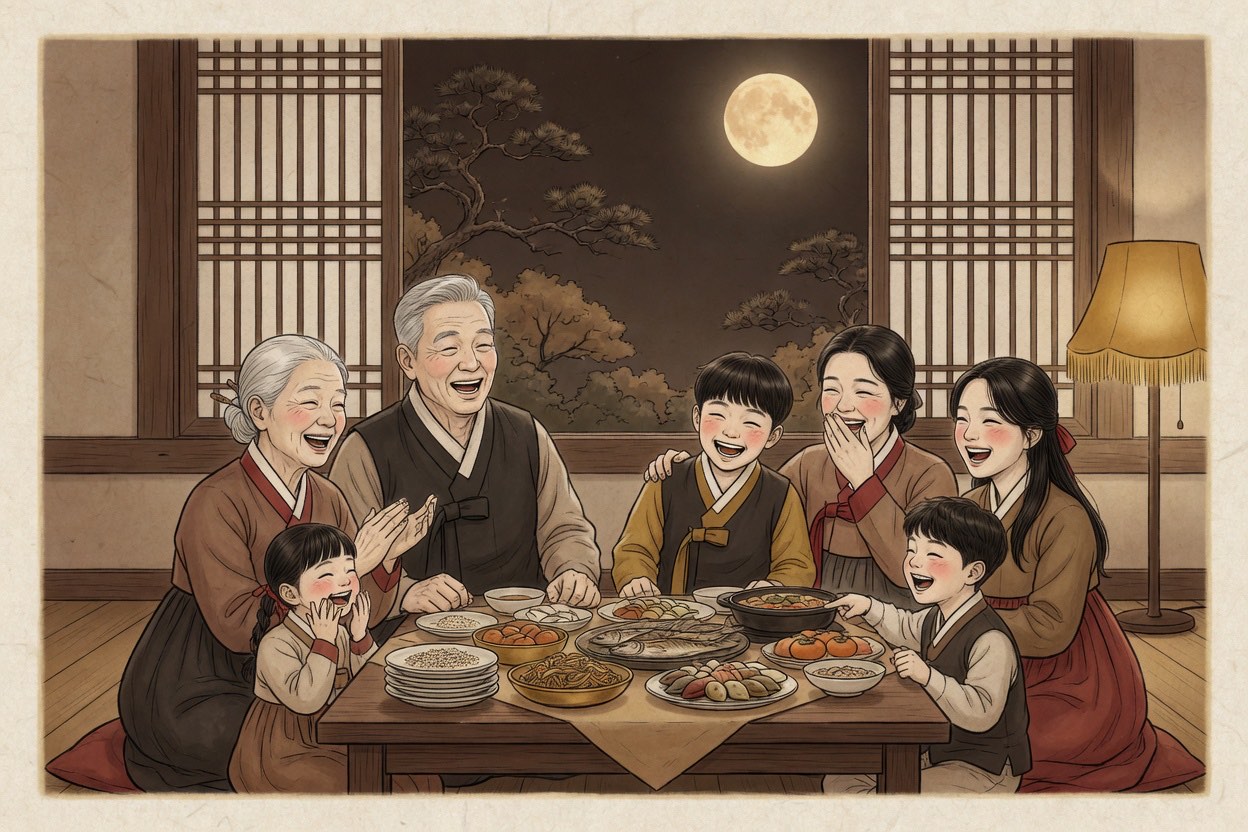
Chuseok (추석, pronounced choo-suhk) is Korea’s great mid-autumn harvest holiday—a time when families gather, honor ancestors, share seasonal food, and often travel long distances home. It falls on the 15th day of the 8th lunar month, so the Gregorian date moves every year, usually landing between mid-September and early October. One-sentence definition: Chuseok is harvest gratitude plus ancestral remembrance, timed to the full moon of the eighth lunar month.
English often glosses it as “Korean Thanksgiving.” That comparison is useful for first contact—family, food, a national pause—and incomplete. Chuseok is not a pilgrims-and-turkey story. It is a three-day public holiday built around a lunar full moon, a memorial table, grave visits, and a kitchen that starts working long before anyone sits down to eat.
Quick facts
| Hangul | 추석 |
| Romanization | chuseok |
| Pronunciation | choo-suhk |
| Also called | Hangawi (한가위) — a warm, traditional name for the same holiday |
| Calendar rule | 15th day of the 8th lunar month |
| Typical Gregorian window | mid-September to early October (exact dates shift yearly) |
| Public holiday length | usually three consecutive days (day before, day itself, day after) |
| Core themes | harvest, ancestors, family reunion, food labor, homecoming travel |
What does Chuseok mean?
In everyday speech, Chuseok is the holiday name. Hangawi is the more poetic, traditional label you still hear in greetings and media. Both point to the same mid-autumn festival.
What people actually do varies by family, region, and generation, but the classic skeleton is stable:
- Go home — or host the people who are coming home
- Prepare food — often for both the living and the ancestral table
- Hold charye — a memorial rite for ancestors
- Visit and tend graves — seongmyo / beolcho
- Eat together — songpyeon, jeon, meats, fruit, leftovers for days
- Survive the highway — then claim you had a restful holiday
Modern life bends every step. Some families streamline rites. Some skip long travel. Some celebrate with friends in the city. Still, when Koreans say “Chuseok,” they usually mean more than a long weekend: a seasonal pressure test of family, duty, traffic, and affection.
When is Chuseok? (The date rule that never lies)
Search “when is Chuseok” every year and you will see a new Gregorian date. That is not confusion. That is the lunar calendar.
Rule you can trust:
- Chuseok = 15th day of the 8th lunar month
- That day is a full moon in the traditional calendar sense people associate with the holiday
- On the modern Gregorian calendar, it usually falls mid-September to early October
- Korea treats it as a three-day holiday block: the day before, Chuseok itself, and the day after (with occasional calendar quirks when other holidays collide)
What you should not trust on a random blog post: a confidently invented “Chuseok is always the same solar date every year” claim. It is not always anything fixed on the Gregorian calendar.
If you need the exact Gregorian dates for a specific year—for flights, school, or work—check a current Korean lunar holiday calendar or a reliable almanac for that year. This page keeps the rule, not a date that can go stale or wrong.
Why the shift matters culturally: Chuseok is not “fall break arbitrarily placed by a government planner.” It is tied to harvest timing and the mid-autumn moon, then folded into modern labor schedules as a long public pause.
Chuseok vs Thanksgiving — helpful comparison, real differences
Calling Chuseok “Korean Thanksgiving” works as a bridge phrase. Both holidays:
- celebrate harvest abundance
- pull family into the same room
- revolve around a heavy meal
- create national chatter about travel and stress
Where the comparison misleads:
| Chuseok | U.S. Thanksgiving (typical picture) | |
|---|---|---|
| Calendar | Lunar: 8th month, 15th day | Fixed Thursday in late November |
| Length | Official multi-day holiday block | One main feast day (weekend travel varies) |
| Ancestors | Charye and grave visits are core for many families | Not structurally central |
| Origin story English speakers know | Harvest + lunar mid-autumn festival | Pilgrims / colonial feast mythos |
| Signature food | Songpyeon, jeon, seasonal table | Turkey, stuffing, pies |
| Emotional weather | Homecoming traffic + ritual duty + reunion | Homecoming + football + reunion |
Use the comparison to open a conversation. Drop it when you need accuracy. Chuseok is harvest + ancestors + lunar timing, not “turkey but with rice cakes.”
The emotional center: going home
Ask many Koreans what Chuseok feels like and you will hear food second. First you hear traffic.
Every major holiday migration has a face. Chuseok’s face is the highway at dusk, gift boxes in the back seat, a child asleep against the window, and a driver calculating whether the next rest stop is worth it. The national story is not only the full moon. It is the attempt to get under the same roof as the people who raised you—or the people you are raising.
That is why Chuseok can feel tender and exhausting in the same hour. The holiday is a reunion machine. Reunion machines create love, logistics, and arguments about who sits where.
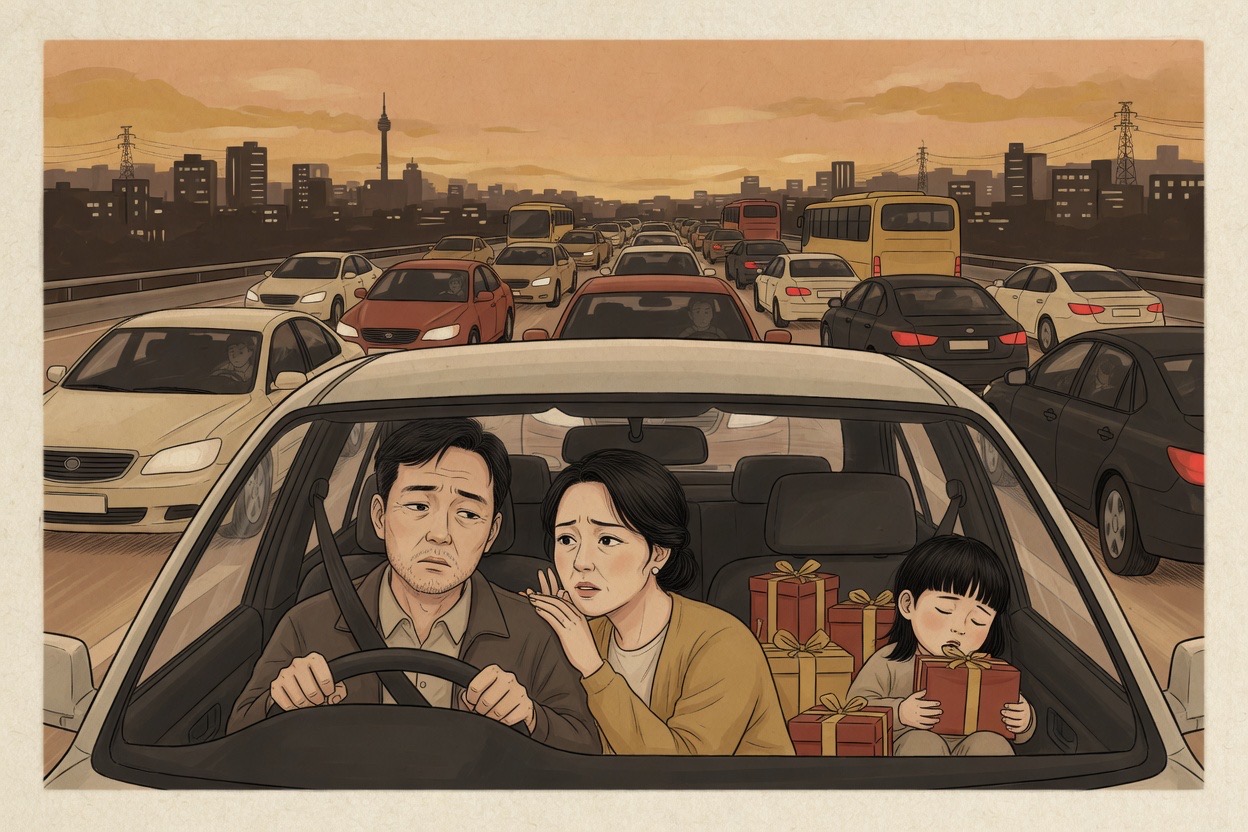
If you are a guest, remember: your hosts may have just spent half a day in a car so you could eat well. Compliment the effort as much as the food. That is basic nunchi—reading the room before you critique the side dishes.
Charye — the ancestral table, described with respect
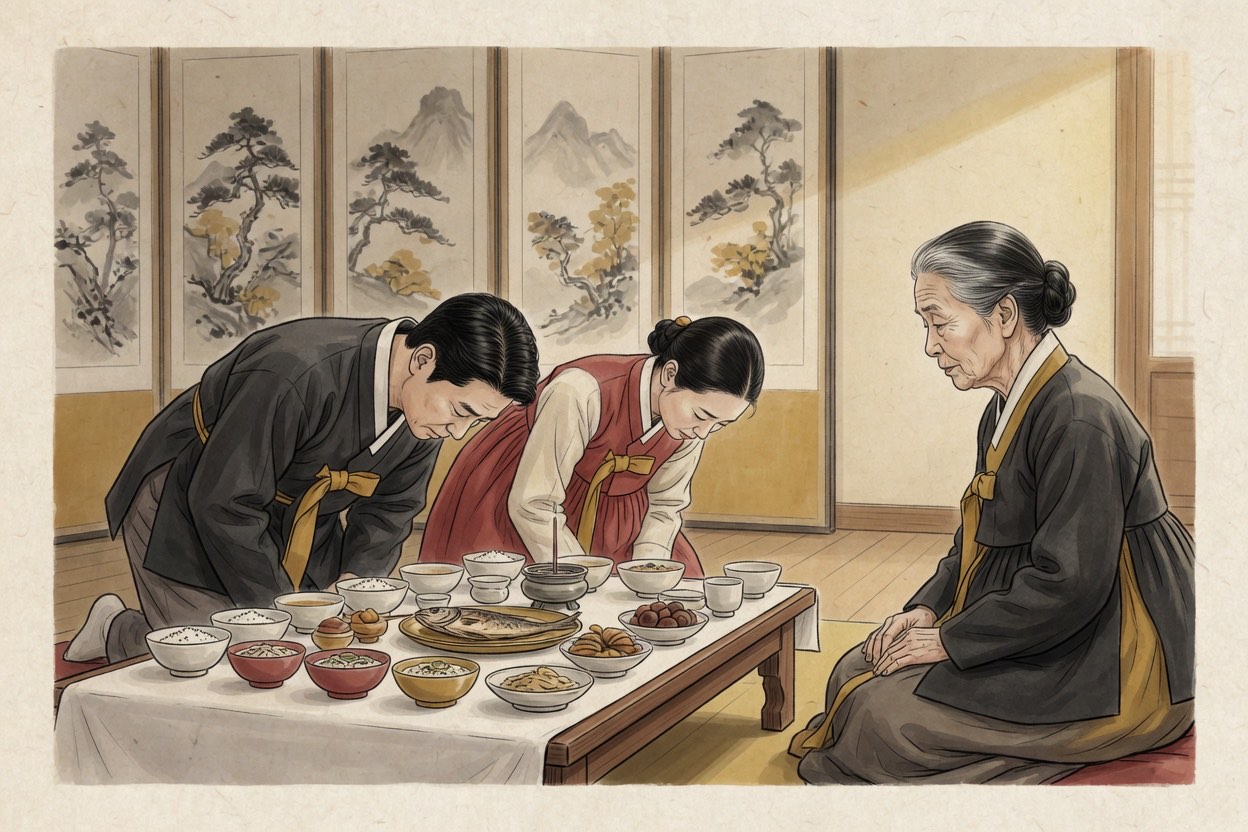
Charye (차례) is a formal ancestral memorial rite many families hold on major holidays, including Chuseok. In practice it looks like this:
- A low table carefully arranged with food and drink
- Specific placement traditions that vary by family line and region
- Family members bowing in turn
- A quiet, formal atmosphere even if the house was chaotic five minutes earlier
- After the rite, food shared among the living
You may also see a folding screen, name tablets or memorial markers depending on the household, and elders guiding younger people through the order of bows.
What charye is not: a random photo-op, a spooky spectacle, or a costume for outsiders to perform. Even if you personally do not share the belief system, the respectful stance is simple—this is family memory work, not content.
Observance varies a lot now. Some families hold a full traditional charye. Some simplify. Some mark the day without a formal table. Do not assume every Korean household does the same rite the same way. Ask your hosts what to do, stand where they stand, and follow their lead on bowing and silence.
Seongmyo and beolcho — visiting and tending graves
Two related practices often pair with Chuseok:
- Seongmyo (성묘) — visiting the family grave or ancestral burial site to pay respects
- Beolcho (벌초) — cutting grass and clearing weeds around the grave, often done before the holiday so the site is tended for the visit
In rural family lines, beolcho can mean a full outdoor workday: tools, sun, water bottles, multiple relatives, and a practical kind of devotion. In cities, families may visit a columbarium or memorial park instead of a hillside grave. The form changes; the care for the dead as family responsibility is the through-line.
Again: practice varies. Some people travel for seongmyo every year. Some cannot. Some have complicated family histories that make the visit heavy. Describe the custom; do not demand a single authentic script from every person you meet.
Chuseok food — songpyeon, jeon, and the labor behind the feast
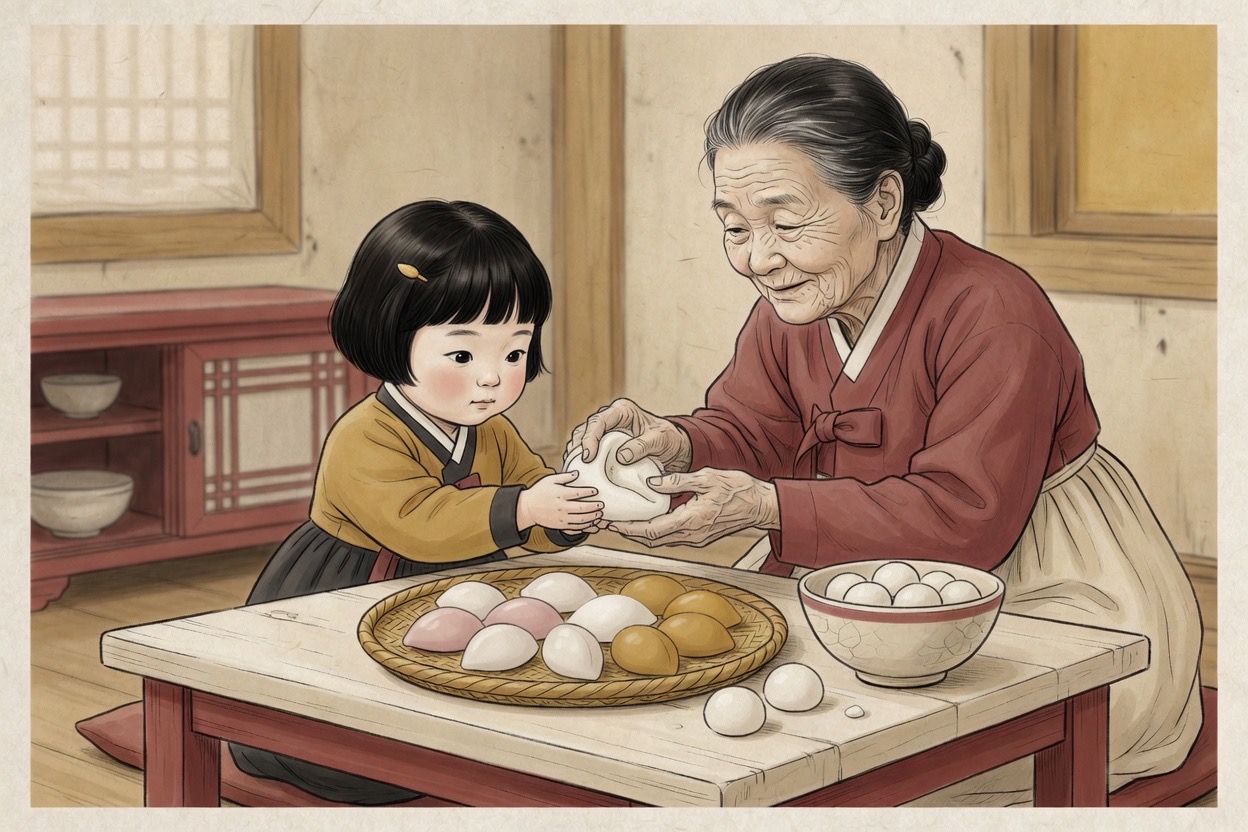
If Chuseok has a mascot food, it is songpyeon (송편): small half-moon rice cakes, often filled with sesame, beans, or other sweet or nutty centers, steamed over pine needles in many traditional tellings. Families shape them together; elders teach the hand motion; kids make lopsided moons that still count.
Other frequent table guests:
- Jeon (전) — pan-fried battered dishes (vegetables, fish, meat)
- Galbijjim (갈비찜) — braised short ribs, celebration energy
- Fresh fruit, rice, soup, namul (seasoned vegetables), and enough banchan to need a second refrigerator shelf
The honest cultural note: the table is work before it is a feast. Preparing Chuseok food can mean days of shopping, chopping, frying, wrapping, and washing. In many households that labor still falls disproportionately on women—mothers, daughters-in-law, aunts—while men may handle travel, graves, or hosting logistics. This is widely discussed in Korea as a social pattern, not a universal law of every kitchen. Some families split work more evenly now; many still do not. If you are a guest, offer help, accept no gracefully if the host wants control of their kitchen, and never treat free labor as “just culture.”
Hanbok, ganggangsullae, and the full moon — tradition without cosplay pressure
Chuseok imagery loves:
- Hanbok (한복) — traditional dress, worn by some for rites, photos, or festival events
- Ganggangsullae (강강술래) — a traditional circle dance and song associated with the harvest moon, taught in schools and performed at festivals
- The full moon itself — the visual heart of mid-autumn storytelling
These are real cultural strands. They are not a mandatory checklist for every modern household. Plenty of families celebrate in jeans, order fried chicken after the formal meal, and never form a moonlit dance circle. Mention tradition accurately. Do not invent a Korea where every cousin owns a full moon choreography routine.
Chuseok greetings — what people actually say
You do not need a speech. You need one warm line and decent timing.
Common greetings:
-
한가위 잘 보내세요
한가위 잘 보내세요
Hangawi jal bonaeseyo.
Have a good Hangawi. -
즐거운 추석 되세요
즐거운 추석 되세요
Jeulgeoun chuseok doeseyo.
Have a happy / pleasant Chuseok. -
Shorter / casual among close people: 추석 잘 보내
추석 잘 보내
Chuseok jal bona.
Have a good Chuseok. (banmal — only if the relationship already is)
Pair greetings with the same judgment you use for hello in Korean: polite defaults with elders and hosts; casual only when the room is already casual. Holiday warmth does not erase speech levels. Korean honorifics still run the table—who pours for whom, who speaks first, how the maknae of the cousins gets both teased and fed first.
Texts and group chats fill up with the same phrases plus food photos. If someone wishes you a good Chuseok, reply in kind. You do not need perfect pronunciation to be kind; you do need not to make the greeting a comedy bit at someone else’s parents’ house.
Example dialogues
1. Greeting exchange, polite, doorway energy
You arrive at a friend’s family home. Shoes off. Gift bag in hand.
- You: 안녕하세요. 추석 잘 보내고 계세요?
Annyeonghaseyo. Chuseok jal bonaego gyeseyo?
Hello. Are you having a good Chuseok? - Friend’s parent: 어서 와요. 오느라 고생 많았지?
Eoseo wayo. Oneura gosaeng manatji?
Come in. That was a long trip, wasn’t it? - You: 네, 덕분에요. 이거 약소하지만 가져왔어요.
Ne, deokbuneyo. Igeo yaksohajiman gajyeowasseoyo.
Yes, thanks to you. It’s small, but I brought this.
Gloss: Guest opens in jondaemal; host welcomes warmly and names the trip, not the holiday’s end. A modest gift (fruit, juice, cookies—follow your friend’s tip) lands better than a speech about “experiencing Korean culture.”
2. Family kitchen, banmal, songpyeon assembly line
Flour on the table. Three generations, one mission.
- Grandmother: 손은 가볍게. 너무 세게 누르면 딱딱해져.
Soneun gabyeopge. Neomu sege nureumyeon ttakttakhajyeo.
Keep your hands light. If you press too hard, they get tough. - Child: 할머니, 제 거는 왜 이렇게 이상해요?
Halmeoni, je geoneun wae ireoke isanghaeyo?
Grandma, why does mine look so weird? - Mother: 이상해도 맛있어. 빨리 빚어, 저녁 전에 끝내야지.
Isanghaedo masisseo. Ppalli bijeo, jeonyeok jeone kkeunnaeyaji.
Weird still tastes good. Shape faster—we have to finish before dinner.
Gloss: Affection with a deadline. Holiday kitchens run on love and the clock.
3. Travel / traffic gripe, cousins in the back seat
Rest-stop coffee. Highway barely moving.
-
Cousin A: 올해는 덜 막힌다더니 이게 뭐야.
Olhaeneun deol makhindadeoni ige mwoya.They said traffic would be lighter this year. What is this?
-
Cousin B: 매년 그 소리 하잖아. 그래도 집에 가는 거지, 뭐.
Maenyeon geu sori hajana. Geuraedo jibe ganeun geoji, mwo.
We say that every year. Still—we’re going home, I guess. -
Driver (parent): 지금 불평할 힘 있으면 물 좀 넘겨.
Jigeum bulpyeonghal him isseumyeon mul jom neomgyeo.
If you have energy to complain, pass the water up.
Gloss: Banmal among family. The gripe is part of the ritual; the destination is the point.
Good nunchi / Zero nunchi
Good nunchi
You are invited to a Korean friend’s Chuseok. You ask what to bring, wear neat clothes, follow the shoe rule, greet elders first, and keep your phone down during charye. In the kitchen you offer to wash, chop, or watch the kids—and you accept “just sit” without sulking. You praise the food without turning the table into your personal Mukbang set. You leave without ranking their family against a drama you watched once.
Zero nunchi
Same invitation. You arrive empty-handed in festival cosplay, film the ancestral table without asking, call charye “so aesthetic,” announce that your country’s Thanksgiving is basically the same, then complain that the highway ruined your holiday vibes. You call your friend’s father oppa as a joke. The room goes polite and thin. You collected content. You skipped respect.
Do / Don’t
Do
- Learn the lunar date rule and the three-day holiday shape.
- Use “Korean Thanksgiving” as a bridge, then name the real differences.
- Treat charye and grave visits as family practice, not spectacle.
- Bring a small host gift if invited; ask your friend what is normal.
- Offer kitchen help; respect a host who wants control.
- Use polite greetings with elders unless invited into banmal.
- Notice labor stress—especially who cooked for two days—and thank people specifically.
Don’t
- Invent a fixed Gregorian date as if Chuseok never moves.
- Demand hanbok photos or ritual participation from people who did not offer.
- Film bows, graves, or the memorial table without clear permission.
- Assume every family does the full traditional package.
- Reduce the holiday to “rice cake day” and ignore ancestors and travel.
- Treat women’s unpaid holiday labor as charming folklore instead of work.
Nearby ideas (on Have Nunchi)
- Nunchi (눈치) — reading whether this room wants help, quiet, or more banchan
- Korean honorifics — who is older, how you speak, how the holiday table still sorts itself
- Maknae (막내) — the youngest cousin may get extra songpyeon and extra errands
- Hello in Korean — doorway greetings before the food opinions
- Oppa (오빠) — a kinship title that is not a holiday party trick for strangers
A closing line
Chuseok is not a single meal with a moon filter. It is a lunar appointment with family memory—harvest on the table, ancestors in the room’s attention, highways full of people trying to get home before the side dishes cool.
Hold the comparison to Thanksgiving lightly, hold the date rule firmly, and if someone invites you in, bring your manners before your camera.
FAQ
What is Chuseok?
Chuseok (추석) is Korea’s major mid-autumn harvest holiday. Families gather, honor ancestors, share seasonal food, and often travel home. It falls on the 15th day of the 8th lunar month, so the Gregorian date shifts each year.
When is Chuseok?
Chuseok is always the 15th day of the 8th lunar month—usually mid-September to early October on the Gregorian calendar. Korea observes it as a three-day public holiday (the day before, the day itself, and the day after). Exact dates shift yearly; check a current lunar calendar.
Is Chuseok the same as Thanksgiving?
Only partly. Both celebrate harvest and family gathering. Chuseok also centers ancestral rites and grave visits, lasts three official days rather than one feast day, and moves with the lunar calendar. Calling it “Korean Thanksgiving” helps first contact; it is not a pilgrim story.
What food do people eat on Chuseok?
Songpyeon (송편)—half-moon rice cakes—are the signature. Tables often include jeon (전), galbijjim, fruits, and many side dishes. The feast is real, but the prep is heavy labor, frequently shared unevenly across the household.
What do you say for Chuseok greetings?
Common lines include 한가위 잘 보내세요 (Hangawi jal bonaeseyo) and 즐거운 추석 되세요 (Jeulgeoun chuseok doeseyo)—roughly “Have a good Hangawi / Chuseok.” Keep polite speech with elders and hosts unless they open casual talk.
What is charye during Chuseok?
Charye (차례) is a formal ancestral memorial rite: a carefully arranged table of food, bows, and a moment of offering and remembrance. Practice varies widely by family. Describe it respectfully; do not treat it as costume or content for strangers’ cameras.
Do you have nunchi?
Get short Korean word lessons and social cues in your inbox.