What Does “Hyung” Mean in Korean? Older Brother, Male Code
Older brother among men—blood, friendship, barracks, and the bill at 2 a.m.
- Hangul
- 형
- Romanization
- hyung
- Pronunciation
- hyuhng
- Category
- Words
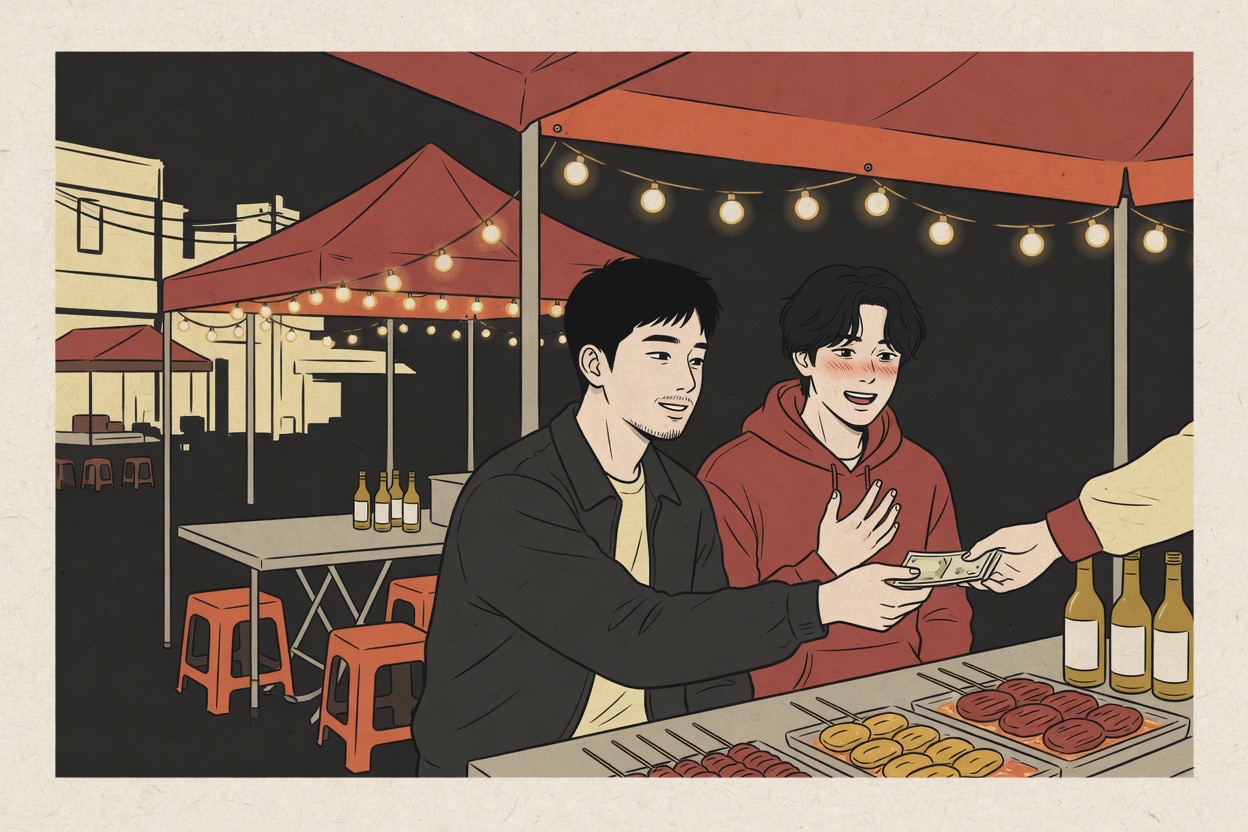
Hyung (형, pronounced hyuhng) is a Korean kinship title a man or boy uses for an older brother—and, by extension, for older male friends, classmates, teammates, and seniors he is close enough to address casually. Women and girls do not normally say hyung; they use oppa (오빠) for the same older-male relationship. One-sentence definition: hyung marks an older male as seen from a younger male speaker.
English “bro” only catches the vibe. Hyung carries age hierarchy, the speaker’s gender, and a quiet script of obligation—who pays, who protects, who absorbs the mess. Used well, it builds male closeness without a speech. Used on the wrong person, it can feel either too intimate or strangely cold, depending on the room.
Quick facts
| Hangul | 형 |
| Romanization | hyung (official romanization: hyeong—see below) |
| Pronunciation | hyuhng (one syllable; not “high-ung”) |
| Literal sense | older brother (from a younger brother’s perspective) |
| Speaker | man / boy |
| Addressee | older male (brother, friend, senior, sometimes mentor figure) |
| Female equivalent for same addressee | oppa (오빠) |
| Respectful form | hyungnim (형님) |
How do you pronounce hyung?
Hyuhng—one short syllable. The y is light; the vowel sits between English “u” and “uh.” Do not stretch it into HIGH-ung or hee-yung.
You will also see hyeong, the spelling that follows South Korea’s official romanization. Everyday English writing—K-pop captions, textbooks aimed at fans, most search results—settles on hyung. Both point to 형. Once you know the alternate form, stick to the spelling your room already uses.
Why hyung is not just “brother”
Korean address culture treats relative age as social software. Where English might use a first name forever, Korean often slots people into a kinship grid even when they share no blood.
Hyung sits in that grid for men:
- Blood: a man’s older brother.
- Social: an older male friend he is close enough to drop formal distance with.
- Institutional: senior classmates, club seniors, army “hyungs,” sports captains—age plus shared hierarchy.
- Soft mentor: someone a few years older who pays for coffee and corrects your form without making it a lecture.
The point is not genealogy obsession. The point is that who may call whom what is a status signal. Getting the title wrong is not only a vocabulary miss; it is a small social misread—the same family of instincts as nunchi.
Hyung vs oppa
People search “hyung vs oppa” because both get glossed as “older brother.” The real split is who is speaking.
| Title | Hangul | Who says it | To whom |
|---|---|---|---|
| hyung | 형 | man / boy | older male |
| oppa | 오빠 | woman / girl | older male |
| unnie / eonni | 언니 | woman / girl | older female |
| noona / nuna | 누나 | man / boy | older female |
So:
- Younger brother → older brother: hyung
- Younger sister → older brother: oppa
- Man to slightly older male friend: hyung once closeness allows
- Woman to that same older male friend: oppa, not hyung
Same relationship direction. Different speaker gender. That is the whole hinge.
Hyung as obligation, not just a label
Among men, hyung often comes with an unspoken bill of duties. The older one is expected—culturally, not legally—to:
- Pay more often (first drinks, late-night street food, the group order)
- Protect (step in when a younger friend is out of his depth)
- Absorb (take the scolding from seniors, soak the awkward silence, cover a mistake)
The younger one is not free of duty. He shows respect, follows the hyung’s lead in mixed rooms, and returns loyalty when it counts. The word is less a costume and more a contract with soft edges.
That is why the classic pojangmacha scene works as cultural shorthand: the hyung reaches for the check; the younger man protests; both know how the dance ends. The protest is manners. The payment is rank plus care.
What does hyungnim mean?
Hyungnim (형님) is hyung with a respectful suffix. Think of it as the formal or heightened escalation—more hierarchical, more ceremonious, sometimes more theatrical.
You will hear hyungnim in:
- Older-male-peer respect — addressing a clearly senior man in a male social circle with extra deference
- Some workplace or organization contexts — where age hierarchy is loud and titles thicken
- Gangster-movie Korean cinema — the word’s pop reputation: tough men bowing language into loyalty oaths, cigarette smoke optional
Everyday friend groups often stay with plain hyung once banmal (casual speech) is mutual. Jumping to hyungnim without the relationship can sound like you are starring in your own crime drama—or like you are overdoing respect in a room that wanted warmth.
Useful rule of thumb:
- hyung = closeness + age, male-to-male
- hyungnim = closeness-or-hierarchy turned up a notch; more formal gravity
Neither is a free synonym for “sir.” Both still need a real older-male relationship to land.
Can a woman say hyung?
Normally, no. The default kinship system assigns:
- woman / girl → older male: oppa
- man / boy → older male: hyung
If a woman calls a man hyung in ordinary public Korean, many listeners will clock it as odd—either a learner error or a deliberate style choice that needs context.
Honest edges, without overclaiming:
- Joking / playful code-switch among close friends who already share a private dialect
- Queer-community address in some circles, where kinship titles get reassigned to fit identity and relationship texture rather than textbook charts
- Tomboy slang or persona speech — occasional, local, not a nationwide “women now say hyung” rewrite
These edges are real enough to mention and narrow enough not to teach as default. If you are learning the system, learn oppa for women, hyung for men first. Exceptions belong to people who already own the room.
What does hyung mean in K-pop?
If you searched “hyung meaning in kpop,” you already know the word from member speech and fandom captions.
Members calling each other hyung
In mixed-gender and all-male groups, younger male members call older male members hyung. It is ordinary backstage and on-camera talk—not a gimmick invented for international fans. The title tracks real age rank inside the group the way family titles track siblings.
Hyung line
The hyung line is the cluster of older members treated as a soft subunit—shared variety bits, “dad jokes,” protective framing opposite the maknae line. Like other “lines” (vocal line, dance line), it is half company reality and half fandom sorting tool.
How fans borrow it
Fans say “hyung” when:
- quoting members
- explaining age hierarchy to new listeners
- nicknaming dynamics (“the hyungs take care of…”)
Fan use is dialect layered on kinship logic. It does not give strangers permission to walk up to an idol and open with hyung as if you share a dorm.
Hyung in the army (broad strokes)
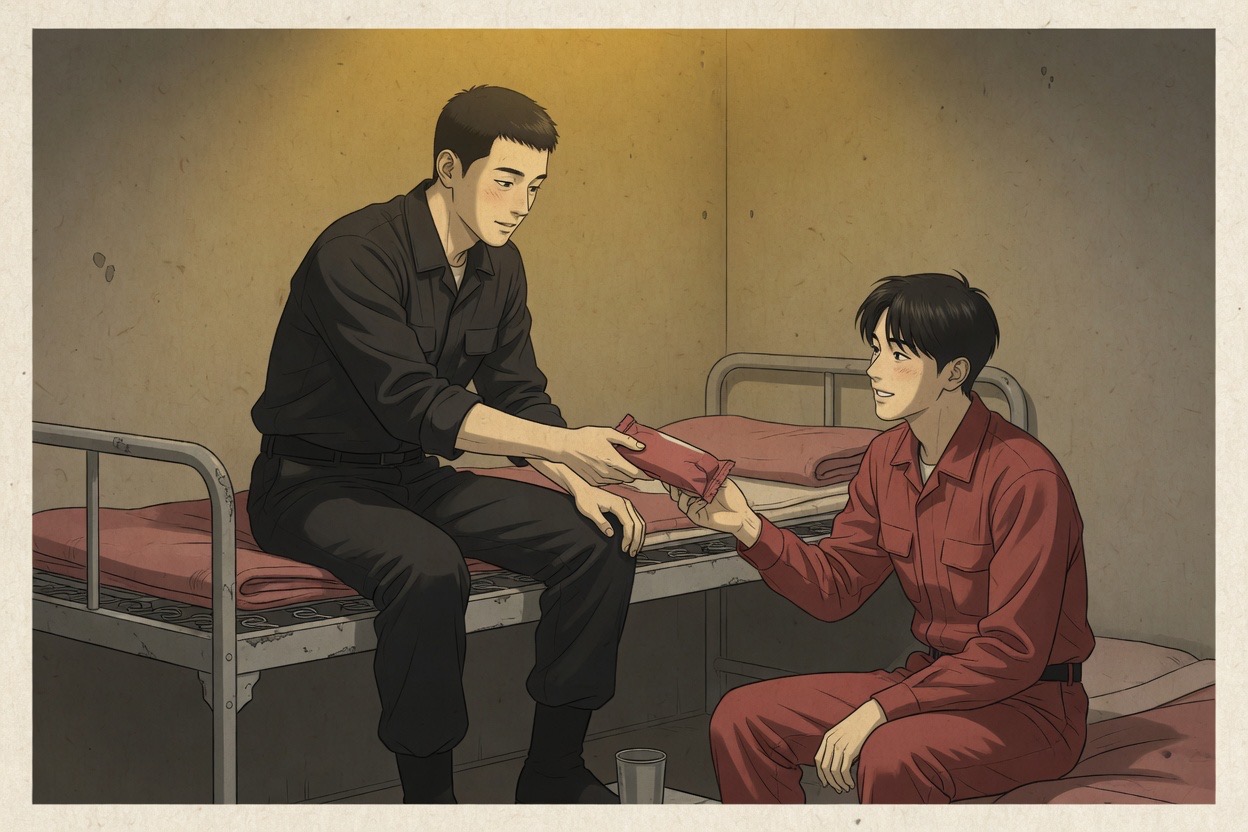
South Korea’s mandatory military service for men puts large numbers of young males into a compressed hierarchy. In that world, older-enlisted or earlier-enlisted men often function as hyung figures: they teach the unspoken rules, share snacks, and model how to survive the system without becoming the problem.
Stick to what is uncontroversial: barracks life amplifies male seniority culture that already exists outside the base. The snack-on-a-bunk scene is not a movie invention; it is how obligation looks when paychecks are small and stress is large. Rank, unit culture, and era vary—do not treat every barracks as the same drama.
When you’ll hear it
- A younger brother yelling 형! down a hallway for the bathroom.
- University friends: the second-year calls the fourth-year hyung after months of shared late nights.
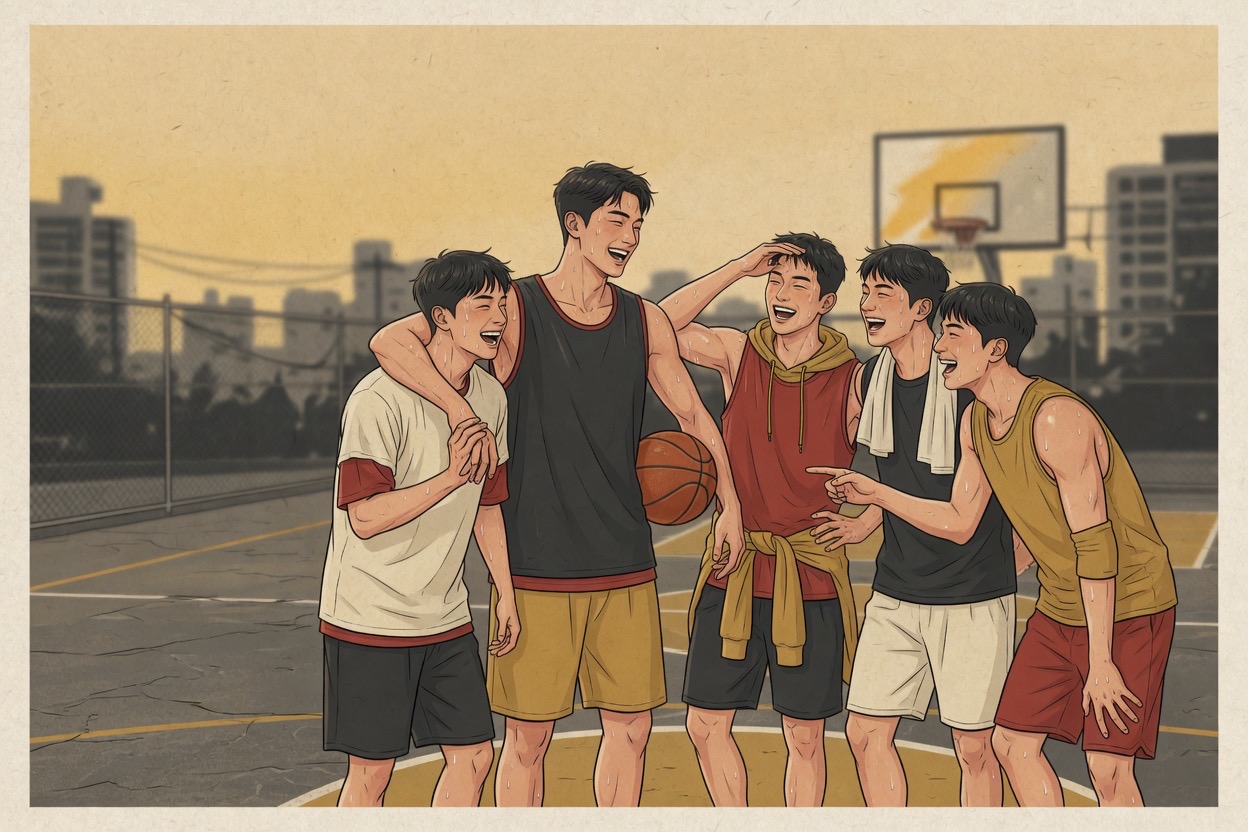
- After basketball, the oldest pays for drinks without a vote.
- Idol livestreams where members correct English-speaking fans on who is whose hyung.
- A foreign learner saying it once to a male classmate who is clearly older—and getting a grin because the age math was right.
You will not typically hear a woman open with hyung to a male stranger, or a junior employee call his CEO hyung on day one. Titles need relationship oxygen.
Example dialogues
1. Blood brothers, casual home speech
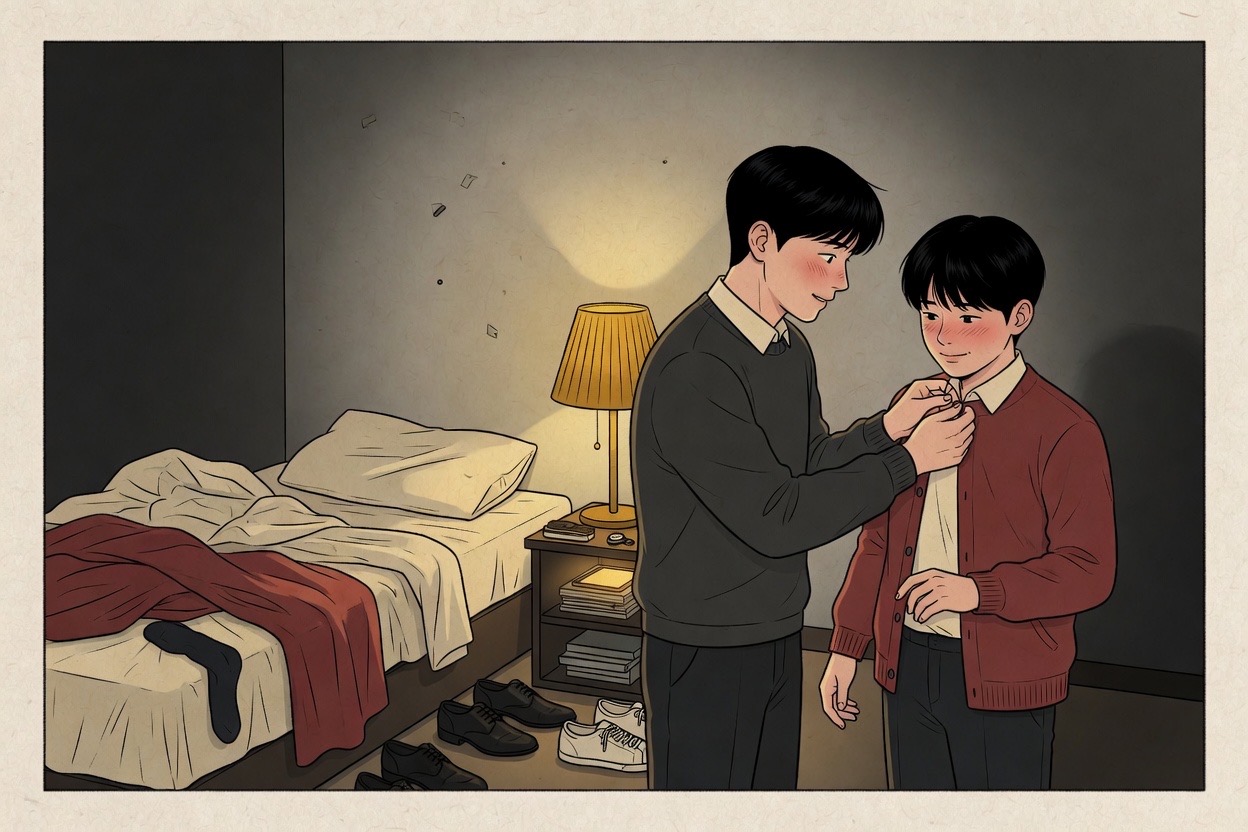
Front door, evening. Younger brother is late for a family dinner across town.
- Younger: 형, 나 옷깃 좀 봐 줘. 이상하지 않아?
Hyeong, na otgit jom bwa jwo. Isanghaji ana?
Hyung, check my collar for me. Does it look weird? - Older: 잠깐. …자, 이제 됐다. 늦었으니까 택시 타.
Jamkkan. …Ja, ije dwaetda. Neujeosseunikka taeksi ta.
Hold still. …There. You’re late, so take a taxi. - Younger: 형은 안 가?
Hyeong-eun an ga?
You’re not coming? - Older: 먼저 가. 내가 계산할게.
Meonjeo ga. Naega gyesanhalkke.
Go first. I’ll cover it.
Gloss: Banmal among brothers. Care lands as bossiness; payment lands as default.
2. Friends after drinks, the bill ritual
Pojangmacha, late. Four guys, one check.
- Younger friend: 형, 오늘은 진짜 내가 쏠게.
Hyeong, oneureun jinjja naega ssolge.
Hyung, I’m seriously paying today. - Hyung: 됐어. 다음에 커피나 사.
Dwaesseo. Daeume keopina sa.
Forget it. Buy coffee next time. - Younger friend: 맨날 다음이라니까.
Maennal daeum-irannikka.
It’s always “next time.” - Hyung: 그래서 형이지.
Geuraeseo hyeong-iji.
That’s why I’m the hyung.
Gloss: The protest is real manners. The refusal is rank performed as generosity.
3. Newish friendship, age clear, closeness earned
Campus café. Minho is two years older; Jae is still half-formal.
- Jae: 민호 형, 다음 주 풋살 하실래요? …아, 할래?
Minho hyeong, daeum ju putsal hasillaeyo? …A, hallae?
Minho hyung, would you like to play futsal next week? …Uh, want to? - Minho: 말 편하게 해. 형이라고 부르는 거 어색해?
Mal pyeonhage hae. Hyeong-irago bureuneun geo eosaekhae?
Talk casually with me. Does calling me hyung feel awkward? - Jae: 아니요—아니. 형, 그래. 그때 보자.
Aniyo—ani. Hyeong, geurae. Geuttae boja.
No—nah. Hyung, cool. See you then.
Gloss: Title and speech level have to move together. Hyung without matching banmal can sound half-zipped; the older friend often opens the door.
Good nunchi / Zero nunchi
Good nunchi
You are a man hanging out with Korean male friends. Someone introduces an older friend as “our hyung.” You learn names, match the casual tone they already use, and when the check arrives you offer once—then let the hyung who insists, insist. You did not demand the title; you recognized a hierarchy that was already warm.
Zero nunchi
Same table. You are the youngest man present, but you call everyone by first name in English volume, then loudly explain that “in my culture we don’t do hierarchy.” Fine as a personal boundary—rough as a speech mid-soju. Later you call the oldest guy “bro” while he is paying. He smiles the polite smile. You thought equality. The room heard refusal to learn the local map.
Do / Don’t
Do
- Use hyung only as a male speaker (or knowingly inside a community that has remapped the word).
- Confirm age + closeness. Hyung is warm; it is not a universal male honorific for every older man.
- Learn hyungnim as the respectful escalation—not as a cooler synonym.
- Watch who pays and who protects; the title often tracks those jobs.
- Borrow K-pop “hyung line” talk as fandom dialect, then switch back to real-room rules offline.
Don’t
- Call your male boss hyung on week one.
- Assume every older Korean man wants to be your hyung.
- Teach women that hyung is the normal address for older males (that’s oppa territory).
- Perform gangster-movie hyungnim with strangers for fun.
- Treat the younger man’s role as freeloading; loyalty is supposed to travel both ways.
If you are still building basic greetings before kinship titles, start with everyday hello in Korean and speech-level awareness—then layer hyung on once age and closeness are clear.
Nearby ideas (for later on Have Nunchi)
- Oppa (오빠) — older male, from a female speaker
- Maknae (막내) — youngest in a group; the other end of the age stick
- Unnie / eonni (언니) — older female, from a female speaker
- Noona / nuna (누나) — older female, from a male speaker
- Nunchi (눈치) — reading whether this room wants titles, banmal, or polite distance
A closing line
Hyung is not “bro” with a Korean accent. It is older male, from a younger male—with the care, the check, and the quiet expectation that someone will catch the fall.
Use it where male closeness already has age shape—and keep your nunchi for the rooms where a name, or a little more formality, is the kinder move.
FAQ
What does hyung mean in Korean?
Hyung (형) is what a man or boy calls an older brother, or an older male friend or senior he is close enough to address casually. Women and girls use oppa (오빠) for the same older-male relationship instead.
Hyung vs oppa—what’s the difference?
Same relationship (older male), different speaker gender. Men and boys say hyung; women and girls say oppa. Mixing them up is one of the fastest ways to sound unfinished in Korean kinship speech.
What does hyungnim mean?
Hyungnim (형님) is the respectful escalation of hyung—more formal, more hierarchical. You hear it with older male peers, some workplace or senior contexts, and famously in gangster-movie speech as exaggerated male respect.
Can a woman say hyung?
Normally no. The default system assigns women oppa for older males. Joking use, queer-community address, and some tomboy slang exist as real edges, but they are exceptions, not the everyday rule.
What is a hyung line in K-pop?
The hyung line is the cluster of older members in a group, often contrasted with the maknae line. Members call older males hyung; fans borrow the word when talking about age ranks and subunit vibes.
Do you have nunchi?
Get short Korean word lessons and social cues in your inbox.