Korean Terms of Endearment: Pet Names for Couples and Family
Not a cute-word dump—a relationship map for how Koreans actually soft-address each other.
- Hangul
- 애칭
- Romanization
- aeching
- Pronunciation
- eh-ching
- Category
- Culture
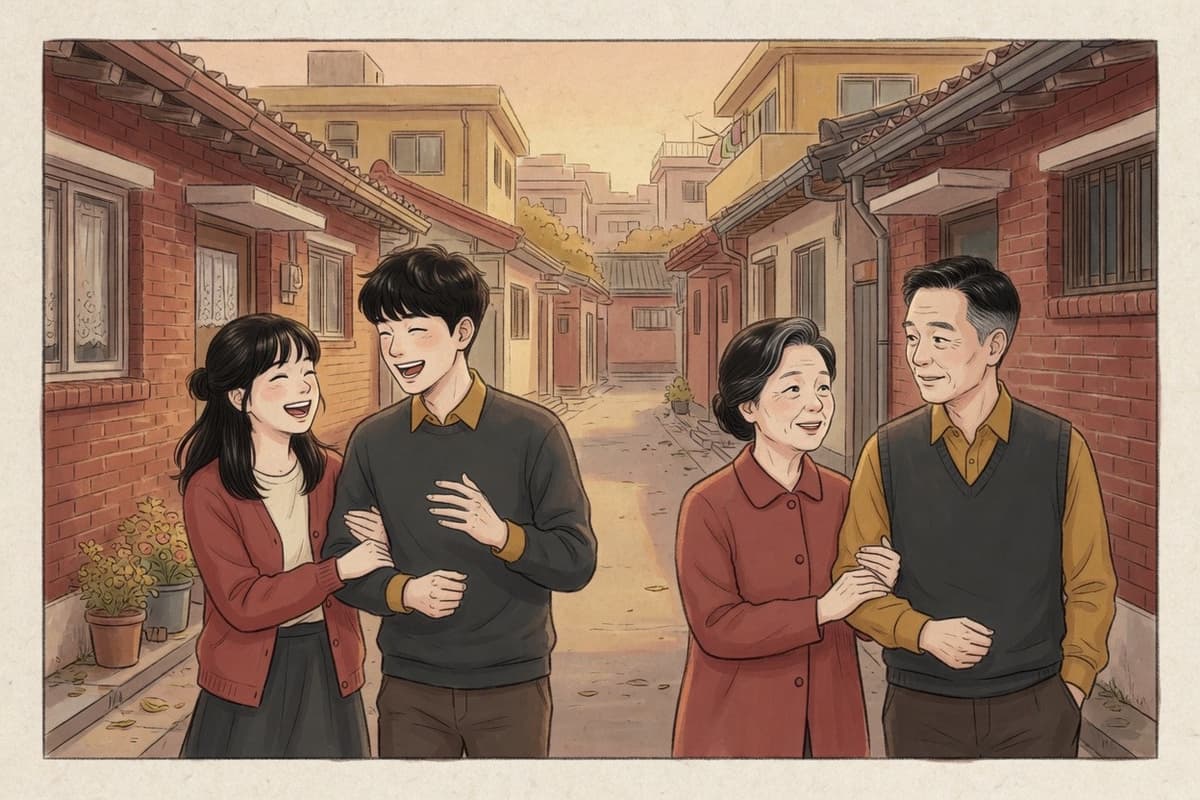
Korean terms of endearment (애칭, aeching, “eh-ching”) are affectionate names that follow the relationship, not cute stickers you paste on anyone. Jagiya (자기야) is honey or babe for partners. Yeobo (여보) is honey or dear between spouses. Aegi (애기) is baby—literal, and “my baby” with people you already fuss over. Oppa is kinship, not a unisex pet name.
Korean does not use one frozen “my love” the way English does. 사랑해 is a verb (“I love you”); 자기야 and 여보 are how you call the person.
Quick map by relationship
Scan the English column first. Depth sections follow.
| Korean | Hangul | English | Who says it to whom |
|---|---|---|---|
| jagiya | 자기야 | honey / babe | partners (dating or married) who already allow pet names |
| yeobo | 여보 | honey / dear (spouse) | married partners; not the phone hello 여보세요 |
| aegi / aegi-ya | 애기 / 애기야 | baby / “baby” as a call | parents; partners in a soft register—not strangers |
| oppa | 오빠 | older brother / older male | woman/girl → older male when closeness fits; not unisex “babe” |
| Relationship | Common endearments | Who says it to whom | Vibe |
|---|---|---|---|
| Dating couples | 자기야, 애기야, 오빠 (if age/gender fit), personal nicknames | Partners who already share intimacy | Soft, exclusive, banmal |
| Married couples | 여보, 당신, 자기/자기야, 아기 아빠/아기 엄마 | Spouses; parent-role nicknames after kids | Domestic, habitual; households vary |
| Family → children | 우리 애기, 우리 강아지, name + 이, doubled nicknames | Parents/grandparents to kids (infants and adults) | Care, pride, soft scolding |
| Friends | 야, name + 아/야, group nicknames, teasing labels | Close equals already in banmal | Warm, not romantic—unless the joke is romance |
| Siblings / close age-mates | oppa, unnie, hyung, noona as warm address | Younger → older when closeness exists | Kinship titles doing double duty as affection |
Endearment is permission-based. The same syllables that melt a partner can freeze a barista.
The four words people actually search
자기야 — “honey / babe” for couples
자기야 (jagiya) is the everyday couple call. Who says it to whom: partners to each other—dating or married—once the relationship is soft enough for banmal pet names. Gender-flexible. Not a friend greeting.
- 자기 alone works in mid-conversation (“honey, look”).
- 자기야 is the calling form—text openers, doorways, “where are you?” energy.
The full 자기야 guide covers tone, texting, and why “jagi” on day two feels faster than English “babe.”
여보 — the classic spouse call
여보 (yeobo) is the traditional married-spouse address. Who says it to whom: spouses to each other. Dating couples rarely use it except as a joke, because the word carries a marriage stamp.
Do not confuse it with phone 여보세요 from hello in Korean. The full 여보 guide covers spouse use and how that differs from the phone hello.
애기야 — “baby” as grown-up soft talk
애기야 (aegi-ya) calls someone baby. Who says it to whom: a partner to a partner; a parent to a child (including adult kids as 우리 애기). Literal infants own the first meaning; couples borrowed the rest.
The full map of spelling (애기 vs 아기), couple talk, and parental use lives on the aegi page.
오빠 — kinship that can sound romantic
오빠 is not a free pet name. Who says it to whom: a woman/girl to an older male—brother, close friend, or boyfriend. Men use hyung for the same age direction. Full rules, K-pop fandom speech, and the cringe line are on the oppa meaning page.
When couples use 오빠, the affection rides on age + speaker gender + closeness, not on “cute Korean flavor.”

Married-layer extras: 당신, 아기 아빠 / 아기 엄마
당신 — careful with this one
당신 (dangsin) can mean “you (dear)” between spouses in literary or formal-soft registers—and it can also sound cold, confrontational, or oddly distant depending on tone and generation. Learners who paste it as a universal “darling” often pick the wrong heat level. Many modern couples never use it daily; they live on 자기/여보/names instead.
Rule: do not lead with 당신 because a textbook labeled it romantic. Listen for whether this couple uses it.
아기 아빠 / 아기 엄마 — parent nicknames as couple talk
After a child arrives, spouses often address each other through the baby:
- 아기 아빠 — baby’s dad
- 아기 엄마 — baby’s mom
The colloquial spelling 애기 아빠/엄마 is also common. Sometimes the child’s name replaces 아기 (민준이 아빠). The romance is indirect: you are not “babe,” you are co-parent in soft voice. Common at home, at playgrounds, and in family group chats.
Family soft names: 우리 강아지, 우리 애기, and more
Parents and grandparents run a separate endearment economy.
| Pattern | Example | Feel |
|---|---|---|
| 우리 + soft noun | 우리 애기, 우리 강아지 | “our baby,” “our puppy”—claim + affection |
| Consonant-ending name + 이 | 민준이, 서준이 | Familiar way to refer to or call someone; distinguish it from the subject particle in a full sentence |
| Doubling | 콩콩이, playful sound-based nicknames | Playful infant/pet register |
| Role-from-child | grandparents using the grandkid’s name as gravitational center | Whole house reorganizes around the small person |
우리 강아지 (“our puppy”) is pure soft talk for a beloved child—sometimes an adult child still getting fuss treatment. 우리 애기 does the same with the baby noun. Neither is a workplace greeting.
If the child is also the family youngest, you will hear maknae as age-rank talk and these soft names as affection talk. Rank and baby-voice are related tools, not identical ones.

Friends: 야, nicknames, and the romance tripwire
Friend-group Korean is loud with attention calls, not couple pet names.
- 야 — “hey” among close equals. Warm when earned; rude when you do not know someone.
- Name + 아/야 — casual call forms (see vocative rule below).
- Teasing nicknames — appearance jokes, school relics, inside-story labels.
What friends usually do not exchange as default address: 여보 or earnest 애기야. 자기/자기야 is couple-coded first, though some women use it non-romantically with close female peers. Other friend groups use these words as deliberate jokes; the relationship and local speech pattern decide the reading.
Unnie among close women can feel affectionate without being a romantic endearment. Same for oppa/hyung/noona when the bond is sibling-like. Those are kinship titles with warmth attached; this hub’s couple words are a different shelf. For the full title grid, use Korean honorifics explained.
The -아 / -야 vocative rule
This particle pair is the grammar under half the nicknames on this page.
| Name ending | Particle | Examples |
|---|---|---|
| Vowel | 야 | 민지야, 준호야, 자기야, 애기야 |
| Consonant | 아 | 하준아, 석진아 |
Notes that keep you out of trouble:
- Vocatives are casual. They live with banmal and real closeness—not first meetings, not client mail.
- 자기야 / 애기야 already bake the particle into the pet name. You do not add a second one.
- 여보 does not take 야 as a fixed form the way 자기야 does; spouses call 여보 as the address itself.
- If you are unsure of the particle on a real name, mirror what friends already say or call without forcing an ending.
Wrong particle + wrong relationship is a double miss. Right particle on a stranger is still a miss.
Diminutive patterns English speakers miss
Korean softens names with a few repeatable moves:
1. Consonant-ending name + 이 (familiar name form)
In family and close speech, a Korean given name ending in a consonant can take -이 when the person is referred to or called familiarly: 민준 → 민준이. Names ending in a vowel do not take this form the same way, and 이 can separately be a subject particle in sentence grammar. Follow the form people actually use for that person.
2. Doubling and sound-play
Infants and beloved kids get doubled or playful nicknames (콩콩, 뭉치, household-only inventions). Couples sometimes invent private doubled nonsense too. The rule is shared history, not public performance.
3. 우리 + term
우리 (“our”) before a soft noun claims the person into the in-group:
- 우리 애기 — our baby
- 우리 강아지 — our puppy
- 우리 자기 — rarer, but the 우리-frame shows how possession-as-affection works
English “my baby” is close. Korean 우리 often sounds less awkward in family air because the default unit is the household, not the solo speaker.
4. Soft voice is not the same as aegyo
Aegyo is performed cute charm—voice, face, gesture. An endearment is the word. You can say 자기야 flatly while cooking. You can do aegyo without using 자기야. Related vibe, different tools.
What English speakers get wrong
1. Using 오빠 as a generic pet name
Oppa is speaker-gendered and age-directed in the conventional kinship map. It is not Korean for “handsome guy I like” in every mouth. A man conventionally uses 형 rather than 오빠 for an older male; community-specific, queer, playful, and quoted uses exist, but a learner should not use oppa on a male stranger as generic Korean flavor. Details live on the oppa page; the hub rule is simple: no free-oppa policy.
2. Calling an adult 애기 in public
Partners whisper it. Parents own it. Managers, professors, and cafe staff do not. Loud 애기 at an adult peer can read as mockery or baby-talk dominance—especially across status lines.
3. Using 자기야 with friends
자기야 is couple-coded. Friend groups that swap it seriously (not as a known joke) create romantic static. If you would not call your friend “babe” in English without irony, do not import 자기야 as Korean flair.
4. Mixing speech level with soft address
Banmal endings + pet name is common, but some couples keep polite speech with each other. The real tone crash is importing a couple nickname into a relationship or client setting that never permitted it. Match the relationship's existing address and speech style.
5. Learning only from subtitles
Dramas compress months of trust into one rainy 자기야. Real rooms still need the months.

Which Korean term of endearment do I use? Decision walk-through
Use this as a short sequence.
-
Is this person your partner or spouse?
- Dating / modern soft default → try listening for 자기/자기야 or a personal nickname.
- Married, especially older register → 여보 may be the house default.
- If you have a child together → 아기 아빠/아기 엄마 may appear.
-
Is this your child (any age) in family air?
Soft nouns with 우리, name calls, playground volume. Not couple words aimed at the kid as if they were your spouse. -
Are you a woman speaking to an older male you are close to?
Oppa may fit—as kinship warmth or couple address—if he accepts it. It is still not automatic on day one of a language exchange. -
Is this a friend already in banmal?
Name + 아/야, 야, real nicknames. Skip 자기야/여보/earnest 애기야 unless the joke is mutual and obvious. -
Is this a stranger, staff, teacher, or new coworker?
No couple endearments. Use polite speech, name + 씨, or role titles. Soft words are not tip money. -
Still unsure?
Use their name the way the group already does. Silence on pet names is not coldness—it is nunchi waiting for permission.
If step 1–4 are all “no,” your answer is already none of the romance shelf.
Example dialogues
1. Dating couple, banmal, 자기야 working
Late evening, shared kitchen. Two partners in their late twenties; banmal is already the house language.
- Minseo: 자기야, 배고파? 라면 끓일까?
Jagiya, baegopa? Ramyeon kkeurilkka?
Honey, you hungry? Should I boil ramyeon? - Junho: 응. 나는 계란 풀래.
Eung. Naneun gyeran pullae.
Yeah. I’ll crack an egg in. - Minseo: 자기 최고야.
Jagi choegoya.
You’re the best, honey.
Gloss: 자기야 opens the call; 자기 mid-line keeps the soft register without re-calling. This couple uses banmal, but another established couple may combine the same pet name with polite endings.
2. Married morning, 여보 as domestic default
Apartment hallway, pair in their early sixties. Keys, shoes, ordinary logistics.
- Wife: 여보, 우산 가져가. 비 온대.
Yeobo, usan gajyeoga. Bi ondae.
Honey (spouse), take an umbrella. They say rain. - Husband: 알았어. 여보 점심은?
Arasseo. Yeobo jeomsimeun?
Got it. What about your lunch? - Wife: 친정 식구들이랑 먹기로 했어.
Chinjeong sikgudeurirang meokgiro haesseo.
I’m eating with my parents’ side.
Gloss: 여보 is furniture, not fireworks—habitual spouse call with banmal. A tourist saying the same word to a new date would sound like cosplay marriage.
3. Parent and adult child, 우리 애기 care mode
Sunday dinner table. Mother in her late fifties; son in his early thirties.
- Mom: 우리 애기 왜 이렇게 말랐어? 반찬 더 먹어.
Uri aegi wae ireoge mallasseo? Banchan deo meogeo.
Why is our baby so thin? Eat more side dishes. - Son: 엄마, 나 서른두 살이야.
Eomma, na seoreundu sariya.
Mom, I’m thirty-two. - Mom: 그래도 우리 애기지.
Geuraedo uri aegiji.
Still our baby, though.
Gloss: Parental 우리 애기 ignores the résumé. Age rank may also make him maknae among siblings; the baby noun is pure care lane.
4. Zero-endearment crash — friend winces at the cafe
Crowded cafe, afternoon. Visitor practices “cute Korean” on staff.
- Visitor: 자기야, 아이스 아메리카노 주세요!
Jagiya, aiseu amerikano juseyo!
Honey, one iced americano please! - Barista (forced smile): …네. 아이스 아메리카노 한 잔 드릴게요.
…Ne. Aiseu amerikano han jan deurilgeyo.
…Right. One iced Americano for you. - Korean friend (low): 야, 그건 안 돼. 그냥 “아메리카노 주세요”라고만 해.
Ya, geugeon an dwae. Geunyang “amerikano juseyo”ragoman hae.
Hey, don’t do that. Just say “americano please.”
Gloss: Couple word + customer transaction = intimacy the job never offered. Polite ordering needs zero pet names.
Good nunchi / Zero nunchi
Good nunchi
Your Korean partner sometimes calls you 자기야 at home. You try it back once, lightly, matching their banmal. With their parents, you use polite speech and no couple pet names aimed at elders. With friends, you stick to names and 야. You treated endearments as relationship-specific, not vocabulary stickers.
Zero nunchi
Same week. You call your partner 여보 on date three because a blog said it was romantic, shout 애기야 across a restaurant at them, call their older brother “oppa” even though you are a man (he needed hyung energy, not a fandom bit), and open a group chat with 자기들아. You collected soft words. You skipped the relationship map.
Do / Don’t
Do
- Match the relationship: couple words for partners, family nicknames for kids, kinship titles only when age, gender, and closeness fit.
- Learn 자기야 vs 여보 as honey/babe vs honey between spouses, then listen to the actual household.
- Use -아/-야 only inside banmal relationships.
- Read the deep pages for oppa, aegi, jagiya, and yeobo instead of treating this hub as a final dictionary.
- Keep aegyo performance separate from the noun you choose.
Don’t
- Spray 오빠 as a unisex pet name.
- Baby-name adult coworkers or service staff.
- Use 자기야 as a friend greeting.
- Pair stiff formal speech with sudden couple nicknames.
- Trust drama timing as real-life permission.
Nearby ideas on Have Nunchi
- Oppa — older male, female speaker; kinship that can turn romantic
- Unnie — older female, female speaker; warmth without romance required
- Aegyo — cute performance, not the pet-name noun itself
- Korean honorifics explained — titles, -ssi/-nim, speech levels around the soft words
- Maknae — youngest in a group; rank talk beside baby-talk
- Nunchi — reading whether this room wants honey, titles, or plain politeness
- 자기야 · 여보 · 애기 — deep dives for three common endearment searches
A closing line
Korean terms of endearment are not a charm offensive. They are short passwords for relationships that already exist.
Hold 자기야 and 여보 for the people who share your days, keep 애기 soft and private-enough, let oppa stay inside its gender-and-age lane—and let your nunchi decide when the kindest word is still just someone’s name.
FAQ
What are Korean terms of endearment?
They are affectionate names and soft address words—자기야, 여보, 애기야, couple uses of 오빠, family pet names like 우리 강아지—that mark intimacy by relationship, not generic friendliness.
What is the difference between jagiya and yeobo?
자기야 (jagiya) is the everyday couple pet name—“honey/babe”—used in dating and in many marriages. 여보 (yeobo) is the classic married-spouse call. Households mix them; neither word is locked to one age group.
Can I call my boyfriend oppa as a pet name?
Yes, if you are a woman/girl and he is older (or you both play the age gap that way) and he is fine with it. Oppa is not a unisex pet name for any cute person.
What does the -ya / -ah ending mean in Korean nicknames?
아 and 야 are vocative particles for calling someone in casual speech. Names ending in a vowel usually take 야; names ending in a consonant usually take 아. Only use them with people you already banmal with.
Is it okay to call an adult aegi in public?
Between partners or parents and kids, yes—in private or soft private-in-public moments. Loudly baby-naming an adult coworker, barista, or new acquaintance usually lands as condescending, not charming.
Sources
Primary and authoritative references used for definitions and context on this page.
- Standard Korean Dictionary — 애칭 — National Institute of Korean Language
Read next
Do you have nunchi?
Get short Korean word lessons and social cues in your inbox.