Jagiya Meaning: Honey, Babe, and Annyeong Jagiya
Honey or babe for partners. Annyeong jagiya is “hi, honey”—not a stranger greeting.
- Hangul
- 자기야
- Romanization
- jagiya
- Pronunciation
- ja-gi-ya
- Category
- Words
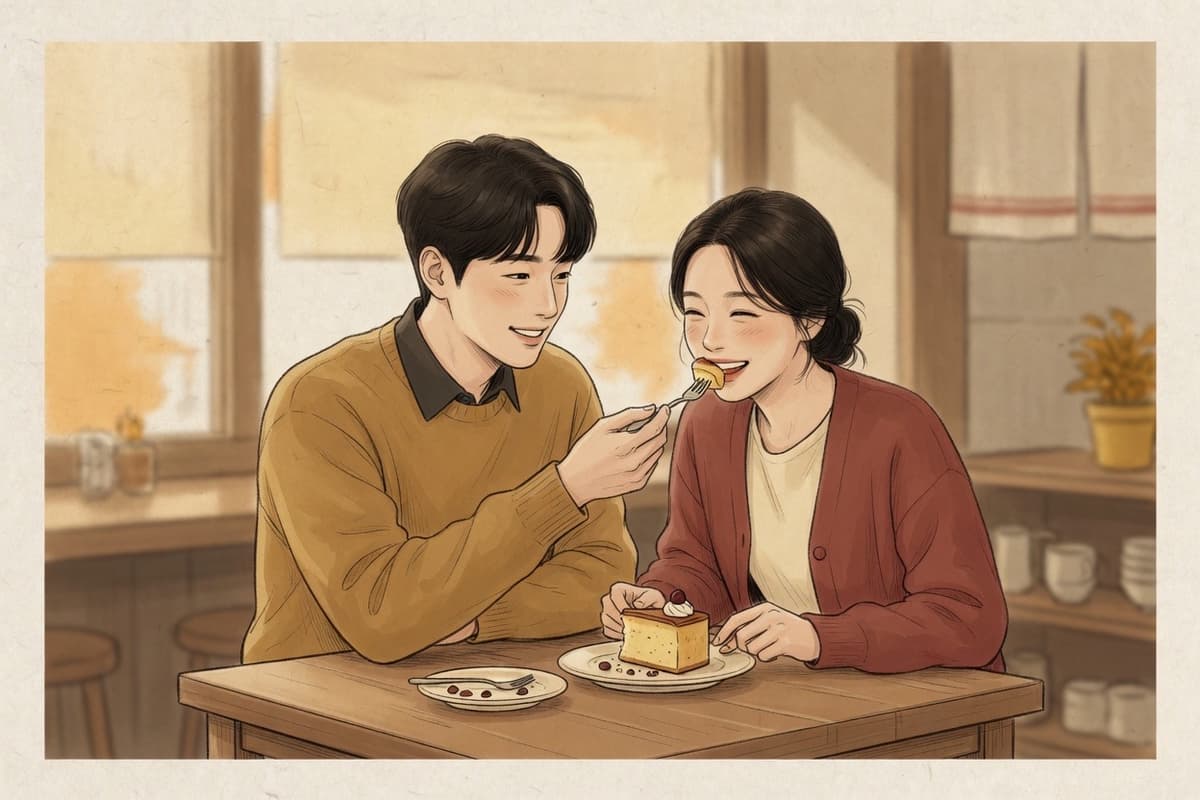
Jagiya (자기야, pronounced ja-gi-ya) is Korean for honey, babe, or darling—the soft call partners use when pet names are already allowed. 안녕 자기야 (annyeong jagiya) is “hi, honey” or “hey, babe”: a greeting to your person, not a hello for a clerk or a new classmate.
The base 자기 (jagi) means self / oneself; add 야 and it becomes a call. You will also hear some women in markets and salons use the same word with each other as familiar warmth, not romance.
Quick facts
| Hangul | 자기야 |
| Romanization | jagiya (also jagi-ya) |
| Pronunciation | ja-gi-ya (three short beats) |
| Literal pieces | 자기 = self / oneself · 야 = casual vocative particle |
| Everyday sense | honey, babe, darling (to a partner) |
| Who uses it | dating couples, married couples; also some older women with each other |
| Not for | strangers, most friends, workplace peers as flirt |
| Nearby words | yeobo (여보), oppa (오빠), aegi (애기) |
How do you pronounce jagiya?
Ja-gi-ya. Three even syllables. First ja like “jah,” not “jay.” Middle gi is hard g, short. Final ya is a soft “yah,” not a long “yaaaa.”
Do not swallow it into jagya or stretch it like a K-drama audition. In real speech it often sits light and quick—especially when someone is only getting the other person’s attention across a room: 자기야— then the request.
If you have practiced clean vowels for hello in Korean, keep that same discipline. Over-sweet pronunciation does not make the word warmer; it makes the performance louder than the relationship.
What does jagiya mean?
Break the word open and the romance becomes less mysterious.
- 자기 (jagi) — self, oneself; also “you/dear” inside couple talk
- 야 (ya) — the casual vocative particle: the sound that turns a name or noun into a call
So 자기야 is not a random cute noise. It is “self” dressed as a call-out: hey, my person. English “honey” and “babe” sit close in function. The dictionary’s 자기 (自己) entry is oneself; the honey/babe use is how partners actually call each other.
안녕 자기야 — “hi, honey”
- 안녕 — casual hello (close people; not the polite 안녕하세요)
- 자기야 — honey / babe, to a partner
Together: 안녕 자기야 = hi, honey. You will see it as a text opener, a voice-note start, or a doorway greeting. It assumes you already call each other that. Said to a stranger, a barista, or a language-exchange partner on day two, it borrows intimacy nobody offered.
For the polite daytime hello that is not a pet name, use hello in Korean. For honey between spouses, use yeobo.
자기 vs 자기야 — the 야 is the call button
This is the first grammar-shaped FAQ people actually need.
| Form | Hangul | Job | Example feel |
|---|---|---|---|
| jagi | 자기 | base noun / soft address / talking about a partner | “자기 likes this cafe.” |
| jagiya | 자기야 | vocative—calling to them | “자기야, pass the soy sauce.” |
Think of 야 the way Korean attaches call endings to names: 민지야, 준호야. Same particle family as the casual name-call system in Korean honorifics—warm, close, informal. You do not slap 야 on a senior’s title. You also do not usually need 야 when you are narrating about your partner to a third person; you need it when you want their face, their eyes, their reply.
Rule of thumb: 자기 can sit in sentences as “you/dear.” 자기야 is the doorbell.
Who uses jagiya?
Dating couples and married couples — the main stage
Overwhelmingly, jagiya belongs to romantic partners—dating, engaged, married. It is gender-neutral in a way oppa is not: either partner can say it. It is not “older male from a female speaker.” It is “my person.”
You will hear it at a cafe counter call-across, in a kitchen request that would sound bossy bare, on the phone at night, and in texts as 자기야 or plain 자기.
What you will not typically hear: two same-age friends swapping 자기야 the way some English speakers toss “babe.” Korean friend groups use names, unnie / hyung-style titles, and teasing nicknames instead. Jagiya belongs to couples. Using it as general friend slang marks a foreigner’s English habit more than Korean fluency.
Married homes — same word, deeper furniture
Married couples keep 자기 / 자기야 for years—brand-new sweet or fully worn-in, depending on tone. It often coexists with yeobo (여보), the classic spouse call. Marriage does not retire jagiya; it often domesticates it into the default “hey, you.”
The shop and salon usage that confuses learners
Here is the section that saves you from a wrong movie in your head.
In some markets, beauty salons, neighborhood shops, and familiar social circles, women who already share an easy peer relationship call each other 자기 or 자기야. Two women inspecting lettuce. A regular and a shop owner who have known each other for years. Friends softening a request.
It is affectionate peer talk, not a secret affair. Learners overhear it, map “honey/babe” from couple dramas onto the scene, and invent a romance plot that is not there. Subtitles and apps push the couple meaning hard; real Korean speech keeps a second lane.
What this lane usually signals:
- friendly familiarity among particular peers
- a warm relationship, not formal customer distance
- soft equal talk—closer to “hon” among some English-speaking women of a certain age than to “my boyfriend”
What it does not signal by default: that the speakers are dating; that a male foreigner can walk in and call the owner 자기야; or that you should copy the word across age without a relationship.
Treat market-stall 자기야 as listen-only culture until a real peer relationship invites you in. Confusing it with couple talk is the classic error this page exists to prevent.

Jagiya vs yeobo vs oppa — which stage, which job?
People search these three together because English collapses them into “what Koreans call their boyfriend.” They are not interchangeable. For the full set—including the ones that never make it into subtitles—see Korean terms of endearment.
| Word | Hangul | Core job | Typical stage / room |
|---|---|---|---|
| jagiya | 자기야 | gender-neutral couple honey/call | dating through marriage; soft everyday address |
| yeobo | 여보 | classic spouse call (“honey” for married partners) | marriage (or marriage-coded intimacy); less “early dating” |
| oppa | 오빠 | kinship title: female speaker → older male | brother, older male friend, boyfriend if age + closeness fit |
Jagiya — the everyday couple default
Jagiya is the flexible honey. Early stable dating, long-term partnership, marriage—all can use it. It does not require an age gap. It does not encode speaker gender. It mostly encodes we are past stranger formality and into private soft talk.
Yeobo — marriage-coded honey
Yeobo (여보) is the word many learners meet as “what Korean spouses say.” It can sound old-fashioned, classic, or simply domestic depending on the couple. Some young married pairs use both yeobo and jagiya. Some lean hard one way. As a foreigner, treat yeobo as spouse-weight until you hear how a specific couple actually talks. Dropping yeobo on a second date is like proposing with the nickname before the relationship exists.
Oppa — not a pure synonym for “boyfriend”
Oppa is a full kinship title inside the age-and-gender grid, not a blank honey sticker. A woman may call an older boyfriend oppa; that does not mean every boyfriend is oppa, or that men use the word the same way. For the full grid and the failure modes, stay with the dedicated oppa page and the wider honorifics map.
Stage sketch (not a law):
- Early dating, still careful → names, polite endings, maybe light nicknames
- Steady couple banmal → jagiya often appears
- Marriage (or marriage-like domestic life) → jagiya and/or yeobo
- Age-gap couple with female speaker + older male → oppa may layer on top of or instead of pure honey words
Your relationship’s real timeline beats any chart. Charts only stop you from skipping three steps because a drama did it in episode four.
When jagiya sounds sweet — and when it sounds try-hard
Sweet
- You already share banmal and a real partner bond.
- The word is quiet, ordinary, useful—not a performance for the table next door.
- It softens a request (“자기야, can you grab napkins?”) instead of staging a confession.
- Both people use it, or one uses it and the other clearly enjoys it.
Try-hard (especially from a foreigner)
- First coffee, first week, or still-jondaemal stage—and you open with 자기야 like a costume.
- Loud public aegyo delivery: elongated vowels, baby voice, whole cafe as audience.
- Using it on a Korean friend, classmate, or language partner to “sound local.”
- Copying it after one K-drama binge without checking whether this person wants pet names at all.
Foreigners are not banned from the word. Premature ownership is the problem. Jagiya is not proof of fluency. It is proof—or fiction—of intimacy. Korean rooms notice when the fiction is louder than the bond. That notice is pure nunchi: reading whether the soft word fits the air, not only the dictionary.
When you’ll hear it
- Couples ordering separately: one calls from the table, the other turns at the counter.
- Married mornings: a half-asleep request for water, keys, or who feeds the cat.
- Phone calls that start with the bond, not the agenda.
- Drama and variety: the subtitle will say “honey.”
- Markets and salons among older women: peer affection, not couple plot.
- Group chats narrating a partner: “자기가 늦게 온대” — jagi says they’ll be late.
You will rarely hear it as a professional icebreaker or stranger-safety word. If someone uses it and you are not their partner (or salon peer), treat it as marked speech—joke, flirt, or mistake—and answer with nunchi, not automatic mirroring.
Example dialogues
1. Text opener — 안녕 자기야
Late afternoon, already a couple. One person is leaving work; the other is already out.
- Minji: 안녕 자기야. 지금 어디야?
Annyeong jagiya. Jigeum eodiya?
Hi, honey. Where are you right now? - Junho: 방금 나왔어. 자기는?
Banggeum nawasseo. Jagineun?
Just headed out. You? - Minji: 역 앞. 천천히 와.
Yeok ap. Cheoncheonhi wa.
In front of the station. Take your time.
Gloss: Casual 안녕 plus couple 자기야. Same intimacy as a phone “hey, babe”—not a greeting you paste onto a shop worker.
2. Cafe counter, couple banmal, pure call form
Window seat and counter. One person is ordering; the other forgot the drink.
- At table: 자기야, 나는 아이스 아메리카노!
Jagiya, naneun aiseu amerikano!
Honey—iced Americano for me! - At counter: 응, 알았어. 케이크도 먹을 거야?
Eung, arasseo. Keikeudo meogeul geoya?
Okay, got it. Want cake too? - At table: 하나만 시켜서 나눠 먹자.
Hanaman sikyeoseo nanwo meokja.
Order one and we’ll share.
Gloss: Full banmal. 자기야 is attention + affection in one beat—not a formal address stack.

3. Night phone call, long-distance softness
Twenty-something woman, late, phone to ear. The day was long; the word is automatic.
- Her: 자기야, 지금 뭐 해?
Jagiya, jigeum mwo hae?
Honey, what are you doing right now? - Him: 방금 퇴근했어. 자기는 밥 먹었어?
Banggeum toegeunhaesseo. Jagineun bap meogeosseo?
Just left work. Did you eat? - Her: 응. 자기도 꼭 밥 먹어.
Eung. Jagido kkok bap meogeo.
Yeah. Make sure you eat too.
Gloss: Banmal throughout. 자기야 opens the call; mid-exchange both use 자기 as soft “you,” without 야—already on the line, so no doorbell needed.

4. Market stall, older women, not a couple
Two women in their fifties, vegetable stall. Familiar, practical, warm.
- Woman A: 자기야, 이 상추 어때 보여?
Jagiya, i sangchu eottae boyeo?
Hon, how does this lettuce look to you? - Woman B: 저것보다 이게 낫다. 자기는 파도 좀 사려고?
Jeogeotboda ige natda. Jagineun pado jom saryeogo?
This one’s better than that. Are you getting green onions too? - Woman A: 응, 저녁에 넣어 먹으려고.
Eung, jeonyeoge neoeo meogeuryeogo.
Yeah, I’m going to add them to dinner.
Gloss: Still banmal peer talk. Same surface word as couple honey; the relationship is friendship and familiarity, not romance. Do not subtitle this as a secret date.
5. Zero-nunchi contrast — language exchange gone wrong
Cafe study table. They met twice. He still uses polite endings. He aims for drama.
- Learner: 자기야, 오늘 뭐 할 거예요?
Jagiya, oneul mwo hal geoyeyo?
Honey, what are you going to do today? (polite ending + couple call) - Partner (internal): …
(smile freezes) - Partner: 저희… 아직 그렇게 안 부르는데요.
Jeohui… ajik geureoke an bureuneundeyo.
We… don’t call each other that yet.
Gloss: The problem is not the polite ending—some couples keep jondaemal and pet names together. The problem is that this relationship never established couple address. The vocabulary was fine; the timing and consent were not.
Good nunchi / Zero nunchi
Good nunchi
You are dating someone Korean. Banmal is mutual. One night they call you 자기야 without staging it. You answer in kind when it feels natural—or you keep your name-based address if that is still your shared style. You never force the word as a fluency badge. At a market, you hear two older women use the same call and you do not assume they are a couple, do not film them, and do not copy the line onto the ajumma selling fruit.
Zero nunchi
Week two of knowing someone. You open every text with 자기야, elongate it in public for friends’ cameras, and correct them when they prefer names. Separately, you tell your study group that “Koreans call everyone jagiya, even at the market, so it means people are super friendly.” You collapsed couple intimacy and peer shop talk into one tourist myth. The room goes polite. You thought you were charming. You were loud.
Do / Don’t
Do
- Treat jagiya as partner-coded first, peer-women shop talk second.
- Learn 자기 vs 자기야: base soft “you/dear” vs vocative call.
- Compare yeobo and oppa as different jobs, not synonym flashcards.
- Match the couple's established speech style; jagiya often appears with banmal, but some couples keep polite endings.
- Wait until the relationship can hold soft address—especially as a foreigner.
Don’t
- Use jagiya on friends, classmates, or language partners to sound advanced.
- Assume market/salon 자기야 means romance.
- Deploy yeobo as early-dating flair.
- Confuse oppa with a gender-neutral honey word.
- Perform the word louder than the bond (public aegyo cosplay counts).
Nearby ideas
- Oppa (오빠) — female speaker to older male; kinship first, boyfriend optional
- Unnie (언니) — female speaker to older female; not a couple honey substitute
- Yeobo (여보) — spouse-coded call
- Aegyo (애교) — cute performance that can ride on pet names—or wreck them
- Nunchi (눈치) — whether this room wants soft words, titles, or plain names
A closing line
Jagiya is a small word with a big gate: partners with a private voice on one side, older women keeping each other company over vegetables on the other. Same hangul, different social contracts.
Hold the honey for the person who earned it—and keep enough nunchi to hear when 자기야 is romance, when it is peer warmth, and when you should leave it unsaid.
FAQ
What does jagiya mean in Korean?
Jagiya (자기야) is a common couple pet name meaning honey, babe, or darling. Literally, 자기 means self or oneself, and 야 turns it into a soft call form.
What is the difference between 자기 and 자기야?
자기 is the base word meaning self/oneself and can also address a partner as “dear.” 자기야 adds the casual vocative 야, making the call more explicit. Actual couples use both as direct address.
Who uses jagiya?
Dating and married couples commonly use it with each other. Separately, some women use 자기 or 자기야 with close female peers in a familiar, non-romantic way; that use is relationship-dependent, not a learner default for strangers.
What is the difference between jagiya, yeobo, and oppa?
Jagiya is a gender-neutral couple honey word. Yeobo (여보) is the classic married-spouse call. Oppa (오빠) is a kinship title a woman uses for an older male—brother, friend, or boyfriend—not a pure honey synonym.
What does annyeong jagiya mean in English?
Annyeong jagiya (안녕 자기야) is a casual “hi, honey” or “hey, babe” to a partner. 안녕 is the informal hello; 자기야 is the couple call. It is not a greeting for strangers.
Can foreigners say jagiya?
Yes, if you already have a real partner relationship and both people welcome pet names. Couples may use banmal or polite speech with it. Used too early, too loudly, or as tourist flirt, it reads try-hard.
Sources
Primary and authoritative references used for definitions and context on this page.
- Standard Korean Dictionary — 자기 (自己) — National Institute of Korean Language
- Korean Basic Dictionary — 안녕 — National Institute of Korean Language
Read next
Do you have nunchi?
Get short Korean word lessons and social cues in your inbox.