What Does “Aegyo” Mean? Cute Charm, Explained
Cute on purpose—and only when the room agrees to play along.
- Hangul
- 애교
- Romanization
- aegyo
- Pronunciation
- eh-gyo
- Category
- Words

Aegyo (애교, pronounced eh-gyo) is Korean cute charm on purpose—a soft voice, babyish tone, pout, head tilt, or finger heart used to look adorable, lighten a mood, or nudge someone into saying yes. One-sentence definition: aegyo is performed cuteness inside a relationship or stage, not “being cute” as a permanent identity. You will also see the spelling aegio once in older English posts; modern romanization is aegyo.
It is not the same as being young, being the maknae, or having under-eye “aegyo sal.” Those sit nearby. The word people search for—“aegyo meaning”—usually wants the behavior: the act of doing cute.
Quick facts
| Hangul | 애교 |
| Romanization | aegyo |
| Pronunciation | eh-gyo (two short syllables, even stress) |
| Literal sense | cute charm / endearing affection |
| Core idea | performed cuteness for closeness, comedy, or persuasion |
| Not the same as | aegyo sal (under-eye fat pad); youth alone; nunchi |
| Common settings | couples, close friends, variety TV, K-pop stages, soft sales of favors |
How do you pronounce aegyo?
Say eh-gyo—not “eye-gee-oh” and not a long English “ay.” Both syllables stay short. The first is closer to eh as in “pet,” the second like gyo in “gyoza” without dragging the o.
If you have said hello in Korean out loud before, keep the same light, clean vowels. Over-singing the word turns it into a cartoon label. Korean speakers usually just say it flat: 애교.
What is aegyo? (what does aegyo mean)
In plain English, aegyo is cute behavior used as social currency. Someone raises their voice a little, shortens their words, makes a pleading face, or layers on playful body language so the other person feels warmed, amused, or gently cornered into kindness.
That can mean:
- asking a partner for dessert with a pout instead of a memo
- hyping a friend with baby talk for three seconds, then dropping it
- performing a cute gesture on a variety show because the host asked
- selling a favor—“please?”—with volume and eyes instead of pure logic
What it is not: a clinical trait, a free pass to demand free labor, or proof that every Korean woman (or man) lives in permanent baby-voice mode. Plenty of people never do aegyo. Plenty do it only with one person. Plenty hate watching it when the timing is wrong.
If nunchi is reading the room, aegyo is testing whether the room will accept a cute script. Good timing makes people laugh. Bad timing makes people stiffen.
When you’ll hear it
- Couples negotiating small favors: snacks, “just one more episode.”
- Close friends teasing: “Do aegyo and I’ll forgive you.”
- Variety shows: “Give us aegyo!” as challenge, penalty, or fan service.
- Online comments under idol clips: praise, parody, or “too much.”
- Beauty talk that collides with the word: aegyo sal (separate idea—below).
Strangers on the subway do not usually demand it. The word expects intimacy, a stage, or a joke everyone already opted into.
How to do aegyo (without becoming a cartoon villain)
If you searched how to do aegyo, the honest answer is: small, short, and only for people who already like you.
Common toolkit—none of these are mandatory:
- Voice: slightly higher, softer, slower; shorter sentence endings.
- Face: pout, big eyes, shy smile, head tilt.
- Hands: finger heart, two-handed plea, covering a smile.
- Lines: playful pleading—제발요~, 한 번만요, nickname + soft ending.
- Exit ramp: drop the act after the laugh lands. Staying in baby mode for twenty minutes is how cute becomes sticky.
What “good” aegyo usually has
- Shared history. Partner, best friend, group chat that already teases.
- Consent of the vibe. People are smiling before you start.
- A clear ask or joke. Aegyo as pure monologue with no punchline ages badly.
- Self-awareness. You know it is a bit. They know you know.
What “bad” aegyo usually has
- Wrong power map. Junior employee → senior boss, sales cold call, first date with someone who looks exhausted.
- Length. A five-second bit becomes a five-minute character.
- Gender stereotypes as costume. Forcing only women to perform cute while men demand it is not culture—it is bad manners wearing a K-drama filter.
- Zero reciprocity. Cute voice to get free work, then flat voice forever after.
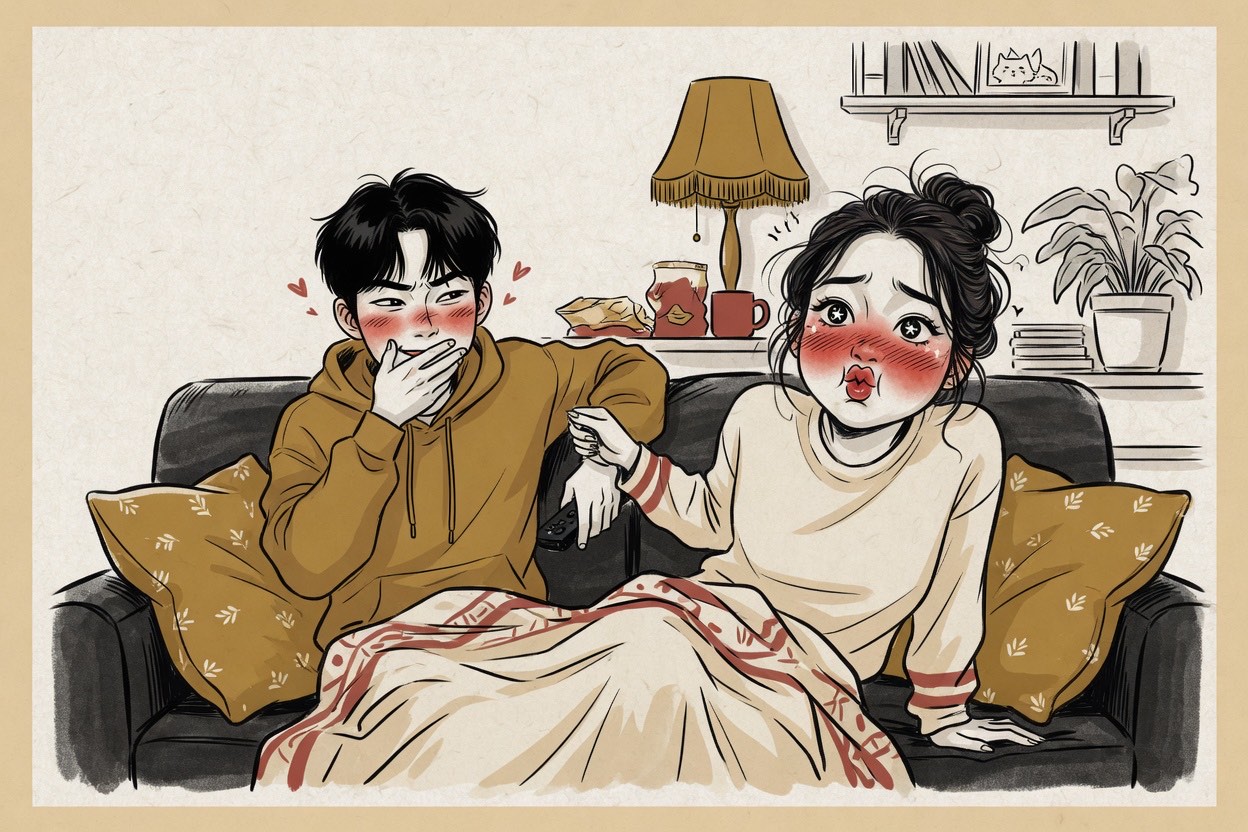
Aegyo sal (애교살) — not the same word game
Aegyo sal is a beauty/face term, not a behavior term.
- Aegyo = cute act (voice, gesture, performance).
- Aegyo sal (애교살) = the soft under-eye fat that can puff slightly when you smile, making eyes look rounder and “cuter.”
People discuss aegyo sal in makeup, skincare, and “do I have it?” selfies. Some celebrate it; some contour around it—none of that is “doing aegyo” in the social sense. Confusing the two is like confusing “smile lines” with “stand-up comedy.” Related root, different job.
What does aegyo mean in K-pop?
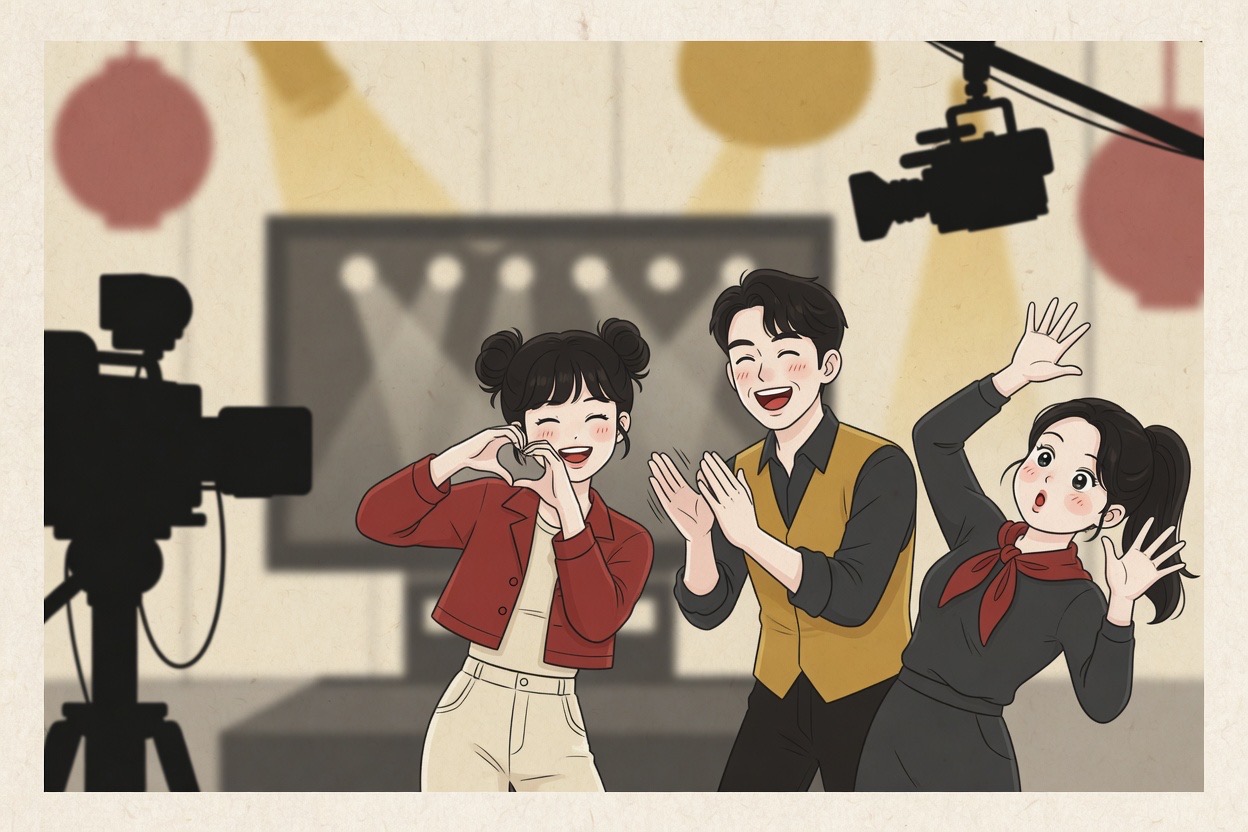
In K-pop and idol variety, aegyo is a scheduled cute segment—often requested by MCs, fans, or concept trailers. A member might:
- deliver a practiced gesture on beat
- switch into a soft voice for a challenge
- refuse dramatically, which is also content
- lean into “forced aegyo” as comedy because the group knows it is awkward on purpose
Fan culture treats these clips as collectible mood. That does not mean idols live in aegyo off camera, or that every oppa on a stage is inviting you to baby-talk them in real life. Stage aegyo is closer to choreography than to a private couple bit: lights, timing, audience contract.
International fans sometimes flatten all cute idol moments into “aegyo.” Soft styling and actual aegyo bits overlap, but they are not identical. A cute outfit is styling. A timed pout-and-finger-heart after a host’s countdown is aegyo-as-segment.
Gwiyomi, the song, and the fan-culture cousin
You will also hear gwiyomi / gwiyeomi (귀요미)—roughly “cutie”—as a nickname and meme reference. The Gwiyomi song wave (a playful count-and-pose cute routine in Korean internet and variety culture) trained viewers to treat on-command cute as content, not only private flirtation.
Useful distinction:
| Term | Rough job |
|---|---|
| Aegyo | the act of performing cute charm |
| Gwiyomi | calling someone (or yourself) a cutie; also a meme/song cue |
| Aegyo sal | under-eye soft fat / beauty feature |
Fans may shout “gwiyomi” the way English crowds yell “so cute!” Aegyo is what the performer does in response—or refuses to do, which can be funnier.
Is aegyo cringe? Do Koreans actually like aegyo?
Yes and no—often in the same friend group.
Many Koreans enjoy aegyo when:
- the relationship is close
- the bit is short
- the person is known for humor, not for weaponized helplessness
- entertainment framing makes “forced cute” the joke
Many Koreans side-eye aegyo when:
- it feels like emotional pressure dressed as baby talk
- a workplace junior uses it to dodge responsibility
- gender scripts demand women be cute and men be recipients only
- a stranger or a camera forces it without warmth
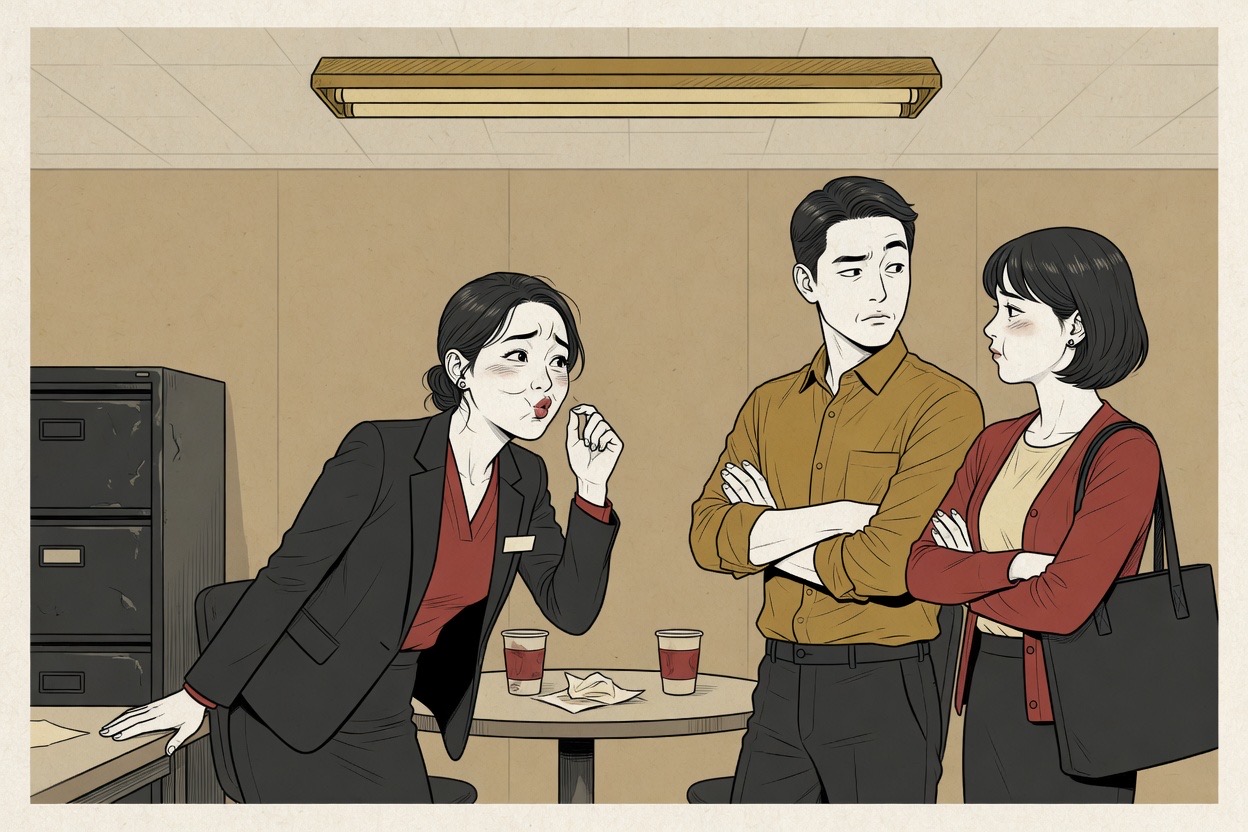
So is aegyo cringe? It can be. Do Koreans actually like aegyo? Some do, some don’t, most are situational. The cultural fact is not “Korea loves baby voice.” It is that Korea has a named social tool for performed cuteness, and people argue about it the way people argue about pickup lines: useful, optional, easy to overplay. What works in a couple’s kitchen can die by the office microwave.
Example dialogues
1. Couple sofa, banmal, dessert diplomacy
Friday night. There is ice cream. There is also a person who “wasn’t hungry.”
- Partner A: 나 아이스크림 먹고 싶어.
Na aiseukeurim meokgo sipeo.
I want ice cream. - Partner B: 냉장고에 있잖아. 네가 가져오면 되지.
Naengjanggoe itjana. Nega gajyeoomyeon doeji.
It’s in the fridge. You can go get it. - Partner A: 부탁해~ 한 번만. 응?
Butakhae~ han beonman. Eung?
Please~ just this once. Yeah? - Partner B: …알았어. 대신 다음엔 네가 사 와.
…Arasseo. Daesin daeumen nega sa wa.
…Fine. But next time you buy it.
Gloss: Classic home aegyo—soft pleading, not a full baby monologue. Banmal. The deal still has terms.
2. Friend group, “do aegyo” as a joke tax
Cafe table. Someone is late. Forgiveness has a price.
- Friend 1: 늦었으니까 애교 하나 해 봐.
Neujeosseunikka aegyo hana hae bwa.
You’re late, so do one aegyo. - Late friend: 싫어. 창피해.
Sireo. Changpihae.
No. It’s embarrassing. - Friend 2: 그럼 커피는 네가 사는 거지?
Geureom keopineun nega saneun geoji?
Then you’re buying coffee, right? - Late friend: …알겠어. 그냥 애교 부릴게.
…Algesseo. Geunyang aegyo burilge.
…Fine. I’ll just do the aegyo.
Gloss: Aegyo as playful penalty. Refusal is allowed; the group is negotiating comedy, not obedience.
3. Variety-adjacent practice, polite-ish banter
Dorm hallway. Two trainees (or theater kids—same energy) dare each other.
- A: 카메라 있으면 애교 부릴 수 있어?
Kamera isseumyeon aegyo buril su isseo?
If there’s a camera, can you do aegyo? - B: 연습할 때만. 평소엔 안 해.
Yeonseuphal ttaeman. Pyeongsoen an hae.
Only when practicing. Not in normal life. - A: 그럼 지금 연습이다. 하나, 둘!
Geureom jigeum yeonseupida. Hana, dul!
Then this is practice. One, two! - B: 귀엽지~? …끝. 절대 다시 묻지 마.
Gwiyeopji~? …Kkeut. Jeoldae dasi mutji ma.
Cute, right~? …Done. Never ask again.
Gloss: On-demand cute with a hard stop. The joke includes the refusal to live there.
Good nunchi / Zero nunchi
Good nunchi
You are at a Korean friend’s apartment. Their partner does a two-second pout for the last fried chicken wing; everyone laughs; life continues. You do not film it. You do not demand an encore “for the foreigners.” Later, when someone jokes that you should try aegyo, you offer a tiny awkward finger heart, own the cringe, and buy the next round. You treated cuteness as optional social spice, not a tourist checkpoint.
Zero nunchi
Same night. You hear “aegyo” once and decide the whole culture is a baby-voice theme park. You baby-talk the maknae of the friend group, ask the quietest person to “be cute for the camera,” and crown a random woman “aegyo queen” unprompted. The room goes polite. You thought you were fluent in K-pop. You performed a stereotype without a relationship.
Do / Don’t
Do
- Keep aegyo short, situational, and aimed at people who already like you.
- Separate aegyo (behavior) from aegyo sal (under-eye fat / beauty talk).
- Read K-pop aegyo as stage content, not a personal invitation.
- Laugh with forced-cute bits; let people refuse without punishment.
- Use your nunchi: if faces freeze, stop.
Don’t
- Deploy cute voice as a workplace strategy for favors you should ask normally.
- Assume all Koreans want or perform aegyo.
- Confuse gwiyomi nicknames, aegyo sal, and aegyo performance as one blob.
- Stretch a three-second bit into a permanent personality cosplay.
- Film or demand cute from people who did not opt in.
Nearby ideas (for later on Have Nunchi)
- Nunchi (눈치) — whether this room wants cute, quiet, or neither
- Maknae (막내) — youngest in a group; not automatically “the aegyo one”
- Oppa (오빠) — older-male address from a female speaker; fan speech ≠ real-life script
- Hello in Korean — greetings first; cute later, if ever
- Banmal / jondaemal — speech level changes how aegyo lands; baby talk + wrong politeness level is chaos
A closing line
Aegyo is not “Korean people are childish.” It is a named dial for performed cuteness—useful in love and comedy, loud on variety TV, easy to misread from outside the relationship that licensed it.
Turn the dial with people who already handed you the remote. Everyone else gets regular human volume—and your best nunchi.
FAQ
What does aegyo mean in Korean?
Aegyo (애교) is cute charm—soft voice, babyish speech, and playful gestures used to look adorable, soften a request, or entertain a close audience. It is a social performance, not a personality diagnosis.
What is aegyo sal?
Aegyo sal (애교살) is the soft under-eye fat that can make eyes look rounder and cuter when you smile. It is a face feature people talk about in beauty culture—not the same thing as doing aegyo behavior.
How do you do aegyo?
Common moves include a soft high voice, pouts, head tilts, finger hearts, and playful pleading. Context matters more than the pose—aegyo that works with a partner can feel wrong at work.
What does aegyo mean in K-pop?
In K-pop and variety, aegyo is on-demand cute performance for cameras and fans—often a timed bit, not a permanent offstage personality. Idols may also refuse it as a joke or boundary.
Is aegyo cringe? Do Koreans actually like it?
Both. Close relationships and entertainment can enjoy it; strangers, formal rooms, and forced cute can read as awkward or manipulative. Taste varies by age, mood, and who is performing for whom.
Do you have nunchi?
Get short Korean word lessons and social cues in your inbox.