What Does Saranghae Mean? 사랑해, 사랑해요, and 사랑합니다
Three ways to say I love you—and a whole culture that does not say it lightly.
- Hangul
- 사랑해
- Romanization
- saranghae
- Pronunciation
- sa-rang-hae
- Category
- Phrases
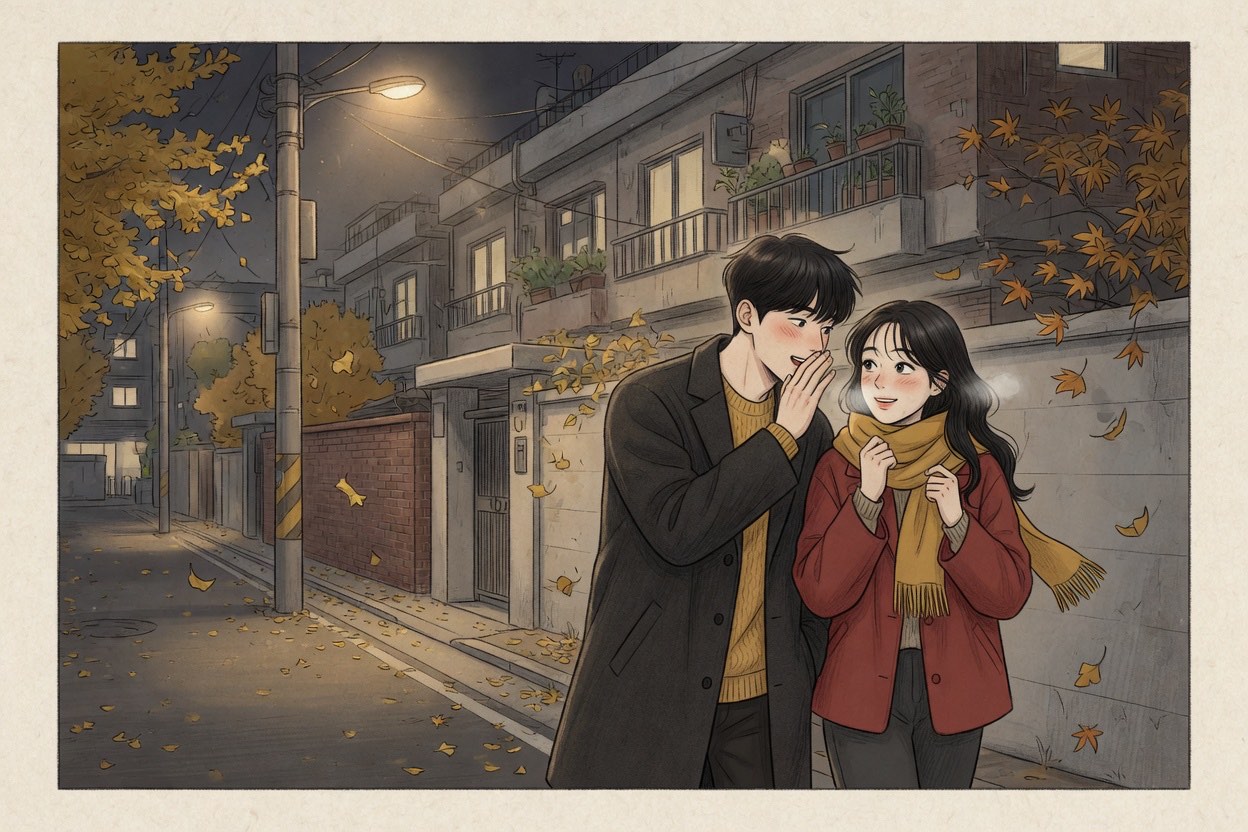
Saranghae (사랑해, pronounced sa-rang-hae) means I love you in casual Korean. The polite twin is saranghaeyo (사랑해요), and the formal version is saranghamnida (사랑합니다). One-sentence definition: saranghae is “I love you” with the intimacy already built in—the ending tells you how close the speakers are allowed to sound.
English “I love you” can cover partners, pets, pizza, and a friend leaving the party. Korean 사랑해 is heavier. People use it, of course—couples, parents, idols, lyrics, late-night texts—but many rooms treat the words as a real threshold, not daily seasoning. If you only need the search answer: 사랑해 = casual “I love you”; 사랑해요 = polite “I love you”; 사랑합니다 = formal “I love you.” The rest of this page is when each one fits, and why 좋아해 (I like you) is the step English speakers often skip.
Quick facts
| Hangul | 사랑해 |
| Romanization | saranghae |
| Pronunciation | sa-rang-hae (three clear beats) |
| Literal sense | I love (you) — casual ending |
| Polite form | 사랑해요 (saranghaeyo) |
| Formal form | 사랑합니다 (saranghamnida) |
| Plain/declarative | 사랑한다 (saranghanda) |
| Lighter neighbor | 좋아해 (joahae) — I like you |
| Register | banmal intimacy, not stranger-safe |
How do you pronounce saranghae?
Sa-rang-hae. Even stress, three short syllables. Do not turn it into “sa-rang-hay” with a long English diphthong on the end. The final hae is closer to “heh” than “hay.”
Saranghaeyo adds a soft yo: sa-rang-hae-yo. Saranghamnida lands as sa-rang-ham-ni-da—the b in hangul ㅂ becomes an m sound before 니다, which is why you hear hamnida, not habnida.
If you have practiced hello in Korean, keep the same clean vowels. Over-acting the romance in the pronunciation does not make the feeling truer; it just makes the line sound like a karaoke challenge.
What does saranghae mean?
사랑 is the noun love. 해 is the casual “do / I do” ending. So 사랑해 is the banmal way to say you love someone: intimate, direct, no politeness padding.
That intimacy is the whole point. You do not open a first coffee date with 사랑해 the way an English speaker might jokingly say “love you, bye” to a coworker. In Korean, the line usually assumes:
- you already share casual speech (banmal), or
- the relationship can hold the weight of the word, or
- the setting is staged (song, drama, fan call, variety bit)
The word is simple. The social software around it is not.
사랑해 vs 사랑해요 vs 사랑합니다 — three registers
This is the spine of the search. All three mean I love you. The difference is speech level—the same axis that runs through Korean honorifics: who is older, how formal the room is, and how close you already are.
| Form | Hangul | Feel | Who usually gets it |
|---|---|---|---|
| Casual | 사랑해 | intimate, soft or blunt | partner, close family in banmal, same-age friend you already speak casually with |
| Polite | 사랑해요 | warm + respectful | dating early stages, someone older you love, public soft confession, many idol-to-fan lines |
| Formal | 사랑합니다 | ceremonial, public, firm | stages, weddings, speeches, fan greetings, highly respectful declarations |
사랑해 — casual, close range
사랑해 is the form English speakers usually want when they type “saranghae meaning.” It is the whisper after a long day, the text at 1 a.m., the quiet line that only works because the two of you already dropped formality.
Use it when banmal is already the air you breathe. If you still say 요 endings to each other for everything else, jumping to bare 사랑해 can feel either too fast or strangely intimate—like switching from “Ms. Kim” to a pet name mid-sentence.
사랑해요 — polite default for soft rooms
사랑해요 keeps the love and adds the polite ending. Couples who still use jondaemal with each other may land here first. So may a younger person speaking up the age ladder, or a public figure aiming warmth without full formal stiffness. Same feeling as 사랑해, with the hallway light still on: sincere, a little safer, still real.
사랑합니다 — formal and public
사랑합니다 is the suit-and-microphone form. You hear it in:
- concert mentos and fan meetings
- wedding vows and public speeches
- highly respectful declarations to elders or audiences
- broadcast lines meant to land cleanly for a crowd
It is not “colder love.” It is love that knows the room is listening. The formality is about setting and hierarchy, not about caring less.
Quick chooser
- Already banmal with this person? → 사랑해 is available.
- Still polite with each other, or the person is older / the moment is semi-public? → 사랑해요.
- Stage, ceremony, broadcast, or maximum respect? → 사랑합니다.
- Unsure and the relationship is new? → say something lighter first (see 좋아해 below). Silence plus care often beats a dramatic wrong register.
What about 사랑한다?
사랑한다 (사랑한다, saranghanda) is the plain / declarative style: “I love (you).” It shows up a lot in:
- parents speaking to children (or adult kids)
- letters, notes, and diary-like writing
- song lyrics and literary narration
- firm, declarative speech rather than soft pleading
Compared with 사랑해, 사랑한다 can sound a shade more stated than tender—not colder, just less “cute ending,” more “this is the fact.” A father might say it without performing romance. A lyric might use it because it sits cleanly in a melody. Do not treat it as wrong; treat it as another speech-style dial on the same verb.
When do Koreans actually say it?
Less freely than English “love you,” and that gap is the culture, not a failure of romance.
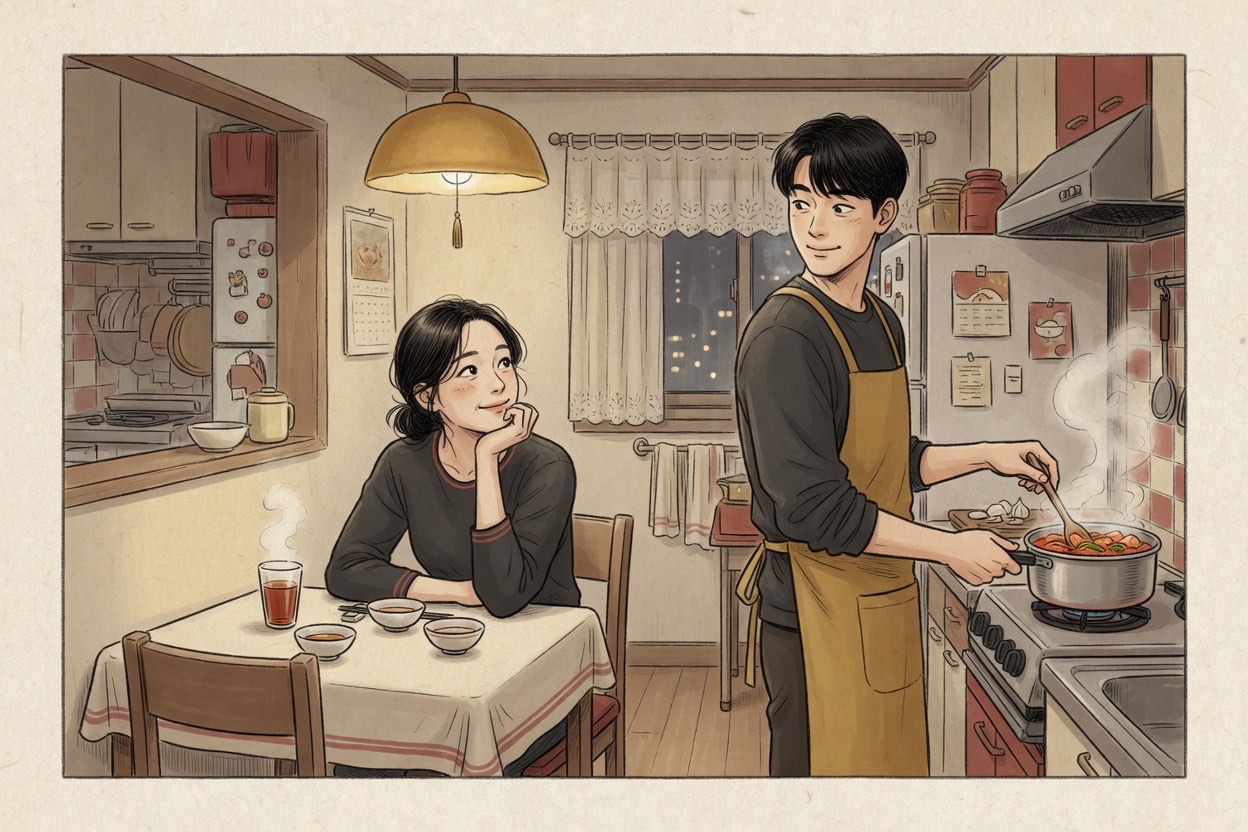
Many Korean speakers grow up hearing love shown more than scheduled as a daily verbal checkbox:
- packing extra side dishes
- waiting at the station
- checking whether you got home
- fixing the thing you mentioned once
When 사랑해 finally appears, it often marks a peak—confession, reconciliation, a hard day—not “bye, love you” after every call. Families and couples vary; younger speakers text more freely. Still, the core holds: the words are expensive, so people spend them carefully.
That is also why foreigners who spray “saranghae” like confetti can create awkward heat. You meant friendliness. The room heard a level-up.
Nunchi matters here more than vocabulary. Read whether this relationship wants the word, a gesture, or dinner that appears without announcement.
좋아해 vs 사랑해 — the confession ladder English skips
This is the section learners mess up most.
| Line | Hangul | English weight |
|---|---|---|
| I like you | 좋아해 / 좋아해요 | romantic interest; the classic confession |
| I love you | 사랑해 / 사랑해요 | deeper attachment; often later, heavier |
In a lot of Korean dating scripts, 좋아해 is the real door-opener. It says: I have feelings for you as more than a friend. 사랑해 says the feelings have matured into love—or that you are already inside a relationship where love is the agreed word.
English speakers often jump the ladder because “I like you” can sound junior-high, while “I love you” sounds adult and decisive. In Korean, the junior-high embarrassment is partly the point. A careful 나 너 좋아해 can be braver and more accurate than an early 사랑해 that the other person has to answer with a heavier vocabulary than they are ready for.
How the ladder usually climbs
- Interest without a label — more texts, better listening, slightly stupid courage.
- 좋아해 / 좋아해요 — the confession many dramas and real lives treat as the hinge.
- Dating language — titles, banmal negotiations, public couple status.
- 사랑해 / 사랑해요 — love named out loud, once the relationship can hold it.
People skip steps—some early, some never. The mistake is importing English timing and then wondering why the room froze.
Related soft language (without faking fluency)
You will also hear care without the full love word:
- 보고 싶어 — I miss you
- 좋아 — I like (it / this / you, depending on context)
- 고마워 / 고마워요 — thank you (often doing emotional work)
- presence, food, and showing up — the unglamorous majority of affection
If someone never says 사랑해 but always makes sure you ate, do not score that as zero. Score the whole relationship.
Saranghae in K-pop and at concerts
K-pop is where English speakers meet 사랑해 / 사랑해요 / 사랑합니다 as a public ritual.
On stage, idols often send love outward to fans with polite or formal forms—사랑해요, 사랑합니다—because the audience is huge, mixed-age, and not a private banmal relationship. Fans shout it back. Light sticks wave. The exchange is real emotion inside a performance frame: love as collective bond, not a private couple contract.
You will also see:
- fan chants and slogan slogans built around love language
- ending mentos that thank and love the crowd in one breath
- online comments that use 사랑해 the way English uses “I love this person” about a stranger celebrity
Fan 사랑해 can be loud because the idol–fan channel is a known genre. Personal 사랑해 to a classmate still follows private rules. Do not copy concert volume into a quiet café confession.

Finger hearts and the gestures that stand in for words
Sometimes the body says it so the mouth does not have to.
Finger heart — thumb and index finger making a tiny heart — became a default cute love signal in K-pop, selfies, and friend groups. It can mean love you, you’re adorable, or just camera ready. Context decides whether it is romance or brand.
Other stand-ins:
- two arms overhead in a big heart
- a quick hug that ends a little early because the station is public
- linking arms, pouring a drink, pushing a plate closer
- a sticker pack that says what the speaker will not type in plain text
Gestures are lower-stakes currency, not a free 사랑해. A finger heart after a concert is easy; across a first date table it is a hypothesis. Read the room the way you would before using a kinship title like oppa—warmth needs permission, not only technique.
Example dialogues
1. Late-night banmal — the quiet real one
Apartment, lights half off. They already speak casually.
- Minseo: 오늘 진짜 힘들었어.
Oneul jinjja himdeureosseo.
Today was really hard. - Joon: 알아. 잘 버텼어.
Ara. Jal beotyeosseo.
I know. You got through it well. - Minseo: 사랑해.
Saranghae.
I love you. - Joon: 나도. 자, 물 마셔.
Nado. Ja, mul masyeo.
Me too. Here—drink some water.
Gloss: Casual all the way. The love line is short; care continues as logistics. No speech-level clash.
2. Early dating, polite — 좋아해 before 사랑해
After dinner walk. They still use polite endings.
- Hana: 저, 할 말이 있어요.
Jeo, hal mari isseoyo.
Um, I have something to say. - Sora: 네? 무슨 말인데요?
Ne? Museun marindeyo?
Yeah? What is it? - Hana: 소라 씨, 저 소라 씨 좋아해요.
Sora ssi, jeo Sora ssi joahaeyo.
Sora, I like you. - Sora: …갑자기요? 저도, 사실 조금요.
…Gapjagi-yo? Jeodo, sasil jogeum-yo.
…Out of nowhere? Me too, actually, a little.
Gloss: Jondaemal confession with 좋아해요, not 사랑해요. Name + 씨 keeps respectful distance while the feeling steps forward. This is the ladder working correctly.
3. Parent to adult child — 사랑한다 at the station
Departure board, rolling suitcase. Slight public embarrassment, full sincerity.
- Mother: 도착하면 전화해.
Dochakhamyeon jeonhwahae.
Call when you arrive. - Son: 네, 엄마.
Ne, eomma.
Okay, Mom. - Mother: 엄마는 우리 아들 사랑한다.
Eommaneun uri adeul saranghanda.
Mom loves her son. - Son: …알고 있어요. 엄마도요.
…Algo isseoyo. Eommadoyo.
…I know. You too, Mom.
Gloss: Declarative 사랑한다 from parent; adult son answers with polite warmth. Nobody needs a drama monologue. The hug can be short. The sentence still lands.

4. Concert mento — public formal love
Encore lights. Mic feedback. Twenty thousand people pretending not to cry.
- Idol: 오늘도 와 줘서 고마워요.
Oneuldo wa jwoseo gomawoyo.
Thank you for coming again today. - Idol: 여러분, 사랑합니다!
Yeoreobun, saranghamnida!
Everyone—I love you! - Crowd: 사랑해!
Saranghae!
Love you!
Gloss: Idol uses formal 사랑합니다 to the crowd; fans fire back casual 사랑해 as a mass shout. Different registers, same ritual channel. Do not treat this as permission to 사랑해 your professor.
Good nunchi / Zero nunchi
Good nunchi
You have been dating for a while in polite speech. On a quiet walk, you say 좋아해요 first—clear, a little nervous, matched to the relationship. Later, when banmal and real partnership settle in, 사랑해 arrives without a press conference. You let the ladder climb at human speed.
Zero nunchi
First language-exchange meetup. You learned “saranghae” from a lyric video and drop it as a fun goodbye, complete with finger heart, to someone who offered you tissue pack recommendations. They laugh too hard. You think you made a friend. You performed a couple-threshold word as a party trick.
Do / Don’t
Do
- Match the ending to the relationship: 해 / 해요 / 합니다.
- Learn 좋아해 as the confession step, not a childish downgrade.
- Notice love that arrives as food, time, and logistics—not only as three syllables.
- Keep concert 사랑합니다 in the concert genre.
- Soften with timing: private rooms beat public ambushes.
Don’t
- Spray 사랑해 at strangers, teachers, or new coworkers for “practice.”
- Jump from English “love you” habits straight to Korean love timing.
- Mix banmal love into a still-polite relationship without reading the room.
- Demand the word as proof while ignoring care you already receive.
- Force a finger heart to replace a conversation you are avoiding.
Nearby ideas
- Hello in Korean — register practice with lower stakes than love
- Korean honorifics explained — why endings and titles move together
- Nunchi — whether this room wants the word, a gesture, or silence
- Oppa — kinship warmth that can sit beside dating language
- Maknae — family and group roles where affection often shows as care, not speeches
A closing line
Saranghae is easy to romanize and expensive to mean. The hangul is short; the relationship underneath is the real vocabulary list—좋아해 when you are climbing, 사랑해 when you are home, 사랑해요 when respect still shares the room, 사랑합니다 when the lights are on and the crowd is listening.
Say the form the other person can answer. Hold the rest in how you show up—and keep your nunchi sharper than your lyric translations.
FAQ
What does saranghae mean?
Saranghae (사랑해) means I love you in casual Korean (banmal). It is the intimate form you use with a partner, a close family member, or someone you already speak casually with—not a first-meeting line.
What is the difference between 사랑해, 사랑해요, and 사랑합니다?
All three mean I love you. 사랑해 is casual, 사랑해요 is polite/standard, and 사랑합니다 is formal. Who you are speaking to—and how close you already are—decides which ending fits.
What does 사랑한다 mean?
사랑한다 is the plain/declarative form of I love you. Parents, older speakers, letters, lyrics, and diary-style lines use it often. It can feel firm or literary rather than soft-cute.
What is the difference between 좋아해 and 사랑해?
좋아해 means I like you. 사랑해 means I love you. In Korean dating culture, liking is often the real confession step; jumping straight to love can feel rushed or heavy if the relationship is still early.
Do Koreans say saranghae as often as English speakers say I love you?
Usually no. Many people save 사랑해 for partners, family, and charged moments. Care often shows up as food, presence, and practical help—so the words land harder when they finally appear.
Do you have nunchi?
Get short Korean word lessons and social cues in your inbox.