What Does “Mukbang” Mean? Eating on Camera, Explained
Someone eats on camera. You watch. Somehow that is dinner for two.
- Hangul
- 먹방
- Romanization
- mukbang
- Pronunciation
- muk-bbang
- Category
- Words
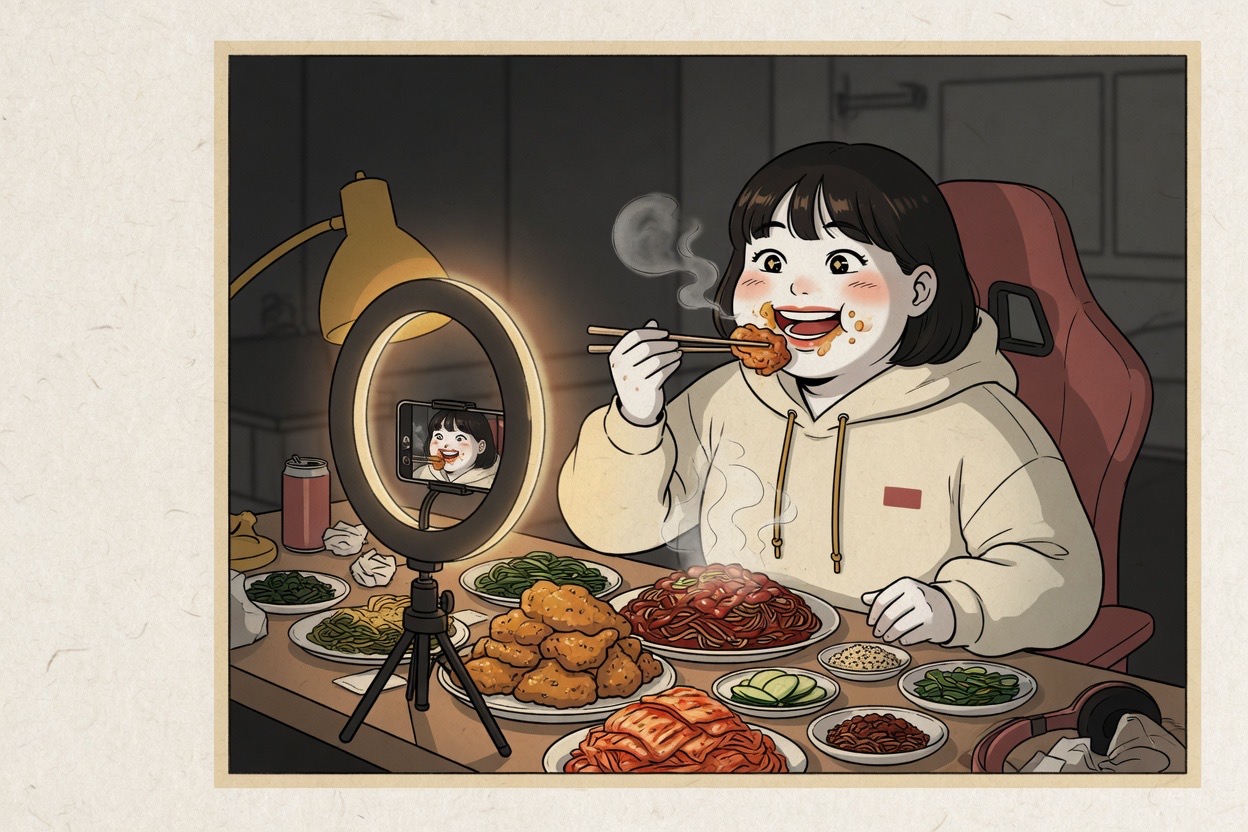
Mukbang (먹방, pronounced muk-bbang) is a Korean internet word for a broadcast of someone eating—a livestream or video where the host eats on camera, often talking, reacting, and letting the meal’s sounds do half the work. The word is a blend of 먹다 (meokda, to eat) and 방송 (bangsong, broadcast). One-sentence definition: mukbang is eating turned into a show, made for people who want company, noise, or appetite without cooking a second meal for a guest.
English borrowed the label; Korea built the format. If you only needed the definition for search, you already have it. The rest is why the word stuck, how natives say it, and why a camera pointed at noodles can feel less lonely than silence.
Quick facts
| Hangul | 먹방 |
| Romanization | mukbang (rarely meokbang) |
| Pronunciation | muk-bbang (tensed second syllable) |
| Etymology | 먹다 (to eat) + 방송 (broadcast) |
| Core format | person eats on camera; talk optional; sound often essential |
| Where it grew | Korean livestream culture → global YouTube / short video |
| Nearby idea | 혼밥 (honbap) — eating alone |
How do you pronounce mukbang?
English usually says mook-bang, long and soft. Spoken Korean is closer to muk-bbang — hangul 먹방, often felt as [먹빵] in the mouth. The second half is a tensed bbang, not a loose English bang. Think short first syllable, punchy second: muk-BBANG, not MOOK-baaang.
You will still hear “mook-bang” in English headlines and creator bios. That is fine for recognition. If you want the native shape, tighten the second beat.
What is a mukbang?
A mukbang is not “any food video.” It is eating as the main event: portions visible, chewing audible, host present. Early Korean versions lived on livestream platforms—hosts with chat open, long sessions, real-time comments, a camera that treated dinner like a talk show without a studio budget.
The classic ingredients:
- A person on camera (solo is the default)
- Food arranged to read well on screen
- Continuous eating across a stretch of time
- Chat or comments as the social layer
- Sound that is either casual or deliberately crisp
Some hosts talk constantly. Some barely speak and let crunch do the work. Some stage mountains of fried chicken; some film a normal bowl of ramen at a normal speed. The word covers a spectrum—from soft company-at-dinner to spectacle eating—as long as broadcast + eating stay in the frame.
Why did mukbang land when it did? (Hello, honbap)
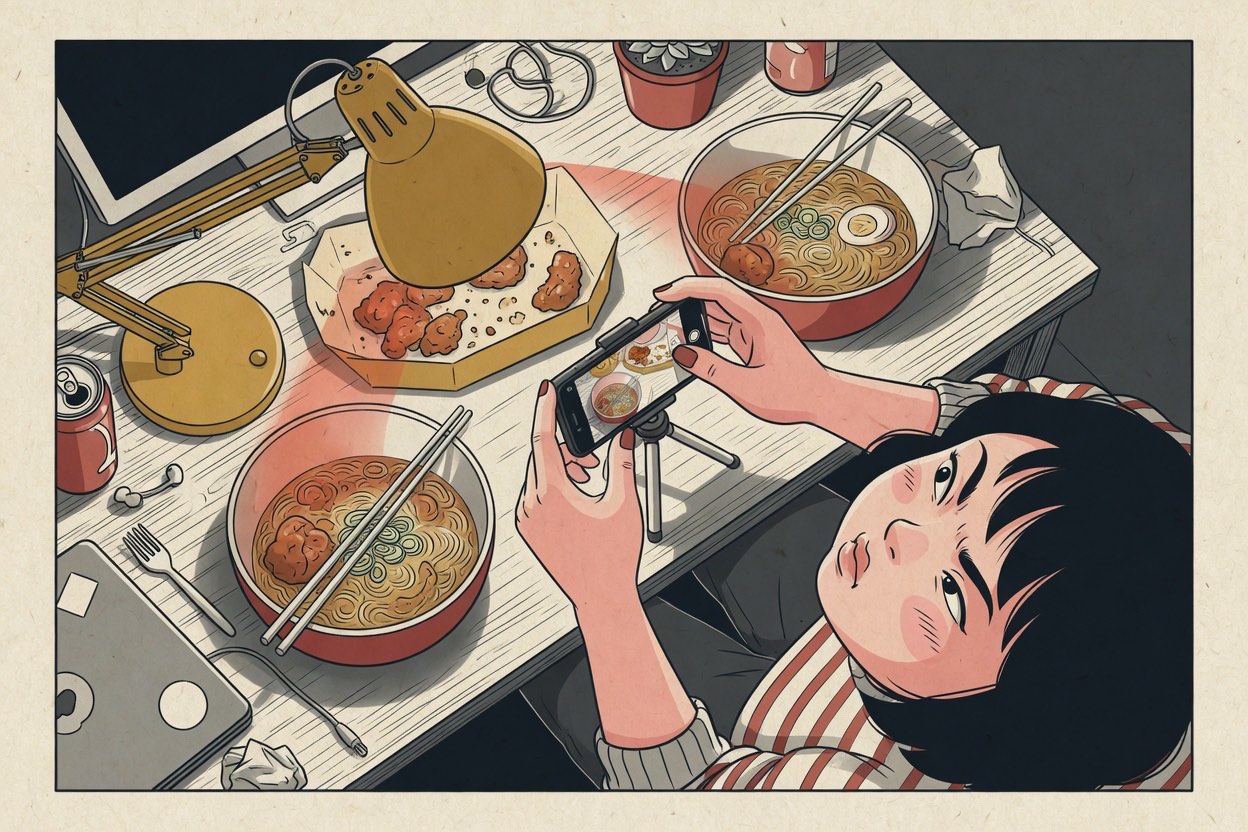
Mukbang did not arrive in a vacuum. It rose alongside honbap (혼밥)—eating alone—as a normal part of city life. Long work hours, one-person households, late nights, and the mild awkwardness of a restaurant table for one made dinner a lonely slot for a lot of people.
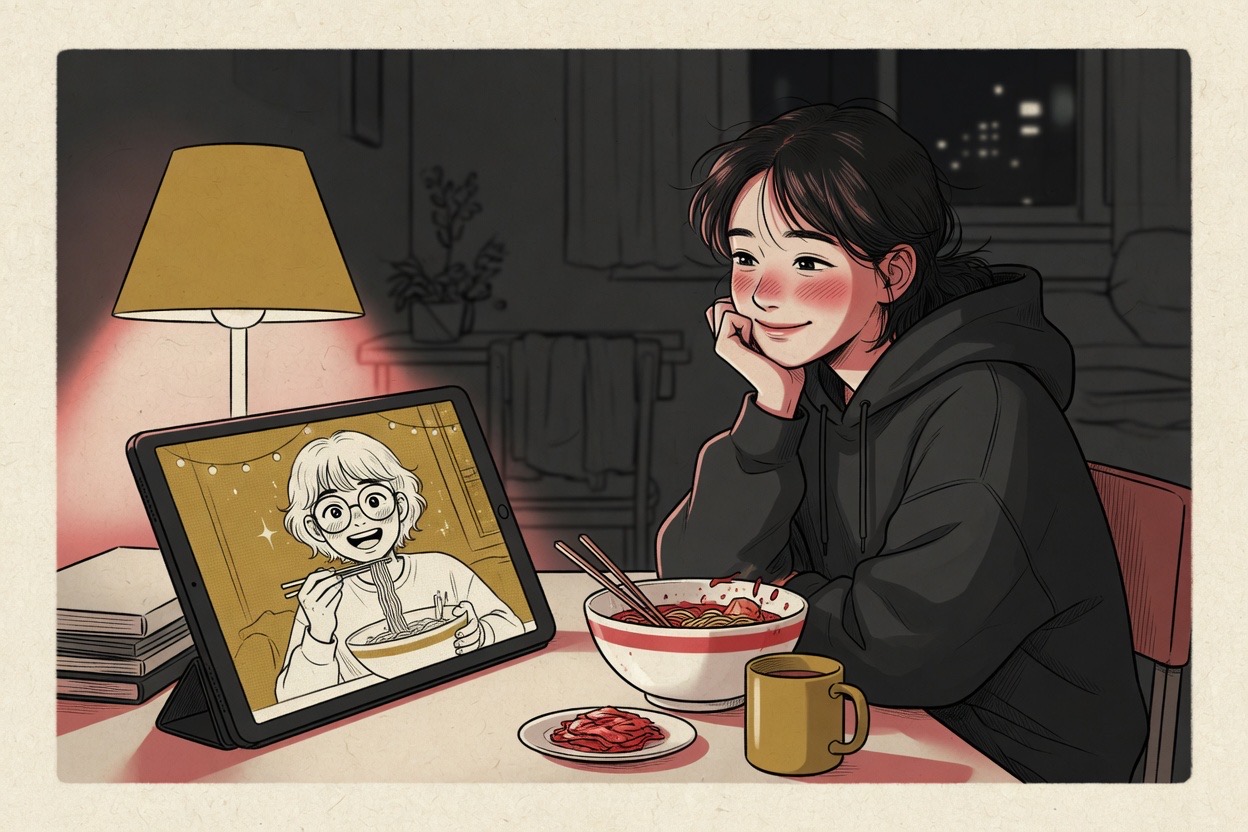
A livestream host eats on the other side of a screen. You eat at your table. Nobody has to perform a full friendship. That is company-by-proxy: not a date, not a family meal, not nothing. For many viewers, mukbang is less “watch a stranger binge” and more “borrow a dinner companion for forty minutes.”
If you have read our note on nunchi, the social read is similar: the format thrives when people sense a gap in the room—here, the gap is an empty chair—and invent a low-friction way to fill it without a full invitation.
Why do people watch mukbang?
Honest reasons, not a PR deck:
1. Company while eating alone
You do not want silence with your takeout. A host chatting about the day, or simply chewing in good lighting, softens the alone part of alone-eating.
2. Appetite and vicarious fullness
Some viewers watch hungry and get hungrier. Others watch full and feel strangely satisfied by proxy. Food media has always done both; mukbang makes the timing match your meal.
3. Sound as pleasure (ASMR edge)
Crispy batter, soup slurps, sticky rice pull. For a large slice of the audience, the audio is the point, not a side effect.
4. Spectacle
Huge spreads, challenge plates, dramatic first bites. Same logic as watching someone open mystery boxes—except the box is a table of food.
5. Low-stakes social hangout
No group chat pressure. No “where should we meet.” You can leave mid-bite. That freedom is part of the product.
None of these require you to copy the host’s portion size. Watching is not a meal plan.
What is mukbang ASMR?
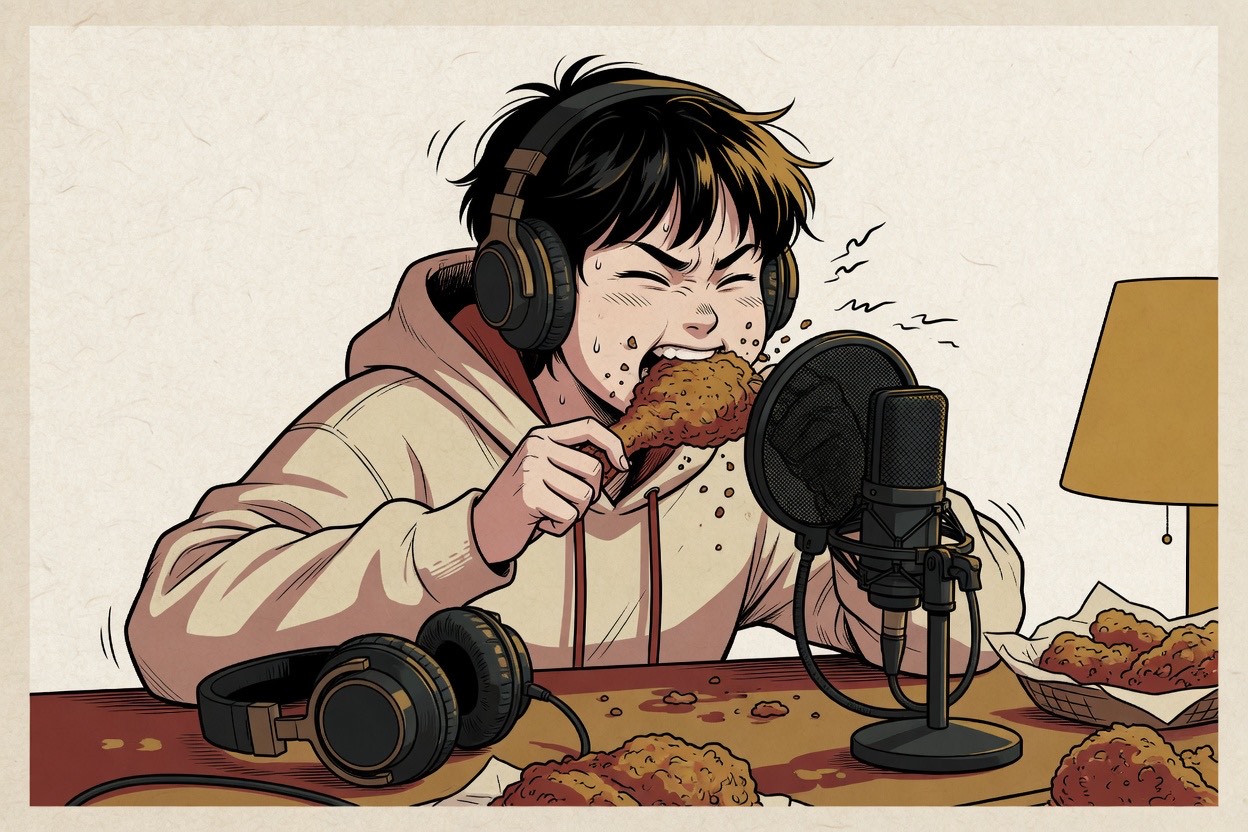
Mukbang ASMR is the branch where eating sounds lead. A sensitive mic sits close to the bowl. Headphones on the viewer side make every crackle of fried chicken feel three inches from your ear. The host may speak in a soft voice, or barely speak at all, eyes half-closed, chasing clean audio more than comedy.
Why sound matters:
- Food already has a texture story; mics amplify it
- ASMR audiences already train for soft, rhythmic, intimate audio
- Eating is repetitive enough to become a sound loop without needing a script
Not every mukbang is ASMR. A loud, chatty livestream with jokes and chat raids is still mukbang if eating is the spine. ASMR is a flavor of the format—popular enough that people search “mukbang asmr” as its own phrase.
Mukbang vs ASMR eating vs food vlog
People mash these together. The boundaries are messy in practice, cleaner in intent:
| Format | Main promise | Typical energy |
|---|---|---|
| Mukbang | Watch someone eat (often live-adjacent culture, portions, presence) | Company, spectacle, or sound-led eating |
| ASMR eating | Watch/hear eating for tingles and texture audio | Quiet, mic-forward, soft talk or no talk |
| Food vlog | Follow a person through meals, places, recipes, travel | Story and setting; eating may be secondary |
A single video can sit on two rows at once. A travel creator who films a night market can do food-vlog structure with mukbang-adjacent close-ups. An ASMR eater who never talks is still doing a kind of mukbang if the whole video is one meal on camera. Use the labels as center of gravity, not as police tape.
If you came from K-culture vocabulary like maknae or oppa, treat mukbang the same way: a Korean word that English stretched into a genre name, then argued about forever.
Is mukbang still popular? Mukbang in Korea today
Yes—as a global content category. No—not as a single unchanging Korean fad frozen in 2010s livestream culture.
Rough arc without fake numbers:
- Korean livestream rooms made eating-with-chat a recognizable job and pastime.
- YouTube and short video exported the word and the visual grammar worldwide. English “mukbang” became a genre tag next to cooking channels and ASMR.
- Domestic mood shifted. Extreme portion shows still exist, but Korean conversation around them often carries ambivalence: concern about waste and health optics, jokes about exaggeration, and preference for smaller, talkier, more everyday meals on camera.
So if you ask “is mukbang still popular,” the honest answer is split by geography and format. Internationally, the hashtag and the search still pull hard. Inside Korea, the early gold-rush glow cooled into something more ordinary—and more judged when the plate looks like a stunt.
That is culture doing what culture does: invent a clever form, export it, then argue with its own export.
When you’ll hear it
- Friends planning a quiet night: “I’m doing honbap and putting on a mukbang.”
- Comment sections under food videos: “this is pure mukbang, not a recipe.”
- English media explaining Korean internet culture in one borrowed noun.
- Someone contrasting “real mukbang” (long eat, presence) with a thirty-second snack clip.
- Light teasing: “Stop filming. This isn’t a mukbang.”
You will less often hear it for a private family dinner with no camera. No broadcast, no mukbang—etymology still rules.
Example dialogues
1. Late-night apartment, banmal, company on a screen
Tuesday, 11 p.m. One person, one table, one tablet.
- A: 오늘 또 혼밥이야?
Oneul tto honbab-iya?
Eating alone again tonight? - B: 응. 먹방 틀어 놓고 먹을 거야.
Eung. Meokbang teureo noko meogeul geoya.
Yeah. I’m putting on a mukbang while I eat. - A: 그거 보면 더 배고프지 않아?
Geugeo bomyeon deo baegopeu-ji ana?
Doesn’t that make you hungrier? - B: 이상하게 덜 외로워.
Isanghage deol oerowo.
Weirdly, I feel less lonely.
Gloss: Casual speech. Mukbang as loneliness softener, not as cooking class.
2. Office kitchen, polite-ish work talk
Lunch break. Two coworkers comparing evening plans.
- Colleague: 주말에 뭐 하세요?
Jumare mwo haseyo?
What are you doing this weekend? - Minho: 집에서 치킨 시켜 먹고 먹방 볼 거예요.
Jibeseo chikin sikyeo meokgo meokbang bol geoyeyo.
Ordering chicken at home and watching mukbang. - Colleague: 먹는 방송 보면서 또 먹는 거예요?
Meongneun bangsong bomyeonseo tto meongneun geoyeyo?
You’re eating while watching an eating broadcast? - Minho: 네. 그게 제일 편해요.
Ne. Geuge jeil pyeonhaeyo.
Yes. That’s the most comfortable setup.
Gloss: Soft polite speech. The double-eating loop sounds absurd until you have tried it once after a long week.
3. Friends arguing genres, banmal
Group chat energy, in person.
- Sora: 이거 먹방이야, 브이로그야?
Igeo meokbang-iya, beuirogeu-ya?
Is this a mukbang or a vlog? - Jae: 먹는 소리만 들리는데?
Meongneun sori-man deullineunde?
All I hear is eating sounds? - Sora: 그럼 ASMR 먹방이지.
Geureom ASMR meokbang-iji.
Then it’s ASMR mukbang. - Jae: 이름을 왜 이렇게 많이 붙여?
Ireumeul wae ireoge mani buchyeo?
Why stick so many names on it?
Gloss: Friends doing free genre theory. The food does not care what you call it.
Good nunchi / Zero nunchi
Good nunchi
A Korean friend says they are tired and doing honbap with a mukbang on. You do not lecture them about “real social life,” do not demand they join your group dinner after they already said no, and maybe offer to drop off snacks without turning it into a performance. You treated the format as rest, not as a character flaw.
Zero nunchi
Same friend. You film their quiet dinner without asking, caption it “mukbang practice lol,” and push them to finish more food “for content.” They wanted silence and a screen. You turned their recovery night into unpaid entertainment. That is not fluency. That is skipping the most basic hello: may I?
Do / Don’t
Do
- Use mukbang for eating-as-broadcast, not every food photo on Instagram.
- Pronounce it closer to muk-bbang when you care about the Korean shape.
- Separate “I enjoy watching” from “I must eat like the thumbnail.”
- Remember honbap as the social weather system that made the format make sense.
- Credit ASMR, chat culture, and spectacle as different reasons people stay.
Don’t
- Invent health miracles or dangers as clickbait science.
- Assume every Korean loves extreme-portion shows.
- Call a silent family meal a mukbang because someone chewed loudly.
- Shame people for watching company-on-a-screen when the alternative is worse silence.
- Confuse food vlogs, recipe tutorials, and mukbang into one blurry blob forever—unless the video truly sits on the border.
Nearby ideas (for later on Have Nunchi)
- Honbap (혼밥) — eating alone; the social gap mukbang often fills
- Nunchi (눈치) — reading whether this room wants company, quiet, or a camera off
- Oppa / maknae culture words — other Korean labels English borrowed into internet dialect
- Bangsong (방송) — broadcast; the second half of the blend, still doing work
A closing line
Mukbang is not a diet. It is dinner with the lights on for an audience—sometimes you, sometimes a chat room, sometimes a stranger who also did not want to eat in total silence.
Keep the etymology in your pocket: eat + broadcast. Use the word when a camera makes a meal into shared time, and keep your nunchi when someone’s quiet table is not content at all.
FAQ
What does mukbang mean?
Mukbang (먹방) is a blend of 먹다 (to eat) and 방송 (broadcast)—a livestream or video of someone eating, usually with talk, sounds, and a camera pointed at the food.
How do you pronounce mukbang?
Closer to muk-bbang [먹빵], with a tensed second syllable. English “mook-bang” is common abroad; native speech is shorter and punchier on the second beat.
Why do people watch mukbang?
Company while eating alone, appetite (or vicarious fullness), ASMR crunch, spectacle, and a low-stakes social hangout without leaving home.
What is mukbang ASMR?
Mukbang that leans on eating sounds—chewing, soup sips, crispy batter—as the main draw. The mic is half the show; the meal is the other half.
Is mukbang still popular?
Yes, but the center of gravity moved from Korean livestream rooms to global YouTube, and Korean audiences are more mixed about extreme-portion formats than the early hype years.
Do you have nunchi?
Get short Korean word lessons and social cues in your inbox.