What Does “Jeong” Mean? Korea’s Bond That Time Builds
Not friendship, not romance—the bond that grows because you shared time, even when you never chose to like each other.
- Hangul
- 정
- Romanization
- jeong
- Pronunciation
- juhng
- Category
- Culture
Jeong (정, pronounced juhng) is the Korean word for the attachment that accumulates between people—and often places and things—over shared time. It is not friendship, not romantic love, not loyalty you swear out loud. One-sentence definition: jeong is a bond that forms because you have lived beside something long enough, whether or not anyone chose to care.
If you only needed the search answer, stop here. Jeong is time-built stickiness—the market ajumma who slips extra greens into your bag, the coworker you still check on after quitting, the old mug you cannot throw away. The part English struggles to carry is 미운 정 (miun jeong): attachment that grows even toward someone you dislike, because you have endured each other. That idea is the heart of this page.
Quick facts
| Hangul | 정 |
| Romanization | jeong |
| Pronunciation | juhng |
| Core idea | attachment that accumulates through shared time |
| Not the same as | friendship, romance, loyalty, obligation |
| Key patterns | 정이 들다 · 정이 많다 · 정 떨어지다 · 미운 정 |
| Closest English | bond / attachment / soft loyalty of habit (all incomplete) |
How do you pronounce jeong?
One syllable: juhng. Soft j (as in just), short vowel, nasal ng at the end. Not jee-ong. Not jong like a temple bell. Older academic romanization sometimes shows chŏng; modern search spelling is jeong, and the mouth still wants juhng.
What does jeong mean, really?
English keeps reaching for near-misses.
- Friendship implies mutual choice and liking. Jeong can form without either.
- Love implies intensity and often romance. Jeong can be quiet, domestic, almost boring.
- Loyalty implies a decision to stay true. Jeong can make leaving hard before anyone names a duty.
- Affection is close on warm days and fails on the days you are irritated.
Jeong is closer to residue. You shared meals, schedules, weather, silence, and small favors. The relationship acquired weight. That weight can feel warm—or heavy—or both at once.
Koreans do not treat jeong as a museum word. It shows up when someone explains why they still visit a so-so restaurant, why they keep a cracked rice cooker, why they miss a neighborhood that never looked special on a map. The feeling is ordinary. The naming is precise.
Time is the main ingredient
Jeong almost never arrives on first contact. A first date can be thrilling without it. A perfect customer-service script can be polite without it. What builds it is repetition with a human face: the same bus stop, the same desk row, the same corner-store auntie who already knows your milk brand, the same sibling who still steals the remote and still calls after midnight.
Shared time does not guarantee fondness. It guarantees contact history. Jeong grows out of that history—and not only between people. Places hold it (a hometown alley, a campus cafeteria). Things hold it too: a chipped mug, worn slippers, a childhood spoon. Throwing them out feels slightly like betrayal, not because they are expensive, but because time stuck to them.
미운 정 — the bond English cannot carry
Here is the payload of the page.
미운 정 (미운 정, miun jeong) is jeong that grows even toward someone you dislike, precisely because you have endured each other.
It is not a love-hate relationship. Love-hate implies swinging between attraction and repulsion, or secret romance under friction. 미운 정 does not require attraction. It does not need the plot twist that you “actually love them.” You may still find them annoying. You may still avoid long dinners. And yet, after enough shared seasons, something attaches.
Bond-through-endurance.
Think of the coworker whose habits grate every Monday—and who still knows your coffee order, and whose absence on leave leaves the floor oddly empty. The relative you argue with at every holiday—and still check on when the weather turns dangerous. The roommate from a hard year abroad: you would not rebook that apartment, but you would answer their message at 1 a.m.
English sometimes says “we have history.” History is the raw material. 미운 정 is what history deposits when the deposit is attachment, not nostalgia and not admiration. Tourists learn nunchi as social radar. Learners meet honorifics as etiquette software. 미운 정 is the emotional physics of co-endurance—and English does not own a clean word for it.
What 미운 정 is not
| Tempting English gloss | Why it fails |
|---|---|
| Love-hate | Implies romantic or attraction oscillation |
| Stockholm syndrome | Pathologizes ordinary social residue |
| Forced loyalty | Makes it duty; 미운 정 can exist without an oath |
| “We’re frenemies” | Too performative; 미운 정 can be quiet and private |
| Toxic attachment (always) | Can be unhealthy or simply human; the word is descriptive |
Respect the idea by not sweetening it. You can dislike someone and still carry jeong for them. That sentence is allowed to be uncomfortable. It is also true.
The verb patterns: how Koreans do jeong
Jeong is a noun that lives in verbs. Learn the patterns and the concept stops being abstract.
정이 들다 — jeong takes hold
정이 들다 (jeong-i deulda) means jeong has entered / taken hold. You have grown attached—after months at a small office, toward a local bakery, or with a difficult class cohort that became family-shaped. Nobody scheduled it. Time did the work.
정이 많다 — full of jeong
정이 많다 (jeong-i manta) describes a person who gives attachment generously—extra side dishes, remembered exam weeks, fruit when you move. Not “nice” as manners; “this person deposits care.” You might hear it about grandmothers who feed the building, or a senior who treats juniors as more than task receivers. Related warmth shows up in terms of endearment, but 정이 많다 is broader than pet names.
정 떨어지다 — jeong falls away
정 떨어지다 (jeong tteoreojida) means the attachment drops—cruelty, betrayal, a coldness that cannot be unheard, or small disrespects that finally empty the account. It is not a mild disagreement. Afterward, manners may remain. Jeong may not.
Nearby phrases
| Phrase | Sense |
|---|---|
| 정 있다 | has jeong; warm attachment shows |
| 정 없다 | cold, detached, no residue of care |
| 정을 주다 / 받다 | give / receive that sticky care |
| 미운 정 고운 정 | ugly-and-beautiful jeong from long co-living |
고운 정 (goun jeong) is the gentle counterpart: soft affection grown through kindness and ease. Paired with 미운 정, it reports on living near someone for a long time—not a romance novel, a dual ledger.
Everyday manifestations — where you will see it
Jeong rarely announces itself with a speech. It shows up as behavior.
The extra side dish
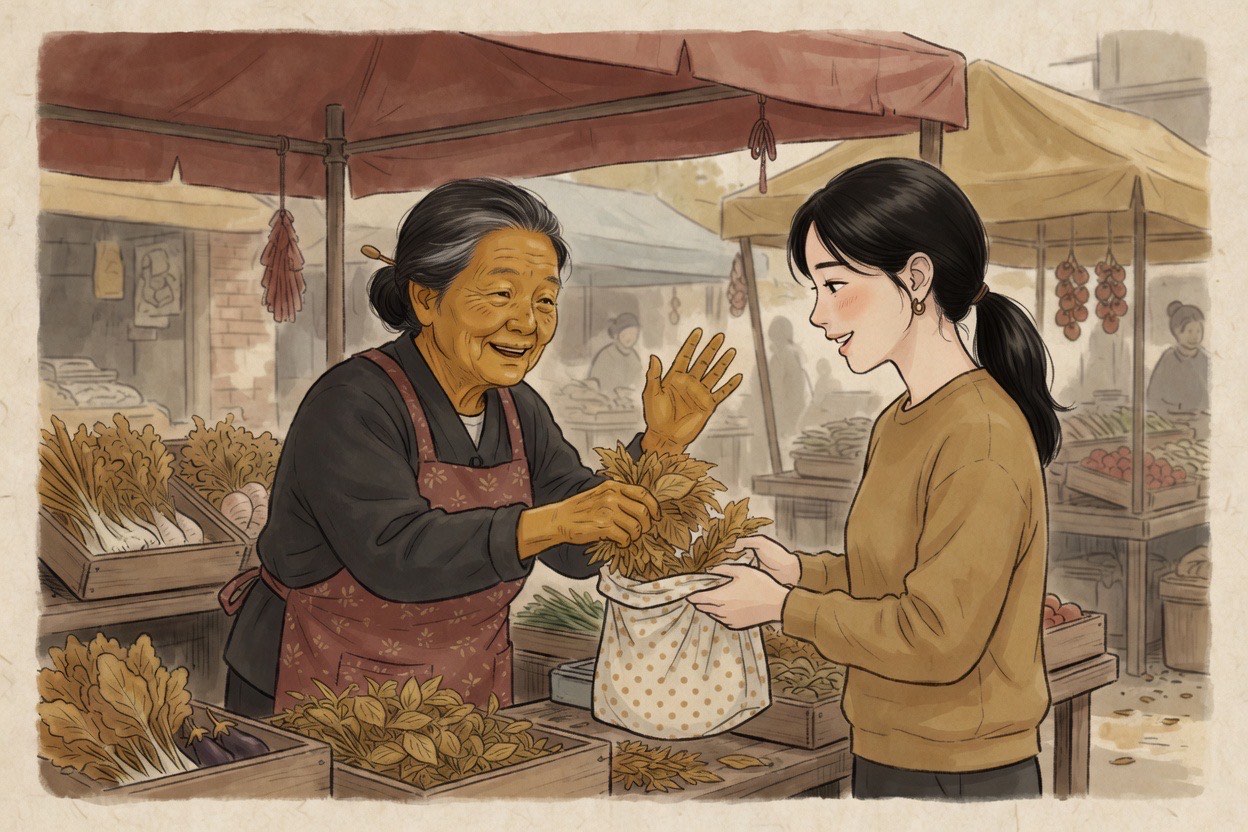
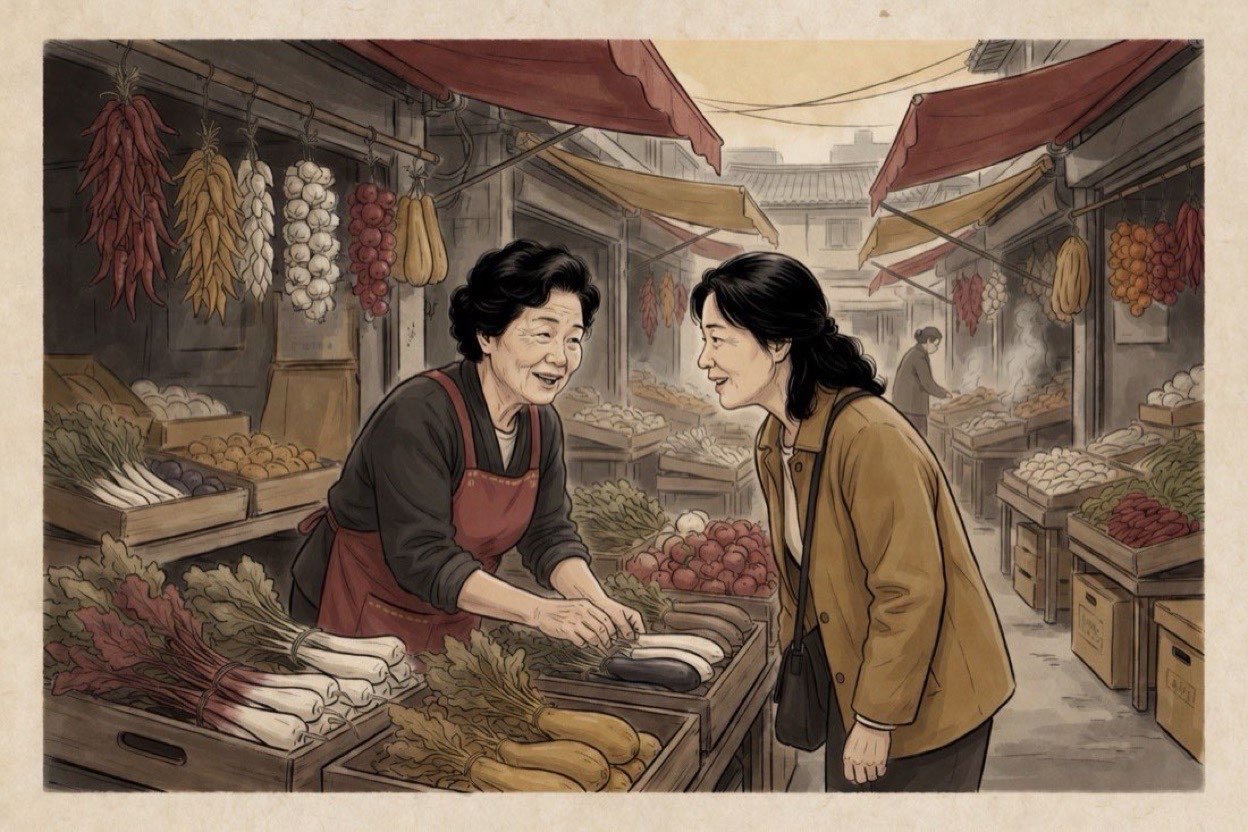
A market vendor adds one more handful of scallions and waves off the coins. She is not running a loyalty program. She is treating you as a person who has returned enough times that the relationship has thickness. That thickness is jeong made edible.
The shopkeeper who remembers you
“You always take the less-spicy one,” said with a half-smile while already reaching for the package, is jeong performing itself. You feel slightly known. That feeling is why chains can be efficient and still feel empty.
The neighbor with foil-covered food
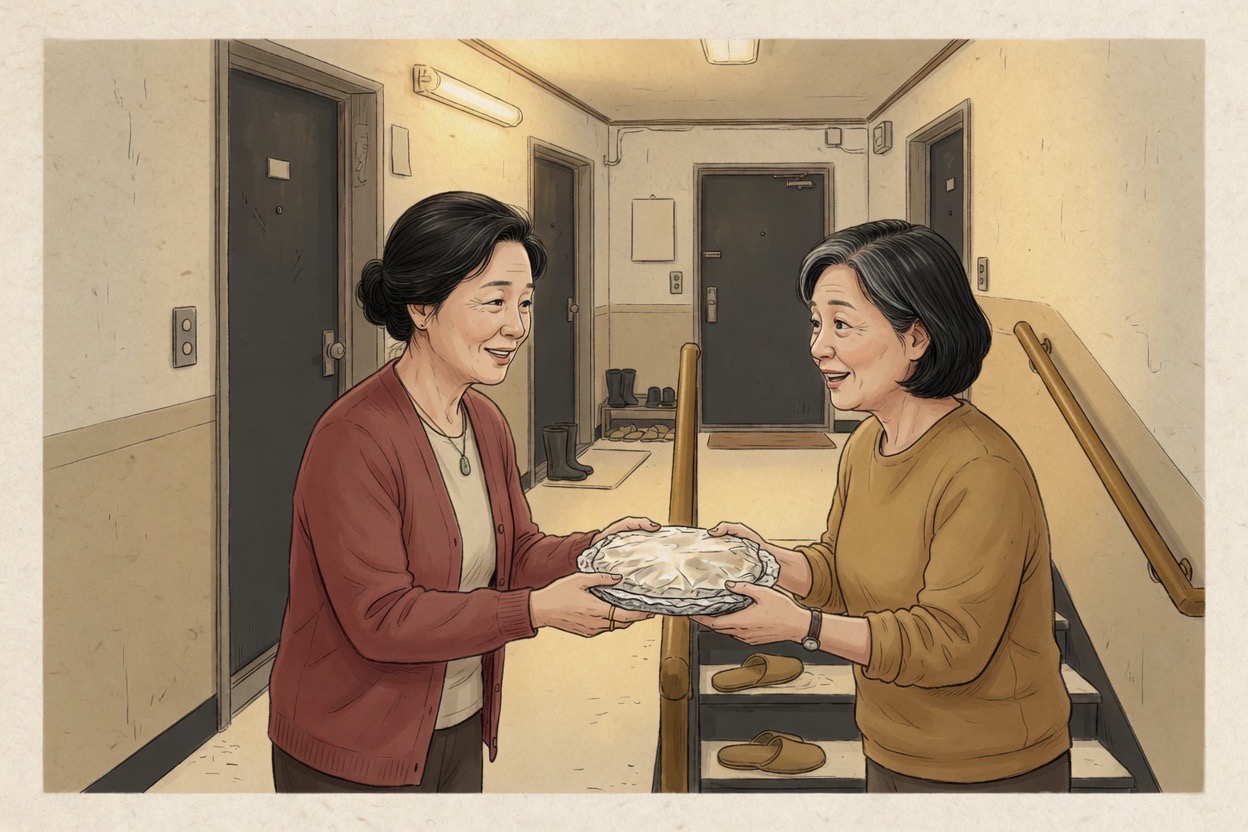
Apartment life has its own quiet economy of plates: leftover stew, fruit from a relative’s farm, soup after someone was sick. The plate will be returned. The foil is temporary. The point is contact.
Objects and group chats that refuse to die
A chipped mug from your first job. A university cohort chat that should have died twelve years ago—until a baby photo or funeral notice proves it still has pulse. Jeong is one reason mute is easier than leave, and why “functionally replaceable” is not the same as “easy to throw out.”
Why jeong makes leaving hard
This is where the concept stops being charming and starts explaining real decisions.
Quitting a job
You can dislike the work and still hesitate—not only for money or résumé optics, but because the team has weight. Night-bus stories. 미운 정 for the manager who micromanages and still covered for you once. Resignation is a career act and a relationship unbinding at the same time.
Moving neighborhoods
A better apartment can lose to a worse commute if the street has your people: the laundry owner, the kimbap place, the neighbor who takes packages. Leaving orphans a web of small recognitions. The grief is often quiet—an elevator in the new building where nobody knows your face yet.
Goodbyes thicker than the sentence
Korean goodbye culture already carries direction and rank—see goodbye in Korean—but jeong is why some farewells get wet eyes over a desk plant. The parting language is one layer. The accumulated attachment is another.
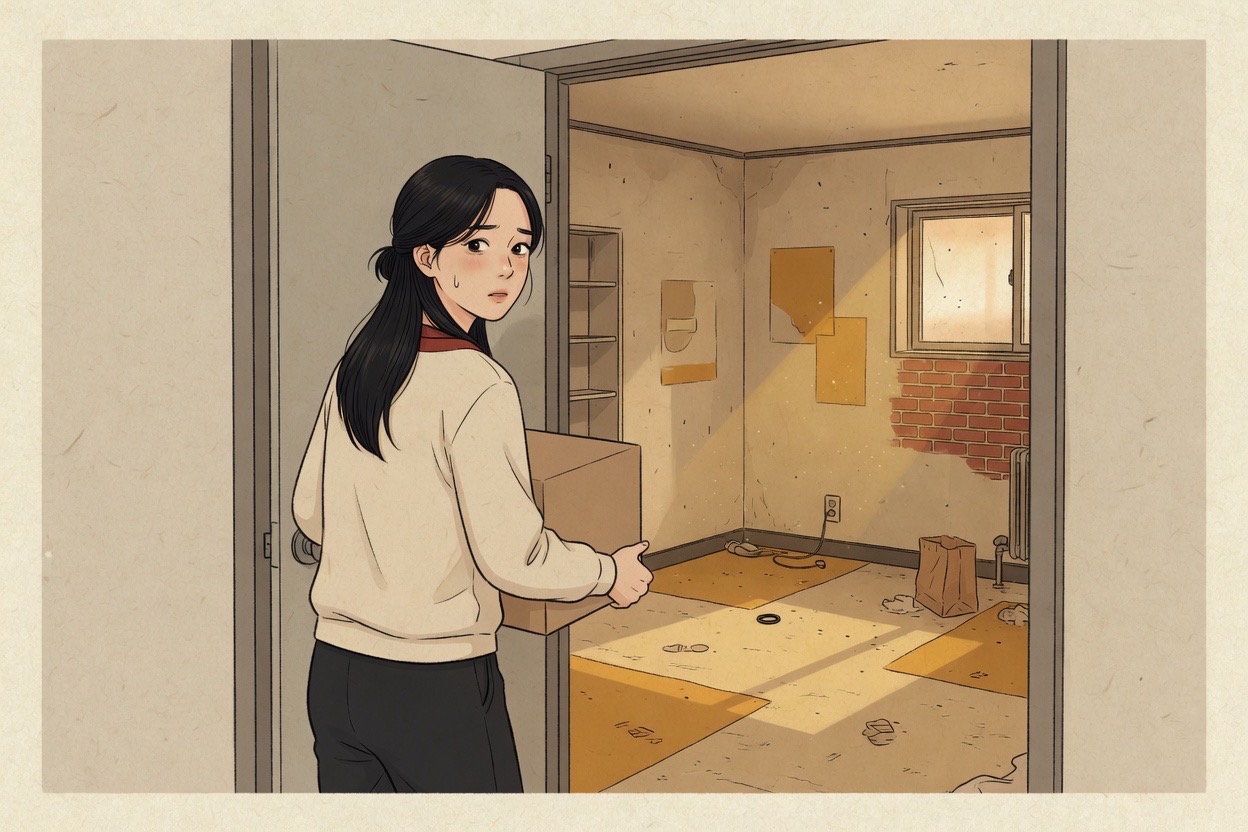
Jeong also complicates breakups. Two people may correctly decide not to continue and still feel the tug of shared winters and dumb jokes. That tug is not a reason to reunite. It is why the clean-break fantasy is rarer than movies sell.
Jeong vs nunchi — different jobs in the same room
People mash Korean “untranslatables” into one mystic pile. Separate them.
| Nunchi (눈치) | Jeong (정) | |
|---|---|---|
| What it is | Skill of reading mood, hierarchy, timing | Attachment residue from shared time |
| Speed | Fast—this moment, this silence | Slow—weeks, seasons, years |
| Can you practice it? | Yes, as social attention | Not really “practice”; you live it into being |
| Fails as | Tone-deafness, missing the cue | Coldness, no bond, or bond broken (정 떨어지다) |
| Metaphor | Radar | Sediment |
Nunchi reads the room. Jeong is what accumulates in it.
You can have sharp nunchi and still form little jeong if you never stay anywhere long. You can have deep jeong and still fumble a moment if your nunchi is off that day. Related social software—age rank, titles, who is the maknae of the team—shapes how care is distributed, but none of those words are jeong. They are the furniture of the room. Jeong is the wear pattern on the chairs.
When you’ll hear it
- A friend explaining a difficult ex-classmate: “미운 정이 들었나 봐.”
- Parents before a move: “여기 정이 많이 들었네.”
- Someone praising a person: “그 사람 정이 많아.”
- After a betrayal: “정 떨어졌어.” Flat. Final.
- Drama dialogue and variety-show confessions—sometimes soft, sometimes comic, sometimes the quiet thesis of a whole arc.
You will not typically hear jeong used as a pickup line the way English speakers borrow “oppa.” It is not a costume word. It is an accounting word for emotional history.
Example dialogues
1. Market regular, polite warmth
Tuesday morning, traditional market. The vendor already has the scale out.
- Vendor: 오늘도 상추랑 고추지? 이거 더 넣어 줄게.
Oneuldo sangchu-rang gochu-ji? Igeo deo neoeo julge.
Lettuce and peppers again today, right? I’ll put in some extra. - Customer: 아유, 그럼 돈 더 드려야죠.
Ayu, geureom don deo deuryeoyajyo.
Oh no—then I should pay more. - Vendor: 됐어, 됐어. 단골인데 뭘.
Dwaesseo, dwaesseo. Dangol-inde mwol.
It’s fine, it’s fine. You’re a regular—don’t mention it.
Gloss: The extra produce is not a coupon. “단골” (regular) is the social fact; the free handful is jeong behaving in public. Soft banmal from the older vendor; polite pushback from the customer.
2. Neighbors on the landing
Evening, apartment hallway. A foil-covered plate changes hands.
- Neighbor A: 어제 반찬 좀 많이 해서요. 맛은 별로여도 드셔 보세요.
Eoje banchan jom mani haeseoyo. Maseun byeolloyeodo deusyeo boseyo.
I made too many side dishes yesterday. They’re nothing special, but try some. - Neighbor B: 아이고, 왜 이러세요. 저희도 다음에 뭔가 가져갈게요.
Aigo, wae ireoseyo. Jeohuido daeume mwonga gajyeogalkkeyo.
Oh my, you shouldn’t have. We’ll bring something next time too. - Neighbor A: 그럼 빈 그릇만 나중에 주세요.
Geureom bin geureutman najunge juseyo.
Then just return the empty containers later.
Gloss: Jondaemal between neighboring adults. The food is the vehicle; the ongoing exchange is the point. Empty containers promise continued contact.
3. After hours, 미운 정 at work
Two colleagues, convenience-store coffee, after a brutal project month.
- Minseo: 팀장님 진짜 짜증 나지 않냐?
Timjangnim jinjja jjajeung naji anya?
Isn’t the team lead actually infuriating? - Haneul: 나지. 근데 이상하게 퇴사한다 하니까 좀 서운해.
Naji. Geunde isanghage toesahanda hanikka jom seounhae.
Yeah. But weirdly, hearing they’re resigning makes me a little sad. - Minseo: 미운 정이 든 거지, 뭐.
Miun jeong-i deun geoji, mwo.
That’s miun jeong for you, I guess. - Haneul: 맞아. 좋아서 그런 건 아닌데.
Maja. Joaseo geureon geon aninde.
Right. It’s not because we like them.
Gloss: Banmal between peers. Nobody claims secret fondness. They name bond-through-endurance out loud—and that honesty is the concept working correctly.
Good nunchi / Zero nunchi
Good nunchi
A Korean friend says they still feel weird about leaving a job they complained about for two years. You do not lecture them about “toxic workplaces” as if feelings were a spreadsheet error. You let them name 미운 정 if they want. You help pack the desk plant. You understand that attachment and approval are different columns.
Zero nunchi
Same friend. You roll your eyes: “If you hated it, just be happy.” You call their sadness fake or weak. You treat every complicated bond as bad English self-help waiting to be optimized. They stop explaining Korean feelings to you. You thought you were being rational. You stepped on sediment with clean shoes.
Do / Don’t
Do
- Treat jeong as accumulated attachment, not a synonym for love.
- Keep 미운 정 as bond-through-endurance—dislike allowed, attachment still real.
- Learn the verb patterns: 정이 들다, 정이 많다, 정 떨어지다.
- Notice everyday signs: extra food, remembered orders, hard goodbyes, unthrowable objects.
- Separate nunchi (reads the room) from jeong (fills the room over time).
Don’t
- Translate 미운 정 as “love-hate” and walk away.
- Force intimacy on day one and call it jeong. Jeong needs shared time.
- Mock someone for missing a place, a team, or a difficult person.
- Assume jeong means they should stay forever. Attachment explains weight; it does not cancel boundaries.
- Use the word as exotic wallpaper in English sentences you do not mean.
Nearby ideas on Have Nunchi
- Nunchi — reading mood and timing; the skill beside the sediment
- Maknae — youngest in a group; care and chores often flow along age lines that jeong later thickens
- Korean honorifics — titles and speech levels that structure how closeness is allowed to sound
- Goodbye in Korean — parting phrases when the bond still has weight
- Korean terms of endearment — warmer name-tools inside relationships that already have history
A closing line
Jeong is not a mood you put on. It is what time leaves behind between people—sometimes soft, sometimes heavy, sometimes aimed at someone you still find difficult.
If you can hold two truths at once—I don’t like this, and I am attached anyway—you already understand why 미운 정 needed its own page.
FAQ
What does jeong mean in Korean?
Jeong (정) is the attachment that accumulates between people—and often places or things—through shared time. It is not the same as friendship, romance, or loyalty; it is a bond that forms whether or not anyone planned to feel it.
What is miun jeong (미운 정)?
Miun jeong is jeong that grows toward someone you dislike, precisely because you have endured each other. It is bond-through-endurance, not a love-hate flip or secret romance.
How do you pronounce jeong?
Roughly juhng—one syllable, soft j, a short vowel, ending in an ng sound. Not “jee-ong,” not “jong” like a bell.
What does 정이 들다 mean?
Jeong-i deulda means jeong has taken hold—you have grown attached. Related patterns include 정이 많다 (someone is full of warm attachment) and 정 떨어지다 (jeong falls away; the bond cools or breaks).
How is jeong different from nunchi?
Nunchi reads the room—mood, timing, hierarchy. Jeong is what accumulates inside the room over shared days. One is a skill of noticing; the other is a residue of time together.
Do you have nunchi?
Get short Korean word lessons and social cues in your inbox.