How to Say Goodbye in Korean: 안녕히 가세요 vs 계세요
Who stays, who leaves—Korean goodbye is a small map of the room.
- Hangul
- 안녕히 가세요
- Romanization
- annyeonghi gaseyo
- Pronunciation
- an-nyung-hi ga-se-yo
- Category
- Phrases
Goodbye in Korean is not one fixed phrase. The polite pair you actually need is 안녕히 가세요 (안녕히 가세요, annyeonghi gaseyo) to the person leaving, and 안녕히 계세요 (안녕히 계세요, annyeonghi gyeseyo) to the person staying. One-sentence definition: Korean goodbye tracks who moves—go-peacefully for the leaver, stay-peacefully for the one who remains. Get the direction wrong and you sound like a textbook that never left the classroom.
Casual rooms swap in 잘 가 / 잘 있어. Close friends often use plain 안녕—the same two syllables that open a chat as hello in Korean. Workplaces layer in 수고하셨습니다. Bow depth and hand-waving fill the gaps speech cannot. Master the leave/stay split first; everything else is register.
Quick facts
| Core polite pair | 안녕히 가세요 (to leaver) / 안녕히 계세요 (to stayer) |
| Romanization | annyeonghi gaseyo / annyeonghi gyeseyo |
| Pronunciation | an-nyung-hi ga-se-yo / an-nyung-hi gye-se-yo |
| Literal spine | go peacefully / stay (remain) peacefully |
| Casual twins | 잘 가 / 잘 있어 |
| Banmal both-ways | 안녕 (hello and goodbye among close people) |
| See-you lines | 다음에 봐요, 또 봐요, 조심히 가세요 |
| Workplace parting | 수고하셨습니다 |
안녕히 가세요 vs 안녕히 계세요 — the spine
If you searched “goodbye in Korean” for one clean rule, this is it. Polite goodbye in Korean is a two-button system, not a single word you fire at whoever is nearest the door.
| You are speaking to… | Say | Why |
|---|---|---|
| Someone leaving (guest, friend heading out, customer exiting) | 안녕히 가세요 | Gaseyo = please go (respectfully) |
| Someone staying (host at home, clerk behind the counter, friend remaining at the table) | 안녕히 계세요 | Gyeseyo = please stay / remain (respectfully) |
Memory rule:
가 = go → 가세요 to the person walking away.
계 (from the humble/respectful “exist/remain”) → 계세요 to the person who is not moving.
Picture a doorway. The guest’s feet point to the hallway. The host’s feet stay on the doormat. Guest hears 가세요. Host hears 계세요. Reverse those and the room feels the glitch even if nobody corrects you out loud—that quiet social radar is pure nunchi.
Why learners flip them
English “goodbye” does not care who owns the door. Korean polite goodbye does. Learners often memorize only 안녕히 가세요 because it appears first in phrasebooks, then aim it at everyone—including the host who is clearly not leaving. The fix is not more vocabulary. The fix is one second of looking: who is moving?
A second trap: using both forms in the wrong order as a “complete” goodbye package. You do not need to fire both sentences at the same person. One correctly aimed line is enough. If two people are both leaving the shared spot—friends splitting on a sidewalk—both can receive a “go well” form, because neither is the stayer.
Same root as hello, different job
Both forms share the 안녕 peace-root you already know from hello. The second half does the real work:
- 가세요 — go (polite imperative / request form)
- 계세요 — stay / be (there) (polite)
You are not wishing abstract peace into the air. You are aiming a respectful go well or stay well at a body in space.
Casual versions: 잘 가 and 잘 있어
Friends and family who already share banmal (casual speech) run the same leave/stay logic with shorter tools.
| Situation | Casual phrase | Rough sense |
|---|---|---|
| To the person leaving | 잘 가 | Go well / take care on the way |
| To the person staying | 잘 있어 | Stay well / hang in there here |
| Soft polite-casual hybrid | 잘 가요 / 잘 있어요 | Same split, slightly softer ending |
잘 means “well.” So 잘 가 is “go well,” and 잘 있어 is “be (here) well.” The motion map did not change—only the speech level did.
Do
- Match banmal goodbyes only with people you already speak casually with.
- Keep the leave/stay direction even when the words get short.
- Wave, text later, move on—no monologue required.
Don’t
- Drop 잘 가 on a professor, client, or first-meeting stranger.
- Say 잘 있어 to someone already halfway down the stairs.
- Mix a polite title with pure banmal endings unless the relationship already lives there—Korean honorifics and speech level should travel together.
안녕 as both hello and goodbye
안녕 (안녕, annyeong) is the short form English speakers meet as “hi.” Between close friends, siblings, and anyone already on banmal, it also means bye.
Context does the sorting:
- Walking into the room → hello
- Walking out of the room → goodbye
- Text thread that is already informal → either, depending on whether the chat is opening or closing
This is why phrasebook rows that list “hello = 안녕, goodbye = 안녕히 가세요” feel incomplete. Real life recycles 안녕 at both ends of a close relationship. What it will not do is replace polite goodbye with elders, service staff, or anyone whose register is still jondaemal.
If your only Korean goodbye is a cheerful 안녕~ aimed at every clerk and auntie, you are not being warm—you are freelancing status.
See you again and get home safe
Once the leave/stay pair is solid, add the lines people actually stack on top of goodbye.
다음에 봐요 / 또 봐요
- 다음에 봐요 (다음에 봐요, daeume bwayo) — see you next time
- 또 봐요 (또 봐요, tto bwayo) — see you again
Casual versions drop the polite ending: 다음에 봐, 또 봐. These are soft future promises, not calendar invites. You can say them even when the next meeting is vague.
조심히 가세요
조심히 가세요 (조심히 가세요, josimhi gaseyo) means roughly “go carefully” / get home safe. It rides the same 가세요 track—aimed at the person leaving. Hosts say it to guests at the door. Friends say it when someone is catching a late subway. It is care, not a weather lecture.
Casual twin: 조심히 가.
Other exit lines you will hear
| Line | Register | Feel |
|---|---|---|
| 먼저 갈게요 | polite | “I’ll head out first” (you are leaving a group that stays) |
| 이만 가볼게요 | polite | soft “I’ll be off now” |
| 내일 봐 | banmal | see you tomorrow |
| 문자할게 | banmal | I’ll text you |
먼저 갈게요 is especially useful when you leave a table of people who remain seated. You are naming yourself as the leaver—then the stayers can answer with 조심히 가세요 or 들어가세요 depending on context.
수고하셨습니다 — workplace parting
Offices and late shifts often close with 수고하셨습니다 (수고하셨습니다, sugohasyeotseumnida) more than with textbook goodbye.
Rough sense: thank you for your hard work / you’ve worked hard. It is a respect package aimed at effort, not a literal “farewell forever.” Common patterns:
- Junior leaving for the night → 수고하셨습니다 (or 먼저 가보겠습니다) toward seniors still at desks
- Senior answering a junior’s exit → sometimes 수고 / 조심히 들어가 energy, or a light acknowledgment
- End of a shared task → 수고하셨습니다 as the group’s verbal period
You will also hear present-leaning 수고하세요 in some service and shift contexts (“keep up the good work” / hang in there on the remaining shift). Match what your team already uses. Inventing a deeper formal monologue than the room uses is its own kind of awkward.
Timing matters. Saying 수고하셨습니다 the moment you stand up—while your senior is still mid-sentence on a call—lands as interruption dressed as manners. Wait for a break in the air, catch an eye, then speak. Many teams also pair the phrase with a light bow and a half-step toward the door so the words and the body agree.
This is where age-and-rank culture shows up without kinship words. You may never call anyone maknae at work, but you will still feel who bows a little deeper on the way out—and who gets the first 수고하셨습니다.
Bowing and hand-waving when you part
Speech is only half the goodbye. Body language finishes the sentence.
Bows
- Small nod / slight bow with polite goodbye: everyday shops, classmates, coworkers. Shoulders ease forward; eyes soft.
- Deeper bow: elders, formal thanks, serious first-meeting exits. Match the room—do not perform theater-level ninety-degree bows for a convenience-store clerk.
- While leaving a room of seniors: face the room briefly, bow, then turn. Spinning out mid-sentence without a glance reads cold.
Waves
- Friends and same-generation peers: open-hand wave, sometimes walking backwards a few steps while still talking—classic street goodbye energy.
- More formal rooms: smaller hand motion or no wave at all if a bow already closed the exchange.
- Overly huge airport-wave energy at a quiet office door can feel like a variety-show bit. Scale to the space.
Hands and distance
- Handshakes at parting happen in some business and international-mixed settings. Two-handed or forearm-supported handshakes can signal extra respect with elders.
- Close friends may hug; many everyday Korean goodbyes still stay at bow + words + wave. Copy the room you are in, not the drama you watched last night.
Perfect hangul with a rigid, interview-still body still feels unfinished. A small bow is cheap, high-return nunchi.
When you’ll hear each form
- Guest leaving a home: guest → host 안녕히 계세요; host → guest 안녕히 가세요 (often plus 조심히 가세요)
- Shop or café: customer leaving may say a soft thank-you; staff often send them off with 안녕히 가세요
- Friends on the street: 잘 가, 내일 봐, plain 안녕, big wave
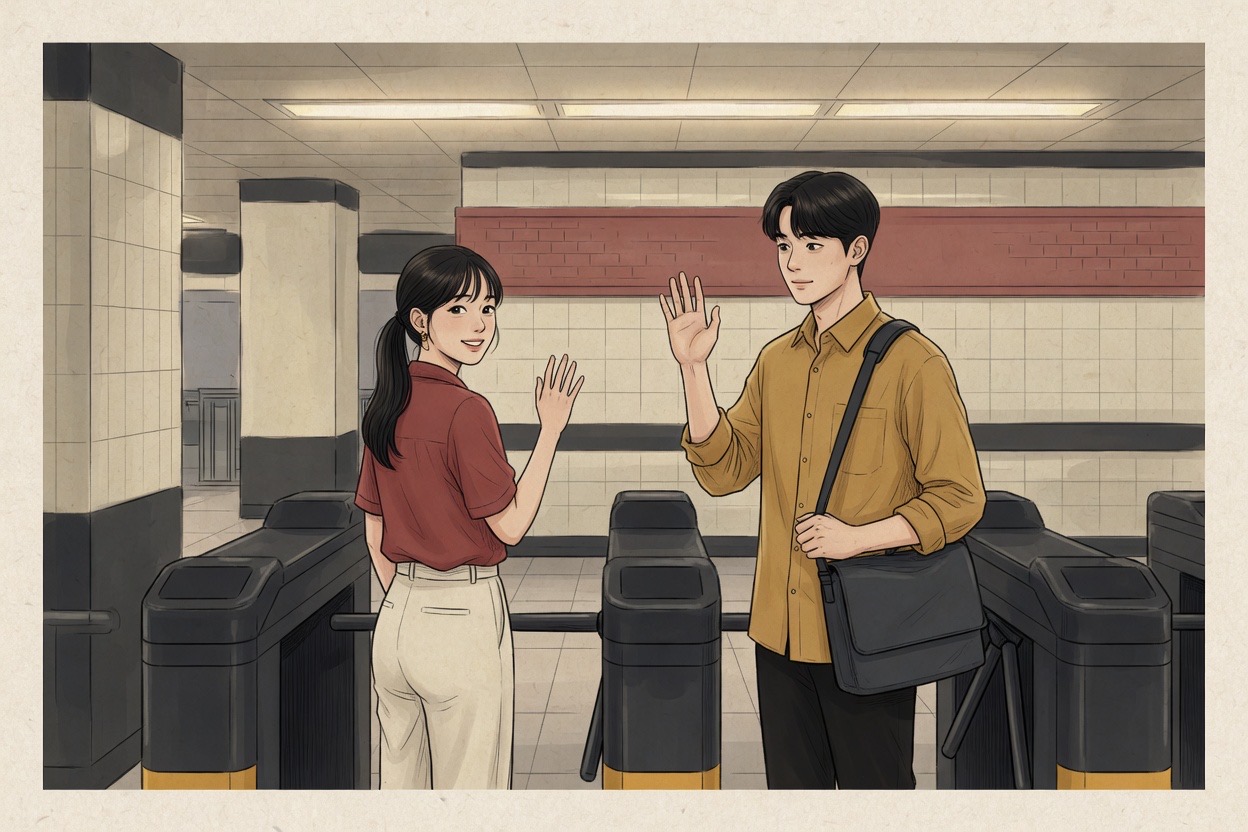
- Subway split: one through the gate, one not—leave/stay still applies if anyone uses the long polite forms; friends usually keep it short
- Office night exit: 수고하셨습니다, 먼저 가보겠습니다, slight bow
- Group dinner, you leave early: 먼저 갈게요 to the table that remains
Example dialogues
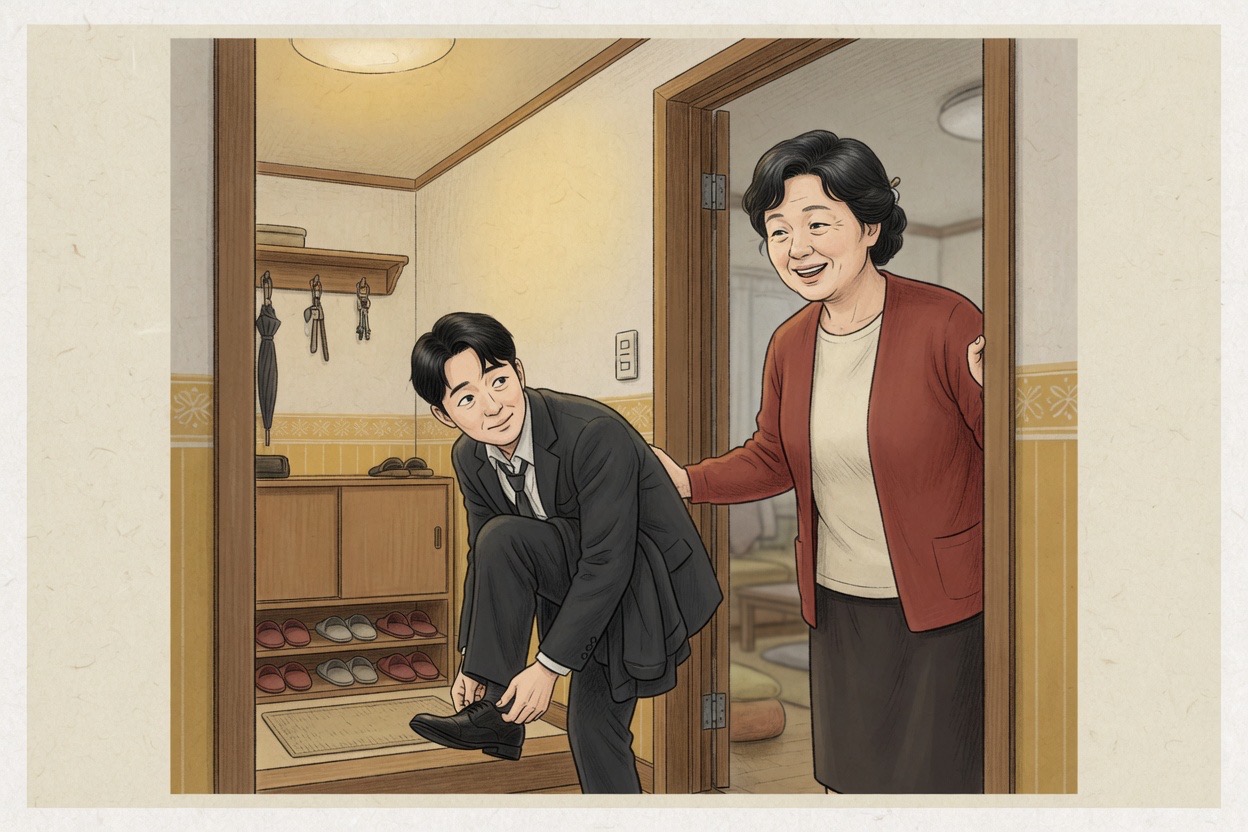
1. Apartment doorway — 가세요 and 계세요 used correctly
Evening. Guest puts on shoes. Host holds the door.
- Guest: 오늘 정말 즐거웠어요. 안녕히 계세요.
Oneul jeongmal jeulgeowosseoyo. Annyeonghi gyeseyo.
Today was really fun. Goodbye (to you who are staying). - Host: 조심히 가세요. 다음에 또 와요.
Josimhi gaseyo. Daeume tto wayo.
Go carefully. Come again next time. - Guest: 네, 다음에 봐요!
Ne, daeume bwayo!
Yes—see you next time!
Gloss: Guest aims 계세요 at the host who remains. Host aims 가세요 (plus care) at the guest who leaves. This is the spine in real time.
2. Friends after coffee — banmal leave/stay
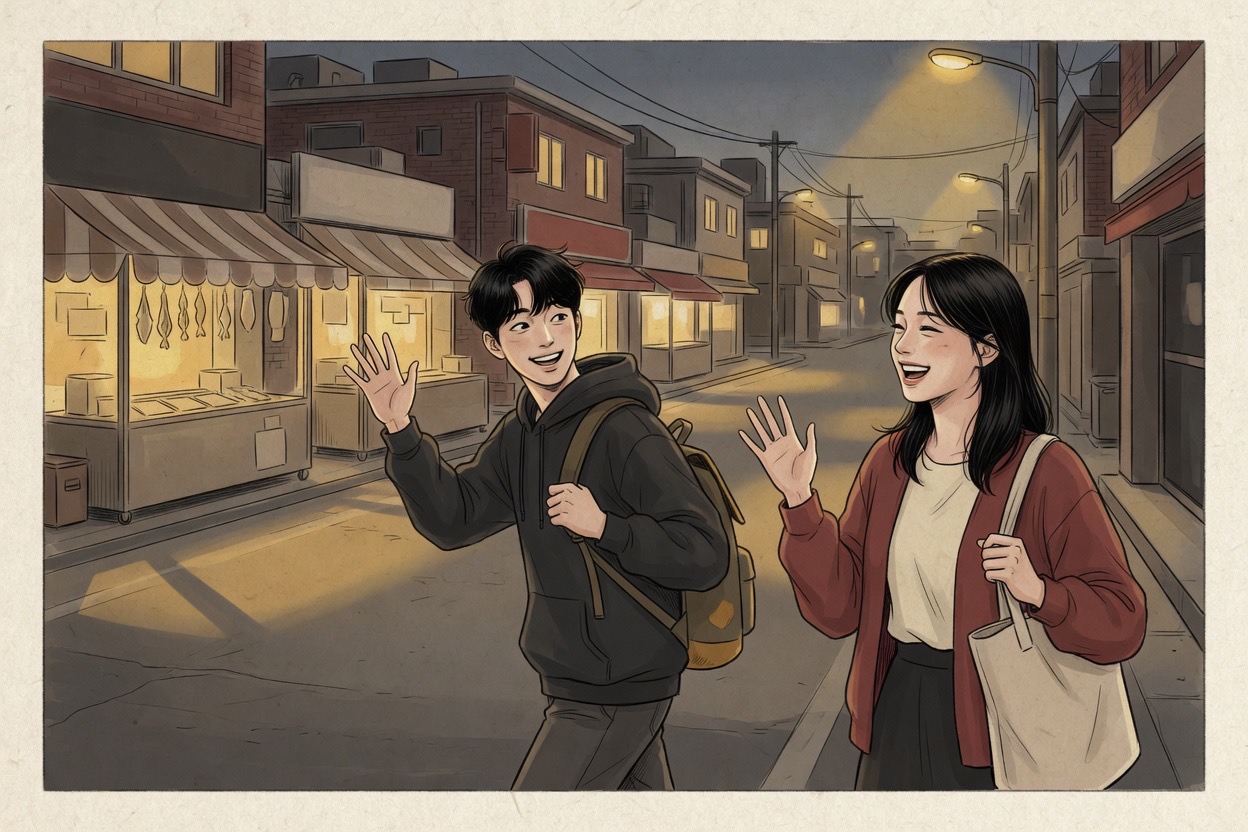
Sidewalk outside a café. One friend is heading to the subway; the other is walking home the other way.
- Minjun: 나 이쪽으로 갈게. 잘 가!
Na ijjogeuro galge. Jal ga!
I’ll go this way. Go well! - Sora: 응, 너도 잘 가. 내일 봐.
Eung, neodo jal ga. Naeil bwa.
Yeah, you go well too. See you tomorrow. - Minjun: 안녕!
Annyeong!
Bye!
Gloss: Both are leaving the shared spot, so both can receive 잘 가. 안녕 closes the banmal loop. No polite endings mixed in—speech level stays clean.
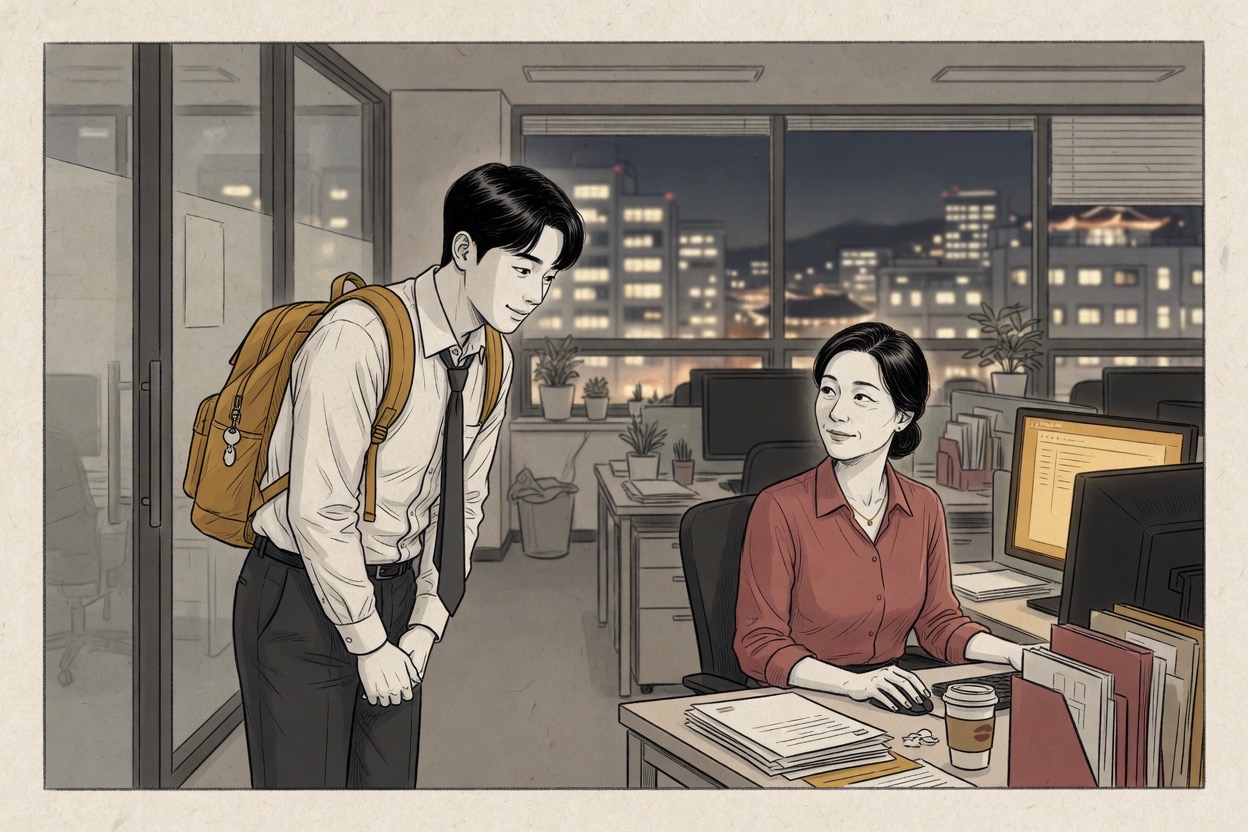
3. Office at 9 p.m. — 수고하셨습니다
Open office. A junior employee packs his bag; a senior is still at her monitor.
- Junior: 팀장님, 먼저 가보겠습니다. 수고하셨습니다.
Timjangnim, meonjeo gabogetseumnida. Sugohasyeotseumnida.
Team lead, I’ll head out first. Thank you for your hard work. - Team lead: 응, 수고했어. 조심히 들어가.
Eung, sugohaesseo. Josimhi deureoga.
Mm, good work. Get home carefully. - Junior: 네, 들어가겠습니다.
Ne, deureogagetseumnida.
Yes—heading out.
Gloss: Role title + polite exit + effort thanks. The senior’s reply can soften; the junior does not answer with banmal back unless that team already lives there.
4. Shop counter — staff to departing customer
Convenience store. Customer finishes paying and turns to the door.
- Clerk: 감사합니다. 안녕히 가세요.
Gamsahamnida. Annyeonghi gaseyo.
Thank you. Goodbye (to you who are leaving). - Customer: 네, 안녕히 계세요.
Ne, annyeonghi gyeseyo.
Yes—goodbye (to you who are staying).
Gloss: Classic reciprocal pair. Customer does not say 가세요 to the clerk frozen behind the register.
Good nunchi / Zero nunchi
Good nunchi
You leave a Korean friend’s family dinner. You face the parents still standing in the entryway and say 안녕히 계세요, then accept 조심히 가세요 with a small bow. You do not perform a phrasebook dump. You tracked who stays and who walks into the night.
Zero nunchi
Same doorway. You blast 안녕히 가세요 at the parents who are clearly not going anywhere, then throw a huge two-handed wave like a departure-board announcement. They smile politely. The hallway air gets a degree colder. You knew hangul. You missed the map of the room.
Do / Don’t
Do
- Ask one question before you speak: who is leaving?
- Default to the polite pair with strangers, elders, and service staff.
- Stack care language when it fits: 조심히 가세요, 다음에 봐요.
- At work, learn your team’s exit ritual—often 수고하셨습니다 plus a slight bow.
- Let banmal goodbyes stay inside banmal relationships.
Don’t
- Fire only 안녕히 가세요 at everyone as a universal “bye.”
- Use casual 안녕 / 잘 가 on people still in polite register with you.
- Correct a native speaker’s goodbye mid-doorway to show you “know the rule.”
- Confuse workplace 수고 language with a romantic farewell line from a drama.
Nearby ideas
- Hello in Korean — the arrival twin of this page; same peace-root, different social job
- Korean honorifics explained — titles and speech levels that decide whether your goodbye can shrink to 안녕
- Nunchi — reading whether this exit wants formality, a wave, or silence
- Maknae — age rank that can shape who bows first when a group breaks up
A closing line
Korean goodbye is not a single stamp you press on every exit. It is direction plus register—leave or stay, polite or casual, street wave or office bow.
Aim 가세요 at motion and 계세요 at the person who remains, keep 잘 가 / 잘 있어 for banmal rooms, and let 수고하셨습니다 carry the fluorescent lights of late work. Hold the map of the doorway, and your nunchi will finish the sentence your mouth starts.
FAQ
How do you say goodbye in Korean?
The polite default depends on motion. Say 안녕히 가세요 (annyeonghi gaseyo) to someone who is leaving, and 안녕히 계세요 (annyeonghi gyeseyo) to someone who is staying. Casual friends use 잘 가 / 잘 있어, and close banmal pairs often just say 안녕.
What is the difference between 안녕히 가세요 and 안녕히 계세요?
가세요 goes to the person who is going; 계세요 goes to the person who is remaining. The verbs literally track leave vs stay. Swapping them is the classic learner mistake—and native speakers notice.
Can 안녕 mean both hello and goodbye?
Yes. Between people already on banmal, 안녕 (annyeong) works both ways. Context does the work—walking in is hello, walking out is bye. Do not use it as a polite goodbye with strangers or elders.
How do you say see you later in Korean?
Common polite options are 다음에 봐요 and 또 봐요 (see you next time / see you again). Friends drop the polite ending to 다음에 봐 / 또 봐. 조심히 가세요 adds “go carefully” / get home safe.
What does 수고하셨습니다 mean when leaving work?
수고하셨습니다 (sugohasyeotseumnida) thanks someone for their effort—a workplace parting phrase more than a dictionary “goodbye.” Juniors often say it when leaving; seniors may answer with rest well or a light 수고.
Do you have nunchi?
Get short Korean word lessons and social cues in your inbox.