How to Say I Miss You in Korean: 보고 싶어 vs 그리워
English has one “miss.” Korean splits want-to-see from ache-for-what-cannot-return.
- Hangul
- 보고 싶어
- Romanization
- bogo sipeo
- Pronunciation
- bo-go ship-uh
- Category
- Phrases
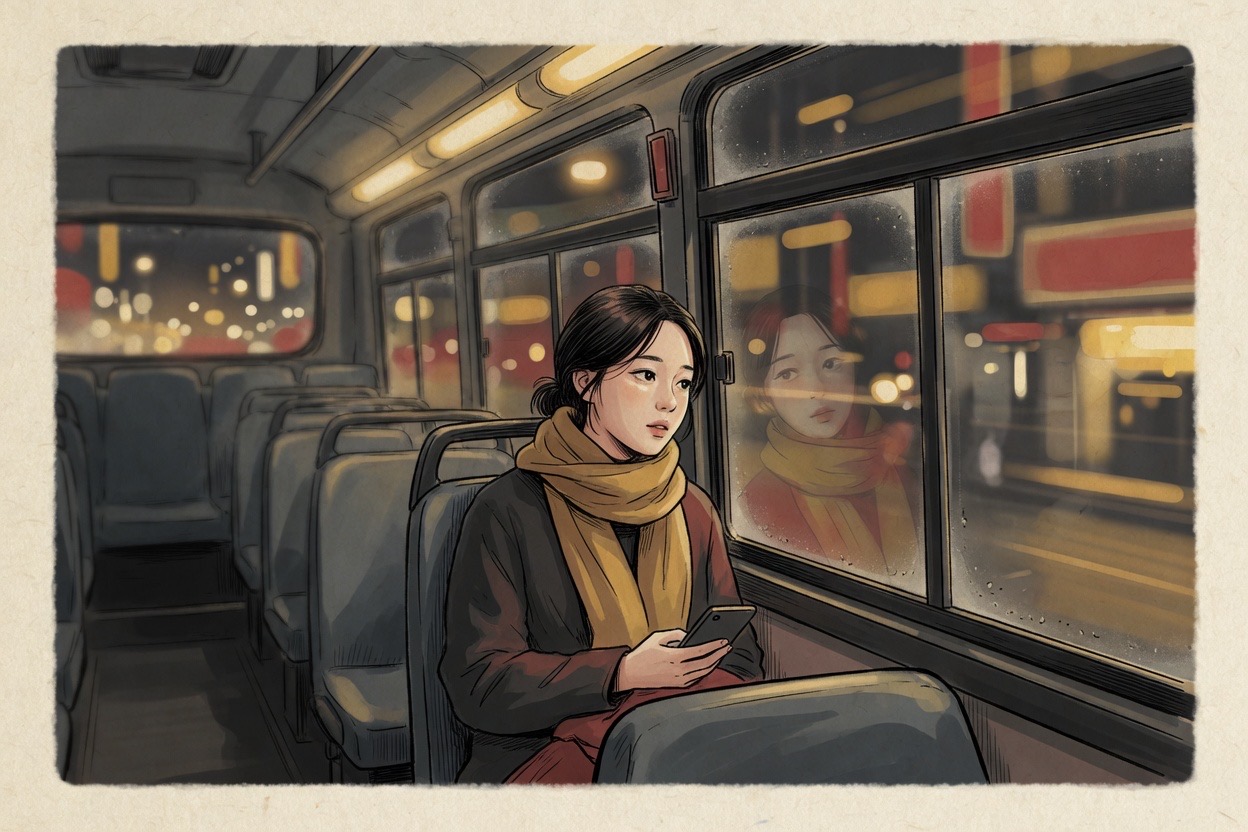
How to say I miss you in Korean: the everyday phrase is 보고 싶어 (보고 싶어, bogo sipeo)—literally “I want to see (you).” The polite form is 보고 싶어요, and the formal is 보고 싶습니다. One-sentence definition: 보고 싶어 is missing someone you can still meet; 그립다 / 그리워 is the deeper ache for what may not return. English packs both into one verb. Korean does not. Use the wrong one and you either underplay a real loss or over-weight a Friday reunion.
That split is the whole page: the register ladder, past 보고 싶었어 (“I missed you”), intensifiers 많이 / 너무, and when plain 잘 지내? carries the warmth without the weight.
Quick facts
| Everyday hangul | 보고 싶어 |
| Romanization | bogo sipeo |
| Pronunciation | bo-go ship-uh (soft sh on 싶) |
| Literal sense | I want to see (you) |
| Polite | 보고 싶어요 (bogo sipeoyo) |
| Formal | 보고 싶습니다 (bogo sipseumnida) |
| Past | 보고 싶었어 / 보고 싶었어요 |
| Deeper twin | 그립다 / 그리워 — longing, often non-returnable |
| Soft substitute | 잘 지내? — “How have you been?” |
How do you pronounce 보고 싶어?
Bo-go ship-uh. Three beats, even stress. The middle of 싶어 lands closer to ship than English “sip.” Do not stretch it into “see-poe.”
보고 싶어요 adds a soft yo: bo-go ship-uh-yo. 보고 싶습니다 is bo-go ship-seum-ni-da. Same ending ladder as banmal vs jondaemal: bare casual, polite yo, formal seumnida. The feeling stays; the social distance changes.
보고 싶어 vs 그리워 — the spine of “miss”
English searchers type “how to say i miss you in korean” and expect one sticker. Korean hands you two tools that English collapses into miss.
| 보고 싶다 | 그립다 | |
|---|---|---|
| Core feel | I want to see you | I long for / ache for |
| Typical object | a person you can still meet | a person, place, time, or era that may not return |
| Everyday line | 보고 싶어 | 그리워 |
| Weight | warm, present, reachable | deeper, reflective, often irreversible |
| Classic mistake | using it for someone who has died, as if a meet-up is still on the calendar | using it for a friend you will see Friday, as if they are a lost homeland |
보고 싶어 — want to see you
보고 싶다 is 보다 (to see) + 싶다 (want to). So 보고 싶어 is practical longing: I want to see your face again.
Use it when your partner is traveling, a close friend moved cities, family is far but a visit is possible, or a video call makes the feeling immediate. The phrase assumes possibility—not a guarantee, just that the door is not closed. That is why it is the default for living relationships.
그립다 / 그리워 — the ache that does not book a ticket
그립다 is the adjective of longing. Casual speech often lands as 그리워 (“I miss / long for…”). Objects include a person you cannot simply “see” again, a hometown street after years away, a childhood kitchen, or a season of life that will not return.
You can 그립다 a living person when the gap is long and thick. The center still differs: 보고 싶어 points toward a future meeting; 그립다 often points toward something already out of reach.
The learner trap in one picture
A friend you will hug at the station on Friday → 보고 싶어.
A grandparent who has passed, a house that was sold, a summer that will not repeat → lean 그립다, not a cheerful “I want to see you.”
English speakers reverse this constantly: 보고 싶어 on every English “I miss…,” including graves; or ballad-grade 그립다 on a coworker after a long weekend. Both scrape.
The register ladder: 보고 싶어 / 보고 싶어요 / 보고 싶습니다
Same meaning. Three social distances—the speech-level logic you meet in Korean honorifics and love lines like saranghae.
| Form | Hangul | Feel | Who usually gets it |
|---|---|---|---|
| Casual | 보고 싶어 | intimate, direct | partner, close friend, family already on banmal |
| Polite | 보고 싶어요 | warm + respectful | early dating, someone older you care for, semi-public softness |
| Formal | 보고 싶습니다 | ceremonial, public, firm | stages, letters with high respect, speeches, carefully framed messages |
보고 싶어 is the midnight-text form. If you still end every sentence with 요 with this person, bare banmal can feel like skipping steps—intimate on purpose, or awkward by accident.
보고 싶어요 keeps the feeling with a polite ending: useful when banmal is not fully open, the other person is older, or the moment is soft but not private.
보고 싶습니다 is the suit form—prepared speech, respectful writing, public mentos. Not colder emotion. Emotion that knows the room is listening.
Quick chooser: already banmal → 보고 싶어; still polite or speaking up → 보고 싶어요; ceremony / maximum respect → 보고 싶습니다; unsure the bond can hold it → try 잘 지내? first.
보고 싶었어 vs 보고 싶어 — past and present
| Time | Casual | Polite | Sense |
|---|---|---|---|
| Present | 보고 싶어 | 보고 싶어요 | I miss you (now) / I want to see you |
| Past | 보고 싶었어 | 보고 싶었어요 | I missed you (while we were apart) |
Present is the open state—the missing is active now. Past is the reunion form: face to face (or finally on the call), naming the gap that just closed. English “I missed you!” at the hug is usually 보고 싶었어, not a quiz about whether the missing continues.
Time stacks you will hear:
- 요즘 너무 보고 싶어. — I’ve been missing you a lot lately.
- 그동안 보고 싶었어. — I missed you all that time.
Intensifiers: 많이 and 너무
| Phrase | Rough English | Weight |
|---|---|---|
| 보고 싶어 | I miss you | baseline |
| 많이 보고 싶어 | I miss you a lot | clear, warm |
| 너무 보고 싶어 | I miss you so much | stronger, more emotional |
많이 is volume. 너무 is intensity that can tip into “almost too much.” Neither upgrades you into 그립다 territory—you are turning up the dial, not changing instruments. Also common: 진짜 보고 싶어 (really) and 엄청 보고 싶어 (colloquial “enormously”).
For partners who already trade terms of endearment or pet names like jagiya, intensifiers feel ordinary. For a classmate you barely know, even the baseline can land heavy.

When do Koreans actually say it?
Less freely than English “miss you,” and that gap is culture, not a shortage of feeling.
English speakers toss “miss you!” at group chats, coworkers after PTO, and acquaintances who liked a story. Korean 보고 싶어 is more expensive: it wants real closeness, real absence, and a bond that can hold directness.
You will still hear it—couples, close friends, family, lyrics, dramas. Many speakers show care without the line: packing food, asking whether you ate, waiting at the station, or a short 잘 지내? after weeks of silence.
Fits: partners, close banmal friends, warm family, people with a real gap (distance, military service, long travel).
Overshoots: casual classmates, office acquaintances, someone you met twice, any room that still wears full polite distance for everything else.
If saranghae is a threshold, 보고 싶어 is a smaller one—but still a threshold. Treat it like emotional software, not a phrasebook sticker.
잘 지내? — the everyday substitute
잘 지내? (잘 지내?, jal jinae?) means roughly “Have you been well?” / “How have you been?” Polite: 잘 지내요? Formal: 잘 지내십니까?
In many reunions and catch-up texts, this line does the job English speakers expect “I miss you” to do: opens the door, names the gap lightly, invites the other person in—without a confession-shaped sentence on a medium-weight bond.
| Situation | Heavy option | Lighter option |
|---|---|---|
| Texting a close friend after months | 너무 보고 싶어 | 잘 지내? 요즘 뭐 해? |
| Polite check-in with someone older | 보고 싶었어요 | 잘 지내셨어요? |
| Soft reunion at a café | either, if the bond is real | start with 잘 지내?, then escalate if the room opens |
Good nunchi is simple: match word weight to relationship weight. You can always go deeper later. Climbing down from an over-heavy 보고 싶어 is harder.
Example dialogues
1. Partners on a late call — banmal, present tense
Two people in their late twenties. One is traveling; the other is still in Seoul.
- A: 지금 뭐 해?
Jigeum mwo hae?
What are you doing right now? - B: 방금 씻었어. 너는?
Banggeum siseosseo. Neoneun?
I just washed up. You? - A: 호텔이야. 진짜 보고 싶어.
Hoteriya. Jinjja bogo sipeo.
I’m at the hotel. I really miss you. - B: 나도. 빨리 와.
Nado. Ppalli wa.
Me too. Come back soon.
Gloss: Casual speech throughout. 보고 싶어 sits naturally because the relationship already holds it—no polite endings mixed in.
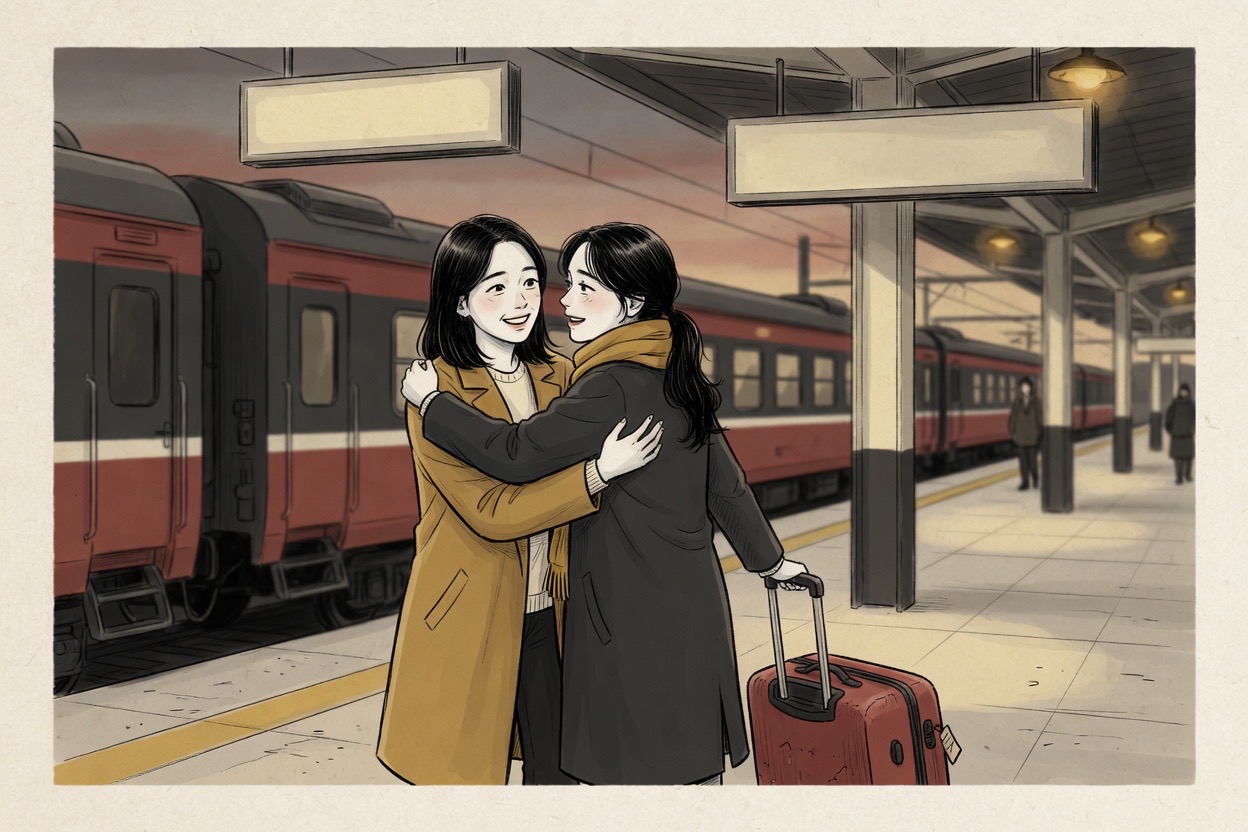
2. Friends reuniting at the station — past tense
Platform evening. Two friends in their twenties; one has a suitcase.
- A: 야, 진짜 오래간만이다.
Ya, jinjja oraeganmanida.
Hey—it’s been so long. - B: 그러게. 그동안 보고 싶었어.
Geureoge. Geudongan bogo sipeosseo.
Right? I missed you the whole time. - A: 나도. 밥부터 먹자.
Nado. Bapbuteo meokja.
Same. Let’s eat first.
Gloss: Reunion energy prefers 보고 싶었어—the missing lived in the gap that just closed.
3. Polite warmth after a long gap
Café catch-up. Friendly speakers still on polite speech.
- A: 민지 씨, 정말 오랜만이에요.
Minji ssi, jeongmal oraenmanieyo.
Minji, it’s really been a long time. - B: 네, 맞아요. 잘 지내셨어요?
Ne, majayo. Jal jinaesyeosseoyo?
Yes, it has. Have you been well? - A: 네. 사실 종종 보고 싶었어요.
Ne. Sasil jongjong bogo sipeosseoyo.
Yes. Honestly, I missed you now and then. - B: 저도요. 오늘 얘기 많이 해요.
Jeodoyo. Oneul yaegi mani haeyo.
Me too. Let’s talk a lot today.
Gloss: Polite endings stay consistent. 잘 지내셨어요? opens; 보고 싶었어요 escalates because the history supports it. A first coffee with a stranger would skip that third line.
4. Longing that is not a meetup — 그립다
Quiet evening. Someone speaks about a grandmother who has passed.
- A: 요즘 할머니 생각이 많이 나.
Yojeum halmeoni saenggagi mani na.
I’ve been thinking about Grandma a lot lately. - B: 보고 싶지?
Bogo sipji?
You miss her, huh? (literally: want to see her, right?) - A: 응… 그냥 그리워.
Eung… Geunyang geuriwo.
Yeah… I just long for her.
Gloss: A friend offers everyday 보고 싶지?; the speaker answers with 그리워—not a visit you can schedule.
Good nunchi / Zero nunchi
Good nunchi
A close friend has been abroad for six months. You text 잘 지내? 요즘 어때?. They answer with photos and a long voice note. Only then do you send 진짜 보고 싶어. Weight matched bond; want-to-see language for a living person you will meet again.
Zero nunchi
You met someone twice at a language exchange. After three days of silence you send 너무 보고 싶어요 ㅠㅠ with heart stickers, then post a ballad lyric about 그리움 under their photo. They reply with a polite sticker and stop answering. Confession-shaped line to a near-stranger—and the wrong depth tool for a shallow gap.
Do / Don’t
Do
- Default to 보고 싶어 for people you can still meet.
- Reach for 그립다 / 그리워 when the missing is deep, reflective, or not fixable by a train ticket.
- Match speech level: banmal with banmal people; polite endings when the relationship still wears them.
- Use 보고 싶었어 when reuniting after a real gap.
- Try 잘 지내? when warmth is right but full missing-language is too heavy.
Don’t
- Paste 보고 싶어 onto every English “I miss…,” including what cannot return, unless you know how the soft everyday version lands.
- Drop 그리워 on a coworker you will see Monday as if they are a lost era.
- Fire 보고 싶어 at casual acquaintances because dramas made it sound friendly-light.
- Mix bare banmal 보고 싶어 into an otherwise full-polite conversation without noticing the gear shift.
- Confuse volume (너무) with category change (그립다).
Nearby ideas
- Saranghae (사랑해) — I love you; another threshold word with a register ladder
- Jagiya (자기야) — partner call-name that shares intimate air with 보고 싶어
- Banmal vs jondaemal — speech-level map behind every ending here
- Goodbye in Korean — leave/stay language for the moment before missing starts
- Nunchi — whether this room wants the heavy line or the light check-in
A closing line
English gives you one verb. Korean gives you a want-to-see and a long-for—and expects you to know which absence you are naming.
Hold 보고 싶어 for living closeness with a door still open. Keep 그리워 for the ache that does not book a ticket. When in doubt, start with 잘 지내? and let the relationship decide whether missing needs to be said out loud.
FAQ
How do you say I miss you in Korean?
The everyday line is 보고 싶어 (bogo sipeo)—literally “I want to see you.” The polite form is 보고 싶어요, and the formal is 보고 싶습니다. For deeper longing, especially for places, times, or people you cannot simply meet again, Koreans often use 그립다 / 그리워.
What is the difference between 보고 싶어 and 그리워?
보고 싶어 is “I want to see you”—used for people you can still meet. 그립다 / 그리워 is a deeper ache, often for what cannot return: a hometown, a past season, someone gone. English collapses both into “miss,” which is why learners misplace them.
How do you say I missed you in Korean (past tense)?
Use 보고 싶었어 (casual) or 보고 싶었어요 (polite)—“I missed you / I wanted to see you.” Present 보고 싶어 means you miss them now. Greeting someone after a long gap often lands in the past: “I missed you (while we were apart).”
When do Koreans say I miss you?
Less freely than English speakers say “miss you.” Close friends, partners, and family use it when absence is real. Dropping 보고 싶어 on a casual acquaintance can feel heavy. Many rooms carry the same warmth with 잘 지내? (“How have you been?”) instead.
What does 많이 보고 싶어 mean?
많이 보고 싶어 means “I miss you a lot.” 너무 보고 싶어 is stronger—“I miss you so much.” Both intensify 보고 싶어; they do not change the core distinction with 그립다.
Do you have nunchi?
Get short Korean word lessons and social cues in your inbox.