Korean Age System Explained — How Old Are You in Korea?
Born at one, plus a year on January 1—until the law changed. Here’s the mixed reality.
- Hangul
- 한국 나이
- Romanization
- hanguk nai
- Pronunciation
- han-guk na-ee
- Category
- Culture
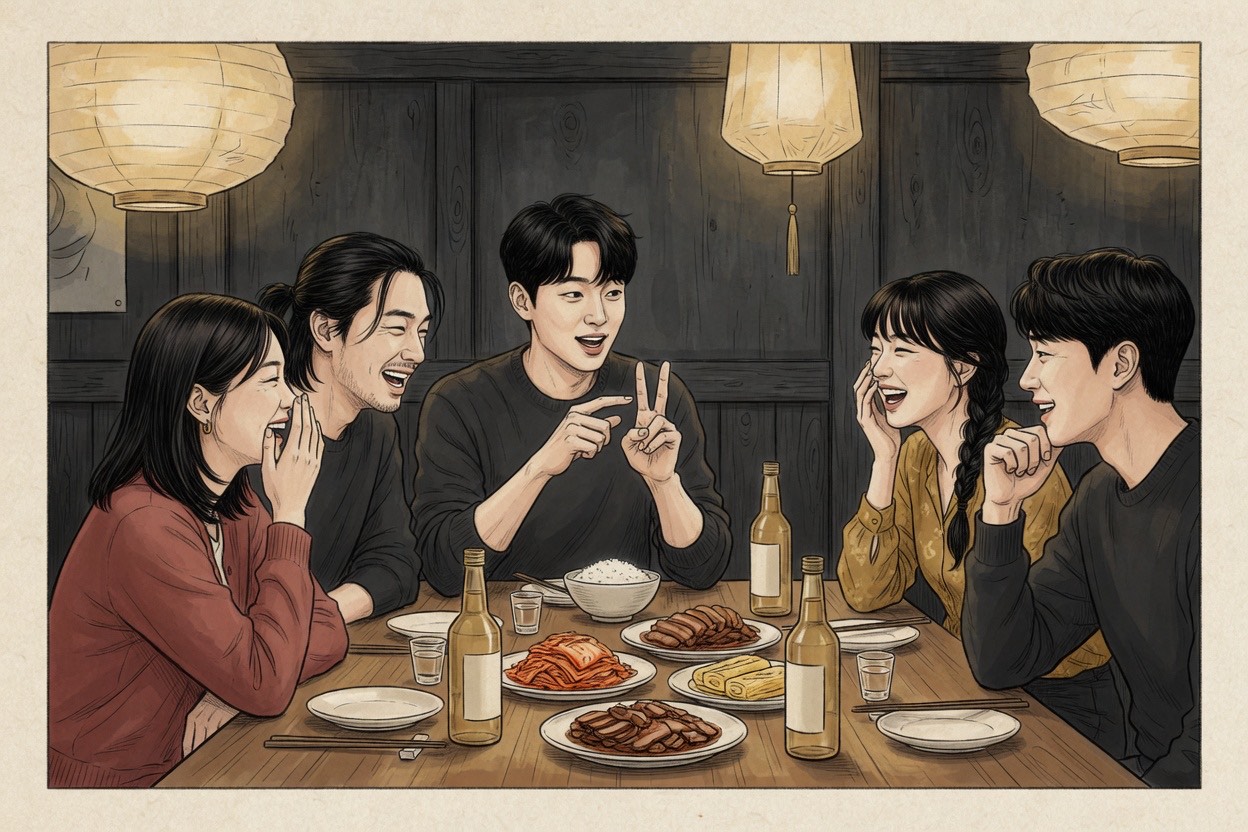
The Korean age system (often searched as Korean age or hanguk nai) is the traditional way many Koreans counted years: you are 1 at birth, and everyone gains a year on January 1, not on your personal birthday. That is why a baby born in December could be “two” weeks later, and why friends born months apart sometimes shared the same social age all year.
In 2023, Korea officially moved legal and administrative age to international age—the birthday-based count English speakers already know. Everyday speech did not vanish into a single spreadsheet. Forms want 만 나이 (man nai). Casual conversation still slips into the old count. 연 나이 (yeon nai, year age) still sorts school years and conscription. One-sentence reality: Korea now runs three age logics at once—legal, traditional, and year-based—and knowing which room you are in is the whole skill.
Quick facts
| Hangul | 한국 나이 |
| Romanization | hanguk nai |
| Pronunciation | han-guk na-ee |
| Traditional rule | age 1 at birth; +1 every January 1 |
| Legal default (2023→) | international age / 만 나이 |
| Still social | titles, speech level, seating, “who pays,” who is maknae |
| Also in play | 연 나이 for school year and military service rules |
How did Korean age work?
If you searched “how Korean age worked,” start here.
Traditional Korean age—often called 세는 나이 (se-neun nai, “counting age”) or simply 한국 나이—had two rules English birthday math does not:
- You start at 1, not 0. The year of life you are already in counts.
- Everyone ages up on New Year’s Day (January 1 in modern civil life). Your calendar birthday does not move the social counter.
So if you were born in March 2000, by traditional counting you were 1 in 2000, 2 in 2001, and so on. On January 1, 2024 you would already be one year “older” in that system than a birthday-based count that still waits until March.
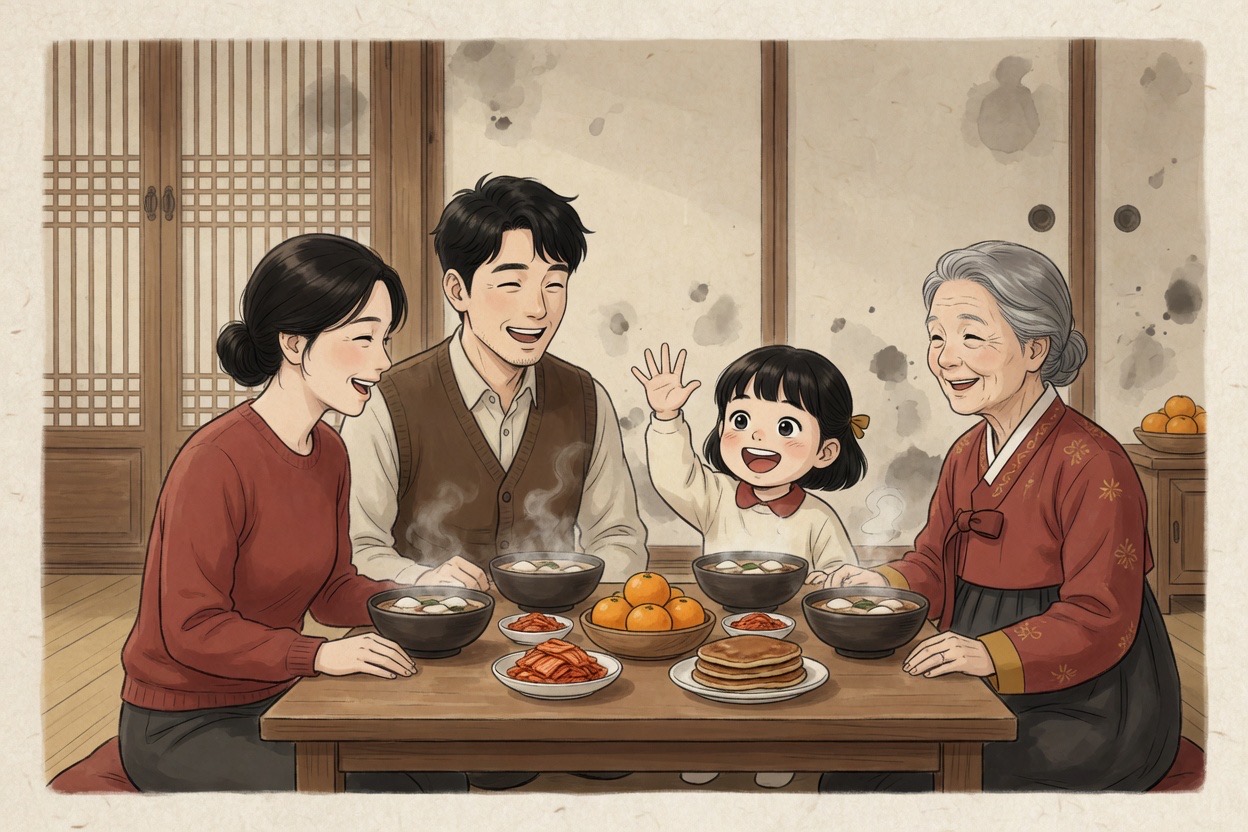
That is also why New Year used to feel like a mass birthday. Families eat rice cake soup, kids hold up fingers, and the whole country increments together. The joke “I got older overnight” was not only a joke—it was calendar software.
Why it felt “one or two years older”
Compared with international age, traditional Korean age is usually one or two years higher:
- Always at least +1 (born at 1).
- Often +2 before your birthday in a given year, because New Year already added a year while your international birthday has not.
People online still ask for a Korean age calculator. The arithmetic is simple once you name which system you mean—covered below.
What changed in 2023?
In 2023, Korea changed the default for legal and administrative purposes to international age—the birthday-based count also called 만 나이 (man nai, literally “full age”).
What that means in practice:
- Government forms, contracts, many official age cutoffs, and bureaucratic “how old are you?” questions are supposed to use 만 나이.
- News and official messaging pushed the idea that the country should stop bouncing between systems for paperwork.
What it does not mean:
- Traditional counting did not evaporate from group chats, family tables, or first-meeting small talk.
- 연 나이 did not disappear from school-year and military logic just because forms got cleaner.
- Older relatives will not rewire decades of habit because a statute updated.
Honest mixed state: legal documents want 만 나이; casual conversation still slips into 세는 나이; school cohorts and conscription still lean on 연 나이. Do not present the old system as universal law, and do not pretend 2023 erased the social software. Both mistakes will mislead you in a real room.
만 나이 vs 세는 나이 vs 연 나이
Three names, three jobs. Memorize the jobs, not the drama headlines.
| Name | Hangul | What it is | Where it shows up |
|---|---|---|---|
| Man nai (international / full age) | 만 나이 | Birthday-based age, same logic as most of the world | Legal docs, admin forms, many official cutoffs after the 2023 shift |
| Se-neun nai (counting / traditional age) | 세는 나이 | Born at 1; +1 every January 1 | Casual talk, older habit, “Korean age” in pop explanations |
| Yeon nai (year age) | 연 나이 | Current calendar year − birth year (no birthday check, no +1 at birth) | School year / grade cohort logic, military service age rules |
How to calculate each (plain arithmetic)
Assume today is a date in year Y, and you were born in year B. For 만 나이 you also need whether this year’s birthday has passed.
1. 만 나이 (international age)
- Base:
Y − B - If your birthday has not occurred yet this year: subtract 1
- Formula people actually use: years completed since birth
2. 세는 나이 (traditional Korean age)
Y − B + 1- No birthday check. January 1 is the level-up for everyone.
3. 연 나이 (year age)
Y − B- No +1 at birth, no birthday adjustment. Your “year age” jumps every January 1 with the calendar year.
Worked example
Born 15 March 2000. Suppose today is 10 February 2026 (birthday not yet this year).
| System | Math | Result |
|---|---|---|
| 만 나이 | 2026 − 2000 − 1 | 25 |
| 세는 나이 | 2026 − 2000 + 1 | 27 |
| 연 나이 | 2026 − 2000 | 26 |
Same person, three numbers. That is why “How old are you?” in Korea sometimes needs a follow-up: which age?
If the same birthday has already passed—say 20 March 2026—만 나이 becomes 26, while 세는 나이 stays 27 and 연 나이 stays 26 until next January.
“Korean age calculator” without an app
For traditional Korean age in your head:
- Take the current year.
- Subtract the birth year.
- Add 1.
For international age:
- Current year minus birth year.
- Subtract 1 if you have not had this year’s birthday yet.
For year age:
- Current year minus birth year. Stop.
You do not need a widget for the arithmetic. You need to know which answer the form, the friend, or the school rule wants.
Why age matters so much socially
Age in Korea is not only a trivia number. It is relationship infrastructure.
Relative age helps decide:
- Kinship titles — who is hyung, oppa, noona, unnie
- Speech level — whether banmal (casual) or jondaemal (polite) feels available
- Seating and serving order — who sits where, who pours, who is poured for
- Group roles — who becomes the maknae of a team or friend circle
That is why first meetings among Koreans often include a quick birth-year check. It is not pure nosiness. It is sorting software so the rest of the conversation knows which grid it is on. For the full title map, see Korean honorifics explained.
Drinking table micro-rules (still age-shaped)
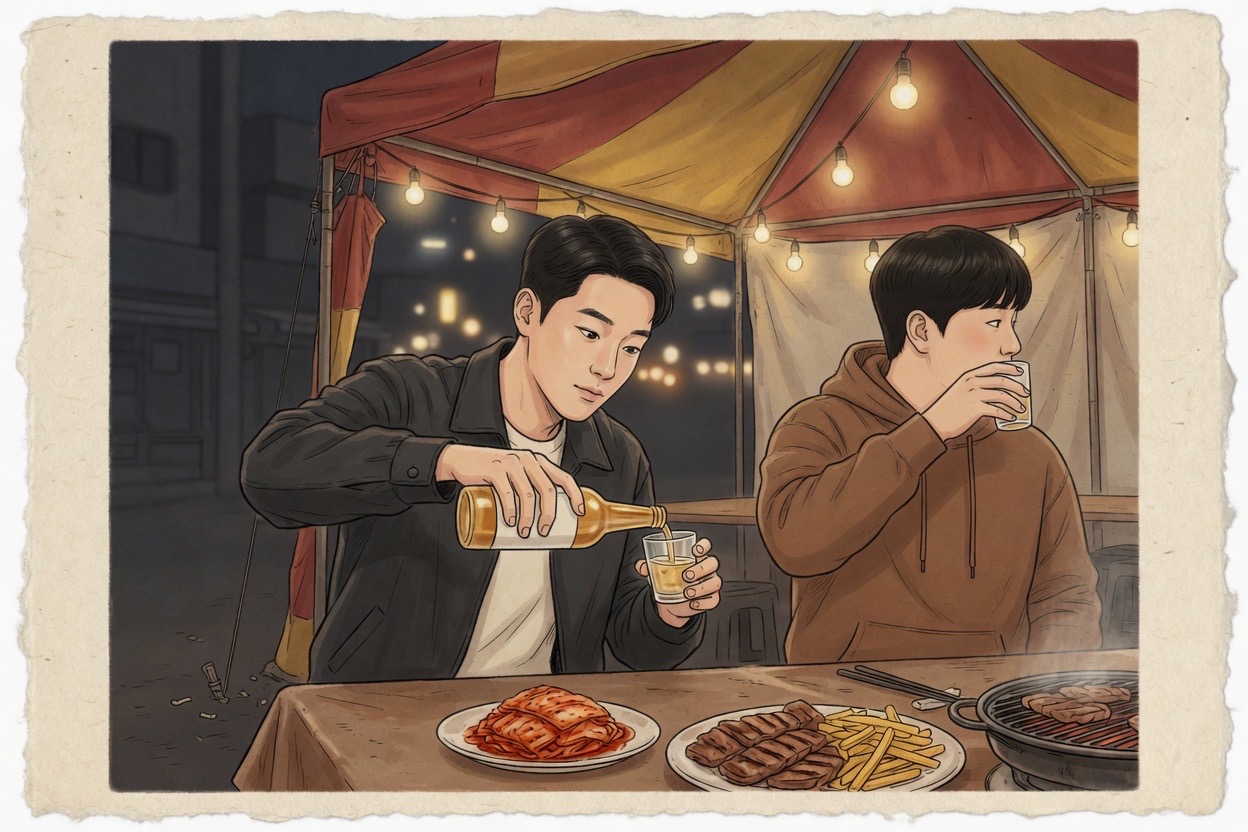
At many drinking tables you will still see:
- younger people pouring for older people
- receiving a pour with two hands (or one hand supporting the other)
- turning the head slightly aside when drinking in front of someone older
None of this requires you to recite a statute. It requires noticing who is treated as senior in this group. After 2023, that senior might still be “older” by traditional habit even when both of you would write the same 만 나이 on a form in different months.
Age and the four-way title grid
If you are younger and close enough for kinship language:
| Older male | Older female | |
|---|---|---|
| Male speaker | hyung | noona |
| Female speaker | oppa | unnie |
Those titles do not fire correctly if nobody knows who is older. That is the social reason age questions stay normal long after bureaucracy standardized on 만 나이.
How do you ask someone’s age in Korean?
A standard polite question is:
- 나이가 어떻게 되세요?
Nai-ga eotteoke doeseyo?
Roughly: “How old are you?” / “What is your age?” (polite)
Other patterns you will hear:
- 몇 살이에요? — Myeot sarieyo? — “How many years old are you?” (polite; common)
- 연세가 어떻게 되세요? — Yeonsega eotteoke doeseyo? — more respectful, often for clearly older adults
- Among close friends in banmal: 몇 살이야? — Myeot sariya?
Why asking is often normal (not automatically rude)
In many English-speaking rooms, age is private unless offered. In many Korean rooms—especially among peers sorting titles—relative age is public infrastructure. Asking can be:
- practical (“Are we same-age friends or is one of us older?”)
- logistical (“Who should order / pour / speak first?”)
- completely ordinary among people about to become a group
It can still be sensitive with strangers in the wrong setting, with large age gaps, or when the question is used to rank someone coldly. Nunchi is knowing whether this room is doing logistics or prying.
After 2023, a careful follow-up is sometimes useful:
만 나이로요, 아니면…? — “In full age, or…?” — if the number will land on a form, a ticket age band, or a rule that cares.

When you’ll hear it
- Friend groups establishing birth years within five minutes of “nice to meet you”
- Parents talking about a child being “already N” right after New Year
- HR or clinics asking for date of birth so 만 나이 is unambiguous
- School talk that sorts kids by entrance year more than by birthday month
- Military-service conversations that lean on year-based age bands
- Variety shows and dramas still playing “Korean age” jokes for comedy timing
- Expats confused why two people with the same international age still argue over who is older by months and New Year
Example dialogues
1. First meeting, polite, sorting the room
Bar table, new coworkers after work. Everyone is roughly mid-twenties.
- Minseo: 안녕하세요. 혹시 나이가 어떻게 되세요?
Annyeonghaseyo. Hoksi nai-ga eotteoke doeseyo?
Hi—if it’s okay, how old are you? - Joon: 스물아홉… 아, 만으로는 스물일곱이에요.
Seumurahop… a, maneuro-neun seumurilgop-ieyo.
Twenty-nine… ah, in full age I’m twenty-seven. - Minseo: 저 스물다섯이에요. 그럼 제가 동생이네요.
Jeo seumuldaseos-ieyo. Geureom jega dongsaeng-ineyo.
I’m twenty-five. Then I’m the younger one.
Gloss: Polite speech. Minseo asks with the standard soft pattern. Joon starts with the old-count habit, then corrects to 만 age—exactly the mixed reality after 2023. The point of the question is hierarchy logistics, not a background check.
2. Family New Year, traditional counting still in the air
Living room, rice cake soup on the table. A child shows fingers; adults play along.
- Mom: 우리 올해 몇 살이지?
Uri olhae myeot sariji?
How old are we this year? - Child: 여덟!
Yeodeol!
Eight! - Dad: 맞다, 새해니까 또 먹었네.
Matda, saehaenikka tto meogeonne.
Right—because it’s New Year, you “ate” another year.
Gloss: Family banmal. The joke “ate another year” nods at New Year aging (and rice cake soup lore) even in a country where official forms now prefer 만 나이. Home talk and paperwork are not the same dialect.
3. Drinking table, age already known
Pojangmacha, two men in their late twenties. One is a year older by birth year; banmal is mutual.
- Younger friend: 형, 술 따라 줄게.
Hyeong, sul ttara julge.
Hyung, I’ll pour for you. - Older friend: 그래. 너는 옆으로 돌려서 마셔.
Geurae. Neoneun yeopeuro doryeoseo masyeo.
Sure. You turn aside a bit when you drink. - Younger friend: 알아, 알아. 눈치 있게.
Ara, ara. Nunchi itge.
I know, I know. With nunchi.
Gloss: Kinship title 형 only works because age order is already settled. The pour-and-turn choreography is social age in motion—not a calculator app.
Good nunchi / Zero nunchi
Good nunchi
You meet a Korean peer group. Someone asks birth years. You answer with a clear number and, if useful, say whether you mean 만 나이. You let titles and speech level settle from that. On a form the next morning, you write your date of birth and let the office compute 만 나이. You did not lecture anyone about the 2023 law at the bar, and you did not invent traditional age on a government PDF.
Zero nunchi
Same week. You insist “Korean age is abolished, so nobody should care,” then call the slightly older woman “unnie” wrong, pour for yourself first, and argue with a school form that wants year logic. You treated a statute like a personality, and the room treated you like homework.
Do / Don’t
Do
- Learn three systems: 만 나이, 세는 나이, 연 나이.
- Default to date of birth + 만 나이 for legal and admin contexts.
- Expect casual speech to still use traditional counting sometimes.
- Ask age politely when the room is clearly sorting titles—and answer helpfully when asked.
- Match titles and speech to relative age and closeness, not to a single blog slogan about 2023.
Don’t
- Claim traditional Korean age is still the universal legal rule.
- Claim 2023 erased social age overnight.
- Put “Korean age” on a form that asked for international age or a birth date.
- Force kinship titles from a guessed number with no relationship.
- Correct elders mid-holiday with “Actually, under the new law…” unless they asked.
Nearby ideas on Have Nunchi
- Korean honorifics explained — titles, -ssi/-nim, speech levels in one map
- Maknae — youngest in a named group
- Hyung / Oppa / Noona / Unnie — the four-way older grid
- Nunchi — reading whether this age question is logistics or pressure
A closing line
Korean age is not one number with a permanent national setting. It is a small stack of counters—legal full age, traditional counting age, year age—and the room tells you which one is speaking.
Hold the arithmetic lightly, hold the hierarchy carefully, and keep your nunchi for the moment someone asks 나이가 어떻게 되세요? like it is the most normal software install in the world—because, socially, it still often is.
FAQ
How did the Korean age system work?
Traditionally you were age 1 at birth, and everyone gained a year on January 1—not on their birthday. That count is often called 세는 나이 (se-neun nai).
Did Korea abolish Korean age in 2023?
In 2023 Korea moved legal and administrative age to international age (만 나이). Everyday speech did not flip overnight. Casual talk can still use the old count, and 연 나이 still matters for school year and conscription.
What is the difference between man nai, se-neun nai, and yeon nai?
만 나이 is international counted age from your birthday. 세는 나이 is traditional Korean age (born at 1, plus one every January 1). 연 나이 is year age—current year minus birth year—used for school cohorts and military service rules.
How do I calculate Korean age vs international age?
International (만 나이): current year − birth year, then subtract 1 if your birthday has not passed this year. Traditional Korean age: current year − birth year + 1. Year age (연 나이): current year − birth year only.
How do you politely ask someone’s age in Korean?
A standard polite form is 나이가 어떻게 되세요? Asking age is often normal in Korea because relative age sorts titles and speech level—not because people are being rude for fun.
Do you have nunchi?
Get short Korean word lessons and social cues in your inbox.