Good Nunchi at Work — Hoesik, Leaving Time, and the Korean Office
When to leave, when to speak, how to pour, and how not to overplay the custom.
- Hangul
- 직장 눈치
- Romanization
- jikjang nunchi
- Pronunciation
- jik-jang noon-chee
- Category
- Etiquette
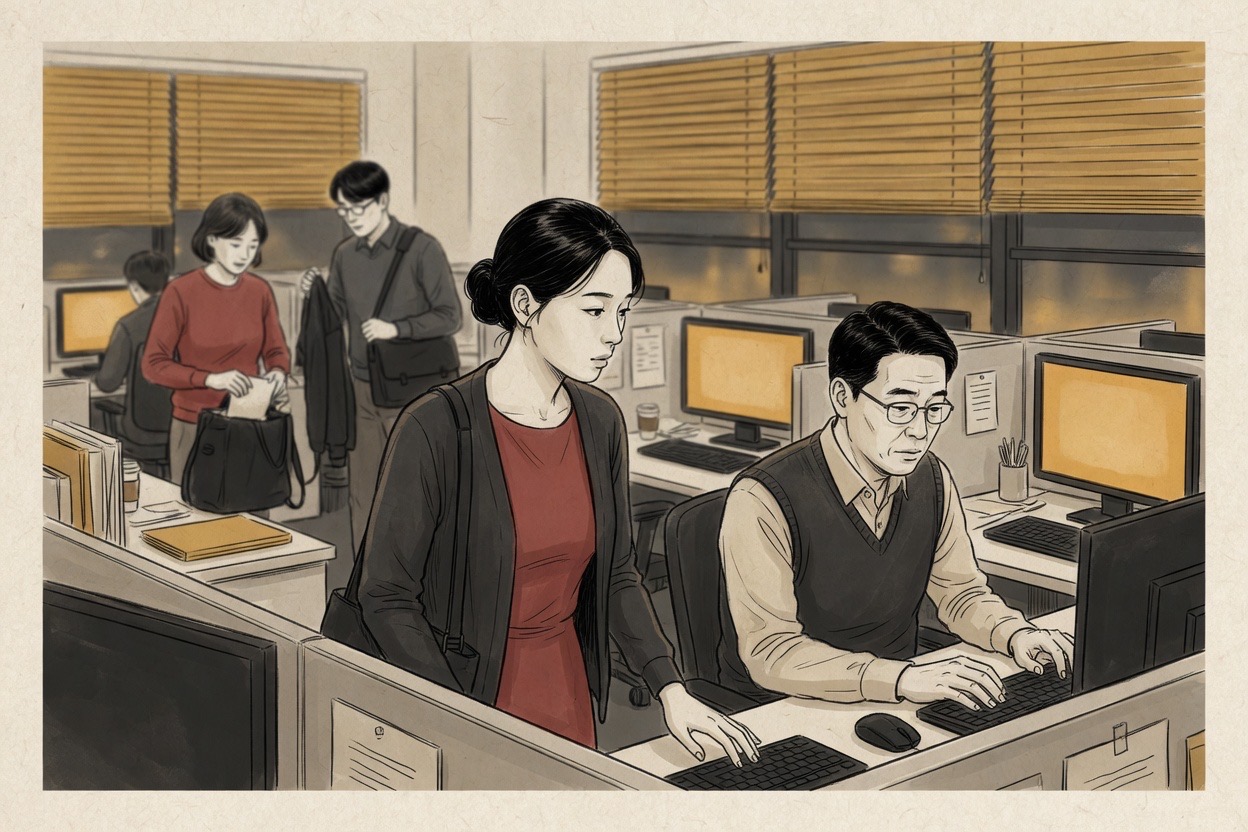
Workplace nunchi—in Korean, 직장 눈치 (직장 눈치, jikjang nunchi)—is the everyday skill of reading a Korean office: when you can leave, when to speak in a meeting, how to disagree with someone senior, whether the last snack on the table is free, and how a team dinner actually works. It is nunchi applied to hierarchy, timing, and shared space—not a secret exam designed to fail outsiders.
One-sentence version: good workplace nunchi means noticing rank and mood early enough that your next move protects both the work and the room. The after-work dinner called 회식 (hoesik), the pressure nicknamed 퇴근 눈치, and the proud/loaded goal of 칼퇴 (leaving exactly on time) all live under that umbrella. Norms are shifting fast. Younger Koreans argue about the same habits. Foreign coworkers usually get slack—if they stay polite and stop performing customs they only half understand.
Quick facts
| Hangul | 직장 눈치 |
| Romanization | jikjang nunchi |
| Pronunciation | jik-jang noon-chee |
| Also spelled | noonchi (older English spelling) |
| Closest English | workplace social radar / reading rank and timing |
| Core scenes | leaving time, meetings, disagreement, last items, 회식 |
| Related words | 회식 (hoesik), 퇴근 눈치, 칼퇴 |
What workplace nunchi actually governs
Forget the fantasy of a single “Korean office rulebook.” What people mean by workplace nunchi is a handful of recurring judgments:
When to leave
Is the team lead still at their desk with a full screen? Is a delivery delayed and everyone hovering? Are you the only one packing a bag while a client call is still hot? Leaving is not only a clock decision—it is a room decision. In some teams, people still wait until a senior packs up. In others, especially younger startups and foreign-facing teams, people leave when the work is done and say goodnight without theater.
When to speak in a meeting
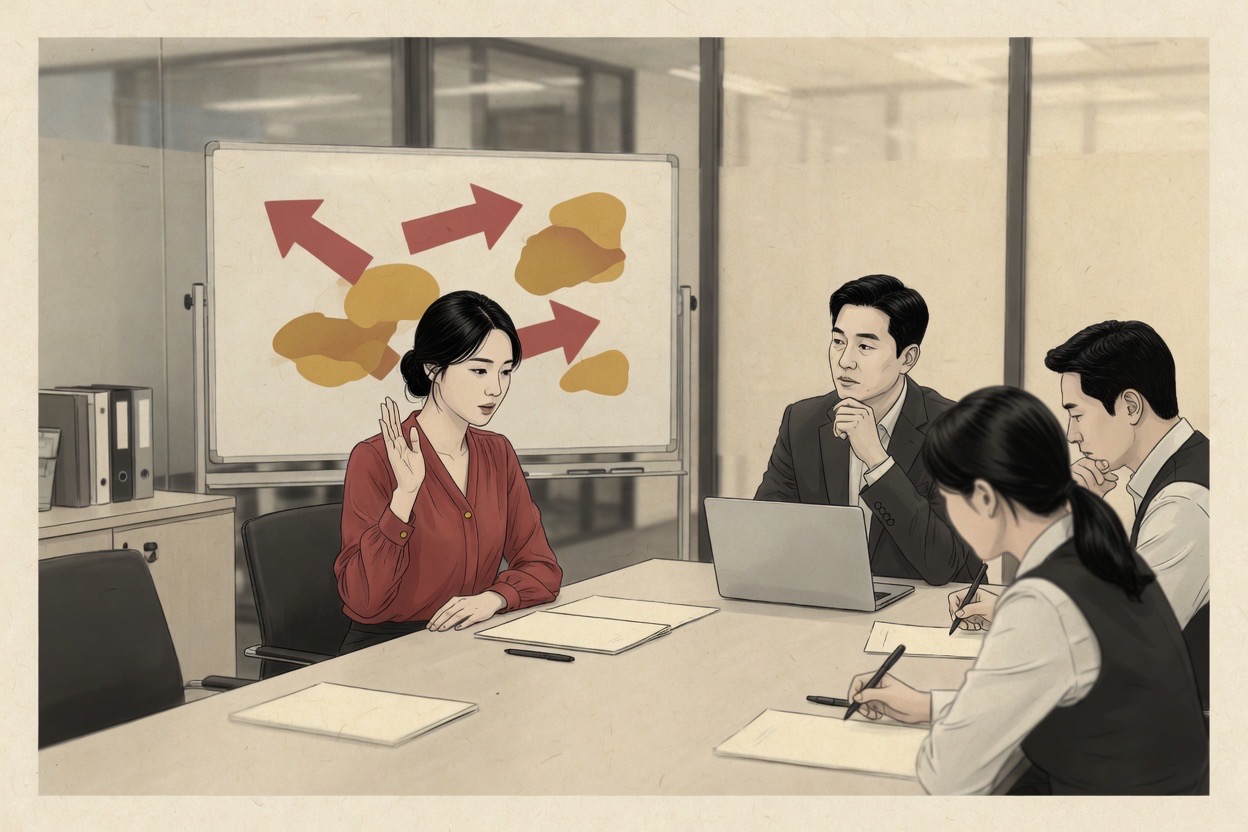
Jumping in over a director mid-sentence is rare even in flexible companies. Waiting forever until every senior has monologued can waste the hour. Good nunchi finds the pause: a hand half-raised, a short “May I add one thing,” a point that builds on the last speaker instead of replacing them. Silence is not always agreement—sometimes it is waiting for rank to finish framing the problem.
How to disagree
Public contradiction of a senior can cost face for both people if it is sharp, personal, or timed for an audience. Soft disagreement—data first, option second, credit shared—usually travels better. The goal is not “never disagree.” The goal is disagree without making the senior look foolish in front of their own seniors.
Whether to take the last item
The last piece of cake, the last coffee pod, the last taxi seat after 회식—these small free-for-alls are classic nunchi quizzes. Offering once, waiting a beat, then taking it if nobody wants it is ordinary. Snatching first while a boss is mid-reach is how “zero nunchi” becomes office folklore.
Who handles small logistics
On many teams the maknae—youngest on the project—still ends up collecting lunch orders or booking the room. That pattern is fading in places and alive in others. Reciprocity is the fix: if the youngest organizes today, someone else organizes tomorrow.
None of this is unique to Korea as pure psychology. What is culturally loud is how often Koreans name the skill, joke about it, and use it as both praise and soft complaint.
회식 (hoesik) — the after-work team dinner
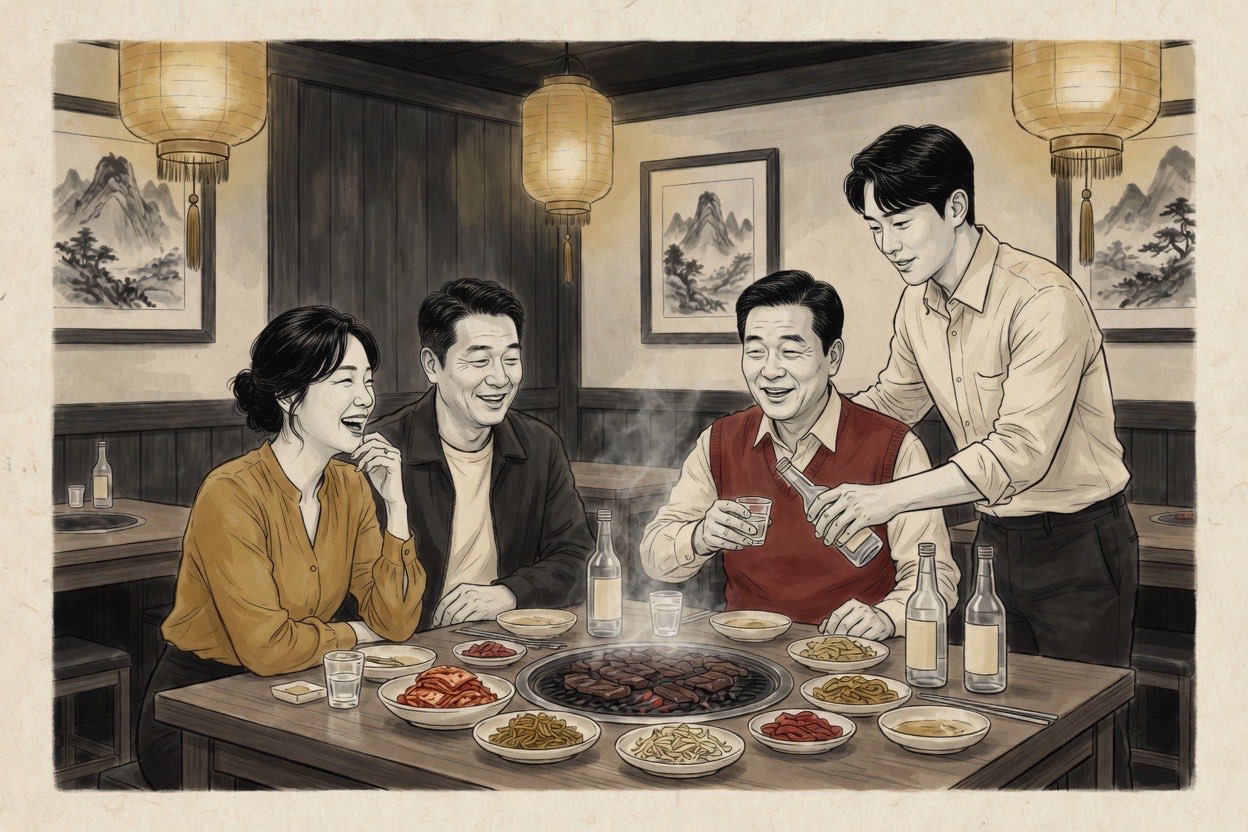
회식 (회식, hoesik) is the company or team meal after work—sometimes food, sometimes soju, often both. Search interest around “hoesik etiquette” is really interest in how hierarchy shows up at the table.
What the classic pattern looks like
In the textbook version many guides still teach:
- A junior pours for a senior first.
- When someone pours for you, you hold the glass with two hands (or one hand under the glass as support).
- When drinking with someone much more senior, some people turn slightly aside rather than drink face-to-face.
- Food is shared; you keep an eye on empty glasses near seniors.
- Leaving early used to require a clear reason, a toast of apology energy, and sometimes permission vibes from the highest rank present.
That pattern is real history and still real in parts of finance, manufacturing, older chaebol cultures, and any team that loves tradition. It is not a universal Tuesday night law in 2026 Seoul startups.
How hoesik has changed since the 2010s
A few shifts are widely discussed among workers themselves: fewer mandatory weekly sessions in many white-collar teams; softer alcohol pressure (“I’ll drink tea” or “driving” is more sayable); clearer optional language in some companies—and still-fake optional language in others; more public talk about gender and late-night safety; more food-first 회식 and daytime team lunches instead of marathon soju nights.
If you are new, the safest nunchi is simple: copy the quiet competent junior, not the loudest blog. Offer to pour once. Accept a pour with two hands if that is what the table is doing. Eat, laugh, and skip the dramatic early-exit monologue if people are already peeling off in ones and twos.
Leaving 회식 early
Acceptable reasons that usually land cleanly: early meeting tomorrow, last train, family care, health, long commute. What lands poorly is disappearing without a word, or performing a theatrical apology that makes the whole table stop eating. A short, specific exit—“I have a 9 a.m. with the client; thank you so much for dinner”—beats a five-minute speech about corporate culture.
퇴근 눈치 and 칼퇴 — the politics of leaving
퇴근 눈치 (toegun nunchi)
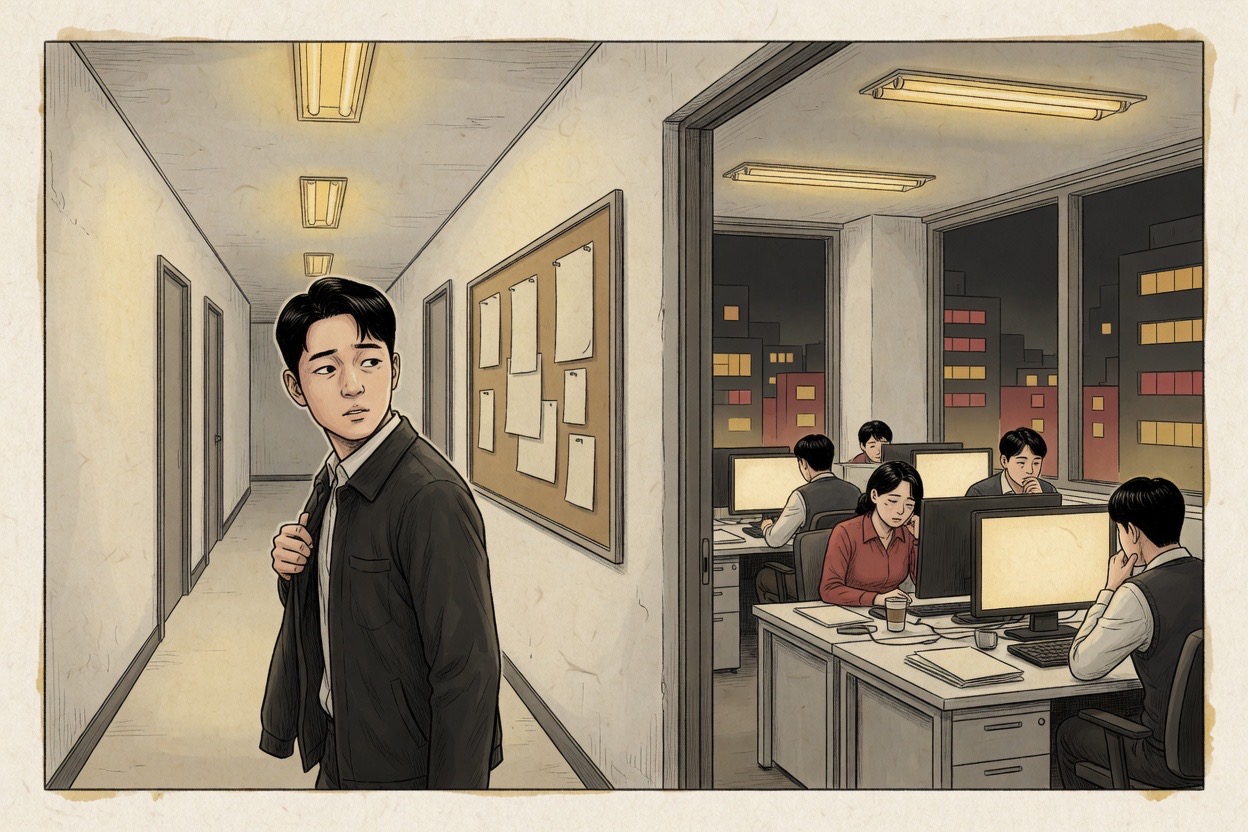
퇴근 눈치 (퇴근 눈치) is the pressure felt around clocking out—especially the old pattern of not leaving before the boss. Lights stay on. Bags stay under desks. People half-work while waiting for permission the boss never verbally gave.
This is one of the most complained-about pieces of Korean office life among younger workers. It is also uneven: some managers actively tell people to leave; some teams measure output and ignore desk theater; some still treat early departure as disloyalty. Naming the phenomenon matters because the complaint is domestic, not only foreign. Koreans roast 퇴근 눈치 in webtoons, variety shows, and team group chats.
칼퇴 (kaltoe) — on-time exit as goal and insult
칼퇴 (칼퇴, from “knife” + “leave work”) means leaving exactly on time, as if cutting the day clean. For many millennials and Gen Z workers, 칼퇴 is aspirational: a healthy boundary, a life outside Slack, proof the job is not a personality.
In older hierarchical rooms, the same word can still sound sharp—as if you care more about the clock than the team. Whether 칼퇴 is praised or side-eyed depends on who is speaking and which company you are in. Good nunchi here is local: if your team celebrates on-time exit, do not martyr yourself for a ghost hierarchy. If your team is mid-crunch on a launch, announcing proud 칼퇴 while others are shipping can read as tone-deaf even among peers who otherwise support work-life balance.
Practical leaving without drama
Finish what you promised that day. Signal clearly—bag, jacket, a short goodbye—not a silent vanish. If a senior is mid-crisis, a quick “Need anything from me before I go?” is often enough. And if the culture is truly stay-until-boss-leaves, decide whether this is a team you want long-term. Nunchi includes reading the room and reading whether the room is worth your evenings.
How to disagree with a senior without losing face
Disagreement is not banned. Humiliation is. The craft is protecting two faces at once: yours (you still have a brain) and theirs (they still lead).
Patterns that usually work: agree with the goal, then fork the method; bring an alternative, not only a veto; use private channels for sharp critique; cite the work, not the person; leave a dignified exit after the risk is visible (“I might be wrong—happy to follow your call”).
Korean honorifics matter here more than people expect. Soft content with the wrong speech level still scrapes. Hard news in steady jondaemal with a role title (팀장님, 부장님) often travels farther than casual banmal bluntness you have not earned.
What foreign workers are—and are not—expected to know
Most Korean colleagues do not expect 1980s department-store etiquette on day three. They expect basic politeness, attention when someone is speaking, not humiliating people in group settings, and effort proportional to how long you have been there.
They usually do not expect perfect pouring choreography, flawless age math on week one, guilt about every 칼퇴, or you policing other foreigners louder than Koreans police each other.
Over-performing can backfire. Bowing too deep for a peer, refusing to leave until midnight as a loyalty show, or lecturing the team about “real Korean culture” from a blog can feel stranger than missing a two-handed pour. Slack is real. Use it as room to learn, not as a free pass to ignore people.
One high-return habit: learn names, use polite speech, and thank people specifically when they cover for you. Gratitude with detail is international nunchi.
When you’ll hear these words
A coworker sighs 눈치 보이네 (they feel watched about leaving). Someone jokes 오늘은 칼퇴한다 (cutting out on time). A group chat announces 이번 주 금요일 회식. A junior mutters about 퇴근 눈치 while still packing slowly. A senior praises a new hire: 눈치가 빨라—quick nunchi. You will also hear younger workers reject the whole package: “Why should I wait?” That pushback is part of the culture now, not a glitch in it.
Example dialogues
1. Leaving with a soft check-in
Open office, 6:05 p.m. Work is done; the team lead is still typing.
- Jiwoo: 팀장님, 오늘 드린 자료는 메일로 보내 뒀어요. 들어가도 될까요?
Timjangnim, oneul deurim jaryoneun meillo bonae dweosseoyo. Deureogado doelkkayo?
Team lead, I sent today’s materials by email. Would it be alright if I head out? - Team lead: 응, 수고했어. 조심히 들어가.
Eung, sugohaesseo. Josimhi deureoga.
Yeah, good work today. Get home safe. - Jiwoo: 감사합니다. 내일 뵙겠습니다.
Gamsahamnida. Naeil boepgetseumnida.
Thank you. See you tomorrow.
Gloss: Polite speech to the lead. Jiwoo names finished work, asks once, leaves. No bag-hovering theater, no disappearing without a word.
2. Hoesik pour, two hands, no performance
Restaurant table. Soju bottle mid-pass; ages span twenties to fifties.
- Junior: 부장님, 술 따라 드릴게요.
Bujangnim, sul ttara deurilgeyo.
Bujangnim, let me pour for you. - Director: 고마워. 너는?
Gomawo. Neoneun?
Thanks. What about you? - Junior: 아, 저도 조금만요. 감사합니다.
A, jeodo jogeummanyo. Gamsahamnida.
Ah, just a little for me too. Thank you. - (Director pours; junior holds the glass with two hands.)
Gloss: Classic table choreography without a monologue about tradition. Two hands receive; gratitude is short; nobody lectures the foreign intern beside them who is simply watching and copying.
3. Disagreement that keeps both faces usable
Project meeting. A timeline looks tight; the junior has the risk numbers.
- Junior: 팀장님 말씀대로 일정은 맞추고 싶은데요, QA를 이틀 당겨 보면 리스크가 줄 것 같습니다.
Timjangnim malsseumdaero iljeongeun matchugo sipeundeyo, QA-reul iteul danggyeo bomyeon riseeukaga jul geot gatseumnida.
I’d like to keep the schedule you outlined, team lead—if we pull QA forward by two days, I think the risk drops. - Team lead: 근거 있어요?
Geungeo isseoyo?
Do you have a basis for that? - Junior: 지난 분기 버그 리포트 요약해 두었습니다. 회의 후에 공유할게요.
Jinan bun-gi beogeu ripoteu yoyakhae dueotseumnida. Hoeui hue gongyuhalkkeyo.
I summarized last quarter’s bug reports. I’ll share them after the meeting. - Team lead: 좋아요. 일단 그 방향으로 검토해 보죠.
Joayo. Ildan geu banghyangeuro geomtohae bojyo.
Good. Let’s review it that way for now.
Gloss: Goal affirmed, method forked, evidence ready, no public dunking. The junior waits for a speaking turn; the lead keeps authority while taking the better path.
Good nunchi / Zero nunchi
Good nunchi
Your first 회식. You watch who pours for whom, offer once, hold your glass with two hands when the director fills it, eat a little of everything, and leave after the second wave of goodnights with a short thank-you. You do not give a TED Talk on Korean drinking culture. The team decides you are easy to include next time.
Zero nunchi
Same dinner. You refuse every pour with a speech about toxins, correct a senior’s English joke at full volume, grab the last grilled piece while three people are mid-reach, then leave at 8:10 without a word because “optional means optional.” Technically you might be right about the invite text. Socially you made the table colder than the banchan.
Do / Don’t
Do
- Watch your team’s actual habits for a week before importing rules from the internet.
- Leave with a clear goodbye when the work is done—especially if your manager models it.
- Disagree with options and evidence, not with personal scorekeeping.
- At 회식, offer help with pouring or ordering once; accept help without drama.
- Give foreigners (including yourself) learning room—polite attention beats perfect choreography.
Don’t
- Treat 퇴근 눈치 as eternal law or as a myth—both oversimplify.
- Over-perform tradition until it becomes cosplay.
- Publicly corner a senior into admitting they are wrong for an audience.
- Confuse 칼퇴 pride with abandoning a real crisis mid-fire.
- Assume every quiet junior agrees with the plan; they may be waiting for a safe turn.
Nearby ideas on Have Nunchi
- Nunchi — the base skill this whole page applies at work
- Korean honorifics — titles and speech levels that carry disagreement
- Maknae — youngest-on-the-team logistics and when to share the load
- Korean age system — why relative age still sorts some rooms
- Thank-you language — specific gratitude that reads as competence, not flattery
A closing line
Workplace nunchi is not a trap map for surviving a hostile culture. It is how a room coordinates rank, time, and care—sometimes gracefully, sometimes badly, increasingly under debate among Koreans themselves.
Read the lights on the desks, the pause in the meeting, the empty glass at 회식, and the real invitation behind “optional.” Then make the next small move that keeps the work moving and the people still able to look at each other tomorrow.
FAQ
What is workplace nunchi in Korea?
Workplace nunchi is the practical skill of reading rank, timing, and mood at a Korean office—when to leave, when to speak in a meeting, how to disagree, and how to behave at team dinners—without needing every rule said out loud.
What is hoesik (회식) and what should I know?
Hoesik is the after-work team dinner or drinks. Classic etiquette includes pouring for seniors, holding a glass with two hands when receiving, and sometimes turning slightly away when drinking with someone much senior—though younger teams have relaxed many of these since the 2010s.
What is 퇴근 눈치 (toegun nunchi)?
퇴근 눈치 is the social pressure around leaving work—especially not clocking out while a boss or senior is still visibly working. Many younger workers push back, and companies differ wildly; the phenomenon is real, not a universal law.
What does 칼퇴 (kaltoe) mean?
칼퇴 means leaving exactly on time, like cutting the day with a knife. For some it is a healthy boundary; for others it is still a loaded word that can sound selfish in older hierarchical teams. Context decides the weight.
Do foreign workers need perfect workplace nunchi?
No. Most Korean teams extend slack to foreigners who are polite and attentive. Trying hard to perform every traditional custom can look stranger than missing one. Warm curiosity beats overacting.
Do you have nunchi?
Get short Korean word lessons and social cues in your inbox.