Why Koreans Seem to Grow Up Fast — and Why It Can Hurt
The youngest face in the room may already be doing the most social math.
- Hangul
- 눈치 문화
- Romanization
- nunchi munhwa
- Pronunciation
- noon-chee moon-hwa
- Category
- Why Koreans
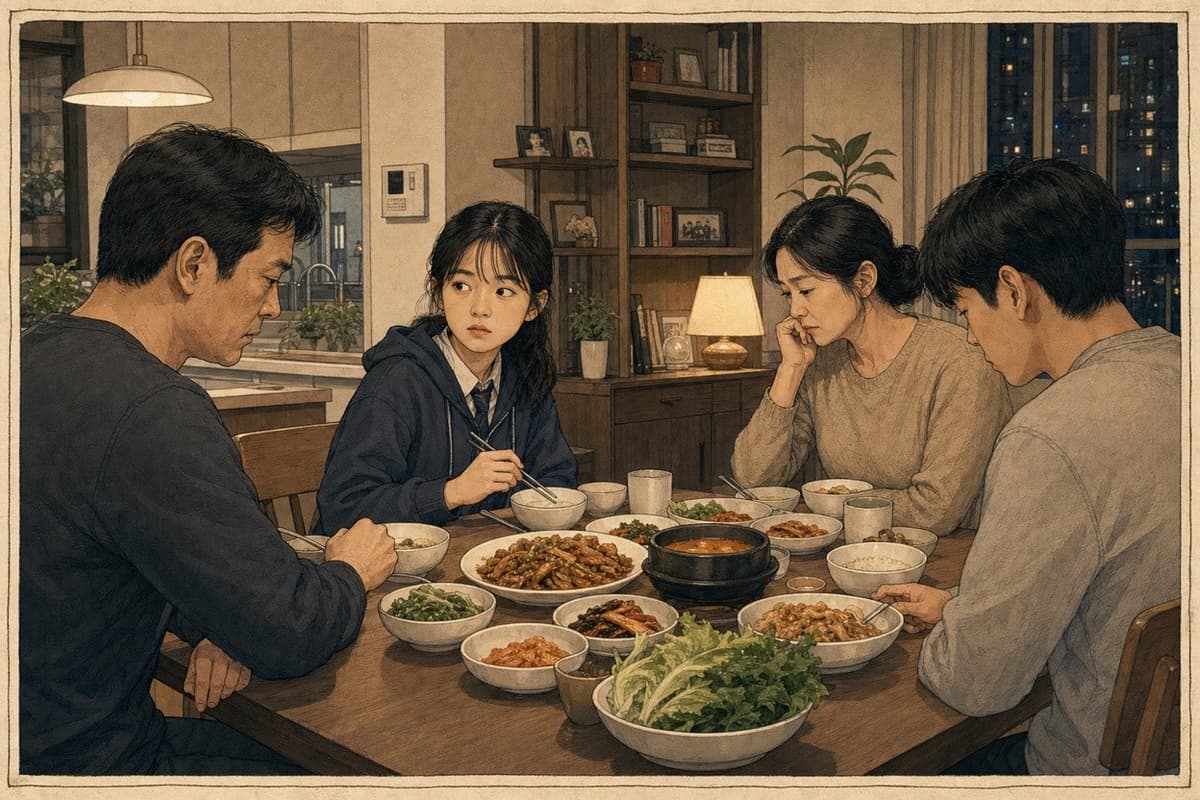
Do Koreans grow up faster? Not biologically, and not in one universal Korean way. What can look like early maturity is often early social forecasting: learning to read age, mood, hierarchy, and other people’s likely reactions before acting. Korean calls much of that skill nunchi (눈치, occasionally spelled noonchi in English).
In a society often described as high-context, more of the message lives outside the sentence—in timing, relationship, status, silence, and facial expression. A child who learns that system early may look unusually composed. But quick room-reading has a cost when every cue feels like an order. You can become excellent at predicting everyone else while getting very quiet about yourself.
Quick facts
| Core word | 눈치 (nunchi) — reading a situation and adjusting |
| Culture phrase | 눈치 문화 (nunchi munhwa) — “nunchi culture,” often said critically |
| Communication frame | high-context communication |
| What looks like fast growth | early skill at tracking adults, rank, timing, and group mood |
| Useful side | tact, coordination, care, adaptability |
| Painful side | self-silencing, approval scanning, carrying moods that are not yours |
| Important correction | social alertness is not the same as emotional maturity |
The hook needs one correction first
“Koreans grow up fast” is a hook, not a scientific finding. There is no national maturity clock, and Korean childhoods vary by family, class, generation, region, and temperament. Plenty of Korean children are loud, direct, gloriously oblivious, and allowed to stay that way.
The more defensible observation is narrower: some Korean children learn socially adult-looking behavior early. They greet elders in the expected way. They notice who speaks first. They change speech depending on age. They read whether a parent’s 괜찮아 (“it’s fine”) sounds genuinely fine.
That competence can be mistaken for inner adulthood. A child who stops asking for something after one look at a tired parent may be praised as 철이 들었다—mature, sensible, having “come to their senses.” Sometimes that is empathy. Sometimes it is a child deciding their need is the easiest thing to remove.
Looking easy to manage is not proof that growing up felt easy.
What does “high-context society” actually mean?
High-context communication is a useful lens for messages whose meaning depends heavily on shared background and relationships. Instead of putting every intention into words, people may expect the listener to use context:
- who is older or more senior
- how close the relationship is
- what happened last time
- the length of a pause
- whether a “maybe” arrived with an uncomfortable smile
- who has the social right to disagree in public
Korea is commonly described as high-context, and nunchi is one way people navigate that environment. Research on nunchi often separates two jobs: grasp the social cue, then adjust your behavior. Korean speech makes a similar distinction in everyday life. 눈치가 빠르다 praises someone who catches on quickly; 눈치를 보다 can describe nervously watching for approval.
But “high-context Korea” is not a law of nature. The model describes a tendency, not every Korean conversation. A blunt sibling, a transparent startup, a close friend, and a formal family gathering can operate at four different context levels before lunch. Researchers have also challenged how neatly national cultures fit a high-versus-low binary.
Use the idea as a map. Do not turn it into a personality test for fifty million people.
How children learn the social math early
The lesson rarely arrives as “Today we study nunchi.” It arrives in corrections and repetition.
인사해야지—you should greet them. Use two hands. Let the adult start eating. Call the older child 언니, 누나, 형, or 오빠, depending on who is speaking. Switch from casual speech to polite endings when the relationship changes. Korean honorifics and the age system turn social information into grammar.
None of those rules automatically harms a child. They can teach attention, respect, and the pleasant art of not making every room orbit you. The pressure appears when a child is expected to manage adult emotional weather as well as manners.
1. After a tense family dinner
- Parent: 오늘 왜 그렇게 조용했어?
Oneul wae geureoke joyonghaesseo?
Why were you so quiet today? - Teen: 어른들 분위기가 좀 안 좋아 보여서… 그냥 가만히 있었어.
Eoreundeul bunwigiga jom an joa boyeoseo… geunyang gamanhi isseosseo.
The adults seemed a little tense… so I just stayed quiet. - Parent: 네가 신경 쓸 일 아니야. 다음엔 편하게 있어도 돼.
Nega singyeong sseul il aniya. Daeumen pyeonhage isseodo dwae.
That isn’t yours to worry about. You can relax next time.
Gloss: The teen read the room correctly. The healthier adult move is to remove the burden, not congratulate the child for becoming invisible.

Why the skill can look like fast growth
A child with quick nunchi may develop a polished set of adult-facing skills:
- anticipation — preparing what a parent or teacher will need before being asked
- code-switching — changing tone, title, and speech level by relationship
- conflict prevention — noticing a mood shift before an argument becomes public
- group care — making sure the quiet person, elder, or newcomer is included
- self-control — delaying a want because the moment is wrong
Those are real strengths. They help people cooperate in dense families, classrooms, and workplaces. They can make a Korean teenager seem unusually capable to an outsider who grew up hearing “say exactly what you need.”
The catch is that anticipation and maturity are not synonyms. Anticipation answers, “What will keep this room stable?” Maturity also asks, “What do I feel? What is my responsibility? What should I refuse?” A person can be brilliant at the first question and under-practiced at the other three.
Why can nunchi culture hurt?
Nunchi hurts when it stops being information and becomes compulsory self-reduction.
Every clue becomes a command
A sigh might mean the boss is tired. It does not automatically mean you must cancel your evening. A parent’s disappointment is real information. It is not always a verdict. Under heavy 눈치 문화, people can learn to treat another person’s face as an instruction panel.
“No one told you” becomes the punishment
High-context systems can reward people who already know the code and embarrass people who need it stated. The rule stays invisible until someone breaks it. Then the group acts as if the rule was obvious.
That is efficient for insiders and lonely for newcomers, neurodivergent people, children, and anyone entering a new hierarchy. The room saves a sentence; one person spends the evening replaying every glance.
You become fast at reading others and late at reading yourself
If “What do they want?” always comes first, “What do I want?” can feel selfish or strangely blank. People may say 눈치 보느라 말을 못 했어—I could not speak because I was watching the room. That is not the praised form of having nunchi. It is the heavy form: social awareness turned inward as restraint.
Nunchi does not equal an anxiety disorder, and one cultural habit cannot explain anyone’s mental health. But constant approval monitoring can be exhausting. Korean research has studied nunchi alongside high-context communication, social anxiety, interpersonal sensitivity, and relationship problems precisely because the skill and the burden live close together.
The same habit follows people into work
Childhood social math does not disappear at graduation. It can become meeting math.
2. The opinion that stayed in the notebook
- Colleague: 의견 있었는데 왜 말 안 했어요?
Uigyeon isseonneunde wae mal an haesseoyo?
You had an opinion—why didn’t you say it? - Junior: 다들 팀장님 의견에 동의하는 분위기여서 눈치 보느라 말을 못 했어요.
Dadeul timjangnim uigyeone donguihaneun bunwigiyeoseo nunchi boneura mareul mot haesseoyo.
It felt like everyone agreed with the team lead, so I held back while watching the room. - Colleague: 다음엔 말해 주세요. 다른 의견도 필요한 회의예요.
Daeumen malhae juseyo. Dareun uigyeondo piryohan jariyeyo.
Please say it next time. This is a room that needs different opinions too.
Gloss: The junior did not lack an idea. They had too much information about the hierarchy. Workplace nunchi becomes healthy when leaders make disagreement safe enough to survive the room.
High context is an explanation, not an alibi
“That is just Korean culture” can explain why a message stayed indirect. It cannot excuse bullying, coercion, or making juniors responsible for a senior’s temper.
Good nunchi is reciprocal. The junior notices the senior’s position; the senior notices how much risk the junior is taking. The child greets the guest; the guest does not demand a performance. The friend catches a soft no; the other friend eventually learns to give a clear one.
When only the lower-status person must read the room, it is not a shared cultural skill. It is one-way emotional labor wearing traditional clothes.
How do you keep nunchi without losing yourself?
The goal is not zero nunchi. A world where nobody notices anyone else is not freedom; it is a group chat with twelve people changing the subject at once. The healthier move is to keep the sensor and loosen its authority.
- Treat a cue as data, not a command. Notice the frown. Then ask whether it is yours to fix.
- Say one preference before scanning the room. Food, meeting time, weekend plan—small choices rebuild access to your own answer.
- Ask when the stakes are high. “Do you want advice or listening?” is kinder than a confident guess.
- Name the hidden rule for people with less power. A good manager makes expectations explicit instead of grading secret etiquette.
- Let disappointment exist. Someone can dislike your boundary without the boundary being rude.
3. A small preference, said out loud
- A: 뭐 먹고 싶어?
Mwo meokgo sipeo?
What do you want to eat? - B: 난 매운 거 말고 국수 먹고 싶어. 이번엔 눈치 안 볼래.
Nan maeun geo malgo guksu meokgo sipeo. Ibeonen nunchi an bollae.
I want noodles, not something spicy. This time I’m not going to watch everyone’s reaction. - A: 좋아. 그럼 국수 먹자.
Joa. Geureom guksu meokja.
Great. Let’s have noodles.
Gloss: No confrontation, no manifesto—just a preference surviving daylight.

Good nunchi / Zero nunchi
Good nunchi
You notice a teenager went silent when the adults became tense. Later you check in privately, tell them the conflict was not theirs to manage, and make space for their actual opinion. You read the child instead of using the child to regulate the room.
Zero nunchi
You praise the same teenager for being “so mature,” keep rewarding them for needing nothing, and tell guests how easy they are. The child learned every adult’s face. No adult learned theirs.
Is this uniquely Korean?
No. Children everywhere can learn to anticipate adults, and every culture has indirect rooms. The Korean difference is not exclusive ownership of the behavior. It is the unusually useful vocabulary around it: nunchi for reading the situation, 눈치가 빠르다 for catching on quickly, 눈치를 보다 for watching approval, and 눈치 문화 for criticizing the system around that watching.
That vocabulary gives English speakers a better question than “Are Koreans more mature?”
Ask instead: Who had to become easy for the room—and how early did they learn?
A closing line
Nunchi can make someone look grown before they feel safe enough to be young.
Keep the part that notices. Question the part that disappears.
FAQ
Do Koreans really grow up faster?
Not biologically, and not every Korean has the same childhood. What can look like early maturity is often early social forecasting: learning to track age, mood, hierarchy, and other people's likely reactions.
What does high-context culture mean in Korea?
It means more of a message may sit in shared relationships, timing, status, and nonverbal cues instead of the sentence alone. Korea is often described this way, but high-context and low-context are tendencies—not fixed national personalities.
Is nunchi the same as people-pleasing?
No. Healthy nunchi notices a cue and chooses a fitting response. People-pleasing treats every cue as a command and makes another person's comfort more important than your own needs.
Does nunchi cause anxiety?
Nunchi by itself is a social skill, not a diagnosis or a single cause of anxiety. But being required to monitor approval constantly—especially under rigid hierarchy—can feel exhausting and can encourage self-silencing.
Do Koreans criticize nunchi culture?
Yes. Koreans often use 눈치 문화 critically when room-reading becomes pressure, while still valuing consideration and good timing. The debate is usually about forced deference, not about becoming careless toward other people.
Sources
Primary and authoritative references used for definitions and context on this page.
- Hierarchy-Oriented Culture in Korean Society — Korea Citation Index
- Working Better with Age: Korea — OECD
- Nunchi Across Cultures: A Mixed-Methods Study — Cross-Cultural Research
- Development and Validation of the Multi-Factor Nunchi Scale for Adults — Journal of Family Relations
- Professional Communication in Korea: Playing Things by Eye — IEEE Transactions on Professional Communication
- Contexting Koreans: Does the High/Low Model Work? — Business Communication Quarterly
Read next
Do you have nunchi?
Get short Korean word lessons and social cues in your inbox.