What Does “Ahjussi” Mean in Korean? (Not the Romantic Version)
K-drama made it sound magnetic. Real Korean made it sound like “sir, you look older.”
- Hangul
- 아저씨
- Romanization
- ajeossi
- Pronunciation
- ah-juh-sshee
- Category
- Culture
Ahjussi (아저씨, official romanization ajeossi, roughly ah-juh-sshee) is a Korean word for a middle-aged man who is not your close kin—and the everyday way to address one. Dictionaries also keep the older kinship sense: a male relative in your parents’ generation, the “uncle” lane. One-sentence answer for searchers: ahjussi names an adult man at some distance; it is not Korean for “handsome older love interest.”
If your ear learned the word from the drama My Mister (나의 아저씨) or the film The Man from Nowhere (아저씨), the English internet often smuggles in romance or cool-loner aura. Real rooms usually do the opposite. Ahjussi marks age band plus social distance. It is closer to “mister / that middle-aged guy” than to oppa or hyung, which encode closeness from a younger speaker.
Quick facts
| Hangul | 아저씨 |
| Romanization | ajeossi (official); common English spellings ahjussi, ajusshi |
| Pronunciation | ah-juh-sshee (tense ss; not “ah-joo-see”) |
| Literal sense | middle-aged / adult man; also uncle-generation male relative |
| Who says it | anyone, when age and distance fit |
| Who it is for | adult men who are not being claimed as close older-brother figures |
| Not the same as | oppa / hyung (warm older-male titles) · 삼촌 (uncle, kinship-first) · 선생님 (role/respect default) |
How do you pronounce ahjussi?
Say ah-juh-sshee in three short beats. The middle vowel is closer to uh than to a long English oo. The ss is tensed—a brief hold—not a soft z.
Spelling chaos is normal in English:
- ajeossi — Revised Romanization (the spelling Korean government materials aim for)
- ahjussi — the search-friendly spelling most English speakers type
- ajusshi — another fan/transcription variant
All three point to 아저씨. On this site we use ahjussi in English headings when that matches how people search, and ajeossi when we need the official romanization.
What does ahjussi actually mean?
Korean Basic Dictionary senses land in two useful buckets:
- Kinship lane — a male relative in the same generation as your parents (an uncle-type adult).
- Social lane — an adult man among non-relatives, or the word used to call that man.
English learners almost always meet sense 2 first: the neighborhood shopkeeper, the man on the subway, the friend’s dad’s friend you do not know well enough to nickname. Ahjussi is ordinary. That ordinariness is the meaning.
What it is not:
- not automatic romance
- not a soft boyfriend title
- not a free substitute for oppa because a male character looks “mature and kind”
If you need the wider map of who may call whom what, start with Korean honorifics. Ahjussi sits on the distance side of that map.
Ahjussi vs oppa vs hyung vs 삼촌 vs 선생님
People mash these together because English collapses them into “older guy.” Korean does not.
| Word | Hangul | Age feel | Closeness | Kinship? | Typical job in the sentence |
|---|---|---|---|---|---|
| ahjussi | 아저씨 | adult / middle-aged | low–medium | sometimes (uncle-generation), often not | name or address a non-intimate adult man |
| oppa | 오빠 | older than speaker | high (once earned) | blood or social | woman/girl → older male she is close to |
| hyung | 형 | older than speaker | high (once earned) | blood or social | man/boy → older male he is close to |
| 삼촌 | 삼촌 | parents’ generation | kinship-coded | yes (uncle) | family first; sometimes playful extension |
| 선생님 | 선생님 | any adult, role-led | polite distance | no | teacher, and a broad respectful default |
Read the table left to right: ahjussi is not the male equivalent of a crush title. Oppa and hyung pull someone into a younger speaker’s intimate grid. Ahjussi leaves him outside that grid—adult, addressable, not claimed as “my older brother figure.”
Family vocabulary nearby is different again. Father in Korean is a parent title, not a stranger-address shortcut. And if the person is younger than you in the sibling-direction sense, you are in dongsaeng territory, not ahjussi territory.
When does a man become an ahjussi?
There is no official birthday. No ministry memo says “from age X, please answer to 아저씨.” The word arrives by social weather: how old he looks, how old the speaker is, how much distance the speaker feels, and how much nerve the speaker has.
That is why the first time a man hears it can sting. The sentence may be ordinary—“아저씨, 자리 있나요?”—while the hearing is personal: someone sorted me into the middle-aged bin. Friends tease. The man laughs, or does not. None of that requires a fixed threshold age, and inventing one would fake a rule Korean does not publish.
Relative age still matters in Korea’s address habits—see the Korean age system for how birth year shapes other titles—but ahjussi is less “exact rank” and more “adult-man silhouette.” A speaker may reach for it too early. The man may feel it too early. Both reactions can be socially real without either one being a calendar fact.
What should you call a male stranger instead?
If you are not sure he wants the middle-aged stamp, do not guess his decade out loud. Use role and attention-getters:
- 저기요 (jeogiyo) — “excuse me”; safest opener in shops, streets, cafés
- 선생님 (seonsaengnim) — broad polite address in many service and careful settings
- 사장님 (sajangnim) — shop/restaurant owner or boss-coded respect
- 기사님 (gisanim) — taxi, bus, or hired driver
These words answer “how do I get his attention without diagnosing his age?” Ahjussi remains common and not automatically rude in many neighborhood contexts—especially with men who clearly present as middle-aged—but learners overuse it as a universal male sticker. Role titles age better than age titles.

Why K-drama and film titles make ahjussi sound cooler than it is
English-language fandom met the word through titles that frame an ordinary man against an extraordinary plot. My Mister uses 아저씨 as understatement: not prince, not idol, a worn adult man. The film The Man from Nowhere does similar work with a sparse title that refuses glamour. The irony only works because the everyday word is plain.
That plainness gets lost in trailer English and GIF culture. Viewers borrow the aura of the character and paste it onto the word. Then a tourist calls a twenty-something barista ahjussi and wonders why the smile thins. The drama sold a story. The noun still means middle-aged man at a distance.
Ahjussi and ajumma are not mirror images
아줌마 (ajumma) is the common paired word for a middle-aged woman, and English guides love to present the pair as neat twins. Linguistically they rhyme. Socially they do not always weigh the same.
As a language observation—not a survey result—many speakers treat ajumma as the sharper stigma word in casual talk: more ready to imply nosiness, pushiness, or a look people mock. Ahjussi can sting as an age label, especially for younger men, but it is also a default address in shops and streets without the same pile of comic stereotypes hanging off every use. Same age-band idea, uneven cultural baggage. If you only memorize them as “mister / missus,” you miss why one apology lands softer than the other.
Example dialogues
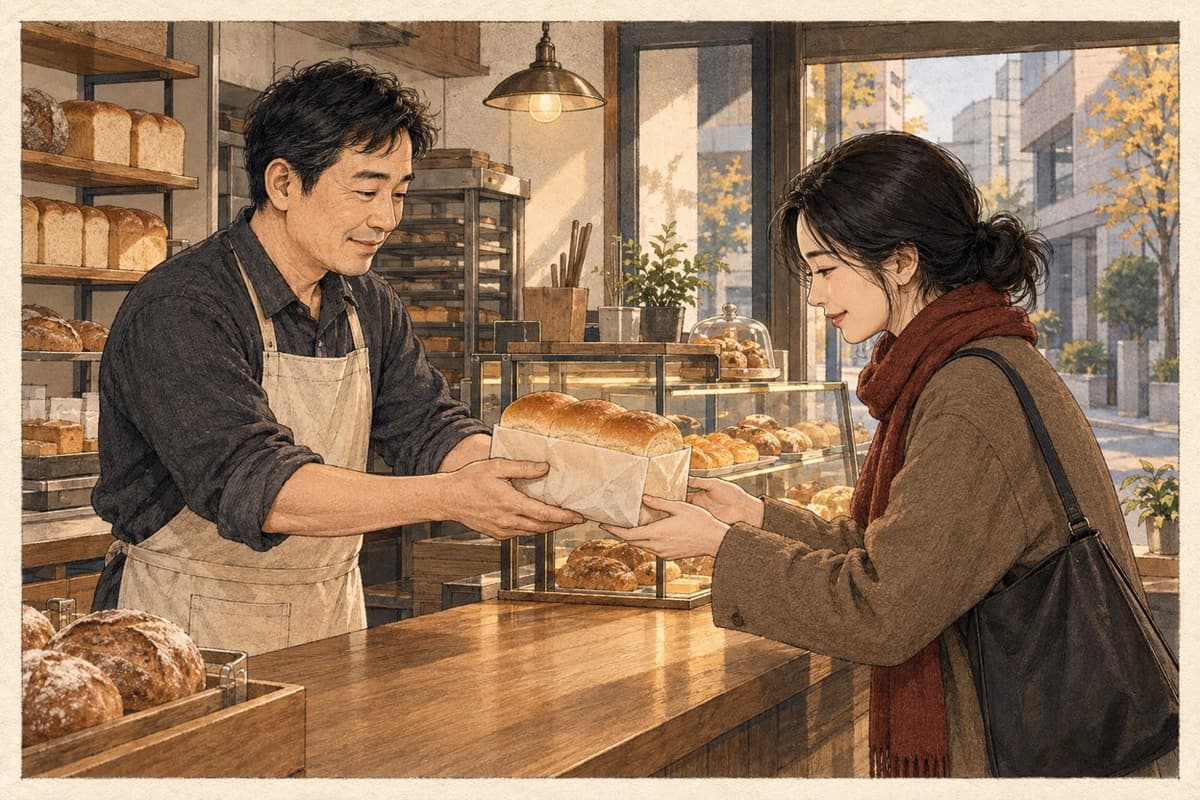
1. Neighborhood bakery — ordinary, correct ahjussi
Late afternoon. The baker looks clearly middle-aged; the customer is just buying bread.
- Customer: 아저씨, 식빵 하나 주세요.
Ajeossi, sikppang hana juseyo.
Ahjussi, one loaf of white bread, please. - Baker: 네, 방금 나온 거예요.
Ne, banggeum naon geoyeyo.
Sure—this just came out. - Customer: 따뜻하네요. 감사합니다.
Ttatteuthaneyo. Gamsahamnida.
It’s warm. Thank you.
Gloss: No romance. No older-brother claim. Just the default adult-man address in a small shop.
2. The age sting — friends after a delivery
Apartment hallway. A delivery has just left. One friend is still chewing on the title he heard.
- Minho: 야, 나 방금 아저씨 소리 들었어.
Ya, na banggeum ajeossi sori deureosseo.
Dude, someone just called me ahjussi. - Jae: 배달 기사님이? 모르는 사람한테는 그렇게 부르기도 해.
Baedal gisanim-i? Moreuneun saramhanteneun geureoke bureugido hae.
The delivery driver? Strangers do call people that. - Minho: 알아. 근데 기분이야 기분이지.
Ara. Geunde gibuniya gibuniji.
I know. Still—it’s the feeling that hits.
Gloss: The word can be socially normal and emotionally loud at the same time. Jae does not invent a legal age. Minho is reacting to being sorted.

When you’ll hear it
- A child calling for the male shopkeeper across a narrow grocery aisle
- A neighbor asking the man downstairs to move a parked car an inch
- Friends describing “that ahjussi on the bus” with zero romantic subplot
- A taxi passenger skipping ahjussi and going straight to 기사님
- A man repeating the word later to friends because it landed as an age verdict
- Drama titles and film posters using the plain noun as understatement, which English captions then overcharge with mood
The big misunderstanding this page exists to fix
Ahjussi is not Korean for “attractive older man in a rainy K-drama.” It is a practical noun and address for an adult man at some remove—often middle-aged, often unrelated, often unromantic on purpose. Oppa and hyung are the closeness titles. Ahjussi is the distance label. Use it when the room already treats him as that silhouette; when you are unsure, call the role, not the decade.
If someone just filed you under ahjussi and your pride needs ice, that reaction is part of the culture too—not a translation error.
FAQ
What does ahjussi mean in Korean?
Ahjussi (아저씨) means a middle-aged man who is not your close kin, or the everyday word used to address one. It can also mean an uncle-generation male relative, but English searchers usually meet the stranger/neighbor sense first.
Is ahjussi a compliment?
Usually no. Calling someone ahjussi marks him as an older adult man at some social distance. To a young or young-looking man, it can land as an age verdict more than a warm nickname.
Ahjussi vs oppa vs hyung—what is the difference?
Oppa and hyung are closeness titles for an older male from a younger speaker (by speaker gender). Ahjussi is not that club. It points to a middle-aged man without the intimacy those kinship titles carry.
How do you spell ahjussi—ahjussi, ajusshi, or ajeossi?
Official Revised Romanization is ajeossi. English search and fan writing often use ahjussi or ajusshi. Same Hangul: 아저씨.
What should I call a male stranger instead of ahjussi?
Safer defaults are 저기요 (excuse me), 선생님 in many service or polite settings, 사장님 for a shop owner, and 기사님 for a taxi or bus driver. Role beats age-guessing.
Why do K-drama titles use ahjussi if the word is not romantic?
Because the plainness is the point. Titles like My Mister work as irony or understatement—an ordinary middle-aged man framed against a story that is anything but ordinary.
Sources
Primary and authoritative references used for definitions and context on this page.
- Korean Basic Dictionary — 아저씨 — National Institute of Korean Language
- Standard Korean Dictionary — 아저씨 — National Institute of Korean Language