What Does “Aigoo” Mean? The Korean Sigh With Many Jobs
Not a translation problem—a register marker that sighs, soothes, and scolds.
- Hangul
- 아이고
- Romanization
- aigoo
- Pronunciation
- ai-goo
- Category
- Slang
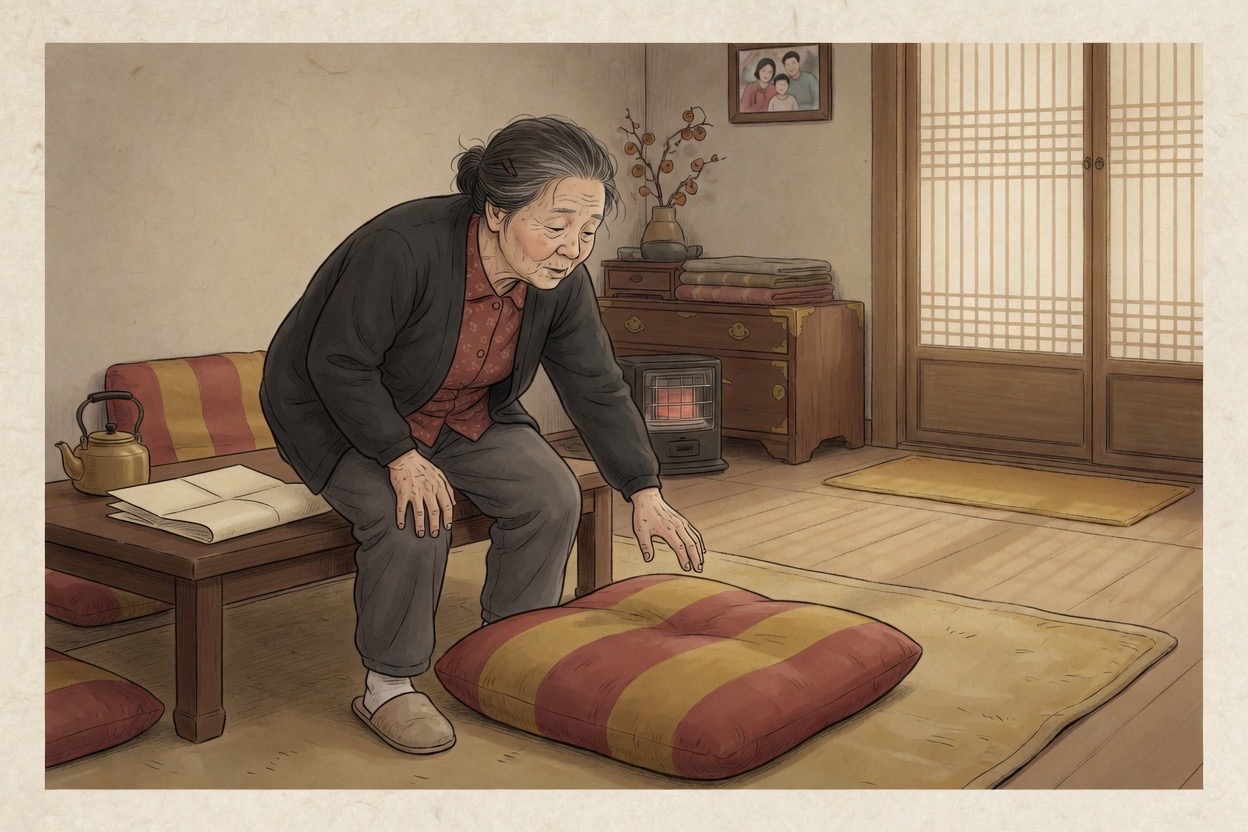
Aigoo (아이고, pronounced ai-goo) is a Korean interjection—a short vocal reaction, not a noun with one English equivalent. Search “aigoo meaning” and you will see oh dear, oh my, ugh, goodness, and ow offered as if one of them wins. None of them fully wins. One-sentence definition: aigoo is a register marker that can carry sympathy, mild exasperation, physical effort, affection, or grief depending on who says it and how.
English wants a tidy gloss. Korean wants a sound that sits before the real sentence—or replaces the sentence entirely. That is why the same three syllables can soothe a tired adult, scold a child gently, announce sore knees, or open a funeral lament. Treat it as social weather, not a flashcard.
Quick facts
| Hangul | 아이고 |
| Romanization | aigoo (also aigo, aigooh in loose English) |
| Pronunciation | ai-goo (two beats; not “eye-goo” with a long English i) |
| Word class | interjection / exclamation |
| Fixed English meaning? | no—range, not one translation |
| Common registers | sympathy · mild exasperation · physical effort · affection · grief |
| Age vibe | strongly associated with older speakers; young use can be self-aware |
How do you pronounce aigoo?
Say ai-goo: a clear ai as in “eye,” then a short goo. Stress is even—not a dramatic AI-goooo unless the speaker is performing. In real rooms the second syllable often softens; the word can land almost like a sigh with consonants.
You will also see aigo in English captions and older forum posts. That is the same word with one o dropped in romanization, not a separate dictionary entry. Hangul stays 아이고 for the default form most people mean.
What does aigoo mean? (no single translation)
If you only remember one thing from this page, remember this: aigoo does not mean one English word. It is closer to a family of English reactions that all share a “something hit me” quality—emotion, body, or both.
Useful English approximations (not synonyms):
| English shade | When it fits | Still missing |
|---|---|---|
| oh dear / oh my | soft concern, mild shock | can sound too dainty |
| ugh | tiredness, annoyance | can sound ruder than intended |
| goodness | surprise + sympathy | too formal for floor-cushion groans |
| oof / ow | physical effort or ache | skips social care |
| poor you (tone) | consoling someone | English needs more words |
The Korean advantage is speed. A speaker can drop 아이고 alone and the room already knows whether the next move is comfort, a joke, a scolding, or silence. English usually has to keep talking.
The register range (this is the real meaning)
Think of aigoo as a dial, not a definition.
1. Sympathy
Someone finished a brutal shift, a long commute, or a hard week. A listener answers with 아이고, 힘들었겠다—Aigoo, that must have been hard. The word opens the care package. The clause after it does the specific work.
2. Mild exasperation
A child left shoes in the doorway again. A coworker repeated the same mistake. The aigoo is not rage; it is “I saw this coming and I am still a little done.” Tone does most of the job. Flat and long can feel scolding. Soft and breathy can still feel fond.
3. Physical effort
Standing up from a low table. Sitting down after market bags. Lifting a heavy box. Many speakers—especially older ones—release 아이고 as the body moves. It is not always about pain; it is the sound of effort becoming public.
4. Affection toward children (and the child-adjacent)
Wiping a sticky face, finding a scraped knee, hearing a dramatic toddler story. Aigoo can mean “oh you little storm” without a lecture. The same shape of sound that scolds can also cocoon.
5. Grief and heavy sorrow
At funerals and in deep mourning speech, elongated aigoo / related cries can open real grief—not comedy, not light inconvenience. English subtitles that still print “oh my” here are doing violence to the moment. If you only know drama-clip aigoo, treat funeral register as a different weight class.
None of these five is a “correct” meaning that cancels the others. Context + voice + relationship pick the channel.
Aigoo vs aigu vs ayu vs eogu
English search boxes collapse everything to “aigoo.” Spoken Korean keeps a small sigh family:
| Hangul | Common romanization | Feel (approximate) |
|---|---|---|
| 아이고 | aigoo / aigo | default, wide range, the form this article centers |
| 아이구 | aigu / aigu | close sibling; some ears hear it softer or more “ajumma/ajussi kitchen” |
| 아유 | ayu / a-yu | lighter puff—annoyance or “come on” without full elder weight |
| 어이구 | eogu / eoigu / eoigoo | often surprised sympathy—“oh look at that / oh you poor thing” |
These are not strict regional codes with walls between them. The same speaker may use more than one in a day. What matters for learners is not memorizing four definitions—it is recognizing that Korean packages emotion into short vocal shapes, and subtitle English keeps flattening them into the same two words.
You may also hear stretched versions: 아이고고, 아이고나, longer wails in comedy or in real distress. Length and melody are part of the grammar of feeling.
Who says aigoo? Age, humour, and self-awareness
Aigoo is strongly associated with older speakers—grandmothers at the table, fathers after parking, market vendors sorting change. That association is cultural, not a law. Young adults use it constantly; they just often use it with a half-smile that says I know I sound like my mom right now.
A twenty-five-year-old muttering 아이고 while dropping onto a sofa can be:
- genuinely tired
- lightly parodying elder speech
- both at once
That double layer is why young aigoo can feel funny without being fake. It is costume and truth in the same breath—similar to how English speakers might say “lord help me” without attending church that morning.
Foreign learners sometimes overcorrect: either they never touch the word, or they deploy a theatrical aigoo in every photo caption. Better path: borrow it when your body or sympathy actually needs a sound, keep the volume modest, and watch whether locals around you use it as weather or as bit.
Why K-dramas are full of aigoo (and why subtitles flatten it)
Open almost any family drama, workplace tearjerker, or weekend comedy and you will hear aigoo rain down in:
- hospital corridors
- living-room arguments that are half love
- mothers discovering a mess
- leads collapsing onto benches after running through rain
Writers love it because it is efficient emotion. One syllable cluster paints age, intimacy, and stakes before the plot sentence arrives. It also sounds unmistakably Korean on an international soundtrack—fans learn the shape of the sound even when they cannot parse the next clause.
Subtitles have a narrower toolbox. Constrained by character counts and the need for instant readability, many tracks render nearly every instance as:
- “Oh my”
- “Oh no”
- “Oh dear”
- “Goodness”
That is not evil—it is compression. But compression erases register. The grandmother lowering herself onto a cushion, the manager staring at a ruined spreadsheet, and the mother wiping sauce off a toddler’s cheek can all become “Oh my” in English. On your screen they look like the same line. In the original audio they are three different social acts.
If you watch with Korean audio even while reading English text, listen for:
- length (clipped vs drawn out)
- pitch (high flutter vs low groan)
- what follows (care sentence, scolding, silence, tears)
That is how you recover the meaning subtitles deleted.
When you’ll hear it
- A grandmother sitting down after standing at the sink: pure body aigoo.
- A friend finishing a story about overtime: sympathy aigoo before advice.
- A parent finding wet socks on a dry floor: exasperation with a leash still on.
- Office hallways after a system outage: collective quiet aigoos, half joke.
- Drama climaxes and variety-show bit characters: volume turned up for the camera.
- Heavy mourning contexts: do not treat those like meme audio.
You will not typically hear aigoo as a cheerful greeting substitute. It is not hello in Korean. It reacts; it does not open small talk with strangers from zero.
Example dialogues
1. Sympathy after a brutal day (friends, banmal)
Late evening, two friends on a bench. One has been talking for three minutes without air.
- Joon: 야, 오늘 진짜 죽을 뻔했어. 야근에 팀장님 전화까지.
Ya, oneul jinjja jugeul ppeonhaesseo. Yageune timjangnim jeonhwakkaji.
Dude, I nearly died today. Overtime and then the team lead’s call on top. - Min: 아이고, 힘들었겠다. 밥은 먹었어?
Aigoo, himdeureotgetda. Babeun meogeosseo?
Aigoo, that must’ve been rough. Did you eat? - Joon: 편의점 삼각김밥. 맛없더라.
Pyeonuijeom samgak-gimbap. Maseopdeora.
Convenience-store triangle kimbap. Tasted awful. - Min: 아이고… 내가 커피라도 살게.
Aigoo… naega keopirado salge.
Aigoo… at least let me get you a coffee.
Gloss: Banmal between peers. First aigoo = sympathy door. Second aigoo = residual care while moving to a small practical kindness. No single English word covers both hits the same way.
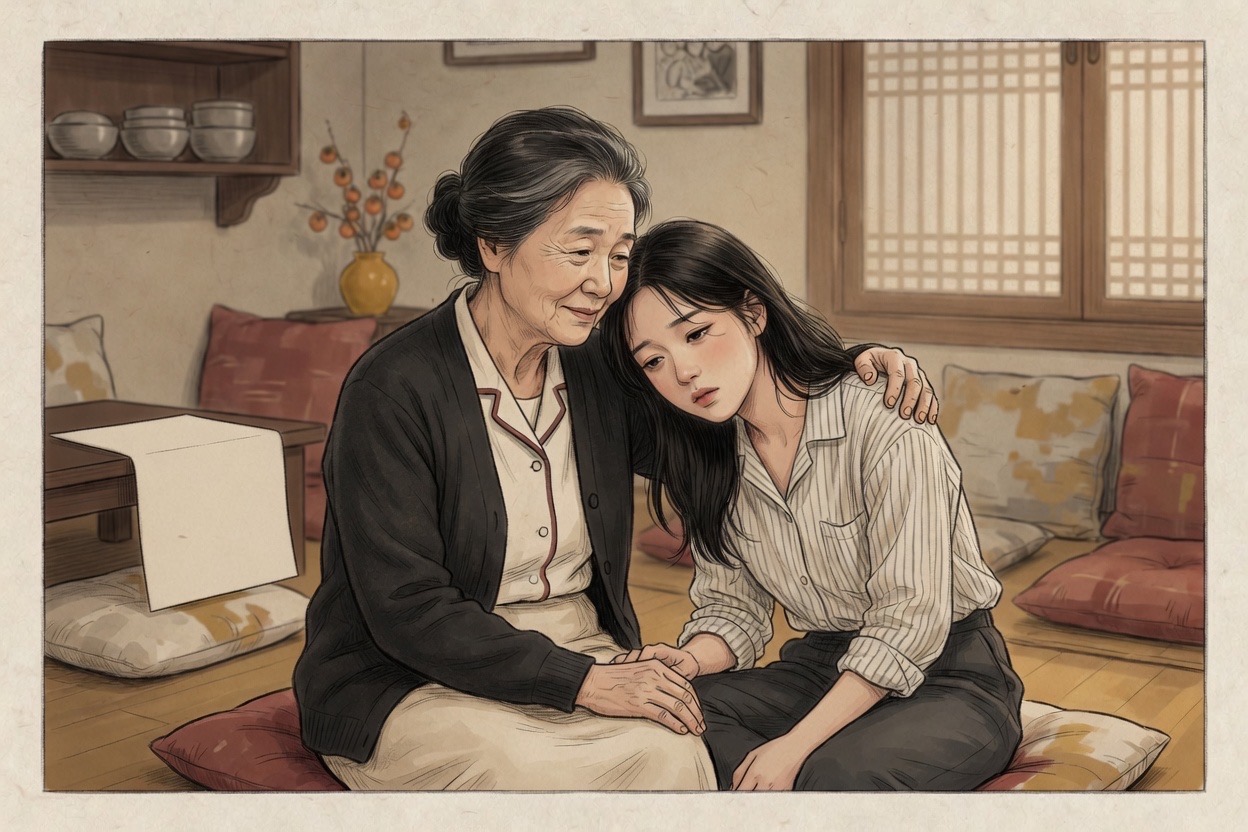
2. Body effort + soft scolding at home (family mix)
Living room floor cushions. Grandmother has been on her feet; the adult granddaughter looks wiped from work.
- Grandmother: 아이고, 무릎이 왜 이래…
Aigoo, mureupi wae irae…
Aigoo, what is wrong with these knees… - Granddaughter: 할머니, 제가 도와드릴게요.
Halmeoni, jega dowadeurilgeyo.
Grandma, let me help you. - Grandmother: 아이고, 우리 손주 고생 많았네. 얼굴이 왜 이렇게 피곤해 보여.
Aigoo, uri sonju gosaeng mananne. Eolguri wae ireoke pigonhae boyeo.
Aigoo, our grandchild worked so hard. Why does your face look this tired. - Granddaughter: 괜찮아요. 그냥 바쁜 한 주였어요.
Gwaenchanayo. Geunyang bappeun han juyeosseoyo.
I’m fine. Just a busy week.
Gloss: Grandmother’s first aigoo is body talk. Her second flips into care aimed outward—classic elder multitasking. The granddaughter stays in polite speech; the grandmother’s warmth does not require the younger person to match banmal.
This is also where nunchi matters: you do not “correct” her aigoo into a cheerful English pep talk. You let the sound do its job, then help with the cushion or the tea.
3. Office fatigue (polite edges, private groan)
Open office, 8:40 p.m. A man in his forties stares at a desk that has become a paper geography problem.
- Colleague: 부장님, 아직 가시고요?
Bujangnim, ajik gasigoyo?
Manager, you’re still here? - Manager: 아이고… 이 서류가 끝이 없네.
Aigoo… i seoryuga kkeuchi eomne.
Aigoo… these documents never end. - Colleague: 내일 아침에 같이 볼까요?
Naeil achime gachi bolkkayo?
Want to look at them together in the morning? - Manager: 그래. 아이고, 눈 빠지겠다.
Geurae. Aigoo, nun ppajigetda.
Yeah. Aigoo, my eyes are going to fall out.
Gloss: Workplace hierarchy still shapes titles (korean honorifics never fully clock out), but aigoo leaks through as human noise. It is not unprofessional here; it is a pressure valve. English “ugh” is close in mood and still too blunt for the care hidden under the complaint.

4. Parent and small child (affection with a wipe)
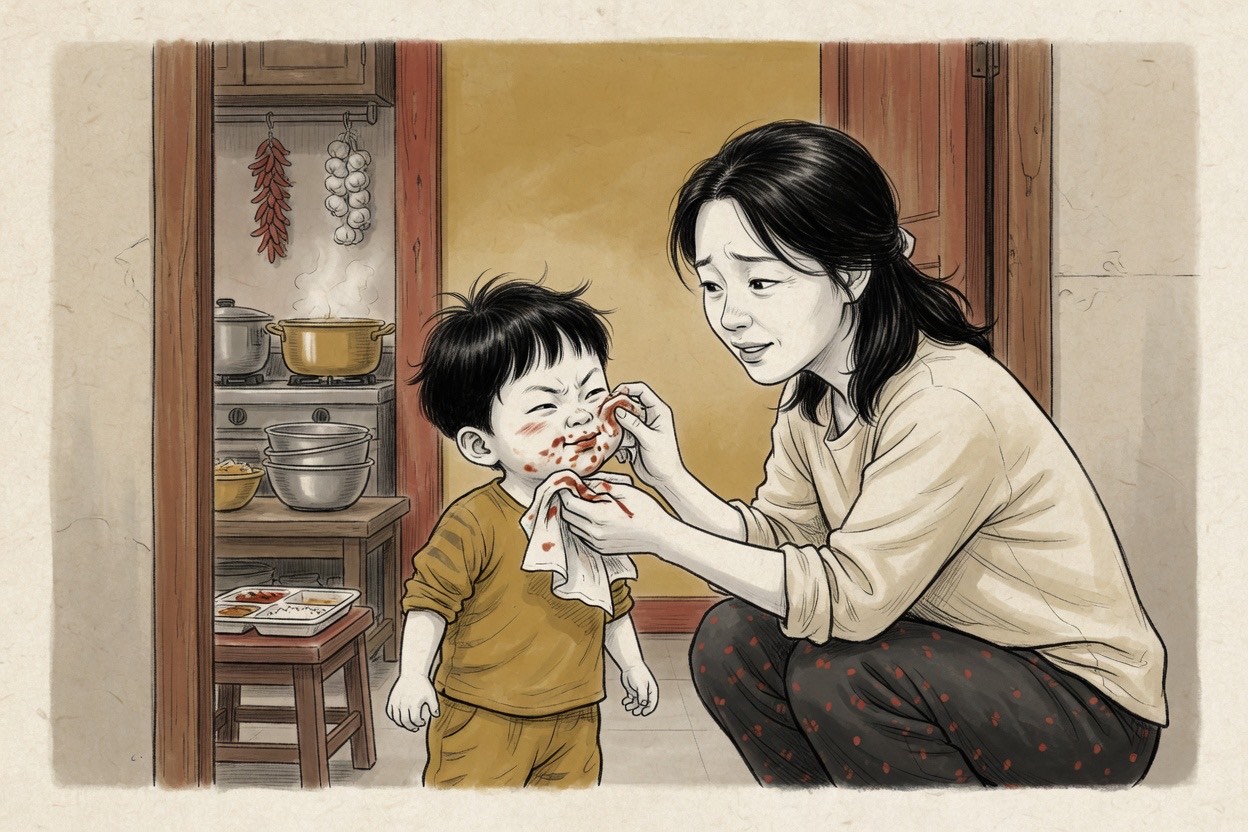
Kitchen doorway. Sauce has colonized a small chin. Mother crouches to eye level.
- Child: 엄마, 안 아프면 돼?
Eomma, an apeumyeon dwae?
Mom, if it doesn’t hurt, it’s okay? - Mother: 아이고, 우리 아기 얼굴이 이게 뭐야. 가만히 있어 봐.
Aigoo, uri agi eolguri ige mwoya. Gamanhi isseo bwa.
Aigoo, what is this on our baby’s face. Hold still. - Child: 잇… 차거.
It… chageo.
Eep… cold. - Mother: 아이고, 조금만. 다 됐다.
Aigoo, jogeumman. Da dwaetda.
Aigoo, just a little. All done.
Gloss: This aigoo is not insult. It is fond exasperation—the same emotional neighborhood as many mom in Korean care scripts. English “oh you mess” can sound sharper than the Korean warmth unless you keep the voice soft.
Good nunchi / Zero nunchi
Good nunchi
A Korean coworker describes a rough week. You answer with a quiet “aigoo…” and then a concrete offer—water, a later deadline help, silence if they are still talking. You matched register: short sound, real care, no TED Talk. They laugh once and keep going. The word worked as a door, not as a costume.
Zero nunchi
Same story. You interrupt with a loud, theatrical “AIGOO~~” learned from a meme compilation, then explain to the room what aigoo “literally means,” then ask them to say it again for your story. The care moment becomes your content. They smile with their mouth only. You collected a clip. You missed the person.
Do / Don’t
Do
- Treat aigoo as a reaction family, not one English gloss.
- Listen for tone and what comes next—that is where meaning lives.
- Use a small aigoo for sympathy or body effort among people who already talk comfortably with you.
- Notice age play: young speakers often use it with a wink; elders may use it as plain weather.
- Watch dramas with audio attention when subtitles say “oh my” for the fifteenth time.
Don’t
- Force one translation (“aigoo = oh my”) as if the other registers were wrong.
- Yell aigoo at strangers as proof you “speak culture.”
- Copy funeral-weight delivery for a missing bus.
- Assume only grandmothers are allowed to say it—or that young speakers are always joking.
- Confuse aigoo with apology language; a groan is not a substitute for a real apology.
Nearby ideas
- Nunchi (눈치) — reading whether this aigoo wants comfort, a joke, or quiet
- Grandmother words — elder speech is where many learners first meet the sound in the wild
- Mom / care talk — affectionate scolding and face-wiping scripts sit next door
- Honorifics & speech levels — aigoo can appear inside banmal or beside polite sentences; the rest of the grammar still has to fit the room
- Hello and everyday openers — aigoo reacts; it does not replace hello in Korean
A closing line
Aigoo is not a vocabulary trophy. It is air leaving the body with social information attached—care, strain, scolding, fondness, sometimes grief. English can chase it with five translations and still arrive late.
Hear the room first. Then let the sound be as small as the moment needs.
FAQ
What does aigoo mean in Korean?
Aigoo (아이고) is an interjection with no single fixed English meaning. Depending on tone and situation it can sound like oh dear, oh my, ugh, goodness, or a soft groan of effort—more a reaction than a definition.
Is aigoo only said by grandmothers?
No, but it is strongly associated with older speakers. Younger people use it too—often half-seriously, half as warm self-aware humour that borrows elder energy for a second.
What is the difference between aigoo, aigu, ayu, and eogu?
They are close cousins of the same sigh family. 아이고 (aigoo) is the default romanized form; 아이구 (aigu) feels a shade softer or regional to some ears; 아유 (ayu) is lighter; 어이구 (eogu / eoigu) often lands as surprised sympathy.
Why do K-dramas use aigoo so much?
Because real Korean conversation loads emotion into short vocal reactions. Subtitles often flatten every instance into oh my or oh no, so the register—sympathy, scolding, effort, grief—disappears on screen.
Can foreigners say aigoo?
Yes, carefully. A quiet aigoo when someone shares bad news, or when you sit down after a long walk, usually reads fine among friends. Loud cartoon aigoo at strangers can feel like costume speech.
Do you have nunchi?
Get short Korean word lessons and social cues in your inbox.