Hanja Explained — What Chinese Characters Still Do in Korean
Hangul is how Korean is written. Hanja is why so many words share roots you can actually learn.
- Hangul
- 한자
- Romanization
- hanja
- Pronunciation
- han-ja
- Category
- Culture
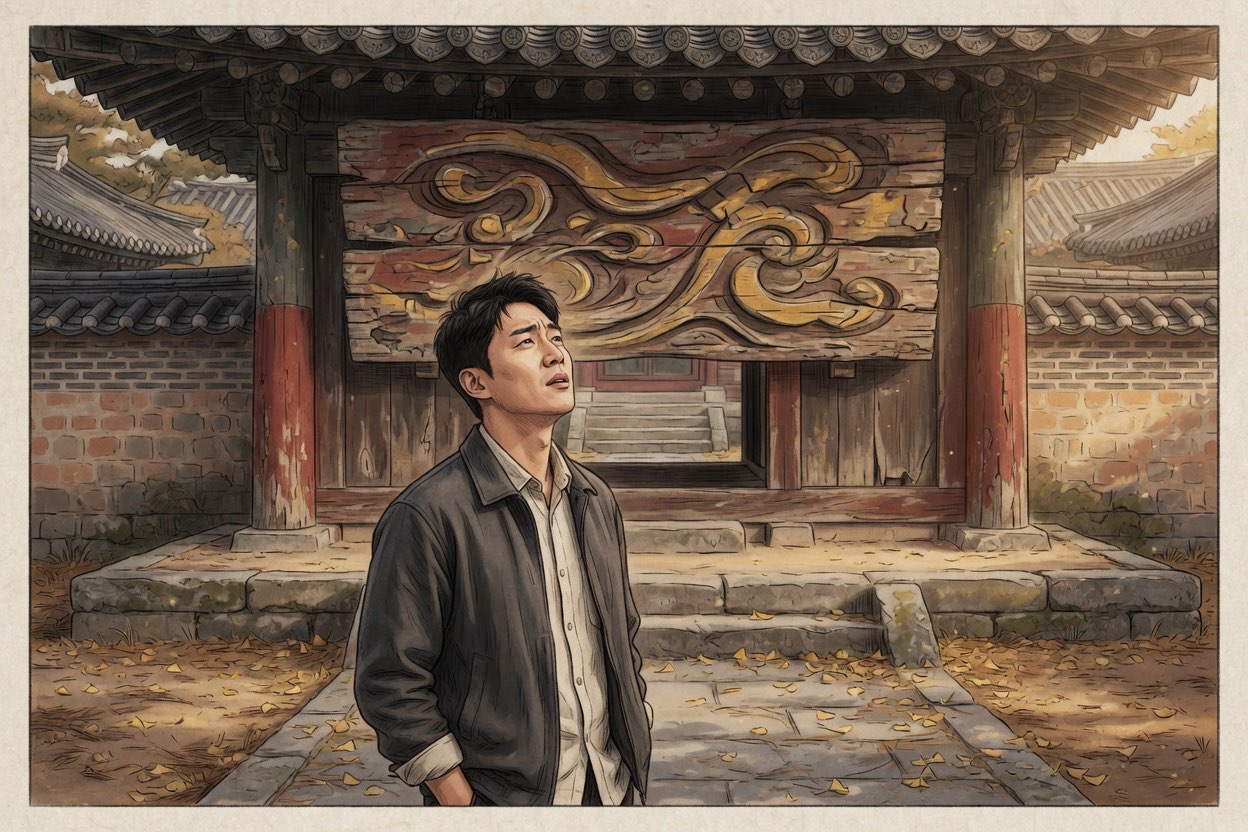
Hanja (한자, pronounced han-ja) are Chinese characters as used in Korean—each carrying a meaning and a Korean pronunciation. Written Korean today is hangul. You almost never write hanja in daily life, yet a very large share of Korean words are Sino-Korean, built from hanja roots even when every letter on the page is hangul. One-sentence definition: hanja stopped being a script most people read and became a vocabulary system Korean inherits.
You do not need to memorize characters to speak well. Notice that 학 (學) means “learn,” and 학교, 학생, 학년, 대학, and 유학 become one family—not five strangers. That is the practical payoff.
Quick facts
| Hangul | 한자 |
| Romanization | hanja |
| Pronunciation | han-ja |
| What it is | Chinese characters used in Korean, with Korean readings |
| What it is not | Korea’s everyday writing system (that is hangul) |
| Where it lives now | vocabulary roots, personal names, disambiguation, temples, idioms |
| Learner priority | optional early; high-leverage later for word families |
Hanja vs hangul — not a competition
People often treat hanja vs hangul like a death match. It is not. They answer different questions.
Hangul is an alphabet invented for Korean so the language could be written clearly and accessibly. Hanja are borrowed logographs. Each character encodes a meaning and is read with a Korean sound—not with modern Mandarin by default.
For centuries, hanja was the scholarly written standard on the peninsula. Hangul was created in the 15th century under King Sejong. The move toward hangul-only publishing and everyday writing happened gradually across the 20th century, not as a single dramatic flip switch. Exact decree years and ministry slogans get overstated online; the honest version is gradual replacement in daily print and schooling, with hanja retreating into specialist and traditional niches.
A careful note: Korean hanja uses traditional character forms, and meanings have drifted in places from modern Chinese usage. Do not assume a character you met in a Chinese app maps cleanly onto every Korean word that shares the same root shape.
Bottom line for learners: hangul is how you write. Hanja is where many words came from.
The word-family payoff
This is the section worth a screenshot. You do not need hundreds of characters. A few high-frequency roots turn opaque hangul strings into families.
學 — 학 — learn
- 학교 — school
- 학생 — student
- 학년 — school year / grade
- 대학 — university
- 유학 — studying abroad
大 — 대 — big / great
- 대학 — university (“great learning”)
- 대통령 — president
- 대사관 — embassy
人 — 인 — person
- 한국인 — Korean person
- 외국인 — foreigner
- 인기 — popularity
生 — 생 — life / be born
- 생일 — birthday
- 학생 — student
- 생활 — daily life
생일 is also the everyday birthday word in greetings—see how to say happy birthday in Korean.
電 — 전 — electricity
- 전화 — telephone
- 전기 — electricity
- 전철 — electric train / subway
食 — 식 — eat / food
- 식당 — restaurant
- 식사 — a meal
- 한식 — Korean food
Once you own a root, new compounds stop arriving as pure noise. That is why intermediate learners who finally touch hanja often say vocabulary “clicks”—not because they start writing essays in characters, but because hangul words start sharing bones.
Where you still actually see hanja
Be concrete. A visitor walking around Seoul today sees very little hanja on storefronts and subway ads. Hangul won the street. Hanja did not vanish; it moved.
Names
This is the big surviving domain. Most Korean given names are still chosen as hanja, even when everyday life only shows hangul. The characters can appear on family registers, some official documents, and traditional wedding invitations. If you care what a name is meant to mean, you are already in hanja territory—start with Korean names and meanings and the surname map in Korean last names. For writing your own name in hangul only, my name in Korean is the practical companion.
Disambiguation
Korean has many homophones—different hanja roots that collapse to the same hangul spelling. In legal, academic, or technical writing, the hanja may appear in parentheses after the hangul so nobody argues about which “jeong” or “gi” was intended.
Headlines, temples, idioms
Newspaper headlines once carried more hanja than they do now; that habit has thinned a lot. You still meet characters on temple plaques, old building signs, calligraphy, and four-character idioms (사자성어). Those are cultural residue, not proof that your barista is about to handwrite your receipt in 漢文.
Pure Korean vs Sino-Korean — two vocabularies
Korean keeps native words and hanja-derived words for overlapping ideas, and they are not free swaps. Register changes.
| Idea | Native (warmer / everyday) | Sino-Korean (more formal / technical) |
|---|---|---|
| Numbers | 하나, 둘, 셋 | 일, 이, 삼 |
| Meal / rice | 밥 | 식사 |
| Age | 나이 | 연세 (honorific, for elders) |
| Name | 이름 | 성함 (honorific) |
Native and Sino-Korean numbers are used for different jobs—counting objects vs dates, money, and phone-style sequences. That split already lives inside the Korean age system article for age math; the same dual toolkit shows up everywhere else.
Pattern learners can keep: Sino-Korean words tend to sound more formal or technical; native words sound warmer and more everyday. Honorific pairs like 나이 / 연세 and 이름 / 성함 sit inside the wider map of Korean honorifics. Using the formal word with the wrong person is not “fancy.” It is slightly off—like wearing a suit jacket to a convenience-store run.
Do Koreans study hanja?
Yes. Hanja still appears in school curricula, and there are proficiency certification exams that some students and job applicants take. That does not mean every twenty-something casually reads temple plaques fluently.
There is a real generational gradient. Grandparents who grew up with more character exposure often recognize far more than their grandchildren. Younger speakers may know the hangul word, the meaning in context, and still shrug at the printed character. Both can be fully fluent Korean speakers. Literacy in hanja is no longer the same thing as literacy in Korean.
Do you need to learn hanja?
No—not to speak, not to text friends, and not for your first year or two of study. Hangul, high-frequency words, and speech levels will take you further, faster.
Later, yes as a tool. Learning roughly the most common hundred roots is one of the highest-leverage intermediate moves for vocabulary. You are not becoming a calligrapher. You are buying a decoding key for the Sino-Korean half of the dictionary.
Honest limit: hanja does not fix pronunciation or grammar. It will not teach you when to use banmal, how nunchi works in a room, or which particle the sentence wants. It organizes meaning. It does not run the conversation.
Example dialogues
1. Temple plaque, friends, honest shrug
Afternoon at a temple. A learner points at the carved board over the gate.
- Learner: 저거 뭐라고 써 있어?
Jeogeo mworago sseo isseo?
What does that say up there? - Friend: 음… 절 이름인 건 알겠는데, 다 읽진 못해.
Eum… jeol ireumin geon algetneunde, da ikjin mothae.
Uh… I can tell it’s the temple name, but I can’t read all of it. - Learner: 너도 못 읽어?
Neodo mot ilgeo?
You can’t read it either? - Friend: 우리 세대는 한자 잘 모르는 사람 많아.
Uri sedae-neun hanja jal moreuneun saram mana.
A lot of people our age don’t know hanja well.
Gloss: Banmal between same-generation friends. The “fluent Korean, partial hanja” combo is ordinary—not a failure.
2. Office desk, name in hanja, phone check
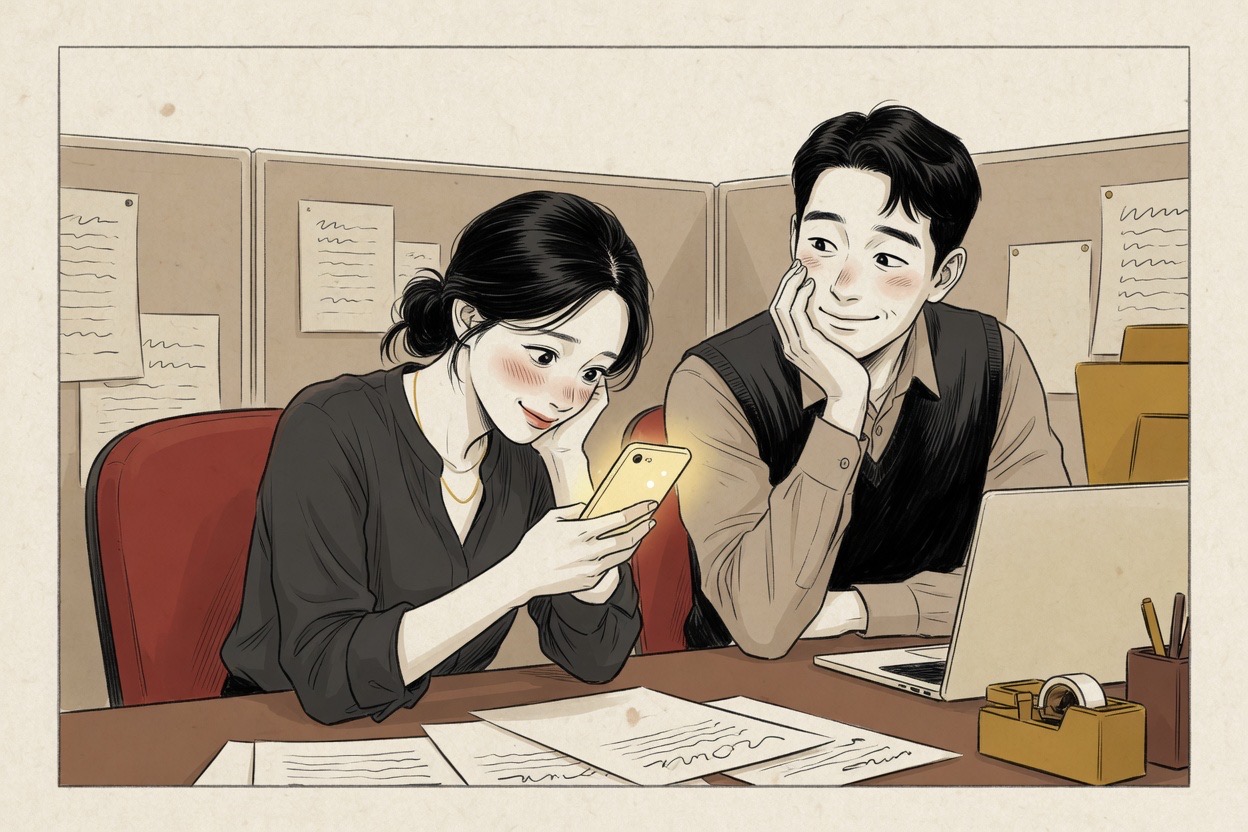
Open office. Someone is filling a form that asks for hanja.
- Colleague A: 민수 씨, 이름 한자로 어떻게 쓰세요?
Minsu ssi, ireum hanjaro eotteoke seuseyo?
Minsu, how do you write your name in hanja? - Minsu: 잠깐만요. 저도 가끔 헷갈려서 확인해야 돼요.
Jamkkanmanyo. Jeodo gakkeum hetgallyeoseo hwaginhaeya dwaeyo.
One second. I get mixed up sometimes too, so I have to check. - Minsu: 여기요. 이거예요.
Yeogiyo. Igeoyeyo.
Here. It’s this one.
Gloss: Polite workplace speech. Adults checking their own name characters on a phone is common enough to be a genre of quiet comedy.
3. Homework table, parent and child
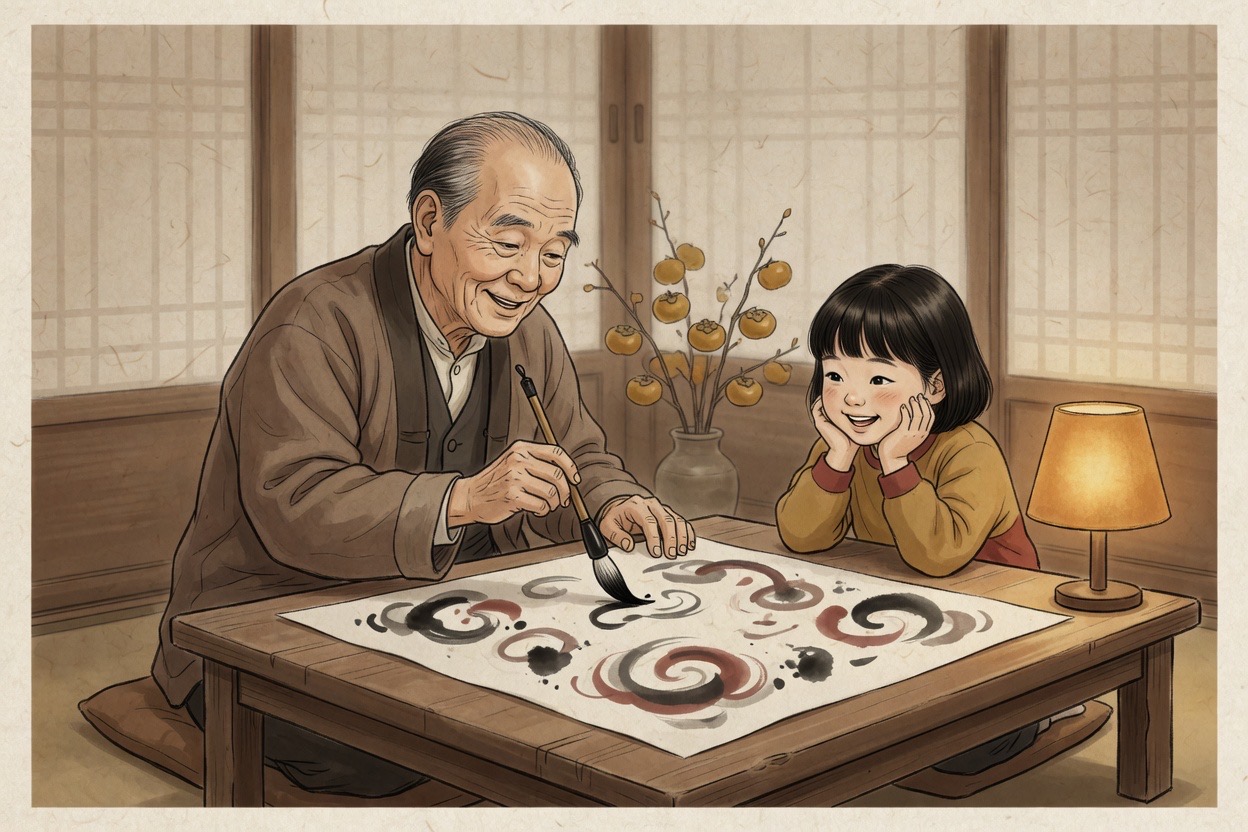
Evening, low table, workbook open.
- Mom: 한자 숙제 했어?
Hanja sukje haesseo?
Did you do your hanja homework? - Child: 거의 다 했어. 근데 이 글자는 뭐야?
Geoui da haesseo. Geunde i geuljaneun mwoya?
Almost. But what’s this character? - Mom: 그건 ‘배울 학’이야. 학교, 학생 할 때 그거.
Geugeon ‘baeul hak’-iya. Hakgyo, haksaeng halttae geugeo.
That’s the “learn” hak. The one in school and student.
Gloss: Family banmal. The parent is teaching a root, not requiring calligraphy mastery—the same move intermediate learners can steal.
Good nunchi / Zero nunchi
Good nunchi
You see hanja on a name card or wedding invitation and ask, lightly, what the characters mean—or you admit you do not read them and stay curious. If a Korean friend only recognizes half a temple plaque, you treat that as normal life, not proof that “real Koreans” failed a test you invented.
Zero nunchi
You announce that hangul made hanja “dead,” then quiz people on characters like a gatekeeping professor. Or you correct a Korean friend’s name meaning from a Chinese dictionary app without checking how that name is actually used in Korean. You turned a vocabulary layer into a purity contest.
Do / Don’t
Do
- Treat hangul as the writing system you need first and always.
- Learn high-frequency roots when vocabulary starts to plateau.
- Expect hanja in names and the occasional formal document—not on every café menu.
- Use formal Sino-Korean pairs (연세, 성함, 식사) where register actually calls for them.
Don’t
- Skip hangul to “study real Korean” through characters alone.
- Assume every Korean can fluently read every plaque and headline leftover.
- Quote fake percentages about “how much of Korean is Chinese.”
- Force Chinese-app meanings onto Korean names without checking local usage.
Nearby ideas
- Korean names and meanings — where hanja still chooses what a given name is supposed to mean
- Korean last names — surname hangul, romanization chaos, lineage context
- Korean honorifics explained — why Sino-Korean honorific nouns matter in address
- Korean age system — another place native vs Sino-Korean counting splits
- What does nunchi mean? — reading whether this room wants a character lesson or just coffee
A closing line
Hanja is not a trapdoor under hangul. It is the root system under a large share of the words hangul already writes for you.
Speak first. Read hangul always. Borrow the roots when the dictionary starts to feel like a pile of strangers who secretly share a last name.
FAQ
What is hanja?
Hanja (한자) are Chinese characters as used in Korean, with Korean pronunciations. Modern Korean is written in hangul; hanja mainly survives in vocabulary roots, personal names, and a few specialist uses.
What is the difference between hanja and hangul?
Hangul is Korea’s alphabet—the system you write with every day. Hanja are borrowed logographs, each carrying a meaning and a Korean sound. Hangul answers how you write; hanja answers where a large share of words came from.
Is hanja still used in Korea?
You rarely write hanja in daily life. It still shows up in given-name meanings, some official records, academic or legal disambiguation, temples, calligraphy, and four-character idioms. A visitor to Seoul today sees very little of it on the street.
Do I need to learn hanja to speak Korean?
No—not to speak well, and not in your first year or two. Later, learning the most common roots is high-leverage for vocabulary. Hanja does not fix pronunciation or grammar.
Do Koreans still study hanja in school?
Yes. Hanja appears in school curricula, and some students and job applicants take proficiency exams. Younger generations generally read far fewer characters than their grandparents.
Do you have nunchi?
Get short Korean word lessons and social cues in your inbox.