Korean Girl Names — Popular Names, Meanings, and Hanja
The names Korean parents choose now—and why the same Hangul name can still carry different meanings.
- Hangul
- 여자 이름
- Romanization
- yeoja ireum
- Pronunciation
- yuh-ja ee-reum
- Category
- Words
Completed-year snapshot
Popular Korean baby names in 2025
These rankings show names registered for babies—not a promise that the same name will fit an adult. Use them as a view of current sound fashion, then check age, gender use, and Hanja separately.
Girls’ list
- 1서윤Seo-yun
- 2서아Seo-a
- 3아린A-rin
- 4이서I-seo
- 5지안Ji-an
- 6하윤Ha-yun
- 7하린Ha-rin
- 8아윤A-yun
- 9지유Ji-yu
- 10시아Si-a
Korean girl names are usually a one-syllable family name plus a two-syllable given name. In a 2025 registration-data compilation, the leading girls’ list included 서윤, 서아, 아린, 이서, and 지안. That shows what sounds current for newborns; it does not tell you which name fits an adult. The given name is often built from hanja (Chinese characters used in Korean naming), but hangul alone does not lock meaning in. The same written name can rest on different characters for different people. Most English “female Korean names” lists skip that and paste one gloss under every row.
One-line rule: sound first; meaning lives in the characters (or native words) behind the sound. For playable combinations, try the Korean name generator—then come back here to see what you are actually choosing.
Quick facts
| Hangul label | 여자 이름 |
| Romanization | yeoja ireum |
| Pronunciation | yuh-ja ee-reum |
| Typical shape | surname (1 syllable) + given name (2 syllables) |
| Meaning source | mostly hanja per syllable; sometimes pure Korean |
| Core trap | same hangul ≠ same hanja ≠ same meaning |
| Also know | generational syllable (돌림자), pure-Korean names, surname + 본관 |
How Korean given names are built
A full name you meet in school, on a drama credit, or at the airport is almost always family name + given name:
- Family name: one syllable for the vast majority of people—김, 이, 박 are the three most common, by a wide margin, with many others in long-tail use.
- Given name: usually two syllables. One-syllable given names exist but are uncommon as modern everyday defaults.
Each syllable of a hanja-based given name is chosen for sound and for a character sense the family likes. Parents (and often grandparents) may weigh approved characters, family tradition, and how the full name reads aloud. The result is not a single English “meaning of the whole name” so much as two stacked intentions—for example 김서연 (Kim + Seo + Yeon) or 이하늘 (Lee + pure-Korean Haneul).
Hangul is the everyday writing system. Hanja for personal names still matter on legal paperwork, family registers, and any serious talk about “what does her name mean?”
The spine: same hangul, different hanja
This is where English listicles fail.
Hangul writes pronunciation. Hanja (when used) writes which character that sound is standing on. One hangul syllable can map to many hanja, each with a different dictionary sense.
Take the ultra-common girls’ syllable 지:
| Hangul | Example hanja | Rough sense (confident, common) |
|---|---|---|
| 지 | 智 | wisdom, intellect |
| 지 | 志 | will, ambition |
| 지 | — | pure sound, no character assigned |
So two women both named 민지 can carry different second characters. One family’s 지 is wisdom; another’s is will; a third might not use hanja for that syllable at all. The hangul name is the same; the meaning is not.
That principle applies across the board. When a website says “Minji means bright wisdom” as if it were a fixed translation, it is inventing a single story for a sound pattern that families fill in differently.
Practical rule: if meaning matters, ask which characters someone uses—or look at the official hanja on documents—not the romanization alone.

Common syllables in girls’ names (and usual senses)
These syllables show up often in modern and recent female given names. Senses below are typical hanja associations, not the only possible characters and not a guarantee for any individual.
| Syllable | Hangul | Common hanja senses (safe, well-known) |
|---|---|---|
| Seo | 서 | auspicious / felicitous (e.g. 瑞); other characters exist |
| Ji | 지 | wisdom (智), will (志) |
| Min | 민 | quick, clever (敏); other 민 characters exist |
| Yu / Yoo | 유 | soft/gentle or “have”; several 유 characters in use |
| Ha | 하 | summer (夏); also “great” or river-related characters in other names |
| Eun | 은 | grace / favor (恩), silver (銀) |
| Ye | 예 | art, talent, or ritual/propriety senses depending on character |
| Su | 수 | excellent (秀); water-related characters also appear |
| A | 아 | elegant / graceful senses in some common choices |
| Yun / Yoon | 윤 | enrich / moisten (潤) and other 윤 characters |
How to read this table: it is a map of frequent building blocks, not a baby-name shopping list with fixed English translations. Combinations like 서연, 지민, 하은, 수아, 예진 feel familiar because the blocks are familiar—not because every bearer shares one official gloss.
If you are unsure of a character, describe the name as sound only. Inventing a rare hanja reading is worse than saying “I don’t know which character her family used.”
Surnames and 본관 (clan seat)—the quiet half of the name
Given names get the search traffic. Surnames still structure Korean identity talk.
- 김, 이, 박 are the three most common family names—so common that meeting several unrelated Kims in one room is ordinary, not a plot twist.
- Same hangul surname does not mean same lineage. Koreans traditionally track 본관 (bon-gwan, clan seat): the regional origin label attached to a surname line. Same surname + different 본관 = different lineage in the classical system.
- Do not assume a surname is “royal” as a personality fact. The well-known historical link between the Joseon royal house and the Jeonju Yi line is the sort of connection people actually cite; random “your last name is princess-coded” claims are fanfiction.
You will hear family elders care about these distinctions more than teenagers do. Still, when someone carefully says both surname and 본관, they are not being pedantic for sport—they are specifying which tree they mean.
Generational names: 돌림자
돌림자 (dollimja, also discussed as generational syllables / 항렬자 in family rules) is the custom where siblings and cousins of the same generation share one syllable of the given name.
Classic pattern:
- Generation of cousins: shared middle (or first) syllable
- Individual second syllable: unique to each person
Example shape (illustrative only): three cousins might be 지현, 지민, 지아—the 지 marks the generation; the second syllable marks the person.
Families used the shared syllable so elders could place someone in the generational grid by ear. The custom is still present—especially where generation poems or clan practice remain strong—but it is fading as a default. Many urban parents pick two syllables for sound without locking a cousin-wide character. You will meet both systems: matching-syllable sibling sets, and siblings who share only the family name.
If you are naming a child inside a Korean family, ask whether a generational character is already decided before you fall in love with a two-syllable combo from a blog list.
Pure-Korean names: the minority tradition
Not every given name is hanja-stacked. Pure-Korean names use native Korean words (or word-like name forms) as the given name, often written only in hangul with no Chinese character assigned.
Familiar examples:
| Hangul | Romanization | Everyday sense people associate |
|---|---|---|
| 하늘 | Haneul | sky |
| 다솜 | Dasom | love / affection as a name sense |
| 슬기 | Seulgi | wisdom, good sense |
| 아름 | Areum | beauty |
These are real and lovable, and still a minority path next to two-syllable hanja-style names. Choosing one can signal modern taste, a break from character charts, or simply a word the parents loved—and it can surprise older relatives who expect a generational character.
Pure-Korean does not mean “more authentic Korean.” Hanja-based names are Korean names with centuries of local practice. Pure-Korean names are another Korean stream—not a purity contest.
What sounds dated vs current (qualitative only)
Name fashion moves. You can hear the shift without fake year-by-year ranking charts.
Qualitative patterns many Koreans will recognize:
- Two-syllable given names dominate modern everyday life—the default on class rosters and credit lists.
- Some syllables and pairings feel older-generation to young ears (“that sounds like my aunt”). The reaction is social, not a chart.
- Other pairings feel recent-default—soft, bright syllables that cluster in younger classrooms. Trends recycle.
- Pure-Korean names and creative hangul-only choices read as a conscious side path, not the invisible majority.
Avoid treating any single name as permanently “old” or permanently “in.” Families keep names for ancestors, generational rules, or a character someone loved. The useful skill is listening: what sounds ordinary on an elementary roll call versus what only appears on older relatives’ ID cards.

How names show up in daily speech
A name is not only a birth certificate line. It is how people call you—and Korean has a whole address system around that.
- Close family and friends may use the given name with a casual call ending: 민지야, 서연아.
- Acquaintances often add 씨: 민지 씨.
- Older siblings and friends may be addressed with kinship titles instead of bare names—see Korean honorifics explained, and the sibling words oppa, unnie, and maknae for the age stack.
Parents still do a lot of the emotional labor of naming. A mother weighing syllables is not “just being cute”; she is picking a sound that will be shouted across playgrounds, printed on diplomas, and whispered in hospitals. For the everyday words people use for mothers and fathers while that debate happens, see mom in Korean and father in Korean. Grandparents often hold veto energy—grandma in Korean is not only a vocabulary page; it is a power map at the naming table.
Example dialogues
1. Naming talk at home (mixed polite and soft pressure)
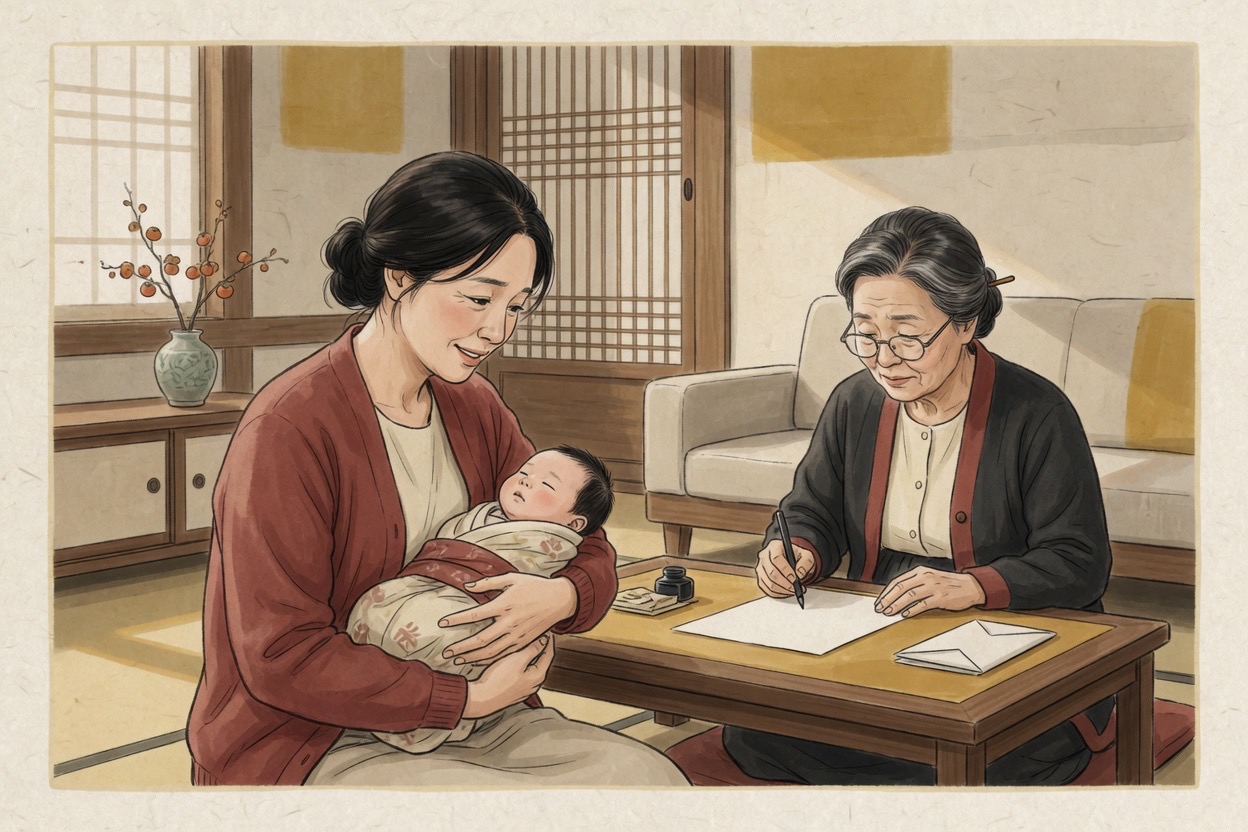
Living room, evening. Newborn asleep. Adults are not asleep.
- Mother: 이름은 서연이 어때요?
Ireumeun Seoyeoni eottaeyo?
What about the name Seoyeon? - Grandmother: 서 자는 우리 쪽 돌림자랑도 맞고, 음도 부드럽네.
Seo janeun uri jjok dollimjarangdo matgo, eumdo budeureomne.
The “Seo” syllable fits our generational character too, and the sound is soft. - Father: 한자는 어떤 걸로 할지 같이 봐요.
Hanjaneun eotteon geollo halji gachi bwayo.
Let’s look together at which hanja we’ll use.
Gloss: Polite family register. Sound and generational fit are on the table before the Instagram announcement.
2. Friends comparing name meanings (banmal)
Café after class. Someone asked the dangerous question: “What does your name mean?”
- A: 네 이름 민지 한자가 뭐야?
Ne ireum Minji hanjaga mwoya?
What’s the hanja for your name Minji? - B: 민은 민첩할 민, 지는 지혜 지.
Mineun mincheophal min, jineun jihye ji.
Min is the “quick/clever” min, ji is the “wisdom” ji. - A: 어, 나는 같은 민지인데 지가 다를 수도 있겠다.
Eo, naneun gateun Minjiinde jiga dareul sudo itgetda.
Oh—so even with the same Minji, the ji could be different.
Gloss: Casual speech. The joke is also the lesson: same hangul, not always same characters.
3. Roll call and the pure-Korean name (classroom polite)
Elementary classroom. Teacher reads the list; one name does not sound like a hanja pair.
- Teacher: 하늘 학생?
Haneul haksaeng?
Student Haneul? - Haneul: 네!
Ne!
Yes! - Friend (whisper): 너 이름 진짜 하늘이야? 멋있다.
Neo ireum jinjja haneuriya? Meositda.
Your name is really Haneul? That’s cool.
Gloss: Teacher uses polite classroom address; friends switch to banmal. Pure-Korean names get noticed because they are still less common, not because they are “wrong.”
4. Foreign friend wants a Korean name (honest caution)
Language exchange. Enthusiasm meets reality.
- Friend: 나 한국 이름 하나 만들어 줘.
Na hanguk ireum hana mandeureo jwo.
Make me a Korean name. - Korean peer: 발음 예쁜 건 많지. 근데 우리가 듣기에 자연스러운 건 따로 있어.
Bareum yeppeun geon manchi. Geunde uriga deutgie jayeonseureoun geon ttaro isseo.
Lots of pretty-sounding ones exist. But what sounds natural to us is a different filter. - Friend: 일단 생성기에서 고르고, 너한테 검수받을게.
Ildan saengseongieseo goreugo, neohante geomsubadgeulge.
I’ll pick from a generator first, then have you check it.
Gloss: Banmal between peers. The healthy sequence: ideas first, native ear second—not a tattoo appointment first.
How to choose a Korean girl name (if you actually want one)
People want Korean names for kids with Korean family ties, for diaspora paperwork, for fiction, for language-class personas, or for fun. The honesty level should match the use case.
A workable sequence:
- Decide the job of the name. Legal name, second name, character name, and classroom nickname have different stakes.
- Learn the two-syllable default. If you pick a four-syllable hangul string because it “sounds fantasy-Korean,” Koreans may hear fanfic, not a person.
- Separate sound from meaning. Fall in love with a sound only after you accept that meaning requires characters (or a pure-Korean word with a clear sense).
- Check generational rules if a Korean family is involved. 돌림자 can veto your favorite combo overnight.
- Run options past a native speaker. Ask: “Does this sound like a real girl’s name, an old relative, a brand, or a joke?”
- Use tools as sandboxes, not oracles. The Korean name generator is built for exploration—pair it with this page’s hanja warning, not instead of it.
The honest caveat
A self-chosen Korean name can read odd, dated, overly dramatic, or slightly off to Koreans even when every syllable is real. Reasons include:
- uncommon syllable pairings
- meanings that feel heavy-handed when stacked
- romanization-first choices that ignore hangul rhythm
- using a name strongly tied to a different generation without knowing it
That does not mean “foreigners may never use Korean names.” It means taste is social. Nunchi applies: notice whether you are asking for a legal name, a stage name, or a sticker on a water bottle—and adjust how seriously you treat native feedback.
Good nunchi / Zero nunchi
Good nunchi
You like the name 하은. You ask a Korean friend which hanja pairs are common, whether it feels current or aunt-coded, and whether it collides with a generational syllable in their family. You treat meaning as family-specific, not as a single line on a Pinterest graphic. You keep a shortlist and let a real ear veto one option.
Zero nunchi
You announce that your new Korean name is a four-syllable invention with a made-up royal meaning, insist every Minji on earth “means bright wisdom,” and correct a Korean woman on the meaning of her own name because a blog told you so. You wanted aesthetic. You delivered a lecture.
Do / Don’t
Do
- Assume two syllables for a standard modern given name unless you have a reason not to.
- Remember same hangul ≠ same hanja ≠ same meaning.
- Ask about 돌림자 before naming inside a Korean family system.
- Treat pure-Korean names as a real minority tradition, not a gimmick.
- Use the name generator for combinations, then verify sound and register with a person.
Don’t
- Paste one English “meaning” onto every bearer of a hangul name.
- Invent rare hanja readings you cannot actually support.
- Claim precise popularity percentages or year-by-year ranks you do not have.
- Call random surnames “royal” as a personality trait.
- Ignore how the name will be called out loud—with 야/아, 씨, or kinship titles—in real rooms.
Nearby ideas
- Mom in Korean — 엄마 / 어머니 and the people who often lead the naming fight
- Father in Korean — 아빠 / 아버지 at the same table
- Grandma in Korean — elder veto power, gently or not
- Maknae — youngest in the sibling set who may share a generational syllable
- Korean honorifics — how names get endings and titles once they leave the birth registry
A closing line
A Korean girl name is not a sticker with one English poem on the back. It is usually two syllables of sound, sometimes two characters of intention, occasionally a native word standing alone—and always a social object that relatives, teachers, and friends will have to say out loud for decades.
Learn the hangul, ask for the hanja, respect the family rules you are stepping into, and keep your nunchi when a self-chosen name meets a native ear. Pretty is easy. Believable takes one more question.
FAQ
What are the most popular Korean girl names in 2025?
A Namechart compilation of South Korean registration data placed 서윤 (Seo-yun), 서아 (Seo-a), 아린 (A-rin), 이서 (I-seo), 지안 (Ji-an), 하윤 (Ha-yun), 하린 (Ha-rin), 아윤 (A-yun), 지유 (Ji-yu), and 시아 (Si-a) in its 2025 top ten. These are newborn rankings, not automatic recommendations for an adult.
What do Korean girl names mean?
Most Korean girl names are two syllables, each often chosen from a Chinese character (hanja) with its own sense. Meaning is not fixed by hangul alone—the same written name can use different hanja for different people.
How are Korean given names structured?
A full Korean name is usually a one-syllable family name plus a two-syllable given name. The given name may share one syllable with siblings (a generational syllable), or it may be a pure-Korean word with no hanja.
Can the same Korean name have different meanings?
Yes. Hangul only records sound. The syllable 지 might be written with the hanja for wisdom, will, or another character—or as sound only. Always ask which characters someone uses if meaning matters.
What are pure Korean girl names?
Pure-Korean names use native Korean words instead of hanja syllables—examples include 하늘 (sky), 다솜 (love/affection as a name sense), 슬기 (wisdom), and 아름 (beauty). They are a real minority tradition, not the default.
How do I choose a Korean girl name?
Learn how two-syllable names and hanja work, pick a sound you can live with, then check whether the hangul already belongs to a common pattern. A self-chosen name can still sound odd to Koreans—use a generator for ideas, then verify with a native speaker.
Do you have nunchi?
Get short Korean word lessons and social cues in your inbox.