Korean Last Names — Kim, Lee, Park, Bon-gwan & Why So Many Share Few Surnames
Same hangul, different lineage—why Korean surnames are fewer, denser, and more layered than English lists admit.
- Hangul
- 성씨
- Romanization
- seongssi
- Pronunciation
- sung-ssi
- Category
- Words
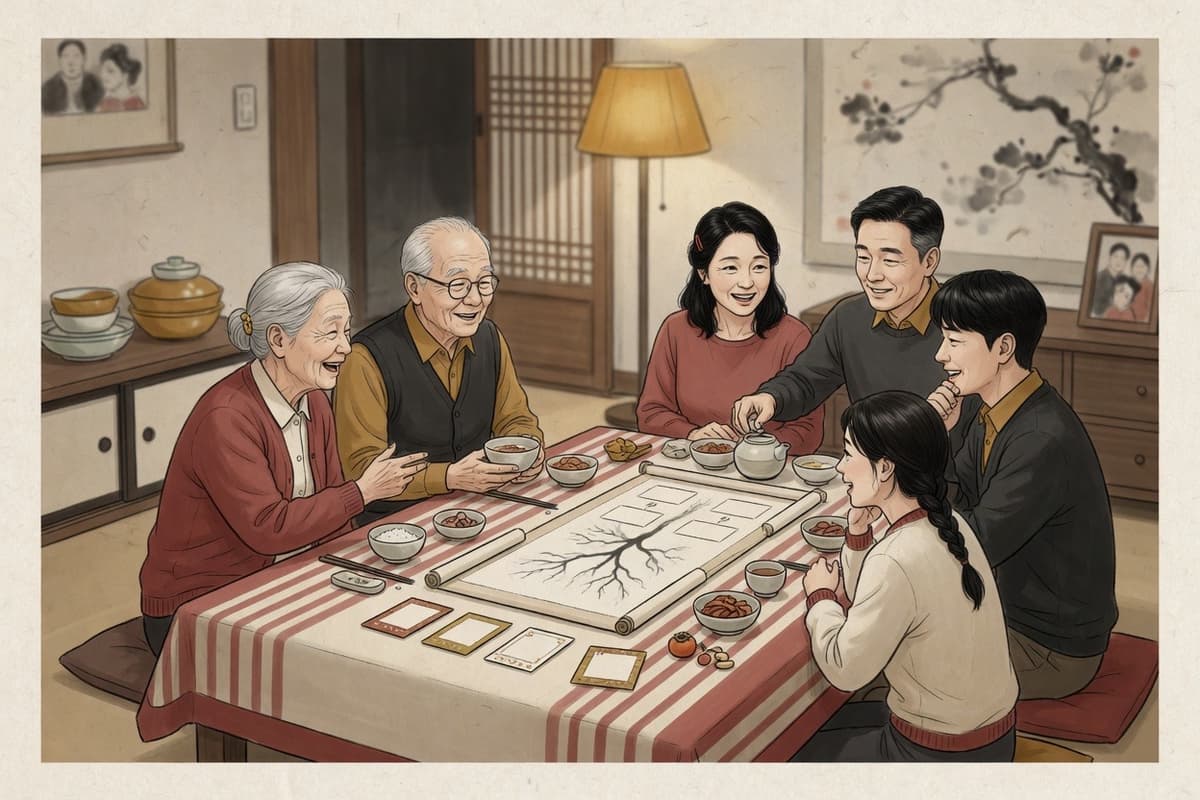
Korean last names—also searched as Korean surnames—are the family names that sit first in a Korean full name: 김 (Kim), 이 (Lee / Yi / Rhee), 박 (Park / Pak), and a long list after them. Compared with English-speaking countries, Korea concentrates a huge population into a relatively small set of surnames, so meeting five Kims in one room is ordinary, not a coincidence. The piece English listicles usually skip is 본관 (bon-gwan): the clan seat that means two people named Kim can belong to different lineages. One-sentence definition: a Korean last name is a shared family label in hangul, but bon-gwan is what tells you which line that label belongs to.
This hub covers the big three, the next tier, romanization chaos, marriage and name order, rare and two-syllable surnames, and the social habits that sit around a name card. If you want to play with full names rather than only surnames, the interactive companion is the Korean name generator.
Quick facts
| Hangul | 성씨 (seongssi) — surname / family name |
| Also called | last name, family name, surname |
| Name order | surname first: 김민준 = Kim Min-jun |
| Big three | 김 Kim · 이 Lee/Yi/Rhee · 박 Park/Pak |
| Key concept English pages skip | 본관 (bon-gwan, clan seat / lineage origin) |
| After marriage | women keep their own surname |
| Writing system note | hangul is how you write the name; hanja once encoded lineage and given-name meaning |
What are the most common Korean last names?
If you only need a short answer for “Korean last names” or “Korean surnames,” start here.
The big three: Kim, Lee, Park
| Hangul | Common English spellings | Notes |
|---|---|---|
| 김 | Kim | Most common surname overall |
| 이 | Lee, Yi, Rhee, sometimes I | Same Korean surname, many English faces |
| 박 | Park, Pak, Bak | Same pattern: one hangul, several Latin spellings |
These three sit at the top of every modern frequency ranking people care about. Exact percentages shift with census years and methods, so treat popular claims as scale, not gospel—but the shape is stable: Kim, Lee, and Park dominate by a wide margin, and “another Kim” is a daily fact of Korean social life, not a punchline.
Why so concentrated? Korean surnames are historically few in number relative to the population, and a handful of them became extremely widespread. Immigrants, regional histories, and old status systems all feed into that density, but you do not need a founding myth for every clan to use the practical rule: same surname ≠ automatic close relatives.
The next tier
After the big three comes a long second shelf of still-very-common names. You will meet these constantly in classrooms, offices, dramas, and airport passport lines:
| Hangul | Common romanizations |
|---|---|
| 최 | Choi, Choe |
| 정 | Jeong, Jung, Chung |
| 강 | Kang, Gang |
| 조 | Cho, Jo |
| 윤 | Yoon, Yun, Youn |
| 장 | Jang, Chang |
| 임 | Lim, Im, Yim |
| 한 | Han |
| 오 | Oh, O |
| 서 | Seo, Suh |
| 신 | Shin, Sin |
| 권 | Kwon, Gwon |
| 황 | Hwang |
| 안 | Ahn, An |
| 송 | Song |
There are many more—홍 (Hong), 유 (Yoo / Yu), 고 (Ko / Go), 문 (Moon / Mun), 양 (Yang), 손 (Son), 배 (Bae), and others. The point is not a fake top-twenty chart. Korea’s surname map is top-heavy, then still crowded for a long way down.
Bon-gwan: the concept English articles skip
This is the payload of the page.
본관 (bon-gwan) is the ancestral seat or clan origin attached to a surname. Think of it as a second coordinate:
- Surname = the hangul family name you see first: Kim, Lee, Park…
- Bon-gwan = which historical line that surname belongs to
So 김해 김씨 (Gimhae Kim) and 경주 김씨 (Gyeongju Kim) are both Kim, and they are not the same lineage. Two people can share a passport-style last name and still belong to different clan seats. In older social practice, that distinction mattered for genealogy books, local identity, and—famously—marriage rules: same surname and same bon-gwan marked the same broader line in ways that shaped who was considered an appropriate spouse. Modern dating is not a museum of every old rule, but the concept still lives in family registers, elder talk, and how Koreans explain “which Kim.”
| What you see | What it may still hide |
|---|---|
| Same hangul surname | Different bon-gwan = different lineage |
| Same English spelling “Kim” | Still may be different lines |
| “We have the same last name!” | Warm icebreaker—not proof of shared grandparents |
Do not invent origin stories. Clan founding tales and precise founding centuries are where English pages go wrong. Clean version: bon-gwan marks lineage under a shared surname, and Gimhae vs Gyeongju Kim is how Koreans teach it in one breath.
One careful note: the Jeonju Lee line (전주 이씨) is widely known for its connection to the Joseon royal house. That association is public historical knowledge. Calling random surnames “royal” as a vibe is not.

Romanization chaos: one surname, many English spellings
Hangul is stable. English is not.
A single Korean surname can wear several Latin outfits because:
- Multiple romanization systems have been used over time (older spellings stick on passports and brand names).
- Families choose a spelling and keep it for consistency abroad.
- Sound mapping is imperfect—English letters are a rough costume for Korean phonology.
Classic chaos examples
| Hangul | English spellings you will actually see | Why it confuses people |
|---|---|---|
| 이 | Lee, Yi, Rhee, I | “Lee” won in English even though the Korean sound is closer to a bare vowel for many speakers |
| 박 | Park, Pak, Bak | English “Park” looks like a green space; Korean 박 is not that word |
| 최 | Choi, Choe | Same name at the airport, different business cards |
| 정 | Jeong, Jung, Chung | All common; none of them is “more Korean” as a personality |
| 신 | Shin, Sin | Family preference and system differences |
Practical rule: romanization is a bridge, not a second soul. Use the spelling someone puts on email and LinkedIn. Correcting a lifelong “Lee” into “Yi” because a textbook prefers it is not scholarship—it is zero nunchi with a dictionary. Real families optimize for recognition at school pickup, not for romanization pedantry.
Name order: surname first
Korean full names usually run:
Surname + given name
So:
- 김민준 → Kim (surname) + Min-jun (given name)
- 이서연 → Lee + Seo-yeon
- 박지훈 → Park + Ji-hoon
In Korean contexts, you often see the full name written without a space, or with a space after the surname. In English contexts, people may reverse the order to match Western forms—or keep Korean order and confuse conference badges forever.
What to call someone
- In many polite adult settings, given name + 씨 (ssi) or a role title is safer than surname alone barked like a roll call.
- Surname alone can sound curt or hierarchical depending on room and tone.
- Kinship titles and office titles often matter more than the bare last name—see the full map in Korean honorifics explained.
Given names are also where hanja (Chinese characters historically used in Korean) used to do heavy lifting. The same hangul syllable can map to several hanja with different meanings. That is the single most misunderstood point in English name explainers:
- Hangul tells you how the name is written and said in modern Korean.
- Hanja, when used, is what people mean by “this character means wisdom / grace / bright.”
- Two people named 민준 can theoretically rest on different character choices.
Well-known given-name flavor people often cite (without pretending every bearer uses that exact character): min (quick/clever · people), ji (wisdom), seo (auspicious), jun (talented), hyeon (virtuous/wise), u (excellent), ha (summer/great), eun (grace/silver), su (excellent/water), jin (precious). If you are unsure of a character, describe the name without forcing a fortune-cookie gloss.
Modern given names are mostly two syllables. Pure-Korean names without hanja roots—things in the spirit of 하늘 (Haneul, sky) or 다솜 (Dasom)—exist and are real, but they are a minority beside the two-syllable mainstream.
This page maps surnames. Lists of given names live on Korean girl names and Korean boy names; writing a foreign name in hangul is a different job, on my name in Korean.
Do Korean women change their last name after marriage?
No. This surprises many Western readers more than the Kim-Lee-Park chart does.
In Korean practice, a woman keeps her birth surname after marriage. Children usually take the father’s surname, so a married household can look like this on paperwork:
- husband: Park
- wife: Kim
- child: Park
Nobody at the wedding “becomes Mrs. Park” as a surname change ceremony in the Western sense. English invitations, school forms, and hotel bookings still create friction because Western systems assume one family label. Korean systems assume each person keeps their seongssi, and the child’s surname is a separate decision pattern (with the father’s name still the common default).
This is one reason Korean family vocabulary and address habits do so much social work—titles for father, mother, and grandmother often carry more daily relationship info than a shared last name ever could.

Rare surnames and two-syllable surnames
Most common Korean surnames are one syllable in hangul: Kim, Lee, Park, Choi, Jeong…
A smaller set is two syllables. These stand out on attendance sheets and drama credits because they sound “longer” as family names:
| Hangul | Common romanization | Notes |
|---|---|---|
| 남궁 | Namgung / Namkoong | Classic two-syllable surname |
| 황보 | Hwangbo | Same pattern: both syllables are the family name |
| 선우 | Seonu / Sunwoo | Easy to misread as given name + something else |
| 독고 | Dokgo | Rare enough that people double-check the spelling |
There are other uncommon one-syllable surnames too. “Rare” here does not mean fake or foreign; it means low frequency in a country where a few names cover huge shares of the population. If you meet a Dokgo or Namgung, do not perform shock as entertainment. Use their name the way they present it.
When surnames show up in real life
You will hear or use Korean last names when:
- reading a roster full of Kims and Lees and needing given names to tell people apart
- filling forms that fight Korean name order
- meeting someone whose English email is “jihoon.lee” while their hangul is 이지훈
- hearing elders mention bon-gwan at holidays
- watching a drama where a chaebol surname becomes brand-like public identity
Korean social life often runs on titles and age, not last-name familiarity alone. The Korean age system and honorific map decide how you speak; the surname mostly fills a form slot.
Example dialogues
1. Same surname, different assumption
University orientation. Two students share a last name and one jumps too fast.
- Minjun: 어, 저도 김씨예요. 친척이세요?
Eo, jeodo Gim ssiyeyo. Chincheogiseyo?
Oh, I’m a Kim too. Are we relatives? - Seoyeon: 아마 아닐 거예요. 본관이 다를 수도 있잖아요.
Ama anil geoyeyo. Bongwani dareul sudo itjanayo.
Probably not. Our bon-gwan might be different. - Minjun: 맞다. 김씨만 같아도 다 같은 집은 아니지.
Matda. Gim ssiman gatado da gateun jibeun aniji.
Right. Same Kim doesn’t mean same house.
Gloss: Polite-casual campus speech. Seoyeon uses bon-gwan as a gentle brake on over-familiar genealogy.
2. Romanization at the coffee order
Cafe counter. The barista asks for a name for the cup.
- Barista: 성함이 어떻게 되세요?
Seonghami eotteoke doeseyo?
May I have your name? - Customer: 이서연이요. 영어로는 Lee요.
I Seoyeoniyo. Yeongeoroneun Lee-yo.
I’m Lee Seoyeon. In English, Lee. - Barista: 네, Lee로 적어 둘게요.
Ne, Lee-ro jeogeo dulgeyo.
Got it—I’ll write Lee.
Gloss: The hangul surname is 이; the customer’s chosen English face is Lee. The barista follows the customer, not a textbook.
3. Marriage, forms, and one household
Newlyweds at a bank desk. The clerk is used to this; the foreign friend watching is not.
- Clerk: 두 분 성씨가 다르신데요.
Du bun seongssiga dareusindeyo.
I see you two have different surnames. - Wife: 네, 저는 결혼해도 성 안 바꿔요.
Ne, jeoneun gyeolhonhaedo seong an bakkwoyo.
Yes—I don’t change my surname when I marry. - Husband: 아이 성은 제 성을 따를 예정이에요.
Ai seongeun je seongeul ttareul yejeongieyo.
The child will take my surname.
Gloss: Ordinary polite speech. Different adult surnames in one marriage are normal; the friend’s surprise is cultural, not a paperwork error.

Good nunchi / Zero nunchi
Good nunchi
You meet three people named Kim at a dinner. You use the given names and spellings they offer. When an older relative mentions bon-gwan, you listen instead of turning it into a DNA joke. You ask how someone spells their name in English before you invent “Pak” for a lifelong Park. You treat the surname as information, not a party trick.
Zero nunchi
Same dinner. You announce that “all Kims are related,” correct a Rhee into Yi out loud, ask a married woman why she “didn’t take her husband’s name,” and demand the “royal meaning” of every syllable. The table stays polite. You have confused a census pattern with intimacy, and a hangul label with a personality.
Do / Don’t
Do
- Learn the big three and the crowded next tier as frequency, not as a personality chart.
- Use bon-gwan when lineage is the actual topic—especially to explain why same surname ≠ same family.
- Follow each person’s chosen English spelling.
- Keep surname first in mind when reading Korean-order names.
- Remember women keep their surnames after marriage.
- Try full-name play at the Korean name generator once you understand the surname layer.
Don’t
- Invent exact population percentages or yearly ranking charts.
- Invent clan founder legends or call random surnames “royal.”
- Assign hanja meanings you are not sure of.
- Force Western name-change assumptions onto Korean marriages.
- Treat rare or two-syllable surnames as comedy material.
Nearby ideas on Have Nunchi
- Korean honorifics explained — what you call someone after you know their name
- Father in Korean / Mom in Korean / Grandma in Korean — family address beyond the surname line
- Korean girl names / Korean boy names — given-name lists, not surnames
- My name in Korean — writing a foreign name in hangul
- Korean age system — why age still sorts the room after names are exchanged
- Nunchi — reading whether this is a form, a joke, or a genealogy conversation
A closing line
Korean last names look simple on a list—Kim, Lee, Park, then a long familiar parade—and get interesting the moment you add bon-gwan, romanization, and who keeps which name after marriage.
Hold the hangul steady, let English spellings belong to the people who use them, and remember that the same surname on two name cards can still point to two different lines. That is the difference between collecting Korean words and actually understanding Korean names.
FAQ
What are the most common Korean last names?
Kim (김), Lee (이), and Park (박) are the three most common by a wide margin. After them come a long next tier—Choi, Jeong, Kang, Cho, Yoon, Jang, and many more—still shared by huge numbers of people.
Why do so many Koreans have the same last name?
Korea has a relatively small set of traditional surnames, and a few of them became extremely common. Sharing a surname does not mean people are close relatives—especially once you account for bon-gwan, the clan seat that marks lineage.
What is bon-gwan in Korean surnames?
Bon-gwan (본관) is the ancestral seat or clan origin attached to a surname. Kimhae Kim and Gyeongju Kim are both Kim, but different lineages. Same hangul on a form can still mean different family lines.
Do Korean women change their last name after marriage?
No. Korean women keep their birth surname after marriage. Children usually take the father’s surname, so a household can hold more than one last name without anyone “changing” at the wedding.
Why is Lee also spelled Yi or Rhee?
Romanization is the messy part. The hangul 이 is one Korean surname; Lee, Yi, Rhee, and sometimes I are English spellings chosen by families, history, or older systems. Park/Pak and Choi/Choe work the same way.
Sources
Primary and authoritative references used for definitions and context on this page.
- Population by surname and bon-gwan, 2015 census — Korean Statistical Information Service
- Civil Act of the Republic of Korea — Korea Legislation Research Institute
- Revised Romanization of Korean — National Institute of Korean Language
Read next
Do you have nunchi?
Get short Korean word lessons and social cues in your inbox.