What Does “Jjang” Mean? Korean for Best, Peak, Awesome
Peak praise in one syllable—and a suffix that still builds new nicknames.
- Hangul
- 짱
- Romanization
- jjang
- Pronunciation
- jjang
- Category
- Slang
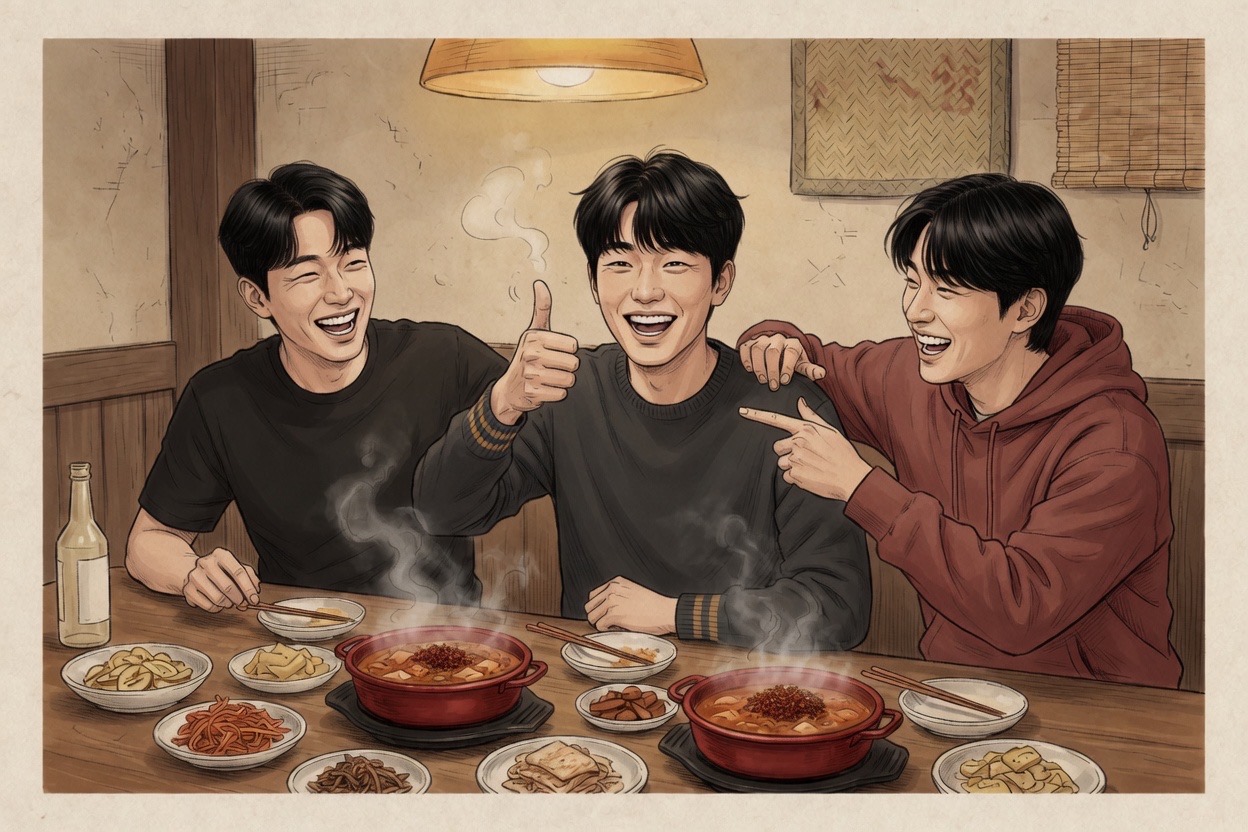
Jjang (짱, pronounced jjang) is casual Korean for the best, the top, peak-tier good. Friends paste it on food, skills, people, and nights that hit the high mark. One-sentence definition: jjang marks the peak of something—quality praise, not pure shock. You will hear bare 짱, full lines like 짱이다 and 완전 짱, and the productive suffix pattern in 얼짱 (best face), 몸짱 (best body), and 노래짱 (best singer in the room).
Say this next part clearly: jjang reads slightly dated in 2026. It is still understood, still used, still warm among friends—but it is not the sharpest edge of youth slang. Younger speakers often turn the volume up with prefixes like 개- and 핵-, or ranking jokes like 甲 (gap). Treat jjang as peak praise with a soft vintage tint, not as this year’s only cool word.
Quick facts
| Hangul | 짱 |
| Romanization | jjang |
| Pronunciation | jjang (one tense beat; the j is tense) |
| Core job | praise / “the best” / top of a category |
| Polarity | positive evaluation (not bad-news slang) |
| Register | casual; slightly dated among younger speakers |
| Nearby tools | daebak (intensity), 최고 (neutral “best”) |
How do you pronounce jjang?
One syllable. Not jang with a soft English j. Korean ㅉ is a tense consonant—tighter, punchier, almost like a doubled j.
- Think jj as in a clipped “jazz,” then ang as in “song” without the s
- Even, short, confident: jjang
- Stretching it into jjaaaang only works as comic exaggeration among friends
If you have already practiced sharp reaction words from Korean slang 2026, keep the same clean batchim habits. Soft English jang is the usual learner miss.
What does jjang mean?
Under the slang sits a ranking idea: number one, the top, the peak of a set. Everyday speech turns that into praise:
- a friend’s cooking → 이거 진짜 짱이다
- a skill or performance → 너 노래 짱이다
- a night out that lands → 오늘 완전 짱
- a freestanding thumbs-up reaction → 짱! or 짱 좋다
English “awesome,” “the best,” or old-school “the bomb” gets close. The key is evaluation at the high end. Jjang is not “pretty good.” It is peak for this category right now.
Unlike daebak, jjang is not your go-to word for catastrophic bad news. Lost wallet energy is usually daebak or 헐, not jjang. Jjang wants something worth crowning.
The thumbs-up association
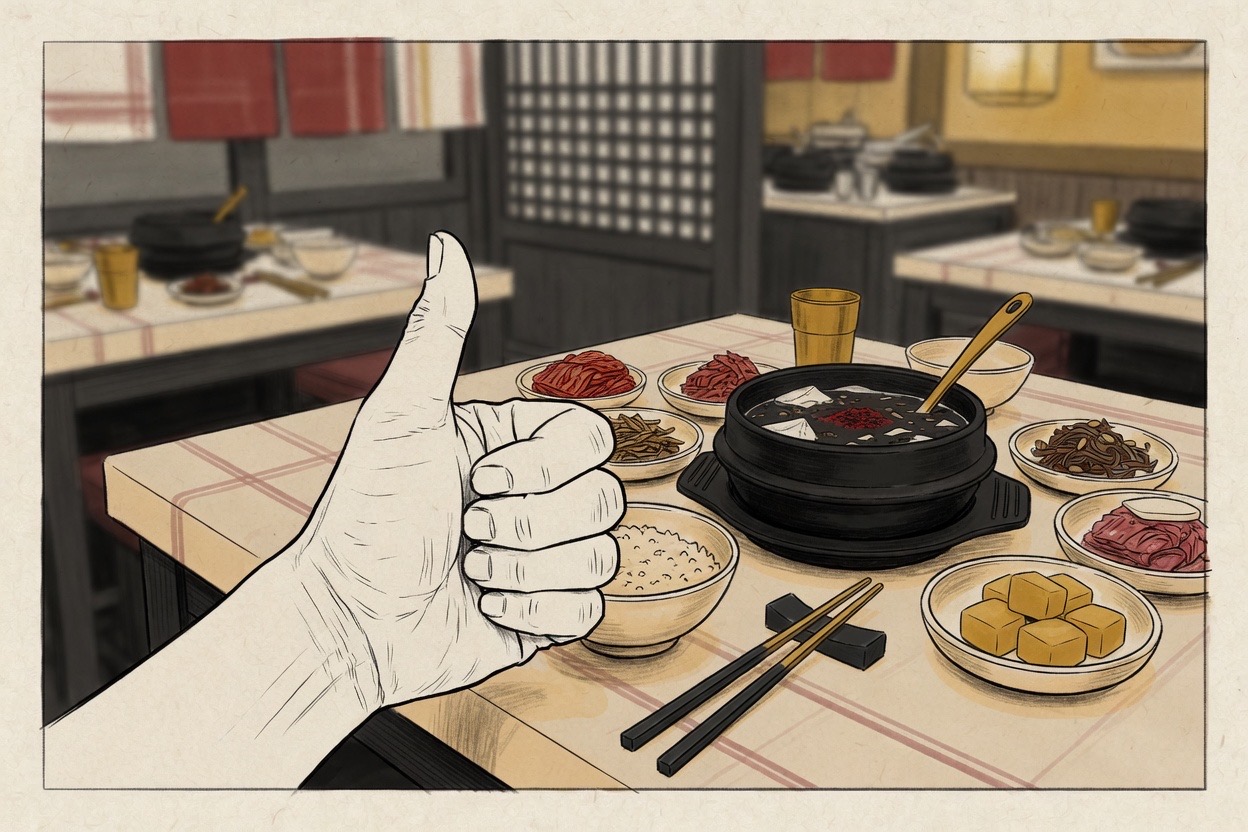
In casual face-to-face talk, jjang often rides with a thumbs-up—or is the verbal version of one. Someone tastes the first bite, lifts a thumb, and says 짱. Someone hears a plan and flashes the same gesture with 완전 짱. The word and the hand signal reinforce each other so strongly that many learners meet them as a pair in variety clips and friend-table scenes.
That does not mean every jjang needs a thumb. Chat and comments run on text alone. But if you picture the social package—praise + small physical cheer—you are closer to how the word feels in the room.
짱 as a suffix: 얼짱, 몸짱, 노래짱
This is the pattern that keeps jjang useful even when bare 짱 feels a little vintage. Attach -짱 to a trait or skill and you get “best at X / the X-king of this group.”
| Coinage | Hangul | Rough gloss |
|---|---|---|
| eoljjang | 얼짱 | best face (from 얼굴 “face” + 짱) |
| momjjang | 몸짱 | best body / fitness-peak body |
| noraejjang | 노래짱 | best singer in the group |
| gongbujjang | 공부짱 | study beast / top student energy |
| meoritjjang | 머리짱 | brainy peak (smartest in the set) |
You do not need a dictionary entry for every new blend. Once you see noun/trait + 짱, you can decode:
- Someone who always picks the playlist might get joked as the group’s music-짱.
- The friend who never loses at board games becomes the game-짱 for the night.
- Fitness culture made 몸짱 a durable social label, not only a one-week meme.
Tone matters. Among close friends these labels can be affectionate or teasing. Aimed at a stranger’s body or face without relationship, they can feel invasive. Same social software as other Korean compliments: closeness first, crown second. If you are still learning when teasing is safe, your nunchi is doing more work than the vocabulary list.
Sentence forms: 짱이다, 짱 좋다, 완전 짱
Learners want one correct sentence. Korean gives you a small praise kit.
짱이다 / 짱이야
Full-ish predicate: “it is jjang / it’s the best.”
- 이 집 떡볶이 짱이다. — This place’s tteokbokki is the best.
- 너 오늘 컨디션 짱이야. — Your condition today is jjang.
짱이야 is the banmal shape most friend talk uses. 짱이다 is the same idea in a slightly more complete predicate form.
짱 좋다
Literally “jjang-good”—warm, casual, slightly soft praise. Common after food, weather, a plan, a vibe.
- 여기 분위기 짱 좋다. — The vibe here is so good (peak good).
- 이 자리 짱 좋다. — This spot is perfect / the best.
완전 짱
Fully / totally jjang. Volume booster. Works as a freestanding reaction or at the end of a short evaluation.
- Friend shows concert footage. You: 완전 짱.
- After a first bite: 와, 완전 짱이다.
You will also hear bare 짱, elongated 짜앙 as comic stretch, and stacks like 진짜 짱 or (among close friends) praise piled with other reaction words. Treat stacks as enthusiasm, not a grammar exam.
Jjang vs daebak vs 최고
This comparison is the page’s real value. English “awesome” and “best” blur three tools Koreans actually keep separate.
| Word | Hangul | Core job | Polarity | Register note |
|---|---|---|---|---|
| jjang | 짱 | peak praise / top of a category | positive | casual; slightly dated |
| daebak | 대박 | jackpot scale / huge intensity | good or bad | casual; still very current |
| choego | 최고 | neutral “best / the greatest” | positive (evaluation) | works from casual to more neutral rooms |
Jjang — crown the peak
You are ranking quality. Food, skill, person-in-this-group, tonight’s plan. Thumbs-up energy.
- 이 치킨 짱이야. — This chicken is the best.
- You would not usually reach for jjang after a file corruption disaster.
Daebak — mark the magnitude
You are flagging scale, not automatically crowning quality. A deal that closes, a score that shocks, a disaster that wrecks the night—all can be daebak. Our full guide is what daebak means; the short version for this page: daebak is a volume knob, jjang is a gold medal.
- Win tickets → daebak (or jjang if you are ranking the night as “best”)
- Lose the presentation file → daebak (not jjang)
- Restaurant that is delicious → either works; jjang leans “best,” daebak leans “whoa, huge”
최고 — the plain “best”
최고 (choego) is the dictionary-clean best. It can sound earnest, standard, or slightly formal depending on the sentence. Ads, speeches, polite compliments, and everyday talk all use it. It does not carry jjang’s slang texture or daebak’s jackpot voltage.
- 오늘이 최고야. — Today is the best.
- 최고의 선택이에요. — It’s the best choice. (polite, more standard)
Quick sort
- Ranking food or skill as #1? jjang or 최고 (jjang more slangy)
- Huge good or bad intensity? daebak
- Need a neutral sentence for mixed company? 최고 is safer than bare 짱
- Want youth-edge intensity in 2026? often 개- / 핵- constructions rather than only jjang
- Bad-news reaction? daebak or 헐—not jjang
Stacking happens: 대박 짱, 완전 최고, praise piles among friends. Learn the cores first so the stacks do not blur the tools.
Register: casual, and a little dated
Jjang is friend-table Korean, not boardroom Korean.
| Room | Jjang? |
|---|---|
| Close friends, banmal | Yes |
| Variety clips, old memes, nostalgic chat | Yes |
| Peer group chat among people who already joke | Often yes |
| First meeting with a stiff senior | Usually no |
| Formal presentation / client pitch | No |
| Polite compliment where you want standard language | Prefer 최고 / careful praise |
Why “slightly dated” matters
English explainers sometimes freeze jjang as eternal youth slang. That misleads. The word still works—your Korean friends will understand you, and many still say it for food and affection—but among younger speakers it can sound soft, mid-2000s-to-2010s, or gently uncool the way English “radical” or “the bomb” can sound when used without irony.
What often carries intensity now:
- 개- and 핵- prefixes for “insanely / extremely” (register: rough, casual, not for seniors)
- 甲 (gap) ranking jokes and other internet scoring slang
- Fresh coinages that turn over quickly—see the system map in Korean slang 2026
None of that kills jjang. It relocates it: warm praise, suffix nicknames, food-table crowns, slightly nostalgic cheer. If you use it, use it on purpose—not because a 2012 blog told you it is the only word for “awesome.”
Speech-level awareness still applies the way it does across Korean honorifics: slang vocabulary does not cancel the need for the right endings with the right people.
When you’ll hear it
- First-bite reactions at a restaurant table
- Friends crowning someone 노래짱 at noraebang
- Comment praise under a photo or clip (“완전 짱”)
- Older millennial / early-gen-Z chat that never fully retired the word
- Variety-show reruns and meme archives where jjang was peak-period slang
- Fitness and beauty talk around 몸짱 / 얼짱 labels
You will not typically hear bare jjang as the only line in a eulogy, a legal filing, or a formal apology. Different toolkit. And you should not assume every twenty-year-old still reaches for it first—many prefer newer intensity gear.
Example dialogues
1. Restaurant table, banmal, first-bite crown
Shared dishes just arrived. Steam, chopsticks, zero patience.
- Sumin: 야, 이거 한 입만 먹어 봐.
Ya, igeo han ipman meogeo bwa.
Hey—just try one bite of this. - Jiyoon: …와. 이거 짱이다.
…Wa. Igeo jjang-ida.
…Whoa. This is jjang. - Sumin: 그치? 여기 진짜 짱이야.
Geuchi? Yeogi jinjja jjang-iya.
Right? This place is really the best.
Gloss: Pure positive peak praise. Food is the classic jjang habitat—evaluation, not shock.
2. Noraebang, suffix nickname energy
Second round of songs. Someone keeps nailing high notes.
- Minho: 야, 너는 진짜 노래짱이다.
Ya, neoneun jinjja noraejjang-ida.
Dude, you’re seriously the song-jjang. - Hyejin: 에이, 과찬이야.
Ei, gwachan-iya.
Come on, that’s too much praise. - Minho: 과찬 아니야. 완전 짱.
Gwachan aniya. Wanjeon jjang.
It’s not overpraise. Totally jjang.
Gloss: Banmal among friends. 노래짱 shows the productive suffix; bare 완전 짱 seals the crown.
3. Group chat, photo verdict
Someone drops a fitted outfit selfie.
- Yuna: 오늘 이 코디 어때?
Oneul i kodi eottae?
How’s this outfit today? - Ara: 완전 짱. 그 자켓 짱 좋다.
Wanjeon jjang. Geu jaket jjang jota.
Totally jjang. That jacket is so good. - Yuna: ㅋㅋ 고마워. 너도 얼짱이고.
Kkkk gomawo. Neodo eoljjang-igo.
Haha thanks. You’re an eoljjang too.
Gloss: Chat-shaped praise. 짱 좋다 + suffix 얼짱. Warm, slightly playful—works because they already banmal.
4. Peer talk that almost picks the wrong tool
Office kitchen, two same-generation coworkers. Good news with scale and quality.
- Taeyang: 야, 우리 영상 조회수 미친 거 같아.
Ya, uri yeongsang johoesu michin geo gata.
Dude, our video views look insane. - Yuri: 대박이다… 편집은 진짜 짱이고.
Daebagida… pyeonjibeun jinjja jjang-igo.
That’s daebak… and the editing is really jjang. - Taeyang: 팀장님한테는 ‘최고였습니다’로 가자.
Timjangnim-hanteneun ‘choego-yeotseumnida’-ro gaja.
For the team lead, let’s go with “it was the best.”
Gloss: Peers split tools on purpose—daebak for scale, jjang for quality praise, 최고 for the safer report upstairs. That three-way split is the whole lesson.
Good nunchi / Zero nunchi
Good nunchi
Your friend serves homemade stew and looks nervous. You taste it, smile, and say 이거 진짜 짱이다 like you mean the peak, not a generic “nice.” Later, in a stiff client debrief, you switch to calm 만족스러웠습니다 / careful 최고 language instead of yelling jjang. Same taste for excellence—different rooms, different tools.
Zero nunchi
You learned “jjang = awesome!!!” from a vocab app and fire it at everyone: your professor, a first-meeting senior, a bad-news story that needed comfort not a crown. You also call a stranger 몸짱 out loud on the street because a blog said the suffix is “fun.” The room cools. You thought you were fluent. You performed a subtitle with no relationship.
Do / Don’t
Do
- Use jjang for positive peak praise—food, skills, plans, affectionate crowns among friends.
- Learn the suffix engine (얼짱, 몸짱, 노래짱) so new blends stop looking random.
- Keep 짱이다, 짱 좋다, and 완전 짱 in your banmal kit.
- Compare tools: jjang = peak, daebak = scale, 최고 = neutral best.
Don’t
- Present jjang as the freshest youth slang of the year—it often sounds slightly dated.
- Use jjang for disasters; that job is closer to daebak / 헐.
- Drop bare jjang into formal rooms where standard praise belongs.
- Slap body/face -짱 labels on people who did not open that door.
Nearby ideas
- Daebak (대박) — jackpot intensity; the scale twin jjang is not
- Korean slang 2026 — how coinages form, age out, and get replaced
- Nunchi (눈치) — reading whether this room wants slang crowns or quiet competence
- Maknae (막내) — youngest in a group; often first to hand out playful -짱 nicknames
- Mukbang (먹방) — food-as-spectacle culture where first-bite jjang reactions are practically stage directions
A closing line
Jjang is not every Korean “wow.” It is a small gold medal—for the stew, the high note, the friend who always shows up peak.
Use it to crown what deserves a peak. Keep daebak for magnitude, 최고 for cleaner “best,” and newer intensity gear when the room has already moved on. Hold the -짱 nicknames for people who can tease you back. Then keep your nunchi on the register: praise lands when the word matches the decade and the table.
FAQ
What does jjang mean in Korean?
Jjang (짱) means the best, the top, or peak-tier good. It praises quality at the high end—not shock, and not every mild compliment.
What does the 짱 suffix mean (얼짱, 몸짱)?
As a suffix, -짱 tags someone as the best at a trait: 얼짱 (best face), 몸짱 (best body), 노래짱 (best singer in the group). Learn the pattern and you can decode new coinages.
What is the difference between jjang, daebak, and 최고?
Jjang praises a peak. Daebak marks huge intensity (good or bad). 최고 is the plain neutral word for best. They overlap in praise, but they are not the same tool.
Is jjang still used by young people?
Yes, but it can sound slightly dated or soft-nostalgic. Many younger speakers lean on 개-, 핵-, or 甲 for intensity. Jjang still works with friends—just not as the newest cool badge.
How do you say 짱이다 and 완전 짱?
짱이다 / 짱이야 means it is the best. 완전 짱 intensifies that praise. 짱 좋다 pairs jjang with good for a warm, casual thumbs-up judgment.
Do you have nunchi?
Get short Korean word lessons and social cues in your inbox.