Why Do Koreans Say “Fighting”? Hwaiting Meaning Explained
Not a fight—a fist, a shout, and a loanword that never asked English for permission.
- Hangul
- 파이팅
- Romanization
- paiting
- Pronunciation
- pa-ee-ting
- Category
- Slang
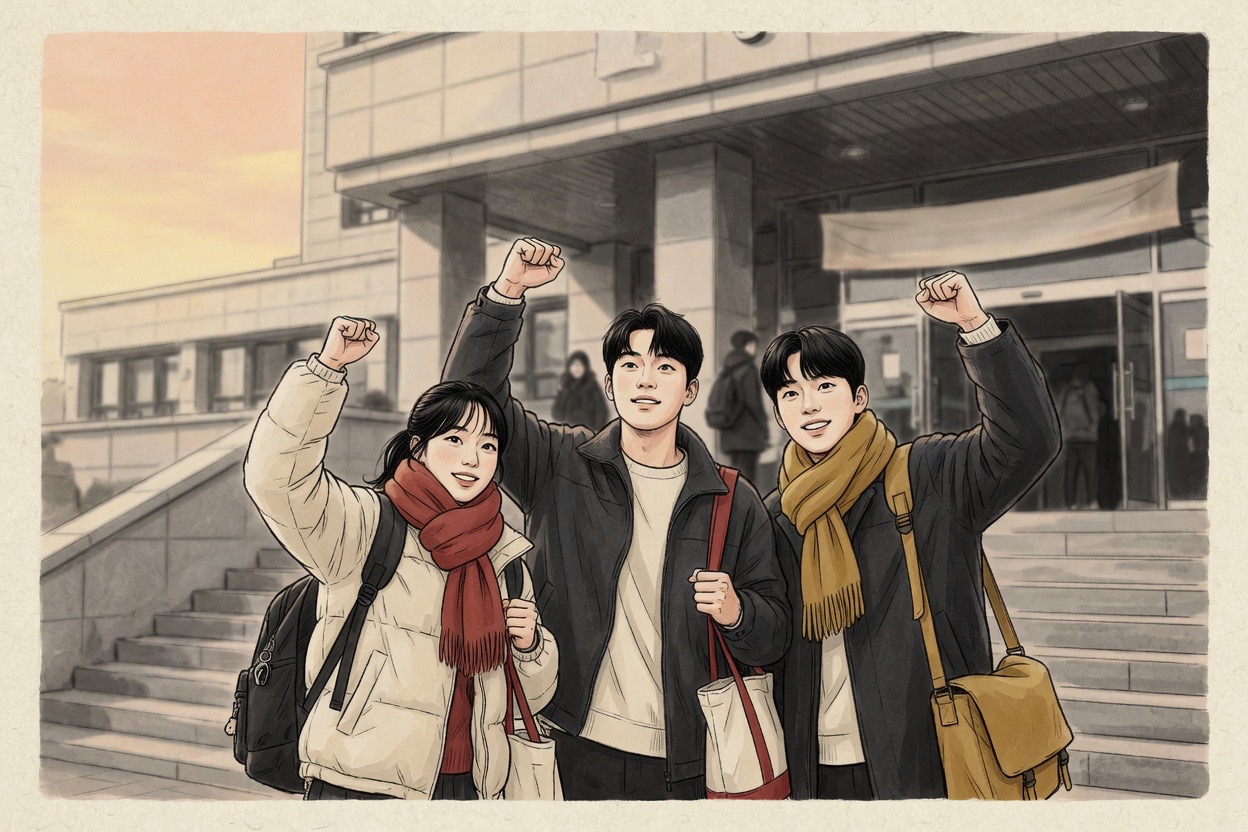
Why do Koreans say “fighting”? Because in Korean, fighting (파이팅 / 화이팅, also romanized hwaiting) is not a combat word—it is an encouragement shout. It means you can do it, go for it, hang in there. Friends yell it outside exam halls. Teammates stack hands and shout it before a match. Coworkers murmur it over late coffee. One-sentence definition: Korean “fighting” is a borrowed English form used as pure pep talk, almost never as a threat to fight.
If you searched “hwaiting meaning,” you already found the same word. English ears hear “fighting” and picture a punch. Korean mouths keep the English shell and rewired the job: support, not sparring. That mismatch is why the loanword earned a page.
Quick facts
| Hangul (standard form) | 파이팅 |
| Hangul (common variant) | 화이팅 |
| Romanization | paiting · hwaiting · fighting |
| Pronunciation | pa-ee-ting / hwa-ee-ting |
| Literal English shell | fighting |
| Actual job | encouragement — you can do it |
| Register | casual to warm-polite; cheer energy |
| Signature gesture | fist(s) raised to shoulder height |
How do you pronounce fighting / hwaiting?
Two beats, bright and punchy—not a long English fight-ing with a soft g.
- 파이팅 — closer to pa-ee-ting (the p is aspirated; the ending is a clean ting)
- 화이팅 — closer to hwa-ee-ting (the opening hwa is what many English spellings try to capture as hwaiting)
English speakers often write fighting, hwaiting, or hwiting. All three point at the same cheer. If you say FIGHT-ing like a boxing ring announcer, people still get it—but the Korean version is lighter, quicker, more “pep rally” than “title bout.”
Practice once out loud the way you would a short hello in Korean: clear vowels, no extra English diphthong stretch. The fist helps. Say it while raising one hand and the rhythm usually lands on its own.
파이팅 vs 화이팅 — same cheer, two spellings
English searchers meet fighting and hwaiting and assume two different slang words. They are not.
In hangul you will see both:
- 파이팅 — the form dictionaries and style guides treat as the standard-prescribed spelling (closer to how Korean maps English f → ㅍ)
- 화이팅 — extremely common in practice: chats, handwritten notes, variety shows, informal signs
Do not treat this like a trap question on a test. Koreans read both as the same encouragement. You will see mixed usage in the same friend group. Correcting a coworker’s 화이팅 mid-deadline is not fluency—it is pedantry with bad timing.
What matters for English readers:
| You see in English | Usually maps to | Use it for |
|---|---|---|
| fighting | 파이팅 | the loanword as English speakers first notice it |
| hwaiting / hwiting | 화이팅 sound shape | the same cheer, different romanization habit |
| “fighting!” with a fist emoji | either hangul form | exams, sports, send-offs, hard days |
This page intentionally covers both queries in one place—“why do Koreans say fighting” and “hwaiting meaning”—because splitting them would invent a distinction Korean does not really live by.
Why “fighting!” sounds odd to English ears
Native English speakers hear fighting and load combat, conflict, or a playground challenge. “Fighting!” yelled at a friend before a test sounds almost wrong—like you are coaching them into a brawl with multiple choice.
That oddness is the whole cultural joke of the loanword.
Korean took an English form, kept the shape, and rewired the social job. The word no longer means “engage in combat.” It means I am on your side for the hard thing in front of you. English still owns the original. Korean owns the pep-talk version. Loanwords do this constantly; this one is just unusually visible because the English shell stays so recognizable.
If you want a mental swap that works:
- English brain hears: fighting → fists and danger
- Korean room means: fighting → courage and company
Once you hear it at a bus stop outside a testing center, the combat reading dies fast. Nobody is starting a street fight. Someone’s younger sibling has a three-hour exam and the family is doing emotional logistics.
The gesture: fist at the shoulder
The word rarely travels alone. The signature move is a fist raised to about shoulder height—one fist is standard; both fists show up when the energy is higher. People say 파이팅 while making it, the way English speakers might clap once and say “you got this.”
What you will see:
- friends mirroring each other’s raised fists in a doorway
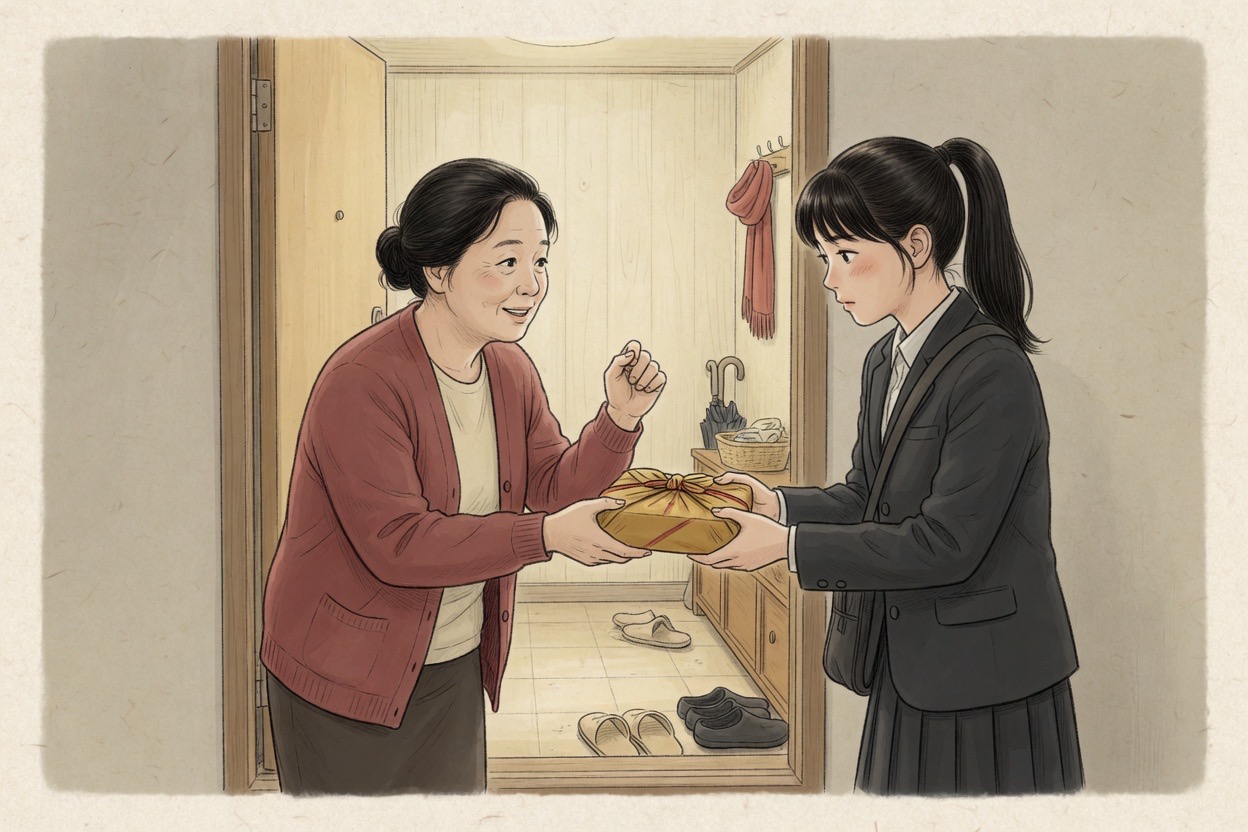
- a parent holding a lunchbox in one hand and raising the other
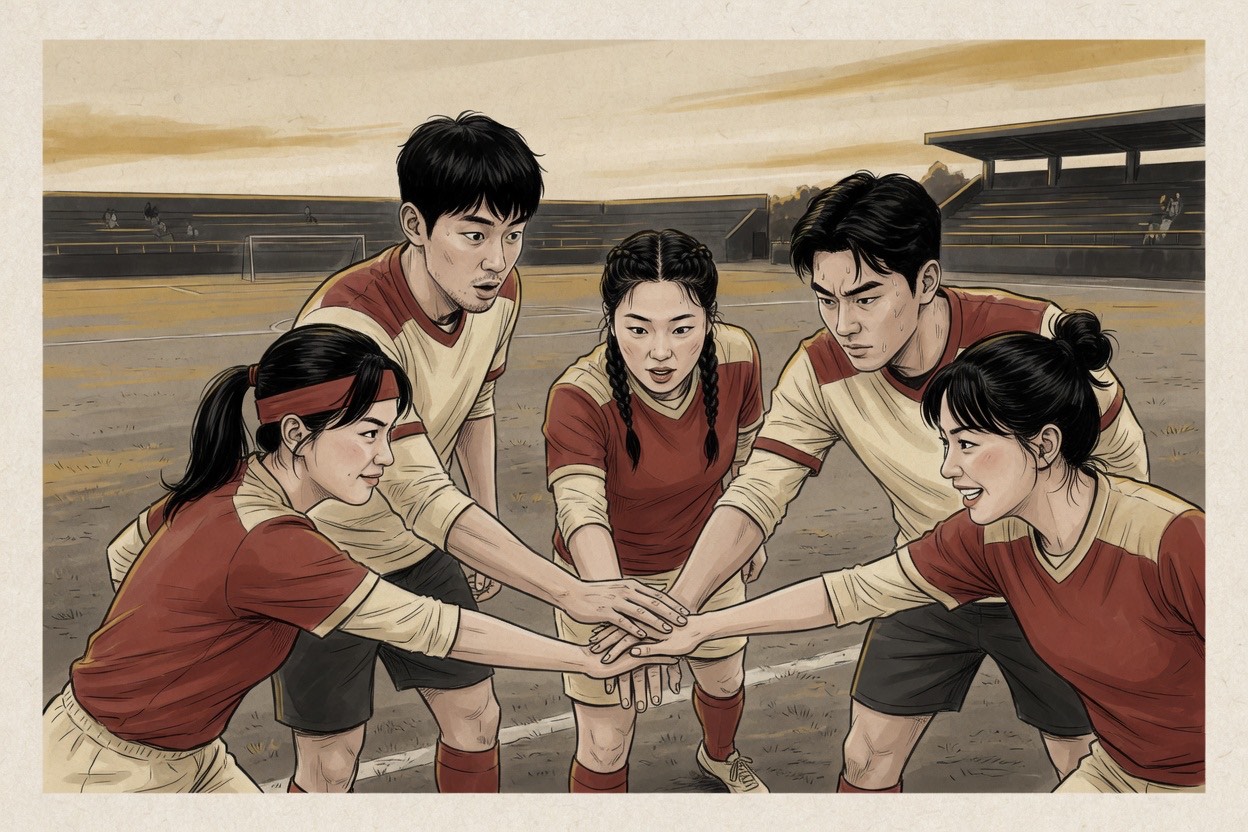
- a team stacking hands, then breaking with a shared shout
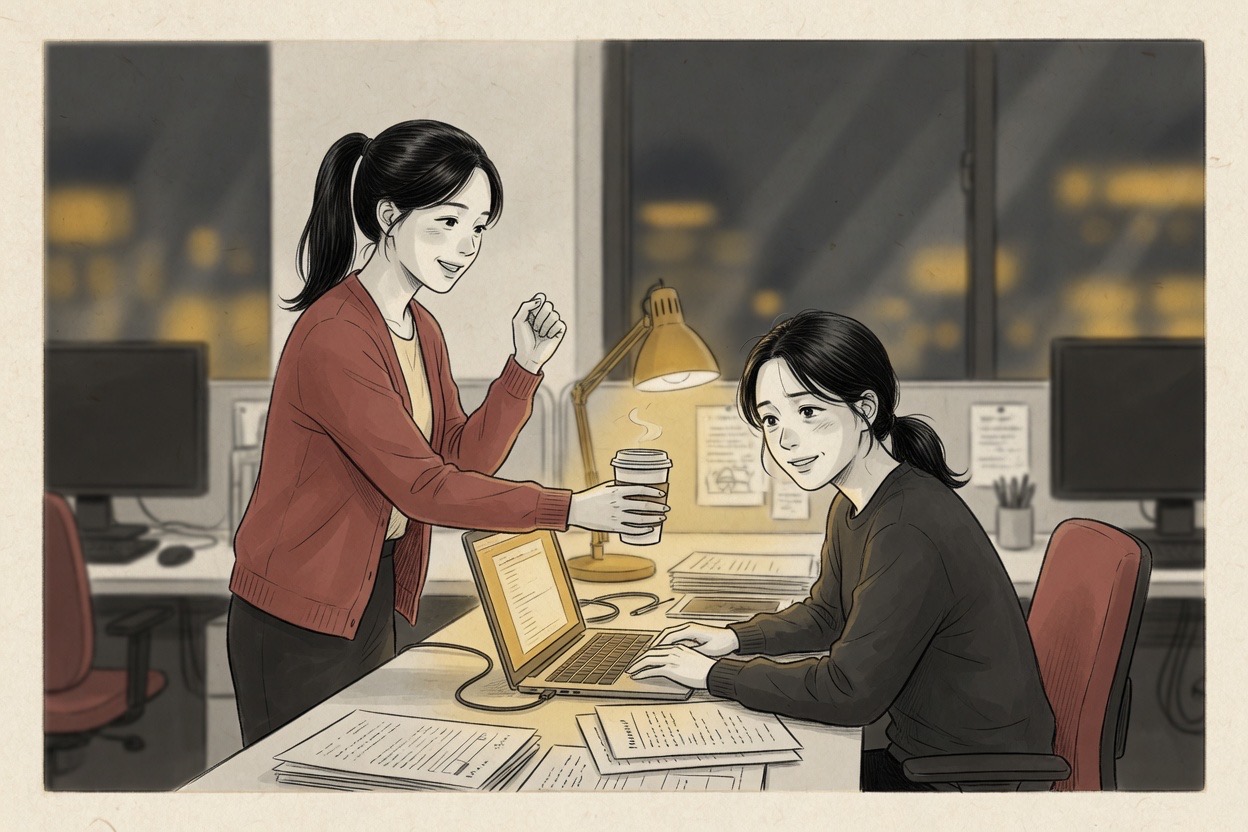
- a coworker offering coffee with a small, half-joking fist pump
The gesture is not martial arts cosplay. It is a compact cheer emoji made of body. Soft rooms get a small fist near the chest. Loud rooms get both arms. Either way, the move says: I am not only texting support—I am performing it.
아자아자 파이팅 — the extended cheer
When one 파이팅 is not enough, Korean stacks energy:
- 아자! — short rally cry
- 아자아자 — repeated, like a drumbeat
- 아자아자 파이팅! — the full candy-bar version
You will hear this before school festivals, charity runs, office team-building that is trying too hard, and any group photo that needs a last spike of courage. It is louder, cuter, and more performative than a single 파이팅. Friends use it sincerely and ironically. Context decides which.
Think of plain 파이팅 as a firm nod. Think of 아자아자 파이팅 as the whole pep band walking through the door.
When you’ll hear it
Real rooms, not textbook tourism:
- Exams — parents and friends outside test centers; lunchboxes; last-second texts at 8:50 a.m.
- Sports — amateur teams, school clubs, weekend leagues, living-room World Cup watches
- Work deadlines — the colleague still at the desk at 10 p.m. gets coffee and a small fist
- Hospital rooms and recovery — careful, softer voice; same word, lower volume
- Send-offs — before someone leaves for the army, a long trip, a new city, a tough first day
- Auditions, recitals, interviews — stage doors and elevator lobbies
- Group chats — sticker packs full of fists, bears, and 파이팅 bubbles
You will not typically hear it as a threat. If two people are actually arguing, Korean has other vocabulary for that. 파이팅 is for effort you support, not conflict you escalate.
This is also a nunchi word in practice: same cheer, different volume. A soft fist for a friend leaving the hospital. A stadium yell for the final of a school tournament. Reading the room is the whole skill.
How to use fighting / hwaiting
Patterns that sound natural
- Standalone cheer: 파이팅!
- With a name or title: 민지 파이팅! / 우리 팀 파이팅!
- Soft support: 오늘도 파이팅 — fighting again today
- Full stack: 아자아자 파이팅!
- Text-message version: same words, often with a fist emoji or a sticker
Who can say it to whom
Broadly, anyone offering support to anyone making an effort. Age and hierarchy matter less than they do for kinship titles like oppa or the wider honorific map. A junior can say it to a senior before a big presentation. A senior can say it to a junior before a certification exam. Parents say it to kids; adult kids say it back when a parent has a hard hospital day.
Still, match the energy:
- Close friends → loud, banmal, both fists welcome
- Workplace peers → warm, not theatrical, unless your team is already that team
- Formal first meetings → wait. A cheer without a relationship can feel like costume.
What to say instead of “good luck” only
English “good luck” is fine and understood. Korean often wants effort solidarity, not only luck. 파이팅 says I see the work. Pair it with something concrete when you can: “eat first,” “text me after,” “I’ll wait outside.” Support with logistics beats support with slogans.
When someone has already finished the hard thing, switch gears. That is thank-you territory, not pep-talk territory—see how to say thank you in Korean once the ordeal is over.
Example dialogues
1. Exam-morning doorway, parent and teenager
Before a big test. Mom has the lunchbox. Daughter has the nerves.
- Mom: 밥 꼭 먹고, 파이팅!
Bap kkok meokgo, paiting!
Make sure you eat, and fighting! - Daughter: 엄마, 걱정 마. 나 잘할 수 있어.
Eomma, geokjeong ma. Na jalhal su isseo.
Mom, don’t worry. I can do well. - Mom: 알아. 그래도 파이팅이야.
Ara. Geuraedo paiting-iya.
I know. Still—fighting.
Gloss: Warm family banmal. The cheer rides on top of care logistics (food), not instead of them. Fist optional, extremely likely.
2. Office night shift, peers with coffee
10 p.m. open office. One person is still finishing a deck.
- Colleague: 아직 안 끝났어요? 커피 사 왔어요.
Ajik an kkeunnasseoyo? Keopi sa wasseoyo.
Still not done? I brought coffee. - Coworker: 아, 감사합니다. 거의 다 됐어요.
A, gamsahamnida. Geoui da dwaesseoyo.
Ah, thank you. Almost finished. - Colleague: 파이팅이에요. 내일 발표 잘 될 거예요.
Paiting-ieyo. Naeil balpyo jal doel geoyeyo.
Fighting. Tomorrow’s presentation will go well.
Gloss: Polite speech between coworkers. The cheer is small, adult, and attached to real help (coffee). No stadium energy required.
3. Amateur team huddle before kickoff
Weekend league. Same generation, same nervous grin.
- Captain: 오늘은 즐기자. 부상만 조심하고.
Oneureun jeulgija. Busangman josimhago.
Let’s enjoy today. Just watch out for injuries. - Teammate: 손 모아!
Son moa!
Hands in! - Team together: 아자아자 파이팅!
Aja aja paiting!
Aja aja fighting!
Gloss: Banmal among peers. The stacked cheer is group theater on purpose—volume is part of the glue.
4. Soft hospital-room version
Visitor chair, low voices. Same word, different weather.
- Friend: 많이 아파? 무리하지 마.
Mani apa? Murihaji ma.
Does it hurt a lot? Don’t push yourself. - Patient: 좀 나아졌어. 고마워 와 줘서.
Jom naajyeosseo. Gomawo wa jwoseo.
I’m a bit better. Thanks for coming. - Friend: 천천히 회복해. 파이팅.
Cheoncheonhi hoebokhae. Paiting.
Recover slowly. Fighting.
Gloss: Still banmal between close friends, but the cheer is quiet. No both-fists performance. Presence matters more than volume.
Good nunchi / Zero nunchi
Good nunchi
Your Korean friend has a licensing exam at 9 a.m. You text the night before: eat something, sleep if you can, fighting—and you offer to meet after with no pressure to “celebrate big.” On the morning, you send one short cheer, not a thread of pep talks. After the exam, you ask how it felt and switch to food plans. You treated 파이팅 as support timed to effort, not as content for your own feed.
Zero nunchi
Same friend, same exam. You burst into a quiet café study session yelling 아자아자 파이팅! with both fists while filming for Instagram, then correct their group-chat spelling from 화이팅 to 파이팅 “because I read a blog.” They smile with their mouth only. You thought you were fluent in Korean cheer culture. You performed a stadium bit in a library whisper zone.
Do / Don’t
Do
- Use 파이팅 / 화이팅 for effort you want to back—exams, games, deadlines, recoveries, send-offs.
- Pair the word with the fist when the room is playful or sports-shaped.
- Match volume to context: doorway whisper ≠ team huddle.
- Accept both hangul spellings and the English romanizations fighting / hwaiting as the same cheer.
- Offer practical help next to the slogan when you can (coffee, lunchbox, a ride, silence to study).
Don’t
- Assume it means “I want to fight you.”
- Blast the full 아자아자 stack into a solemn or exhausted room.
- Use it as random K-culture decoration with strangers who did not ask for a pep rally.
- Correct people’s 화이팅 spelling while they are mid-crisis.
- Keep shouting fighting after the hard thing is over—then you need rest, food, or thanks, not more adrenaline.
Fighting, hwaiting, and nearby Korean social software
파이팅 sits in a wider kit of small social moves:
- Nunchi — whether this room wants a loud cheer, a soft one, or none
- Send-off language — when someone leaves, encouragement and goodbye in Korean often travel together
- Age-and-care roles — a family maknae may get the loudest pre-exam fighting; the job of cheering is still shared
- Aftercare words — when the ordeal ends, gratitude and rest language take over
The cheer is simple. The timing is the craft.
Why this loanword stuck
Korean already had ways to encourage people. What 파이팅 added was a portable, cross-age, slightly foreign sparkle—short enough for a text, physical enough for a fist, English enough to feel modern, Korean enough to mean something English “fighting!” does not.
It is useful in:
- hierarchical rooms that still want warmth
- friend rooms that want a ritual before fear
- public spaces where a full speech would be too much and silence would feel cold
That is why it shows up from elementary sports days to adult overtime. The hard thing changes. The need for a tiny, shared courage script does not.
A closing line
Koreans say fighting because the word stopped meaning combat and started meaning company under pressure. Write it 파이팅 or 화이팅. Romanize it fighting, hwaiting, or hwiting. Raise a fist or keep your hands in your pockets. The core is the same: I see the hard thing, and I am with you for it.
Borrow the cheer if the room wants it. Leave the boxing match in English where it belongs.
FAQ
Why do Koreans say fighting?
They are not starting a fight. Fighting (파이팅/화이팅) is a Korean encouragement shout meaning you can do it, go for it, or hang in there—borrowed from English but used as pure cheer.
What does hwaiting mean?
Hwaiting is the same cheer as fighting—파이팅/화이팅. English spellings vary (fighting, hwaiting, hwiting), but the job is identical: boost someone’s courage before a hard moment.
Is it 파이팅 or 화이팅?
Both spellings circulate. 파이팅 is the standard-prescribed form; 화이팅 is extremely common in chats, signs, and speech. Neither will make a Korean friend fail to understand you.
What is the fighting fist gesture in Korea?
People often raise one fist to shoulder height—sometimes both fists—while saying 파이팅. The gesture and the word travel as a pair, like a mini pep-rally move.
When should you not say fighting in Korean?
Skip it in solemn rooms where cheer feels wrong—a funeral, a cold first meeting, a formal apology. Use it for real effort and support, not as random K-culture cosplay.
Do you have nunchi?
Get short Korean word lessons and social cues in your inbox.